AI Blog Writer
Content Marketing & SEOHow to Choose an AI Blog Writer That Actually Ranks on Google, Bing, and AI Search
Most AI blog writers produce generic essays that stall on page four. Here is the exact technical checklist for selecting an AI blog writer engineered for search rankings and AI citations.
On this page▸
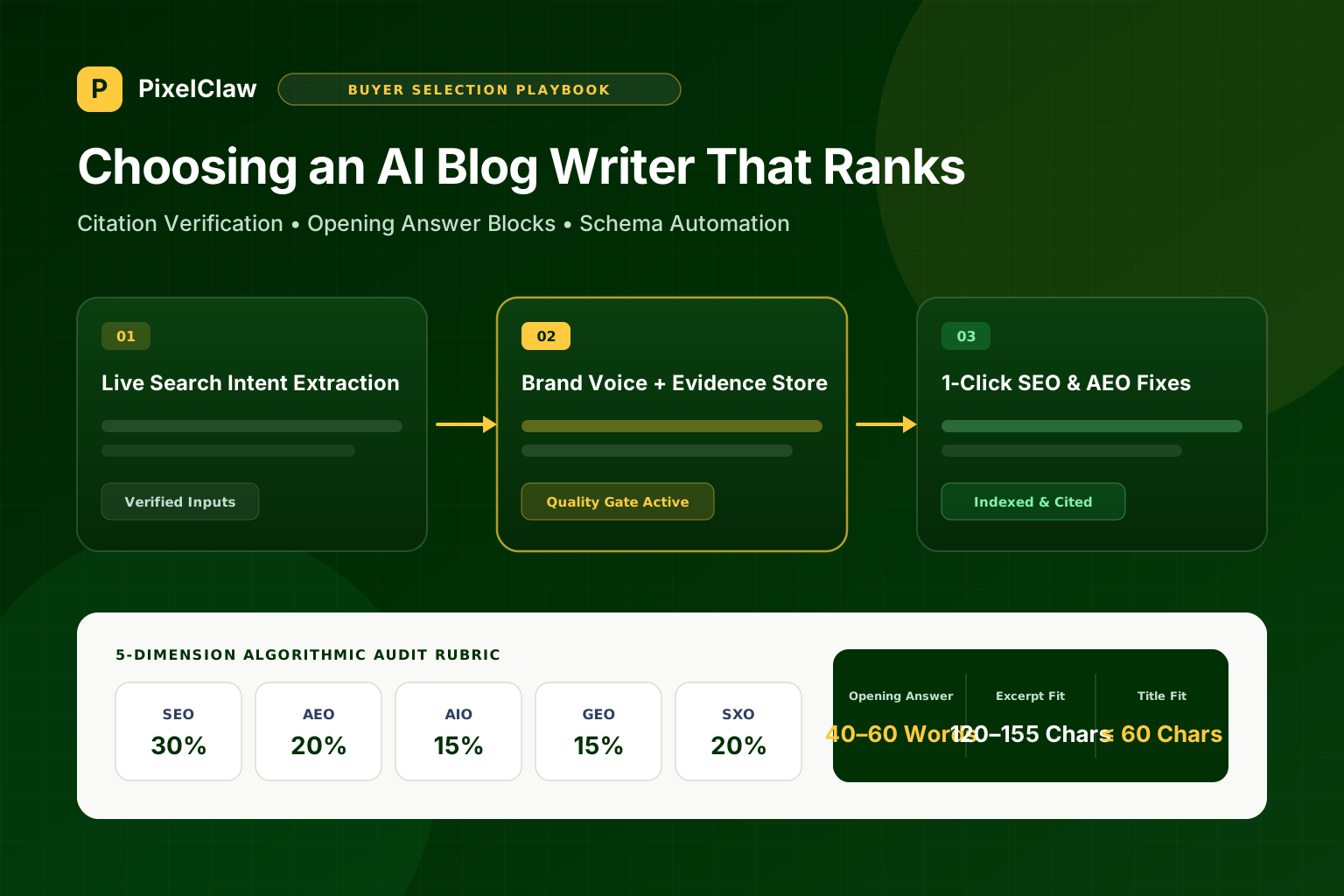
Choosing an AI blog writer that ranks requires looking beyond fluent prose to how the tool researches, structures, and verifies each article. A production-ready AI blog writer scrapes live search results first, opens with a 40-to-60-word direct answer, cites primary sources, and audits 21 on-page SEO and AEO checks before publishing.
Why do most generic AI blog writers fail to rank?
Open ten blogs written by basic AI article generators and you will spot the same fingerprint within five seconds. Every post starts with a throat-clearing cliché about today's digital landscape, meanders through vague subheadings, invents a suspiciously round percentage without a link, and ends with a hollow summary.
Search engines and human buyers reject that pattern for the same reason: it contains zero information gain. When an AI blog writer generates text purely from next-token probability without reading live search results or your product documentation, it defaults to the most average phrasing on the internet.
Ranking on Google and Bing—and earning citations in ChatGPT Search and Perplexity—requires an AI blog writer that treats writing as the third step in the pipeline, only after live SERP research and structural outlining are complete.
What six capabilities define an SEO-ready AI blog writer?
When testing an AI article writer for SEO, verify that the platform automates these six structural requirements rather than leaving them for your team to fix by hand:
- Live SERP length and question benchmarking: Measures how long ranking pages run and extracts the specific questions readers ask.
- Keyword placement discipline: Ensures the target keyword appears naturally in the title, the 40-to-60-word opening paragraph, and at least one H2 heading, while weaving secondary keywords into the body.
- Snippet-ready metadata: Keeps the SEO title at 60 characters or fewer and the meta description between 120 and 155 characters (or 30 and 60-to-77 wide characters for Japanese, Chinese, and Korean).
- Scannable AEO blocks: Embeds a Key Takeaways box, structured comparison tables, bulleted checklists, and an accordion FAQ section.
- Traceable source citations: Links empirical claims to live external sources and renders a dedicated Sources list at the foot of the article.
- Internal link graph verification: Connects each new article to at least two related published posts on your blog.
ChatGPT prompt vs generic SEO wrapper vs PixelClaw AI blog writer
Here is how a standalone chat prompt, a basic keyword-stuffing wrapper, and PixelClaw's writing studio compare across the checks that determine search visibility:
| Ranking Factor | Raw ChatGPT / Claude Prompt | Generic SEO Wrapper | PixelClaw AI Blog Writer |
|---|---|---|---|
| SERP Intent & Length Benchmark | None (guesses length) | Fixed word count slider | Live SERP crawl + competitive length band |
| Opening Direct Answer | Rambling intro paragraph | Unchecked intro length | Enforced 40–60 word quotable answer |
| Reader Question Coverage | Misses long-tail questions | Keyword density stuffing | Requires ≥80% of researched reader questions |
| Source Attribution | Frequently hallucinates URLs | Unverified external links | Grounded in crawled sources + Sources block |
| Internal Linking | Manual copy-paste | Random anchor insertion | Verified links to ≥2 published workspace posts |
| One-Click Quality Fixes | Manual re-prompting | None | Targeted 1-click fixes per failing check |
How does a 5-dimension score improve rankings and AI citations?
Traditional SEO plugins only counted how many times you repeated a keyword. Modern search requires balancing five distinct systems at once.
In PixelClaw, the SEO dimension (30% weight) validates your title length, excerpt length, URL slug format, single H1, sequential H2-to-H3 heading hierarchy, canonical URL, Open Graph tags, JSON-LD schema, internal links, and keyword coverage.
The AEO dimension (20% weight) checks for a 40-to-60-word opening answer, an FAQ block, a Key Takeaways box, lists or tables, and reader question coverage. AIO (15% weight) verifies a named author and at least two cited sources. GEO (15% weight) confirms AI crawlers are allowed and publisher schema is set. Finally, SXO (20% weight) checks saved image dimensions, image alt descriptions, a table of contents on posts over 1,200 words, and a clear call to action.
How do you keep your brand voice and product facts accurate?
Even a well-structured article falls flat if it misstates your pricing tiers or sounds like a corporate press release. Before generating drafts in PixelClaw, configure your workspace business profile, brand voice rules, and approved product evidence.
When the AI blog writer drafts a comparison or tutorial, it pulls your actual product capabilities, supported integrations, and preferred CTA destinations from your workspace context—never inventing features your software does not ship.
A repeatable workflow from target keyword to published post
For teams moving from ad-hoc drafting to a predictable weekly publishing cadence, follow this four-step routine in the PixelClaw writing studio:
- Step 1: Enter your primary keyword and up to four secondary keywords, then run SERP research to collect ranking benchmarks and reader questions.
- Step 2: Review and customize the generated outline, ensuring every H2 answers a distinct buyer question.
- Step 3: Generate the source-grounded draft in your brand voice and inspect the 5-dimension score panel.
- Step 4: Apply one-click fixes for any flagged items, choose the Guide, Editorial, or Premium layout, and publish or translate into your target markets.
- Generic chat interfaces fail at SEO because they draft from static memory without checking what currently ranks on Google or Bing.
- An effective AI blog writer enforces strict structural limits: titles under 60 characters, meta descriptions between 120 and 155 characters, and a single H1.
- Answer Engine Optimization (AEO) requires a 40-to-60-word direct opening answer before the first H2 heading, plus scannable tables and FAQs.
- Brand voice profiles and first-party business context prevent your blog from sounding like every other competitor in your niche.
- One-click diagnostic fixes save hours of manual editing when a draft misses internal links, image alt text, or reader questions.
Frequently Asked Questions
Why can't I just paste a keyword into ChatGPT or Claude to write my blog posts?+
A raw chat prompt does not measure the word count of top-ranking pages, extract live reader questions, verify external URLs, enforce 60-character title limits, or generate BlogPosting and FAQPage JSON-LD. You end up spending more time fact-checking and reformatting the output than drafting.
What is the ideal opening paragraph length for an AI blog writer?+
Aim for 40 to 60 words placed immediately before the first H2 heading, containing your target keyword. That length is concise enough for Google Featured Snippets, AI Overviews, and Perplexity to quote whole while giving human readers an immediate verdict.
How does an AI blog writer know how long my article should be?+
In PixelClaw, the research stage measures the word counts of the top-ranking articles for your exact keyword. The scoring engine then checks that your draft lands within the competitive range—from the planned target up to 10% past the longest ranking article—without padding.
Can an AI blog writer add internal links to my existing articles?+
Yes. PixelClaw checks that every article links to at least 2 related published posts in your workspace, and offers a one-click fix to insert relevant internal links when a draft falls short.
Does the AI blog writer generate images with alt text and dimensions?+
Yes. PixelClaw generates hero and section images with saved width and height attributes (preventing Cumulative Layout Shift) and descriptive alt text for screen readers and Google Image Search.
Sources
- Google Search Central: AI Features and Your Website — Google Search Central (Explains how Google AI Overviews and AI Mode use standard indexing, helpful content signals, and structured data.)
- Google Search Central: Influencing Title Links and Snippets in Search Results — Google Search Central (Details how concise titles and meta descriptions improve click-through rates and prevent truncation in SERPs.)
- W3C Web Accessibility Initiative: Headings and Page Structure — W3C WAI (Establishes semantic heading hierarchy rules (single H1, sequential H2 and H3) used by both screen readers and search crawlers.)
Built & scored using PixelClaw.ai
More from this blog
Continue exploring autoblogging architecture, AI blog writing, and SEO / AEO / GEO playbooks.
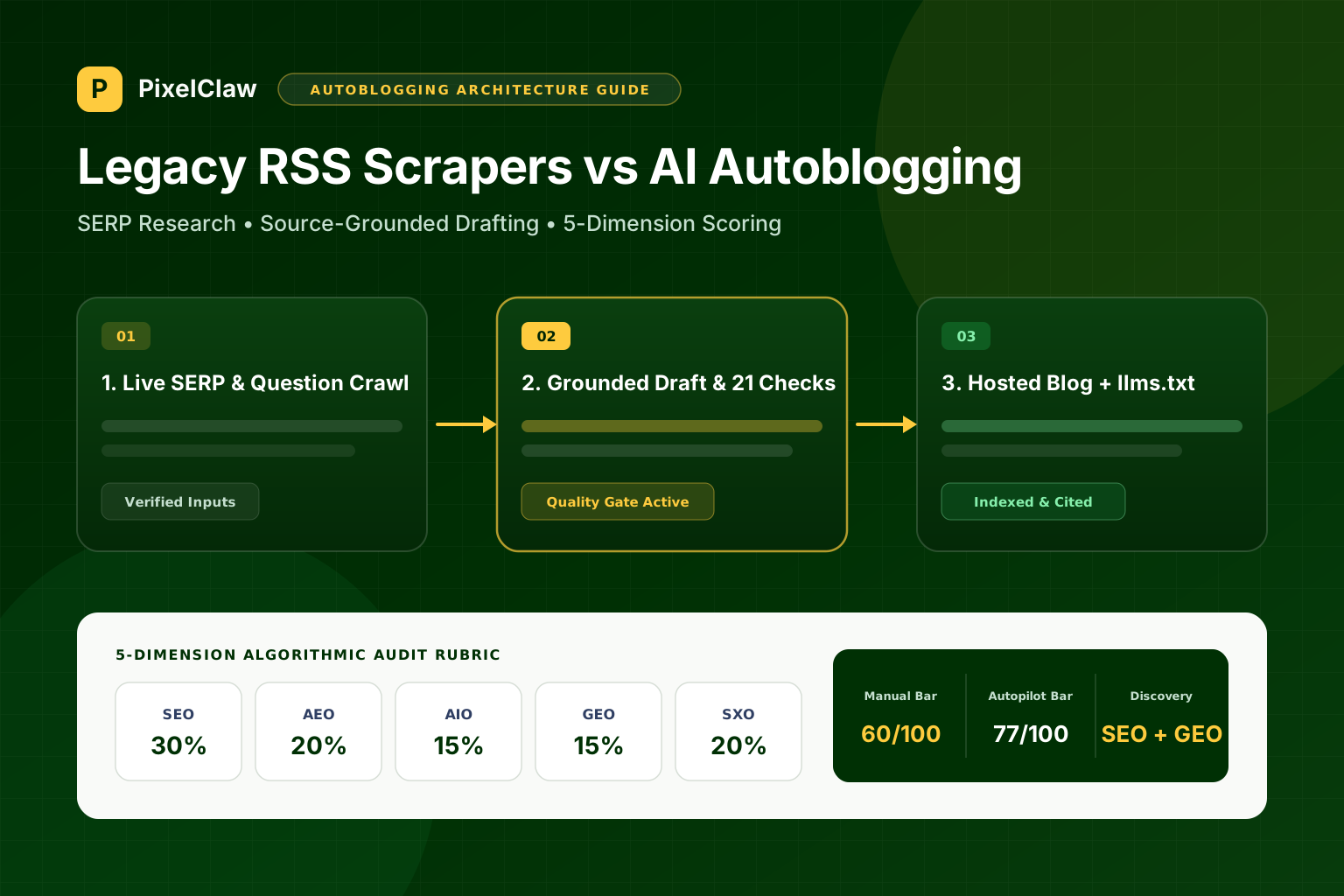
What Is Autoblogging? How Modern AI Autoblogging Works Without Publishing Slop
Autoblogging explained for founders and marketing teams: how modern research-first pipelines differ from old RSS scrapers, and what it takes to earn rankings and AI citations.
Marcus Vance
Head of Growth Architecture
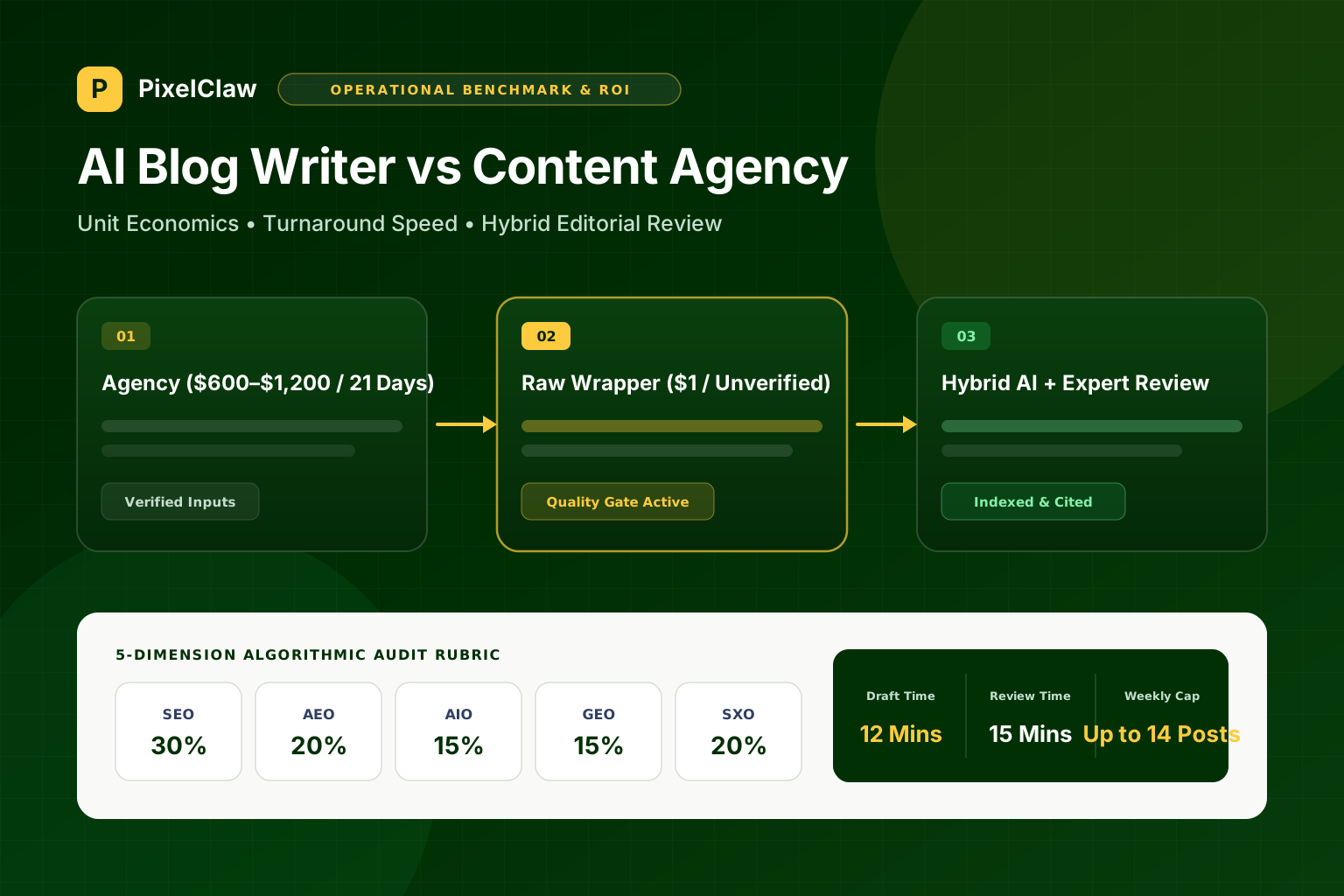
AI Blog Writer vs Human Content Agency: Real Cost, Turnaround, and Organic Pipeline Benchmarks
Should you pay a content agency $6,000 a month for six posts, hire freelancers, or run an AI blog writer with in-house expert review? Here is the honest operational breakdown.
Dr. Arthur Pendelton
Compliance & Editorial Director
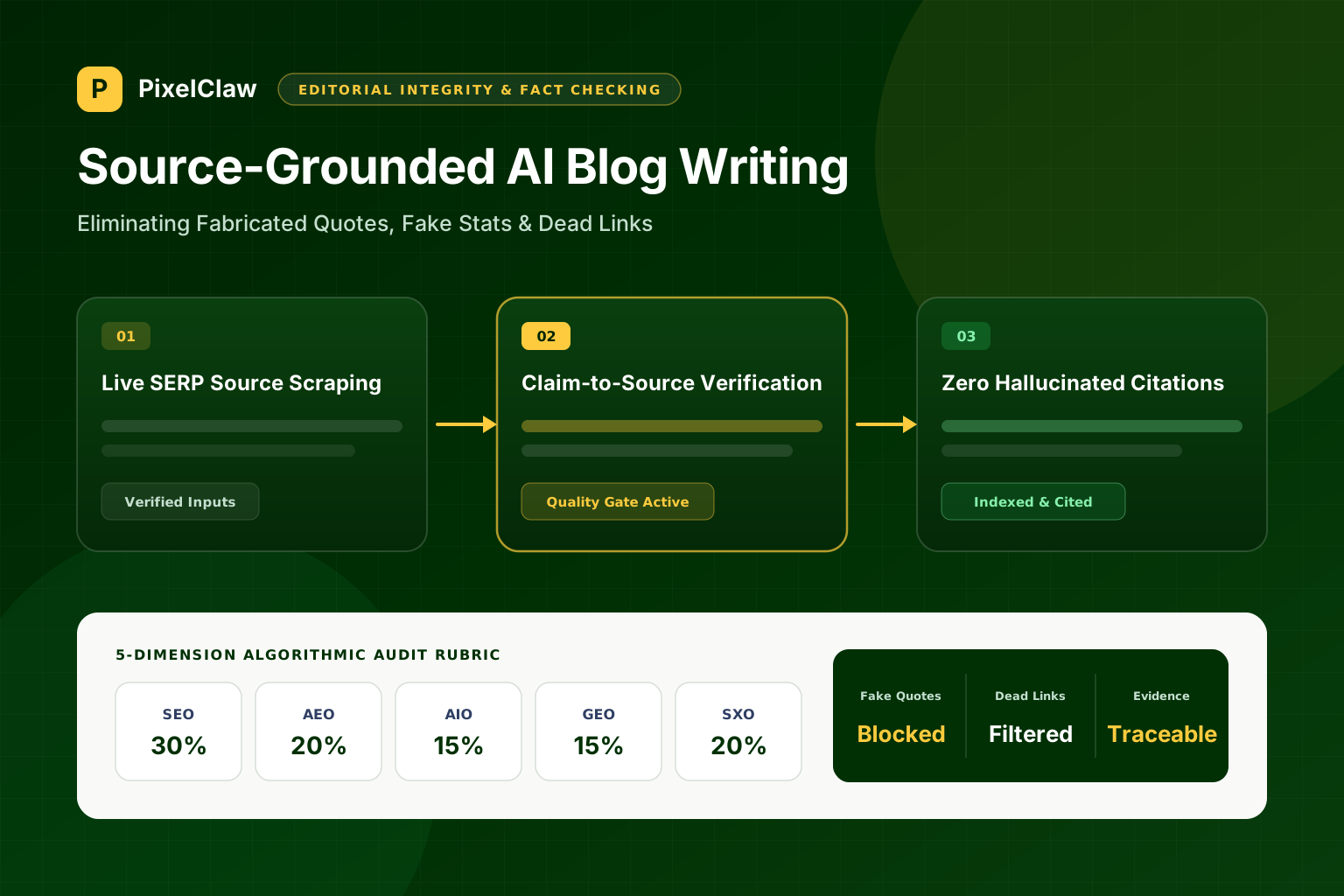
Source-Grounded AI Writing: How to Reduce Hallucinated Stats and Dead Links in Automated Blogs
Why raw language models invent fake percentages, nonexistent studies, and 404 URLs—and how source-grounded AI writing reduces those risks before editorial review.
Dr. Arthur Pendelton
Compliance & Editorial Director