AI content writer
PixelClaw toolsAn AI Content Writer That Knows Your Business: Voice, Facts and Languages
Generic AI writing sounds like everyone. PixelClaw's AI content writer learns your business from your website, writes in voices you define, and publishes in up to eleven more languages.
On this page▸
An AI content writer produces articles and posts on demand, but generic ones sound like everyone else. PixelClaw's AI content writer learns your business from your website, writes in brand voices you define, draws on your own knowledge files, and can publish each post in up to eleven more languages.
Why a generic AI content writer sounds like everyone
Ask any AI model for a post about kitchen renovation costs and you get the same post everyone else gets: national averages, a list of factors, advice to get three quotes. It is not wrong. It is just not yours, and readers can tell.
The difference between generic content and content that wins customers is specificity: your prices, your area, your process, your opinions. An AI content writer can only write that if it knows it. So the real feature of a good AI content writer is not the model; it is how it learns your business.
It learns your business from your website
Add your website to PixelClaw and it reads your pages into a business profile: what you sell, who you sell it to, where you work and what you charge. You check the profile and fix anything it got wrong, then every draft draws on it.
The effect shows in the posts. A roofing company's article on flat-roof repairs mentions the materials it actually uses and the area it serves. A software company's comparison names its real plans. That is the specificity readers trust and generic writers cannot fake.
The profile also feeds research: topic ideas, competitor finding and keyword suggestions all start from what the profile says you do.
Brand voices you define
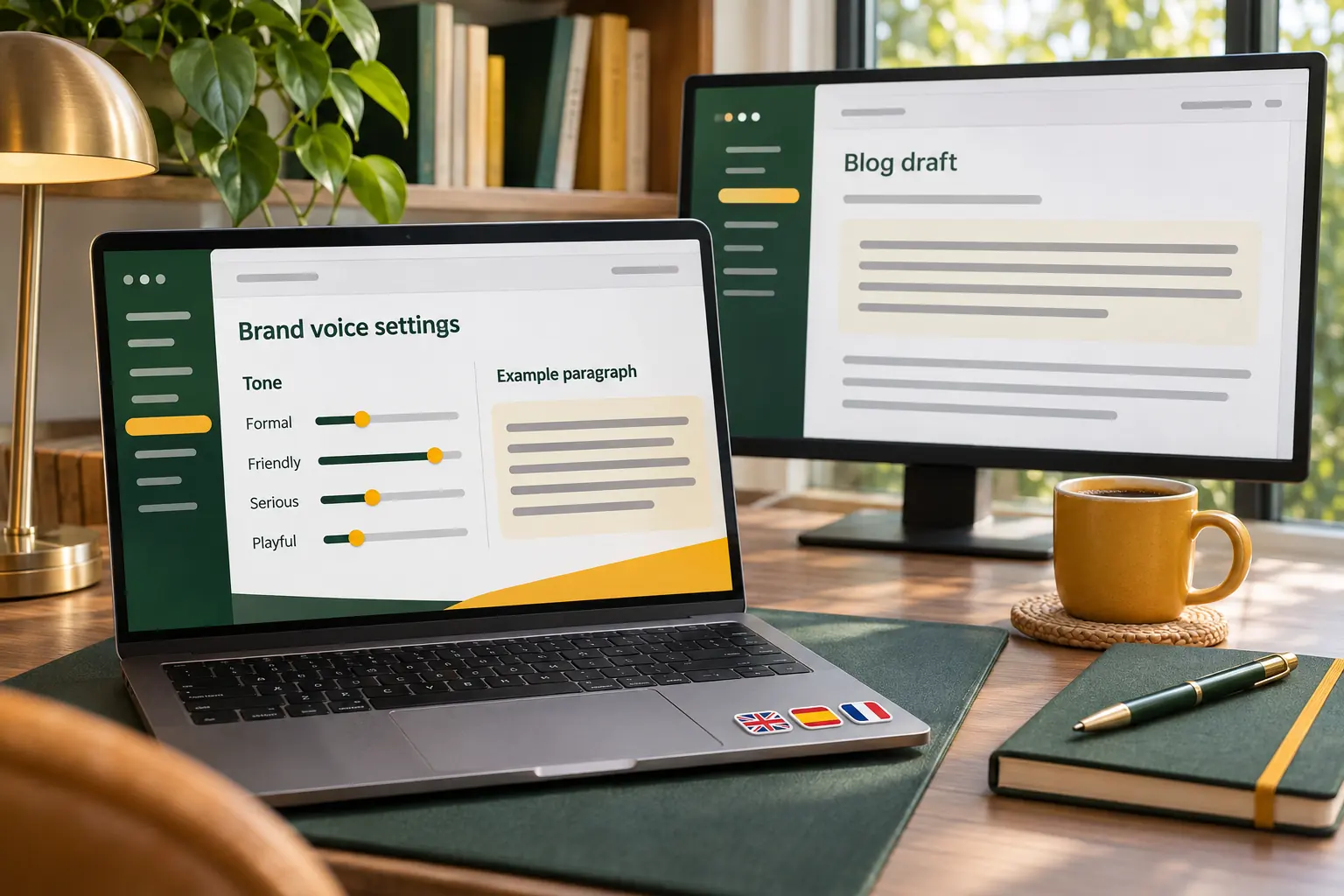
A brand voice tells the writer how you sound: formal or casual, "we" or "you", technical or plain, words you always use and words you never do, with an example paragraph you are proud of. PixelClaw keeps voices per blog. Each post can choose one, and Autopilot can write in its own.
Several voices are useful more often than people expect. A company might write how-to guides for customers in a friendly voice and industry analysis for buyers in a more formal one. Same writer, same facts, different register.
Your own facts, from your own files
Some facts are not on your website: a new price list, a spec sheet, internal guidance on what you will and won't recommend. Add them to the knowledge base as files, pages or notes, and drafts can use them alongside the web research.
This is also how you correct the internet. If competitors or old articles state something wrong about your product, a note in your knowledge base makes sure your own posts state it right.
Content in up to eleven more languages
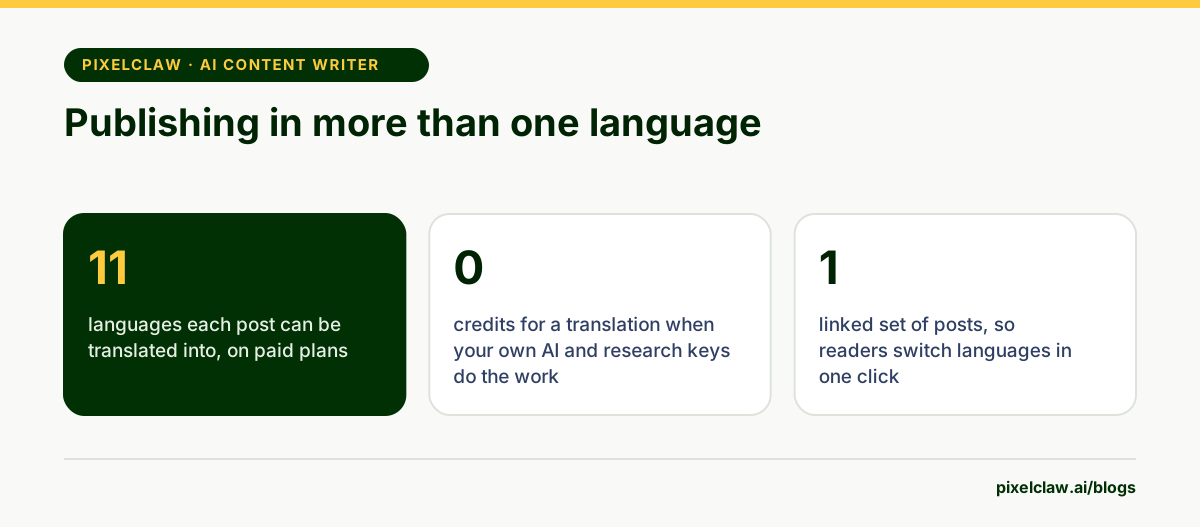
On paid plans, an AI content writer that only writes English leaves markets on the table. PixelClaw can translate each post into up to eleven more languages: Spanish, French, German, Brazilian Portuguese, Italian, Dutch, Hindi, Nepali, Japanese, Korean and Simplified Chinese.
Each translation is more than a translation. It researches the keyword people actually search for in that market, uses the right form of address, and becomes its own post linked to the English original, so readers can switch from the post's language menu and search engines see the versions as one set. Google's guidance on multilingual sites is the reason for that linking.
Each translation's price is shown before it starts. You can translate posts one at a time, or have new posts translated automatically when they first go live.
What the AI content writer costs
A standard post's credits cover research, the outline, the draft and the hero image. The free plan includes 50 credits a month, Starter 250 and Pro 1,000, and the pricing page shows how many posts each plan's credits make. Rewriting a section or applying a fix uses a few credits, shown before you start.
Connect your own key for OpenAI, Anthropic, Google Gemini, DeepSeek, MiniMax, Kimi or OpenRouter and writing uses no credits at all. To compare PixelClaw with other AI content writers by the kind of content you make, read the best AI content writers.
Keeping content consistent across many posts
The longer a blog runs, the more its posts disagree with each other: an old post quotes last year's price, a new one quotes this year's, and a third rounds it. Readers notice, and so do AI systems that compare sources.
Because every PixelClaw draft reads the same business profile and knowledge files, updating a fact in one place updates what every future post says. For older posts, search your posts list for the old figure and refresh the ones that mention it. Consistency is a small habit that makes a blog read like one publication rather than fifty unrelated pages.
- A business profile built from your website gives drafts your real services, places and prices.
- Brand voices set tone, words to use and avoid, and example writing; each post or Autopilot picks one.
- Knowledge files add facts your website does not state, from price lists to product details.
- Translation publishes posts in up to eleven more languages, with the keyword researched for each market.
- Each translation's price is shown before it starts; writing on your own AI key uses no credits.
Frequently Asked Questions
How does the AI content writer learn my business?+
Add your website and PixelClaw reads its pages into a business profile: what you offer, for whom, where and at what price. You review the profile, and drafts draw on it from then on.
How many brand voices can I have?+
It depends on the plan, and the plan cards on the pricing page list the current numbers. Each post, and Autopilot, can use a different voice, which suits a blog that writes for more than one audience.
Which languages can it publish in?+
English plus ten more: Spanish, French, German, Brazilian Portuguese, Italian, Dutch, Hindi, Japanese, Korean and Simplified Chinese. Translation is on paid plans.
Does translated content rank in other countries?+
It can, because each translation targets the keyword people search for in that language, not a word-for-word translation of the English one. Each version is its own post, linked to the others so readers can switch languages.
Sources
- Creating helpful, reliable, people-first content — Google Search Central
- Managing multi-regional and multilingual sites — Google Search Central
Built & scored using PixelClaw.ai
More from this blog
Continue exploring autoblogging architecture, AI blog writing, and SEO / AEO / GEO playbooks.

Best AI Content Writers in 2026, Judged on One Question: Does It Sound Like You?
Any AI can write a decent paragraph. The hard part is sounding like your business and getting your facts right. Seven AI content writers compared on voice, facts and where the writing ends up.
PixelClaw Editorial Team
Product and search team

AI Blogging Without the Slop: A Working Process for Posts People Trust
Where AI earns its place in a blog, where a person still has to step in, and a five-step process that turns AI drafts into posts worth putting your name on.
PixelClaw Editorial Team
Product and search team

An AI Blog Writer That Also Hosts, Scores and Publishes Your Posts
Most AI blog writers stop at the draft. PixelClaw writes the post, scores it, and publishes it to a blog it hosts for you, with everything a blog needs already set up.
PixelClaw Editorial Team
Product and search team