AI article writer
PixelClaw toolsAn AI Article Writer That Researches First: Outline, Draft and Score in One Place
How PixelClaw's AI article writer works: research before writing, an outline you control, a draft shaped to the kind of article the search needs, and a score before anything goes live.
On this page▸
An AI article writer drafts full articles from a topic, but the good ones research before they write. PixelClaw's AI article writer reads the pages that rank and the questions readers ask, lets you edit the outline, writes the kind of article the search needs, and scores the draft out of 100 before you publish.
An AI article writer should research before it writes
Most AI article writers start with a prompt and a model's memory. The result reads fluently and misses what readers actually want, because the model has no idea what the current top results cover or which questions people are asking this month.
PixelClaw's AI article writer starts with research. For each topic it reads the pages that rank and collects up to eight questions readers ask, and you can see the sources and the questions before any writing starts. The article is planned from that, not from a guess.
This is the single biggest difference between an article that ranks and one that only exists. An article built from what the top results cover, plus the questions they leave open, starts ahead.
An outline you control before a word is drafted
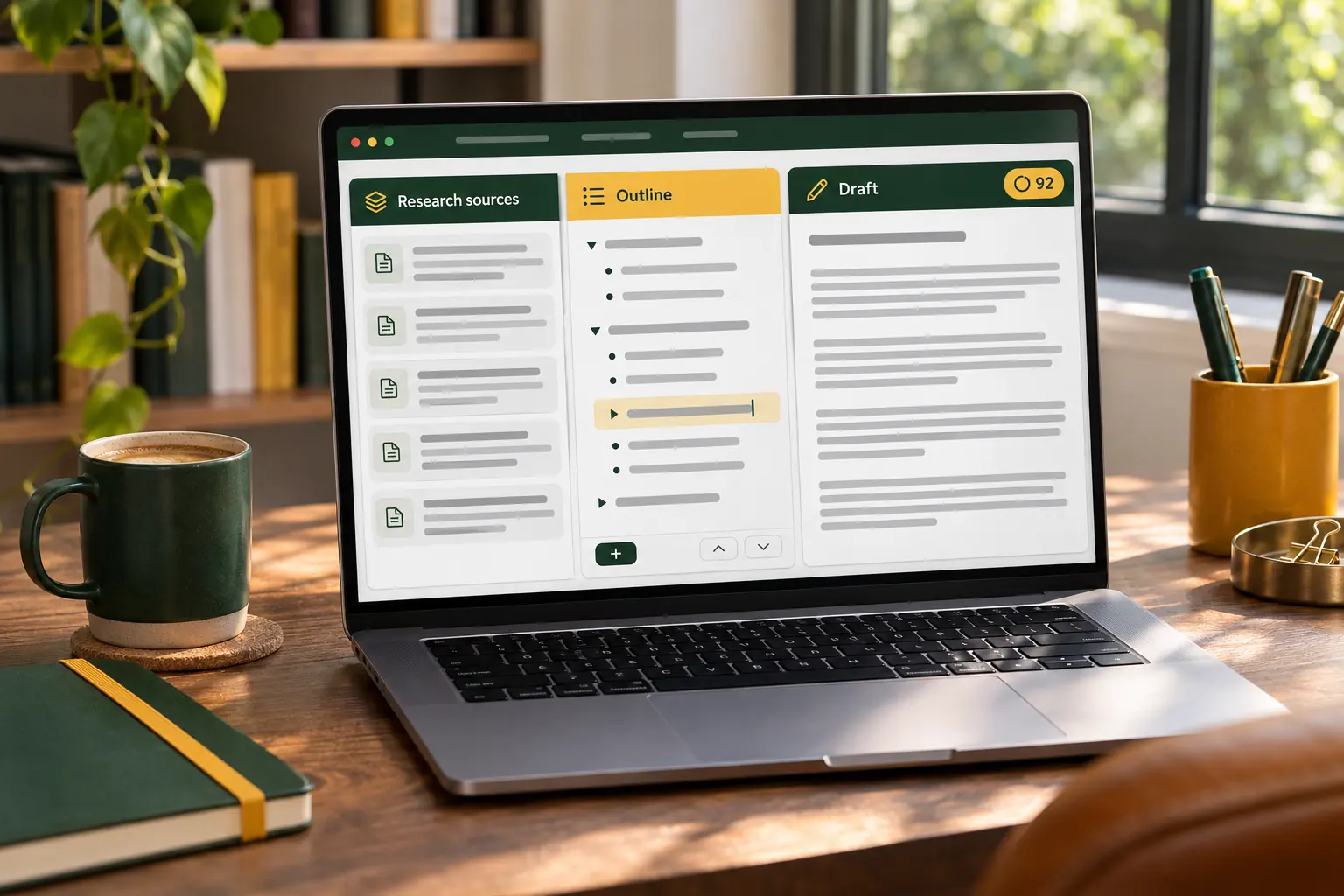
In the writing studio, the outline is yours to shape. Rename headings, reorder sections, add a section the research missed, remove one you don't need, and leave notes for the writer on any section, such as "use our 2026 price list here" or "mention the warranty". An outline can run from one to twelve sections.
This is the cheapest place to fix an article. Moving a section takes two seconds in an outline and twenty minutes in a draft. If the outline is right, the draft usually is.
On Autopilot, PixelClaw builds the outline itself and moves straight to the draft, which is why the writing studio is the better place for articles you care most about.
The right kind of article for the search
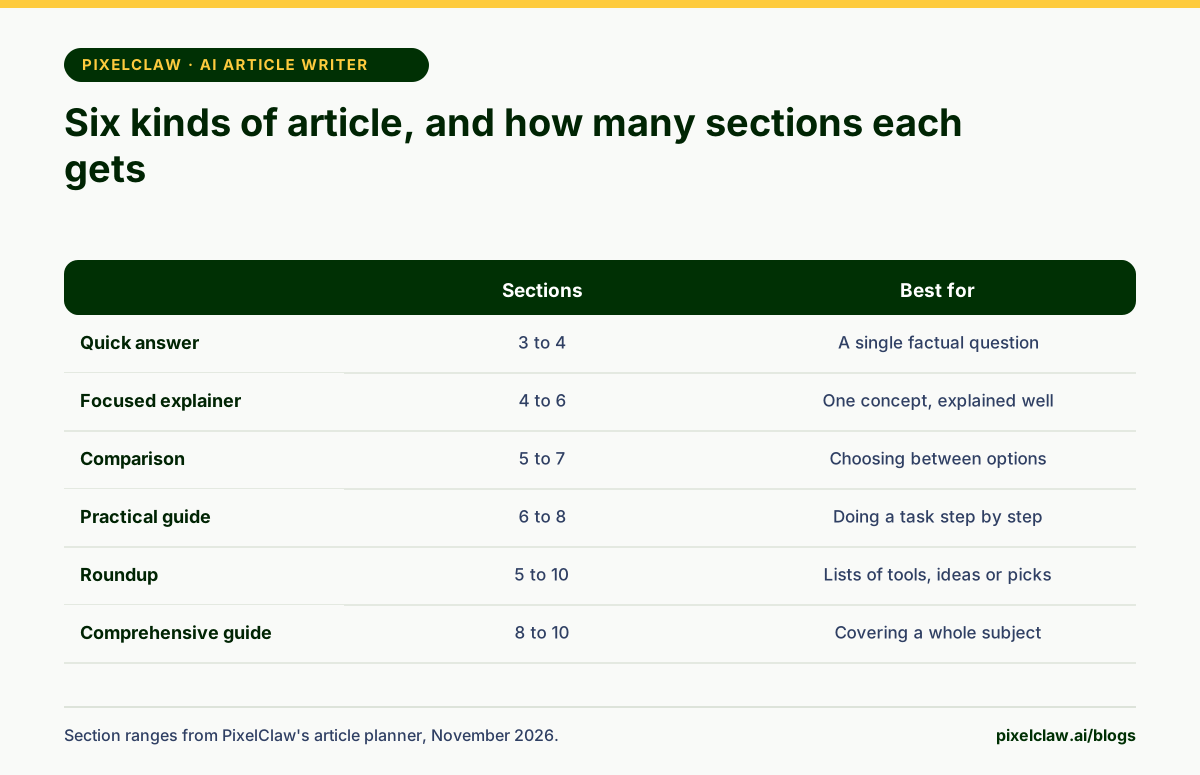
A search for a quick fact and a search for a buying decision need very different articles. PixelClaw's research decides which kind of article the search calls for, and the outline follows it.
A quick answer gets three or four sections and stops. A comparison gets five to seven, with a table. A comprehensive guide gets eight to ten. Matching the shape to the search is half of matching intent, and it keeps articles from being padded or thin.
A draft written from sources, in your voice
The draft is written from the research, in the brand voice you choose, with your business profile supplying facts about your own services and prices. The writing rules ask for an answer in the first paragraph, questions as headings where natural, specifics over adjectives, and the source of each number named in its sentence.
Before you see it, a polish pass scores the draft and fixes what failed: the title, the description, the opening answer, a heading that should carry the keyword, key takeaways, the FAQ, a missing list, image descriptions. A hero image with alt text is added at the top.
Editing tools for the parts AI gets wrong
No AI article writer gets everything right, so the editor matters. PixelClaw's block editor handles headings, callouts, FAQs, tables, key takeaways and calls to action, and you can move any block up or down.
Select a passage and ask the AI to rewrite it, or regenerate a whole section with a note about what to change; each uses a few credits, with the price shown before you start. Improve an entire post in one go if the whole draft needs a lift. Earlier versions are kept, so an experiment is never a risk.
- Rewrite a selection or a section with an instruction, for a few credits.
- Run one-click fixes for any failed check, each shown to you before it is applied.
- Run an AI review of the whole post; the first review of each post is free.
- Preview the post as readers will see it, then publish or schedule it.
Score, then publish
Every article is scored out of 100 across five areas: search engines, answer engines, trust signals, AI discovery and reader experience. Each failed check is listed in plain words, with a fix. An article needs 60 or more to publish; an owner or admin can override that deliberately, and the override is recorded.
Published articles go to your hosted blog with structured data, a sitemap entry and an llms.txt line added automatically. For a comparison with other tools, see the best AI article writers.
- Research comes before writing: the ranking pages and up to eight reader questions shape every article.
- You can edit the outline in the writing studio: rename, reorder, add or remove sections and leave notes.
- The article's shape follows the search, from a quick answer of three or four sections to a comprehensive guide of eight to ten.
- Every draft is scored across SEO, AEO, AIO, GEO and SXO, with one-click fixes you review.
- A standard article's credits include its hero image, and work on your own AI keys uses no credits.
Frequently Asked Questions
How long are the articles PixelClaw writes?+
As long as the search needs. The length is planned from the articles already ranking for the keyword, between 800 and 5,000 words, and an outline with fewer sections brings the target down with it.
Can I edit the article after the AI writes it?+
Yes. The draft opens in a block editor where you can rewrite any section or selected text with AI, move blocks, add tables, callouts and FAQs, and preview the post before publishing. Earlier versions are kept.
Which AI models does the article writer use?+
By default, the writing model included with your plan. You can connect your own key for OpenAI, Anthropic, Google Gemini, DeepSeek, MiniMax, Kimi or OpenRouter, and writing on your own key uses no credits.
Does the AI article writer publish for me?+
It can. Articles publish to a blog PixelClaw hosts at its own address, or your own domain on paid plans, and can be scheduled. Paid plans with API access can also send articles to your own site through the API.
Sources
- Creating helpful, reliable, people-first content — Google Search Central
- Search Engine Optimization (SEO) Starter Guide — Google Search Central
Built & scored using PixelClaw.ai
More from this blog
Continue exploring autoblogging architecture, AI blog writing, and SEO / AEO / GEO playbooks.

Best AI Article Writers for 2026: Matched to the Kind of Article You Write
SEO articles, long-form guides, one-click volume, brand marketing and AI-visibility content each have a different best tool. Eight AI article writers compared by the job they do best.
PixelClaw Editorial Team
Product and search team

An AI Blog Writer That Also Hosts, Scores and Publishes Your Posts
Most AI blog writers stop at the draft. PixelClaw writes the post, scores it, and publishes it to a blog it hosts for you, with everything a blog needs already set up.
PixelClaw Editorial Team
Product and search team

AI Article Writer With References: Sources Readers Can Click and Check
Why references matter more for AI-written articles, how PixelClaw grounds every draft in the sources it researched, and what references can and cannot prove.
PixelClaw Editorial Team
Product and search team