AEO for startups
Growth guideAEO for Startups: How to Become the Answer Google, ChatGPT and Siri Give
Answer engine optimization explained for founders: what AEO means, why a startup can win it before it can win page one, and how to write the answer that gets picked.
On this page▸
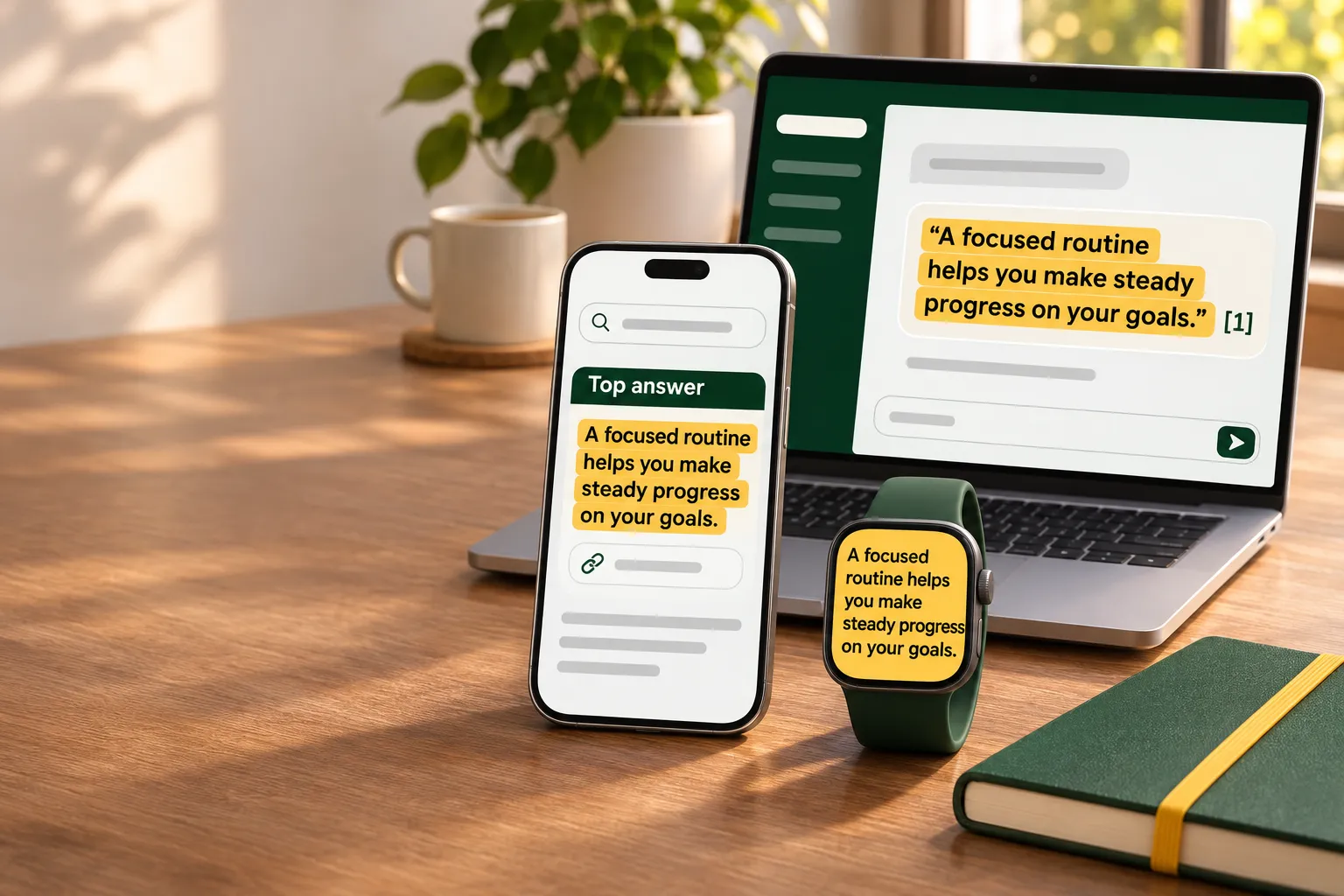
AEO for startups means writing so answer engines quote you. When a buyer asks Google, ChatGPT or a voice assistant a question, the engine lifts one clear passage and shows it as the answer. A startup that answers its market's questions first, in 40 to 60 plain words, becomes that answer even before it ranks on page one.
What AEO means: answer engine optimization in plain words
An answer engine is any system that replies to a question with an answer instead of a list of pages. Google's featured snippet is one. So is the People Also Ask box, Siri or Alexa reading a reply aloud, and ChatGPT, Perplexity or Gemini summarising the web in a chat.
Answer engine optimization (AEO) is the craft of making one passage of your post the obvious thing for those systems to quote. The passage names the subject, answers the question, adds the one qualifier that matters, and stops. Everything else in the post supports it.
Google says there is no special markup that guarantees a featured snippet. What a startup controls is whether a clean, quotable answer exists on the page, and whether the page is good enough to rank among the pages Google considers.
Why AEO matters for startups and founders
For a startup, the answer box is a shortcut. The engine quotes the clearest passage it can find, not automatically the most famous brand, so a small team that writes better answers can stand above companies a hundred times its size for the questions it chooses.
It also matches how people read. Nielsen Norman Group's research on how users read on the web found that 79% of test users scanned a new page and only 16% read word by word. Answer engines turn that habit into a product: they scan for the passage so the reader does not have to.
For founders, the payoff is recognition at the moment of need. When a buyer asks "how do I stop meeting no-shows" and hears your answer with your brand next to it, you have started a sales conversation without paying for the click. For bloggers and copywriters on a small team, AEO is the cheapest win available: often a rewrite of the first paragraph, not a new post.
There is a defensive reason too. If you do not answer your market's questions, someone else's answer becomes the one buyers hear, including answers about your category, your pricing model and the problem you solve. AEO lets you set the record straight in your own words.
An AEO strategy for startups: write the answer that gets picked
Start from the questions, not the keywords. Collect the exact questions buyers ask from sales calls, support tickets, Search Console queries and the People Also Ask box, and give each important one its own post or its own section.
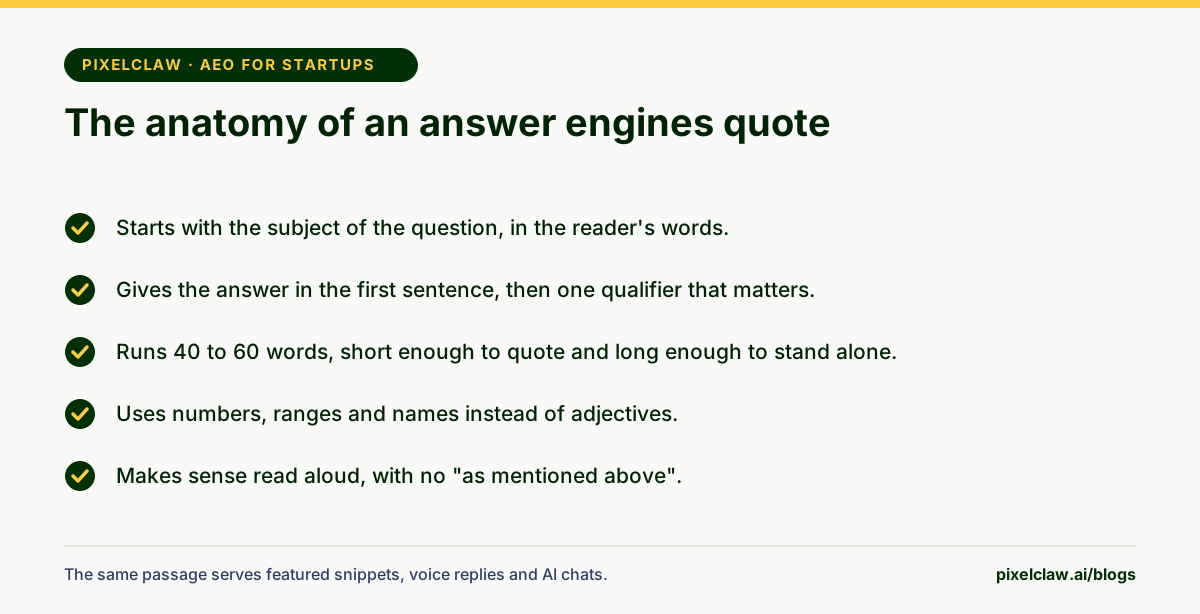
Open with the answer. The first paragraph should answer the title's question in 40 to 60 words, before any heading, in sentences that make sense when read aloud. Then explain, with sources, for the readers who want the detail.
Write headings as questions, or as clear statements of what the section answers, and put the answer in the section's first sentence. Keep each answer self-contained, so it still makes sense when an engine quotes it out of context.
Then read the answer aloud. If you stumble, a voice assistant will too. Replace symbols with words, write numbers the way people say them, and cut any sentence that depends on a table or picture the listener cannot see. Finally, read the answer on its own with the rest of the post hidden: if it still makes sense and still names your subject, it is ready to be quoted.
Questions a startup can own with AEO
The best AEO targets for a startup are questions with a clear answer that big sites cover vaguely or not at all. They usually come straight from your own sales and support conversations. Here are the patterns that work, with examples for a startup that sells booking software to clinics.
Answer each one in its own post, or in a section with the question as its heading, and open with the 40 to 60 word answer. When the same question comes up on a sales call next week, send the link. The post that answers a prospect is the same post that answers the engine.
| Question pattern | Example | Why a startup can win it |
|---|---|---|
| How to do a specific job | How do clinics reduce appointment no-shows? | Big sites answer for every industry at once |
| What something costs | How much does booking software cost a small clinic? | You know the real price ranges |
| Which option fits a situation | Is online booking worth it for a two-dentist practice? | It takes judgment, not a definition |
| What happens when | What happens if a patient double-books online? | Only teams close to the product know |
| How two options compare | Phone booking or online booking for clinics? | A clear verdict beats a list of pros and cons |
Structure that gives answer engines clean pieces to lift
Answer engines love structure because it removes guesswork. A numbered list for steps, a table for comparisons, a short key takeaways box and an FAQ for the follow-up questions each give an engine a piece it can quote whole.
One change worth knowing: since 2023 Google shows FAQ rich results mainly for well-known government and health sites. Keep the FAQ anyway. Readers use it, AI assistants read it, and it is the natural home for the questions that did not deserve their own section.
For the full writing checklist, with examples of openings that get skipped and openings that get quoted, read our guide to AEO blogs.
How PixelClaw builds AEO into every post
PixelClaw treats AEO as part of the score, not an afterthought. Answer engines carry 20% of the score out of 100, and the checks map to the habits above: an opening answer of 40 to 60 words, an FAQ section, a key takeaways box, at least one list or table, and, when research found them, answers to most of the questions readers ask.
Research collects up to eight of those reader questions before the draft is written, so the post is planned around them rather than patched afterwards. When a check fails, a one-click fix writes the missing piece, such as a tighter opening or an FAQ, and shows it to you before anything changes.
Autopilot applies the same checks to every queued topic, which means a startup can publish answer-first posts every week without editing each opening by hand. Posts wait for your approval by default; with automatic publishing switched on, only drafts scoring 77 or more go live by themselves.
How to tell whether answer engines quote you
There is no single AEO report yet, so measure from three sides. In Search Console, posts in position one or two with few clicks are often being shown as a snippet; that is visibility, and a hint to make the rest of the post worth the click.
Once a month, ask Google, ChatGPT and Perplexity the five questions your best posts answer and note who gets quoted. It takes fifteen minutes. In your analytics, watch referral visits from chatgpt.com and perplexity.ai; they are small for most blogs today and they are the readers an answer sent to you.
Keep a simple log of the questions, the date you checked and who was quoted. After three months it becomes the most honest view you have of your share of answers, and a ready-made list of what to write or rewrite next.
AEO is one of five front doors in an organic growth strategy. Its close cousin is GEO for startups, which covers getting your brand recommended in AI answers, and both stand on the basics in SEO for startups.
- Answer engine optimization is about being the passage an engine quotes, not only a link in a list.
- Startups can win AEO early, because the quoted answer goes to the clearest passage, not always the biggest site.
- Lead every post with a 40 to 60 word answer, write headings as the questions buyers ask, and keep each answer complete on its own.
- FAQs, takeaways, lists and tables give answer engines clean pieces to lift.
- Measure AEO with Search Console, monthly spot checks in AI assistants and referral visits from chat tools.
Frequently Asked Questions
What does AEO stand for?+
AEO stands for answer engine optimization: shaping content so that search features and AI assistants can lift a passage and present it as the answer to a question. It covers featured snippets, People Also Ask boxes, voice replies and quotes in AI chats.
Is AEO different from SEO?+
SEO earns a place in the list of results. AEO earns the answer itself. They share most habits, and a post can do both, but AEO adds a stricter rule: the answer has to come first and make sense on its own.
Can a brand-new startup win featured snippets?+
Yes, for specific questions. Snippets tend to come from pages that already rank near the top for the query, so start with narrow questions where a new site can reach page one quickly, and answer them more clearly than anyone else.
Does AEO help with voice search?+
Voice assistants read one answer aloud, so they favour short, plain sentences that sound natural when spoken. The same 40 to 60 word opening that wins a snippet is what a voice assistant can read without a screen.
How does PixelClaw help with AEO?+
Every draft is checked for an opening answer of 40 to 60 words, an FAQ section, a key takeaways box and at least one list or table, and for answers to the reader questions found in research. Those checks make up 20% of the score, and failed ones come with one-click fixes.
Sources
- Featured snippets and your website — Google Search Central
- Changes to HowTo and FAQ rich results — Google Search Central Blog
- How Users Read on the Web — Nielsen Norman Group (79% of test users scanned new pages; 16% read word by word.)
Built & scored using PixelClaw.ai
More from this blog
Continue exploring autoblogging architecture, AI blog writing, and SEO / AEO / GEO playbooks.

Organic Growth Strategy for Startups: Build Traffic That Keeps Growing While You Sleep
Ads rent attention and stop the day the budget does. An organic growth strategy builds a library of posts that rank in Google, get quoted by AI answers and keep sending buyers for years.
PixelClaw Editorial Team
Product and search team

GEO for Startups: What Generative Engine Optimization Means and How to Get ChatGPT to Recommend You
Buyers now ask an AI assistant which tool to use before they ever see a search result. Here is what GEO means, why it matters to startups, founders, bloggers and copywriters, and how to become the name the answer includes.
PixelClaw Editorial Team
Product and search team
SEO for Startups: A 90-Day Plan for Founders With No Marketing Team
You will not outrank the giants on their own keywords this year. You can own the specific questions your buyers search before they buy, and that is where startup SEO starts paying.
PixelClaw Editorial Team
Product and search team