SEO copywriting
Growth guideSEO Copywriting in 2026: How to Write Blog Copy That Ranks, Gets Quoted and Sells
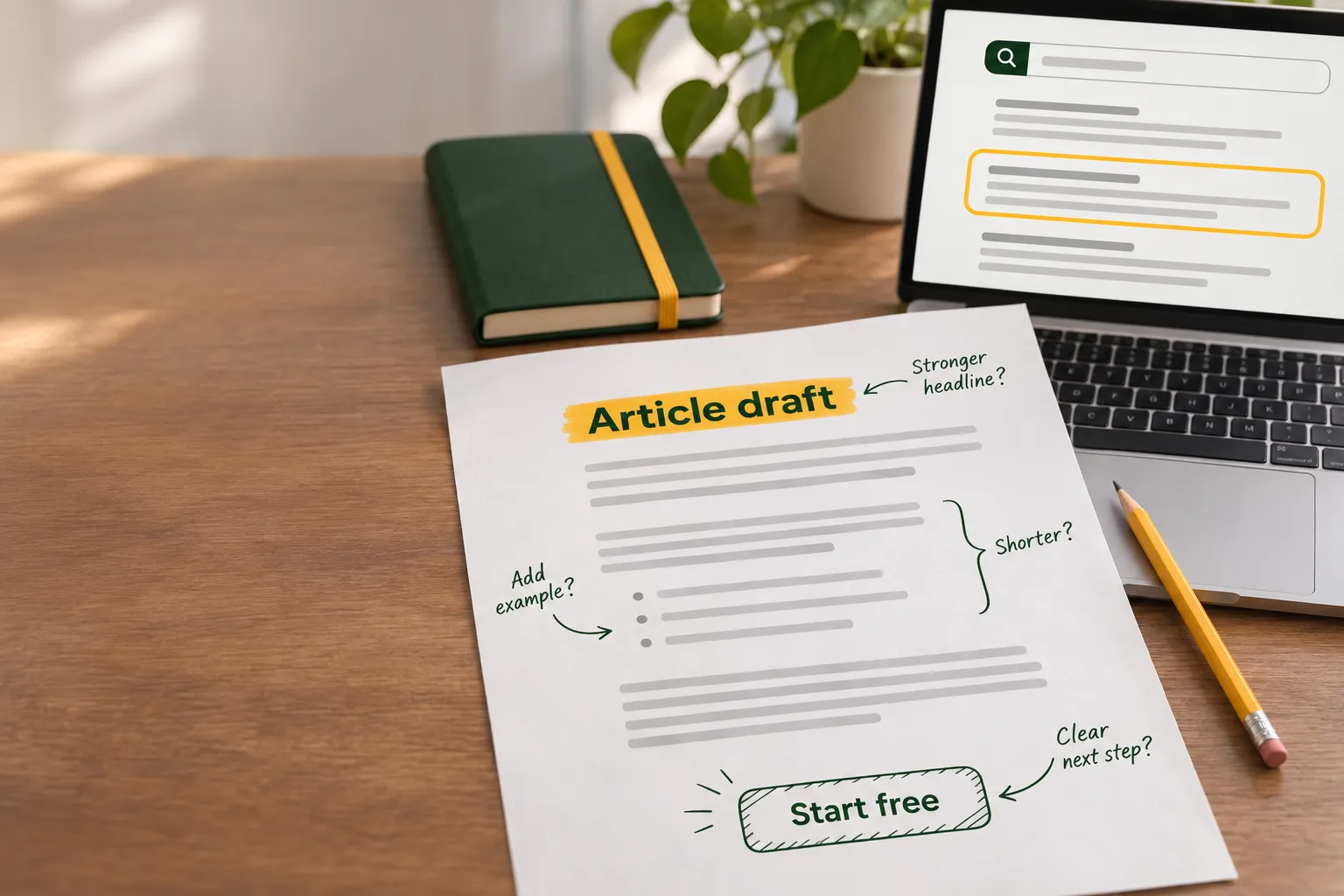
Good copy used to have two readers, the search engine and the person. Now it has three, because AI answers quote it too. Here is how to write for all three without sounding like a robot or a billboard.
On this page▸
SEO copywriting is writing that does two jobs at once: it ranks for what people search and persuades the people who arrive. In 2026 it also has to be quotable by AI answers. Lead with the answer, use the searcher's own words, back every claim, write headlines that keep the promise and end with one clear next step.
What SEO copywriting means in 2026
Classic copywriting persuades. SEO writing gets found. SEO copywriting is the overlap: copy built to rank for what people search and to move the people who arrive. For a startup blog that means posts that bring buyers in from Google and walk them, without pressure, toward trying the product.
The job grew in the last two years. AI answers now sit above many search results and inside chat assistants, and they quote passages from the pages they trust. So copy has a third reader, a machine looking for a clear, credible sentence to repeat. The habits that win it are the same ones that make copy better for people: answer first, be specific, prove it.
None of this means writing for robots. Google's SEO Starter Guide asks for content that is easy to read, well organised and written for people. Good SEO copywriting simply refuses to make the reader work to find what they came for.
Write in the searcher's words, not your product's words
Teams describe their product in their own vocabulary. Buyers search in theirs. A scheduling startup may call its feature "intelligent availability orchestration"; its buyers type "stop double bookings". SEO copywriting starts by adopting the buyer's phrase, in the title, the opening and one heading.
Find those phrases in Search Console queries, autocomplete suggestions, sales call notes and the questions readers ask under competing posts. Then write naturally. Repeating the exact keyword ten times helps no reader, human or machine, and modern search understands related terms and variations.
Headlines and descriptions that earn the click
A headline is a promise about the page. Make it specific, keep it under about 60 characters so it is not cut off, and put the searcher's words near the start. Google's notes on title links explain that it may show a different title when the one you wrote does not describe the page well, so an honest headline is also a stable one.
The meta description is the second half of the promise. Write 120 to 155 characters that say what the reader will get and for whom. Here is the difference between copy that blends in and copy that earns the click.
| Blends in | Gets clicked | Why it works |
|---|---|---|
| Our Guide to Scheduling | How to Stop Double Bookings in 3 Steps | Names the problem and the payoff |
| Best Practices for Onboarding | Onboarding Emails That Cut Churn: 7 Examples | Specific outcome, concrete format |
| Why Choose Our Tool | Calendly Alternatives for Clinics, Compared | Matches how buyers search when choosing |
| Tips for Better Content | SEO Copywriting: Write Copy That Ranks and Sells | Keyword first, benefit second |
Openings that rank, get quoted and keep the reader
The first paragraph is the most valuable real estate in SEO copywriting. Answer the title's question in 40 to 60 words, in plain sentences, before any heading. That passage is what featured snippets and AI assistants lift, and it is what tells a skimming reader they are in the right place. Our guide to AEO for startups shows the anatomy of an answer that gets quoted.
Then earn the next scroll. Say why the answer matters to this reader, and what the rest of the post adds that the answer alone cannot: the steps, the trade-offs, the examples. A strong opening does not tease. It pays first and promises more.
Copy that persuades without hype
Hype is the fastest way to lose a reader who arrived from search. Nielsen Norman Group's study Concise, SCANNABLE, and Objective found that replacing promotional language with neutral, factual wording made a page measurably easier to use, and that combining it with concise, scannable text measured 124% better usability than the original.
Persuasion in SEO copywriting comes from specifics instead. A number with its source. A customer's own words. A screenshot. An honest note about when your product is the wrong choice, which makes every other claim more believable. Those are also the sentences AI systems are most likely to repeat, because they can be checked.
Handle the objection in the copy, not in the sales call. If buyers worry about setup time, say how long setup takes. If they worry about price, link to the pricing page from the paragraph where the worry comes up.
Before and after: rewriting one opening
Here is an opening many startup blogs would publish for the query "how to reduce meeting no-shows": "Meetings are an essential part of every business. In this busy world, no-shows can be frustrating for everyone involved, and there are many reasons they happen." It answers nothing. A reader skims past it, and an answer engine has nothing to quote.
The rewrite: "To reduce meeting no-shows, send a reminder a day before and an hour before, let people reschedule in one click instead of skipping, and ask for the meeting's goal when they book, so it feels worth attending. Each step removes a common reason people miss a meeting: forgetting, a clash, or no clear reason to come."
The second version names the subject in its first words, gives three specific steps and explains why they work, in about 55 words. If you have your own numbers, add them and link the source. That is SEO copywriting in miniature: the searcher's words, the answer first, specifics instead of adjectives.
AI copywriting: what to hand over and what to keep
AI copywriting tools are excellent at the parts of the job that are research and structure: reading what ranks, collecting the questions readers ask, drafting sections, keeping to length and format rules. They are poor at the parts that are judgment: which angle will land with your buyer, which proof is strongest, what the offer should be.
So split the work that way. Give the AI your facts, your brand voice and your sources, and let it draft. Keep the angle, the proof and the call to action for yourself. A founder can do that review in half an hour, which is the idea behind founder-led content without the late nights.
One practical rule keeps AI copy honest: never publish a number, a quote or a claim about a competitor that you cannot click through to its source. If the draft contains one, either link it or cut it. Readers notice invented precision, and so do the AI systems deciding whether to quote you.
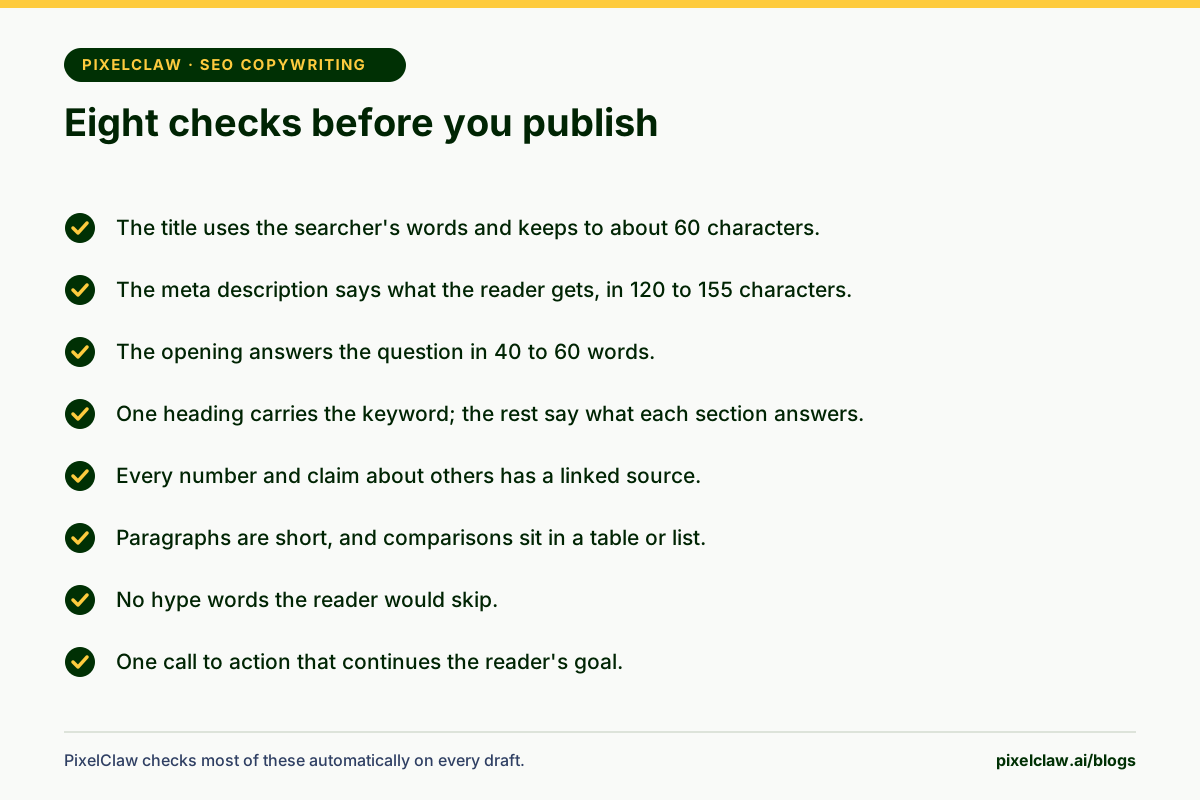
The SEO copywriting checklist
Run every post through this before it goes live. Each item helps the search engine, the AI answer and the reader at once.
How PixelClaw handles SEO copywriting on every post
PixelClaw's score turns most of that checklist into checks. The SEO area, 30% of the score, covers the title and meta description lengths and, when a post has a target keyword, its place in the title, the opening and a heading. The AEO area checks the 40 to 60 word opening, and the SXO area checks for a call to action. Many failing checks come with a one-click fix that rewrites just that piece and shows it to you first.
The writing rules do the rest of the editing. Drafts are written from the sources research read, in the brand voice you set, and the rules tell the model to avoid the stock phrases that make AI copy easy to spot. You keep the angle and the offer; the AI content writer guide explains how the voice and facts get in.
Good copy turns visits into customers, which is why it sits at the centre of an organic growth strategy. For the path after the click, read SXO for startups.
- SEO copywriting now writes for three readers: the search engine, the AI answer that may quote it, and the person who decides whether to act.
- Use the searcher's words in the title, the opening and one heading, then write naturally; stuffing keywords helps none of the three readers.
- A headline is a promise. Titles that overpromise lose the click they win, and Google may rewrite a title that does not match the page.
- Specific, sourced claims persuade people and get repeated by AI; hype gets skimmed by readers and dropped from summaries.
- Every post needs one call to action that continues the reader's own goal.
Frequently Asked Questions
What is the difference between SEO writing and SEO copywriting?+
SEO writing aims to rank and inform. SEO copywriting aims to rank and persuade: it carries the reader from the search result to a decision, such as a signup or a demo request. In practice a good blog post needs both.
Can AI do SEO copywriting?+
AI is good at research, structure and first drafts, and at following rules like keyword placement and answer length. It cannot know your customer's objections or your proof unless you give them to it. The best results come from AI drafting from your facts and a person deciding the angle and the offer.
How long should SEO copy be?+
As long as the question needs and no longer. A useful benchmark is the length of the pages that already rank for the query. PixelClaw plans each post's length from the top-ranking articles, between 800 and 5,000 words.
Where should keywords go in SEO copywriting?+
In the title, in the opening paragraph and in at least one heading, phrased the way people search. After that, write for the reader. Related terms and natural variations matter more than repeating the exact phrase.
Sources
- Concise, SCANNABLE, and Objective: How to Write for the Web — Nielsen Norman Group
- Influencing your title links in search results — Google Search Central
- Search Engine Optimization (SEO) Starter Guide — Google Search Central
Built & scored using PixelClaw.ai
More from this blog
Continue exploring autoblogging architecture, AI blog writing, and SEO / AEO / GEO playbooks.
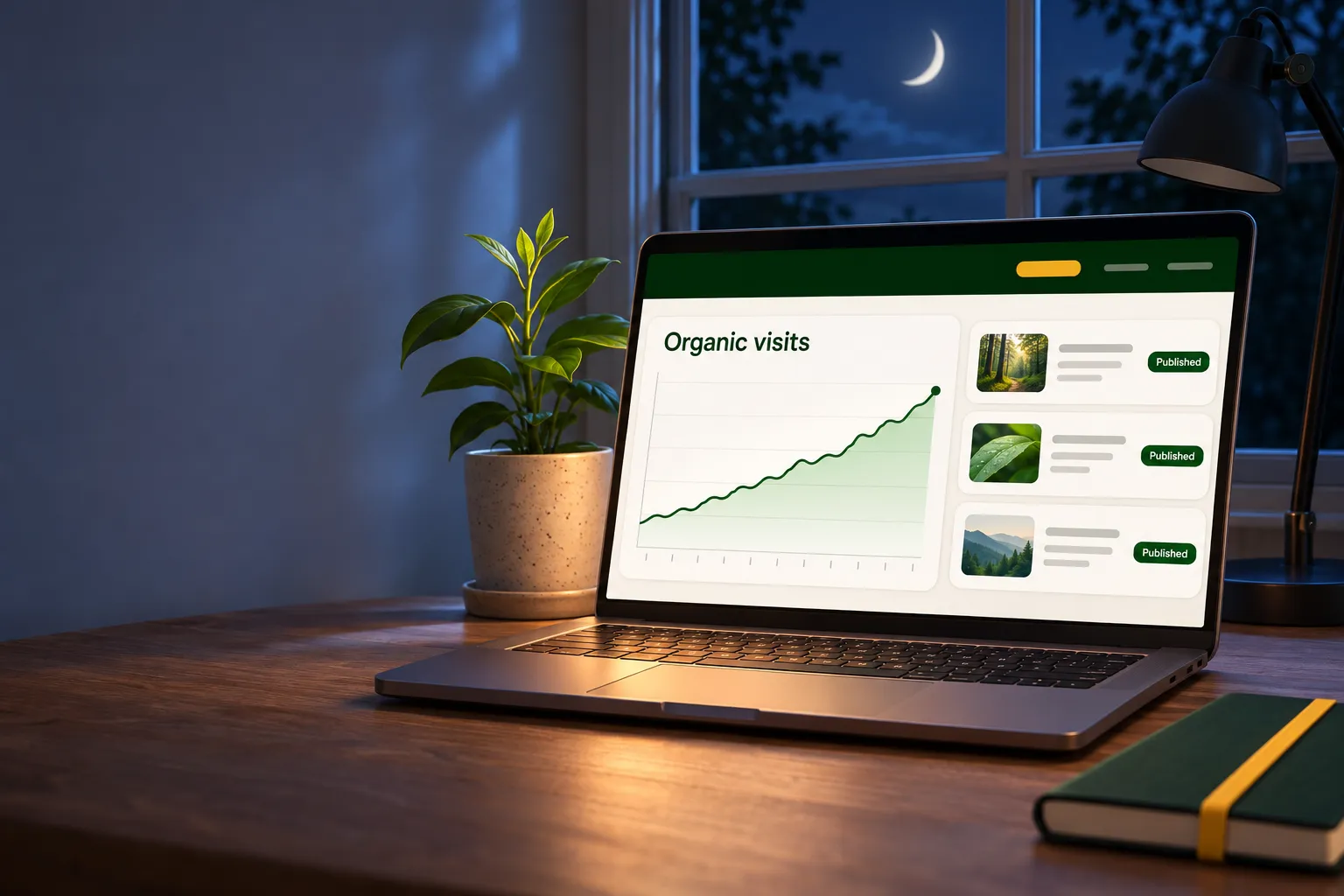
Organic Growth Strategy for Startups: Build Traffic That Keeps Growing While You Sleep
Ads rent attention and stop the day the budget does. An organic growth strategy builds a library of posts that rank in Google, get quoted by AI answers and keep sending buyers for years.
PixelClaw Editorial Team
Product and search team

SXO for Startups: What Search Experience Optimization Means and How to Turn Search Visits Into Signups
Ranking gets the click. What happens next decides whether the visit becomes a customer. Here is what SXO means, why it matters to startups, founders, bloggers and copywriters, and the fixes that pay first.
PixelClaw Editorial Team
Product and search team
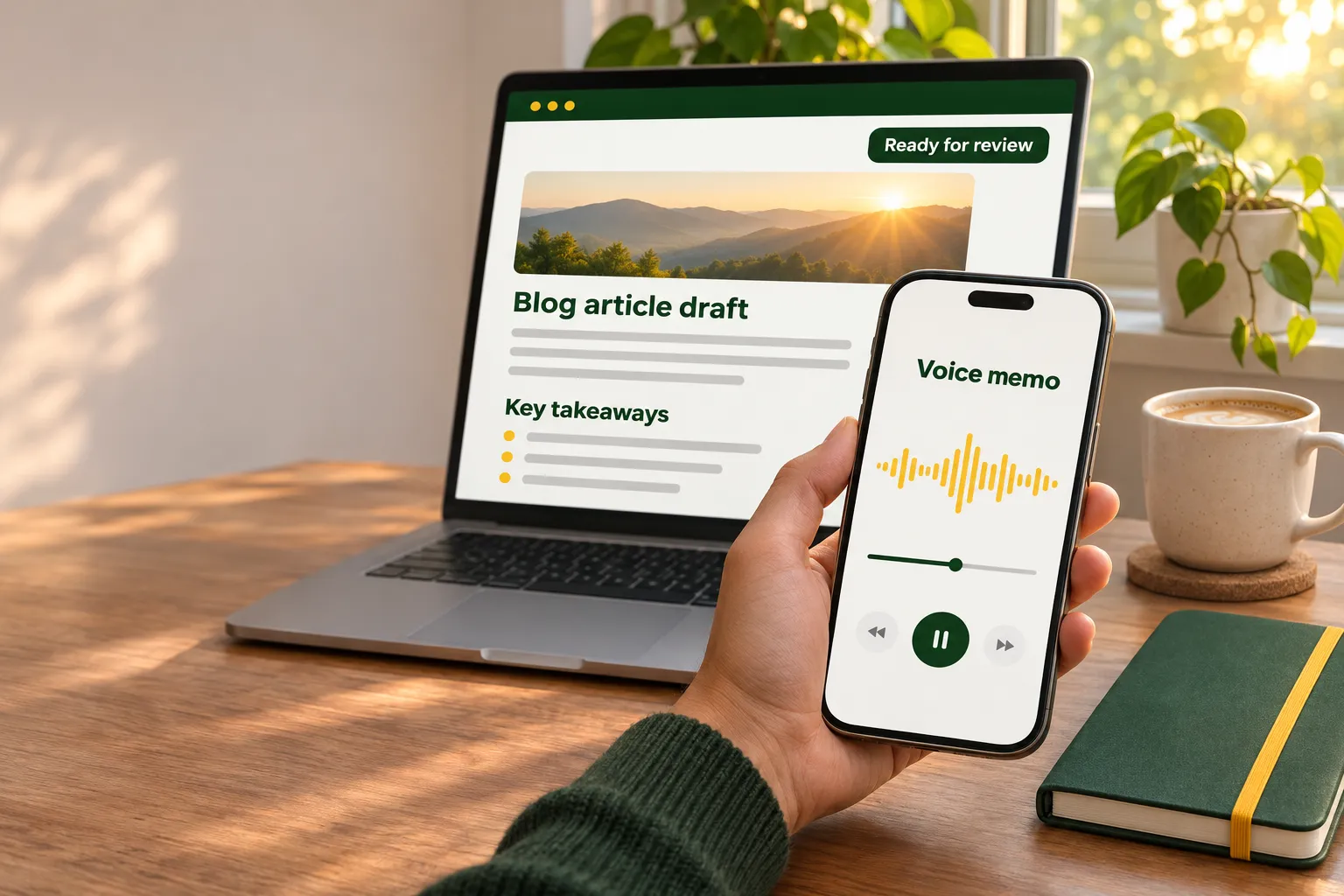
Founder-Led Content Without the Late Nights: How Busy Founders Publish Every Week
Buyers trust the person who built the product more than any brand voice. The problem has always been the founder's calendar. Here is a system that keeps your knowledge and your voice while the hours come off your plate.
PixelClaw Editorial Team
Product and search team