Content optimization
PixelClaw toolsA Content Optimization Tool That Scores SEO, AEO, AIO, GEO and SXO Together
Most content optimization tools grade one thing: keywords. PixelClaw scores every post in five areas, explains each failed check in plain words, and fixes most of them in one click.

On this page▸
A content optimization tool checks a post against the rules that decide whether it ranks and gets read, then tells you what to fix. PixelClaw's content optimization tool scores every post out of 100 across five areas, SEO, AEO, AIO, GEO and SXO, explains each failed check in plain words, and fixes most of them in one click.
Why a content optimization tool should check more than keywords
The first generation of content optimization tools counted keywords. The second compared your terms and topics with the pages that rank. Both help with one thing: getting into the list of results.
Search now has more surfaces. A post can rank in the list, appear as a featured snippet, be quoted by a voice assistant, be cited by ChatGPT, or be skimmed and abandoned by a reader on a phone. Each of those rewards different things, and a tool that only checks keywords misses most of them.
PixelClaw's content optimization tool scores five areas together, so a post is optimized for every place it can be found, not only one.
The five areas, and what each one checks
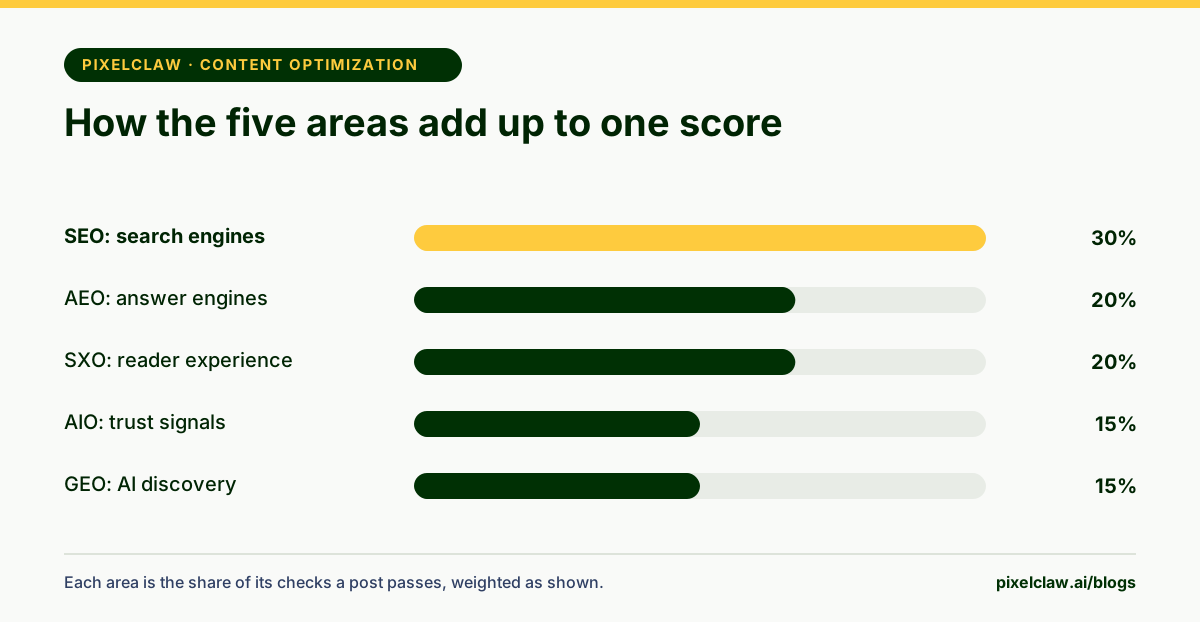
Search engines (SEO) carry the most weight: keyword placement, title and description length, heading order, the web address, links to related posts and structured data. Answer engines (AEO) check the opening answer, the FAQ, the key takeaways, lists and tables, and whether the post answers the questions readers ask.
Trust signals (AIO) check that the post names its author and points to sources. AI discovery (GEO) checks that AI crawlers may read the blog and that the publisher is named. Reader experience (SXO) checks image descriptions and sizes, a contents list on long posts, and a call to action.
Findings in plain words
A score is only useful if you know what to do about it. Every check in PixelClaw explains itself: "The opening paragraph is 92 words. Aim for 40 to 60 so it can be quoted whole." or "Add links to 2 to 5 related posts. They keep readers on your site and help search engines see how your posts connect."
There is no jargon to decode and no grade without a reason. You can read the list top to bottom in a minute and decide which findings to act on.
Thirteen one-click fixes
Most failed checks come with a fix. Click it and the AI writes the missing piece: a shorter title, a new description, an opening answer, a heading with the keyword, key takeaways, an FAQ, a list or table, image descriptions, a call to action, links to related posts, a table of contents, image sizes or a sharing image.
Each fix is shown to you before it is applied, so nothing changes without your say. Fixes use a few credits each, and Fix all with AI applies every available fix at once. Autopilot's own repair pass, for posts it writes, is included in the post's price.
- Rewrite the title or the excerpt.
- Write an opening answer, key takeaways or an FAQ.
- Use the keyword in a heading.
- Add a list or table, a call to action or links to related posts.
- Add a table of contents, image descriptions, image sizes or a sharing image.
An AI review for what rules cannot see
Rules catch structure. They cannot judge whether an argument holds together or a section wanders off topic. For that, run an AI review: a model reads the whole post as an editor would and returns notes.
The first AI review of each post is free. Repeat reviews use a few credits, shown before you start. Use it on posts that matter most, after the rule-based fixes are done.
What any content score cannot do
A score cannot tell whether a claim is true, whether your advice is good or whether the post is better than the one ranking above it. It measures what can be measured reliably: structure, completeness and discoverability.
So treat the score as a floor, not a finish line. A post that scores 95 and states a wrong price is a worse post than one that scores 85 and gets everything right. For writing posts that pass these checks from the start, see SEO writing software.
Optimizing old posts, not just new ones
The quickest wins often sit in posts you already have. Older posts frequently miss an opening answer, an FAQ, alt text on images or links to the posts written since. Open them in the editor, read the score, and apply the fixes that make sense.
Start with posts that already get impressions in Search Console but few clicks, or that sit just off the first page. Small structural improvements, such as a sharper title, a direct answer at the top and a few internal links, can move those posts more than a brand-new article would.
- PixelClaw scores posts across five weighted areas: SEO 30%, AEO 20%, SXO 20%, AIO 15% and GEO 15%.
- Each failed check says what is wrong and why it matters, in plain words.
- Thirteen one-click fixes cover the common failures; you review each change before it is applied.
- The first AI review of each post is free; repeat reviews and fixes use a few credits.
- The score checks structure and discoverability, not truth; facts are still yours to check.
Frequently Asked Questions
How is this different from Surfer or Clearscope?+
Those tools focus on comparing your terms and topics with top-ranking pages, and they do it in depth. PixelClaw's score is broader and simpler: it checks the structure that matters for search engines, answer engines, trust, AI discovery and readers, and it lives in the same place you write and publish.
Can I optimize posts I didn't write with PixelClaw?+
Yes. Paste or write any post in the editor and it is scored the same way, with the same fixes available.
Does a high score guarantee rankings?+
No. A score shows that the post is built the way search engines and answer engines prefer. Rankings also depend on competition, your site's history and whether the post answers the question better than the alternatives.
What does Fix all with AI do?+
It applies every available fix for the failed checks in one go, for a few credits shown before you start, and shows you the changes before they are kept.
Sources
- Search Engine Optimization (SEO) Starter Guide — Google Search Central
- Featured snippets and your website — Google Search Central
- GEO: Generative Engine Optimization — Aggarwal et al.
Built & scored using PixelClaw.ai
More from this blog
Continue exploring autoblogging architecture, AI blog writing, and SEO / AEO / GEO playbooks.

SEO Writing Software That Checks Every Post Before It Goes Live
What to expect from SEO writing software in 2026, from the editor to the checks and the publish step, and how PixelClaw's writing studio handles each part.
PixelClaw Editorial Team
Product and search team

SEO Blogs That Earn Clicks in 2026: How to Plan, Write and Publish Them
The on-page checklist, the length question, internal links and the technical basics, written for people who want their blog posts found rather than admired.
PixelClaw Editorial Team
Product and search team

Best AI SEO Writing Tools That Grade Your Draft Before Google Does
Seven AI SEO writing tools that check a draft before it goes live, compared on what they grade: terms and topics, structure, answer-engine readiness or AI visibility.
PixelClaw Editorial Team
Product and search team