Founder-led content
Growth guideFounder-Led Content Without the Late Nights: How Busy Founders Publish Every Week
Buyers trust the person who built the product more than any brand voice. The problem has always been the founder's calendar. Here is a system that keeps your knowledge and your voice while the hours come off your plate.

On this page▸
Founder-led content is marketing written from the founder's own knowledge and voice: what they learned building the company, solving the customer's problem and choosing the market. It earns trust no agency can copy. The catch is time, so busy founders supply the ideas and the review, and let a tool like PixelClaw do the research, drafting and publishing.
What founder-led content is, and why buyers trust it
Founder-led content is anything your company publishes that carries the founder's knowledge, judgment and name: the post explaining why you built the product, the honest comparison of approaches in your market, the lesson from the customer you almost lost. It is the opposite of generic content marketing written to fill a calendar.
Buyers trust it for a simple reason. The founder has lived the problem and made real decisions about it, and it shows in the details. Google's guide to helpful, reliable, people-first content asks the same questions a buyer does: who made this, how, and why, and does it show first-hand experience.
AI systems apply a similar test before they quote or recommend a source. A post signed by a founder who explains what they saw first-hand is exactly the kind of evidence covered in AIO for startups.
Why founder-led marketing works so well for startups
In the early years the founder is the best salesperson the company has. They know every objection, every competitor and every story of a customer who switched. Founder-led marketing takes those conversations, which happen one at a time, and publishes them so they happen a thousand times.
It also compounds. A post that answers the question every prospect asks on the first call keeps answering it in Google for years, and every sales conversation can start with a link instead of a twenty-minute explanation. Paul Graham's advice in Do Things that Don't Scale is to win the first users by hand; founder-led content is how what you learn doing that becomes something that scales.
And it is the one asset a competitor cannot buy. They can copy your features and outspend your ads. They cannot copy what you learned building the company.
The founder's time problem
Here is why most founder-led content programs stop after the fourth post. Orbit Media's 2026 survey of 1,042 content marketers put the average blog post at 3 hours and 20 minutes to write, and that is for people whose job is writing. Add research, images and publishing, and a weekly post costs a founder most of an evening.
Nobody keeps that up through a fundraise, a launch or a hiring push. The posts stop, the blog goes quiet, and the compounding never starts. The fix is not more willpower. It is separating the part only the founder can do from the part anyone, or anything, can.
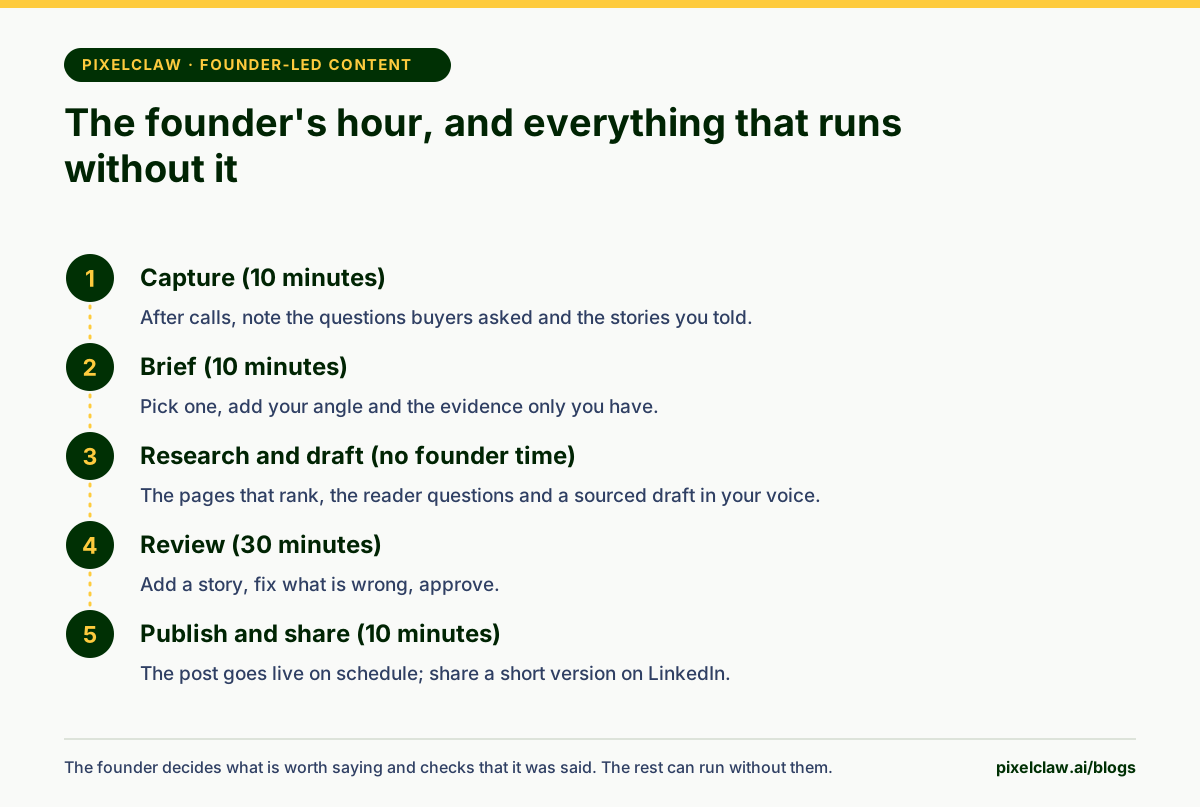
A founder-led content system that needs about an hour a week
The founder's job shrinks to two things: deciding what is worth saying, and checking that the final post says it. Everything between those can be delegated.
How to keep your voice when AI does the drafting
AI drafts sound generic when they are written from nothing. They sound like you when they are written from your material. Describe your business once, in your own words, and let the writer read it before every post. Set a brand voice with examples of how you actually write. Upload the facts you would hate to see wrong: pricing language, product details, customer numbers you are allowed to share.
Then add one thing per post that only you could add. A decision and why you made it. A mistake and what it cost. A number from your own data. That single paragraph is what turns a competent post into founder-led content, and it is also what readers remember.
PixelClaw's AI content writer is built around exactly this: a business profile built from your website, brand voices, knowledge files and research, so drafts start from your facts rather than the internet's average.
Founder-led content ideas that never run out
If you are stuck, these come straight from the work you already do. Each one is a post your buyers are searching for.
- The question every prospect asks on the first call, answered properly.
- Why you built the product the way you did, and what you chose not to build.
- An honest comparison of the approaches in your market, including when yours is the wrong choice.
- What you learned from your first hundred customers, in numbers you can share.
- How to choose a tool in your category, written for a buyer who has never done it.
- The process your own team uses, step by step, with the templates.
- A mistake that cost you money, and what you changed afterwards.
- What you stopped doing, and why the results improved.
How PixelClaw turns a founder's knowledge into weekly posts
PixelClaw handles the part of founder-led content that eats the evenings. It reads the pages that rank for your topic, collects the questions readers ask, writes a draft from your business profile, brand voice and the sources it read, adds a hero picture, and scores the post for search and AI answers before you see it.
In the writing studio you can edit the outline and leave notes for the writer before a word is drafted, which is where your angle goes in. On Autopilot the same steps run for every topic in your queue, and finished posts wait for your review by default. If you switch on automatic publishing, only posts scoring 77 or more and passing the remaining checks publish themselves.
Posts carry an author byline, and the score checks that one is named, so your name and experience stay on the work. For how much can run without you, and where you should still step in, read hands-free autoblogging. For the bigger picture, see the organic growth strategy this system plugs into, and for the writing craft behind posts that convert, SEO copywriting.
How to measure founder-led content
Measure it the way you would measure a salesperson who never sleeps. Count how often a post is sent in a sales conversation, and whether deals that received one close faster. Watch which posts earn impressions and clicks in Search Console, because those are the questions your market asks without being prompted.
Ask new customers where they first heard of you, and listen for a post title in the answer. Once a month, ask ChatGPT and Perplexity the questions your posts answer and note whether your name comes up. Founder-led content is working when prospects arrive having already read you, and quote your own posts back to you on the first call.
Founder-led marketing mistakes to avoid
Publishing only announcements is the most common. Nobody searches for your funding news; they search for answers to their own problems. Ghostwritten fluff is the second: a post with the founder's name and none of the founder's knowledge is worse than no post, because it spends trust.
The third is betting everything on social. Social posts spread fast and vanish fast; the blog is where the knowledge keeps working. The fourth is stopping. A founder who publishes one useful post every week for a year has built something a competitor cannot catch quickly. One who publishes twelve in January and none after has built a quiet blog. If you need the argument for why it is worth it at all, growth hacking for startups makes it.
- Founder-led content works because buyers, search engines and AI systems all reward first-hand experience from a named person.
- Most founder-led marketing stalls after a few posts, because writing takes hours a founder does not have.
- Split the work: the founder supplies insight, stories and the final review; research, drafting, scoring and publishing can run without them.
- Keep the voice by giving the writer your business profile, a brand voice and your own facts, and by adding one story only you could tell.
- A blog post keeps earning in search for years, while a social post fades in days; use social to spread what the blog keeps.
Frequently Asked Questions
Does founder-led content have to be written by the founder?+
No. It has to come from the founder's knowledge and carry their judgment. Many founders dictate ideas, review drafts and add their stories, while research and drafting are done by a writer or a tool. Be open about how posts are made; an editorial policy is an easy way to say it.
How often should a founder publish?+
Once a week is plenty, if it is every week. Consistency matters more than volume, because search engines and readers both learn to expect you, and a steady cadence builds the library that compounds.
Is LinkedIn enough for founder-led marketing?+
LinkedIn is good for reach and fast feedback, but its posts fade within days and do not rank in Google. Publish the full answer on your blog, where it can rank and be cited by AI, and share a short version on LinkedIn that links back to it.
Will AI make my content sound generic?+
It will if you give it nothing. Give it your business profile, your brand voice, your own facts and a story or opinion for each post, and review the draft before it goes live. The review is where your experience goes in, and it usually takes minutes.
Sources
- Creating helpful, reliable, people-first content — Google Search Central (Asks who created the content, how, and why, and stresses first-hand experience.)
- Blogging Statistics 2026: What 1,042 Content Marketers Told Us About What Works — Orbit Media Studios (3 hours 20 minutes to write the average post.)
- Do Things that Don't Scale — Paul Graham
Built & scored using PixelClaw.ai
More from this blog
Continue exploring autoblogging architecture, AI blog writing, and SEO / AEO / GEO playbooks.

Organic Growth Strategy for Startups: Build Traffic That Keeps Growing While You Sleep
Ads rent attention and stop the day the budget does. An organic growth strategy builds a library of posts that rank in Google, get quoted by AI answers and keep sending buyers for years.
PixelClaw Editorial Team
Product and search team

Growth Hacking for Startups in 2026: Why a Blog on Autopilot Is the Hack That Compounds
Most growth hacks work for a month and then everyone copies them. Content is the rare one that gets stronger the longer you run it, and automation finally makes it fast enough for a startup.
PixelClaw Editorial Team
Product and search team

SEO Copywriting in 2026: How to Write Blog Copy That Ranks, Gets Quoted and Sells
Good copy used to have two readers, the search engine and the person. Now it has three, because AI answers quote it too. Here is how to write for all three without sounding like a robot or a billboard.
PixelClaw Editorial Team
Product and search team