Growth hacking
Growth guideGrowth Hacking for Startups in 2026: Why a Blog on Autopilot Is the Hack That Compounds
Most growth hacks work for a month and then everyone copies them. Content is the rare one that gets stronger the longer you run it, and automation finally makes it fast enough for a startup.

On this page▸
Growth hacking for startups is the search for cheap, fast, repeatable ways to win customers. Most hacks fade once everyone copies them. The one that compounds is a content loop: publish answers to buyers' questions every week, let each post keep bringing visitors, and automate the work so it runs while you sleep.
What growth hacking for startups really means
The term growth hacker is usually credited to Sean Ellis, around 2010, to describe someone whose every decision is judged by its effect on growth. The legends followed quickly: Hotmail adding a sign-up line to the bottom of every email its users sent, Dropbox giving extra storage to both sides of a referral, Airbnb letting hosts cross-post listings to Craigslist.
Look closely and those were not tricks. Each one turned something users already did, sending email, sharing files, listing a room, into a way to reach the next user. That is the part worth copying. The specific tactic almost never is.
Paul Graham's essay Startup = Growth explains why founders chase this so hard: a startup is a company designed to grow fast, and a good weekly growth rate in Y Combinator is 5 to 7%. Growth hacking for startups is simply the search for ways to hit that rate without a big budget.
Why most startup growth hacks fade
Every channel rewards the first people to use it well. Then everyone else arrives, readers learn to ignore the tactic, and results fall. Andrew Chen described the pattern years ago: click-through rates on new marketing channels decline over time as they get crowded.
Platforms also change the rules. A referral trick gets limited by an app store, a social network cuts organic reach, an ad auction gets more expensive as competitors bid on the same audience. A startup that grew on one trick spends the next year looking for another.
The pattern repeats so often that the useful question is not "what is the newest growth hack" but "what keeps working after it is copied". The answer is almost always a loop.
Hacks spike. Growth loops compound.
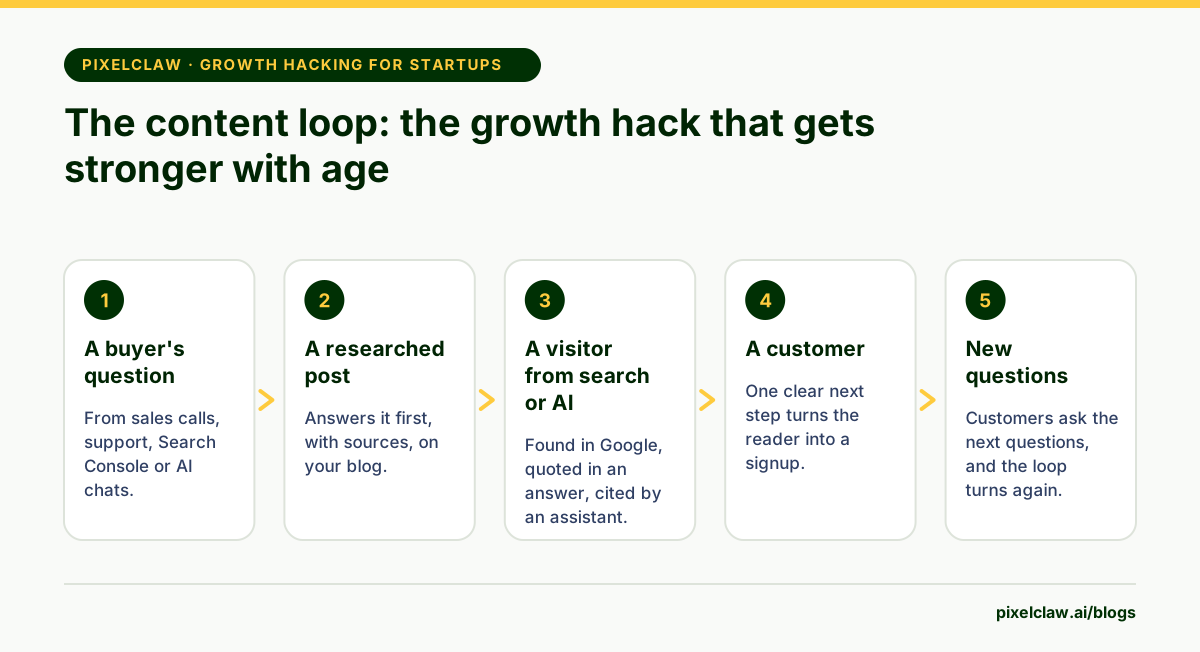
A growth loop is a system where each output becomes the input for the next round. A referral loop turns a new user into an invitation. A content loop turns a buyer's question into a post, the post into a visitor, the visitor into a customer, and the customer's next questions into more posts.
Loops start slower than hacks, because the first rounds are small. They win because each round adds to the last instead of starting over. Ten posts published this quarter are still bringing visitors next year, on top of whatever you publish then.
Startup growth hacks that still work in 2026
These hold up because each one either feeds the content loop or borrows from it. None needs a large budget.
- Answer "alternatives" and "versus" searches honestly, since the reader is choosing a tool this week.
- Turn every question from a sales call into a post, then send that post to the next prospect who asks.
- Publish one small piece of original data a quarter; numbers earn links and AI citations.
- Refresh the posts sitting on page two of Google before writing new ones.
- Translate the posts that already convert, so the same work wins a second market.
- Do things that don't scale for your first customers, as Paul Graham urges in Do Things that Don't Scale, and write up what you learn.
A four-week growth experiment for the content loop
Growth hacking is about testing, so test the content loop before you commit to it. The experiment below takes four weeks and very little money, and it gives you a real signal instead of an opinion.
Choose one narrow topic your buyers ask about, ideally something that came up on three or more sales calls last month. Write down ten questions inside it, in the buyers' words. Publish one pillar post that answers the broad question and four supporting posts that answer the sharpest of the ten, all linked to each other and to the page where a reader can sign up.
At the end of week four, measure three things: whether Search Console shows impressions for the questions you targeted, which unplanned queries appeared next to them, and whether any visitor from those posts took the next step. Impressions with no clicks mean the titles or openings need work. Clicks with no signups mean the call to action does not match the reader. Nothing at all usually means the posts are not indexed yet, which is worth checking before you judge the idea.
If the signal is there, add the next five questions and keep going. That is the loop starting to turn, and the point where automating it pays off.
How PixelClaw turns content into a growth hack that runs while you sleep
PixelClaw was built to remove the slow part of the content loop. Give it a topic and it reads the pages that rank, collects the questions readers ask, plans the length from what ranks, writes a sourced draft with a hero picture and scores it for SEO, AEO, AIO, GEO and SXO before you see it.
Autopilot runs that for every topic in your queue and can refill the queue from your saved keywords and research ideas. Posts wait for approval by default; with automatic publishing switched on, only drafts scoring 77 or more and passing the remaining checks go live on schedule. That is the closest thing to a growth hack that keeps working while the founder sleeps.
Paid plans add God Mode, which turns a description of your business into a pillar guide and its supporting articles, queued for Autopilot; our topical map guide explains why that structure ranks. Pro and higher plans add Competitor Spy, which lists the topics your competitors write about that you have no post on, ready to queue.
Start with the organic growth strategy that ties it together, and if you are a founder writing the posts yourself today, read founder-led content next.
Measure the loop, not the stunt
A hack is judged by its spike. A loop is judged by its slope. Each month, check how many posts you published, how many of them earn impressions in Search Console, how many visits they bring together, and how many signups start on the blog. If all four rise, the loop is turning.
Watch one warning sign closely: publishing faster than you can check quality. Google's spam policies are aimed at pages made in bulk to manipulate rankings, and a growth loop built on thin posts eventually breaks. Steady, useful and scored beats fast and forgettable.
- Growth hacking is a mindset of cheap, measurable experiments, not a list of tricks; the tricks expire, the mindset does not.
- Most startup growth hacks fade because channels saturate and click-through rates fall as everyone copies the same tactic.
- A growth loop, where each new customer or post creates the next one, compounds where one-off hacks spike and drop.
- Content is the loop most startups can run on almost no budget: questions become posts, posts become visitors, visitors become customers and new questions.
- Automation turns the content loop into a real growth hack, because the slow part, research and writing, no longer depends on the founder's evenings.
Frequently Asked Questions
What is the best growth hack for a startup with no budget?+
Two things that cost time rather than money: doing unscalable work to win your first customers by hand, and publishing answers to the questions those customers ask. The first gets you started; the second keeps working after you stop.
Is growth hacking still relevant in 2026?+
The mindset is: run cheap experiments, measure them, keep what works. The famous tactics are not, because they were copied until they stopped working. Today's durable advantages come from loops, owned audiences and content that answers real questions.
How is growth hacking different from marketing?+
Traditional marketing often starts with a budget and a campaign. Growth hacking starts with a metric and an experiment, and it treats the product, the onboarding and the content as levers, not only the ads.
Is automated blogging a growth hack or spam?+
It depends on what gets published. Google treats mass-produced pages made to manipulate rankings as spam. Researched, sourced posts that answer real questions are content. PixelClaw scores every draft and holds back anything under 60, and posts wait for your approval by default.
Sources
- Do Things that Don't Scale — Paul Graham
- Startup = Growth — Paul Graham
- Blogging Statistics 2026: What 1,042 Content Marketers Told Us About What Works — Orbit Media Studios
- Spam policies for Google web search — Google Search Central
Built & scored using PixelClaw.ai
More from this blog
Continue exploring autoblogging architecture, AI blog writing, and SEO / AEO / GEO playbooks.

Organic Growth Strategy for Startups: Build Traffic That Keeps Growing While You Sleep
Ads rent attention and stop the day the budget does. An organic growth strategy builds a library of posts that rank in Google, get quoted by AI answers and keep sending buyers for years.
PixelClaw Editorial Team
Product and search team

Founder-Led Content Without the Late Nights: How Busy Founders Publish Every Week
Buyers trust the person who built the product more than any brand voice. The problem has always been the founder's calendar. Here is a system that keeps your knowledge and your voice while the hours come off your plate.
PixelClaw Editorial Team
Product and search team

SEO for Startups: A 90-Day Plan for Founders With No Marketing Team
You will not outrank the giants on their own keywords this year. You can own the specific questions your buyers search before they buy, and that is where startup SEO starts paying.
PixelClaw Editorial Team
Product and search team