AIO blogs
AI search guideAIO Blogs: Writing Posts That AI Systems Trust, Attribute and Recommend
AI optimization for bloggers: the authorship, sourcing and accuracy signals that decide whether Google's AI Overviews and chat assistants use your post or someone else's.

On this page▸
AIO blogs are posts built for AI optimization: content that AI systems, including Google's AI Overviews and chat assistants, can trust enough to use and credit. In practice that means a named author or team, sources for every claim, accurate specifics, and pages that say plainly who stands behind them.
What AIO means, and why the term is used two ways
AIO gets used in two senses, and it helps to know both. Some people mean AI Overviews optimization: getting your page into the AI summary Google shows above its results. Others mean AI optimization more broadly: making content that any AI system, from Gemini to ChatGPT to Perplexity, will use and credit.
The two meanings meet in the same place. Google says in its notes on AI features and your website that the usual SEO best practices still apply, and that there is no special markup to get into AI Overviews. Chat assistants have no published rules at all. What both reward, in practice, is content they can trust: a clear source, a clear author, and facts that agree with the rest of the web.
That is why PixelClaw's score calls its AIO area trust signals. AIO blogs are not a new format; they are ordinary good posts with their credentials showing.
Why AI systems lean so hard on trust signals
An AI answer is a promise made in the AI company's name. When Google's AI Overview or a chat assistant states a fact, it is the assistant that looks wrong if the fact is wrong. So these systems are built to prefer pages that look accountable: a named publisher, a named author, sources, dates.
Google's human quality raters are told to look for the same things. Its rater guidelines describe experience, expertise, authoritativeness and trust (E-E-A-T), with trust at the centre. Raters do not rank pages directly, but their judgments are used to test whether Google's systems are finding the right pages, which tells you what those systems are being tuned towards.
For a blog, the lesson is that anonymous, unsourced, undated posts are at a growing disadvantage, however well written they are.
The upside is that trust signals are mostly within your control. You cannot make Google's systems pick your page, but you can make sure that when they compare it with a rival's, yours is the one with a real name on it, sources a reader can click, and numbers that match the vendor's own page.
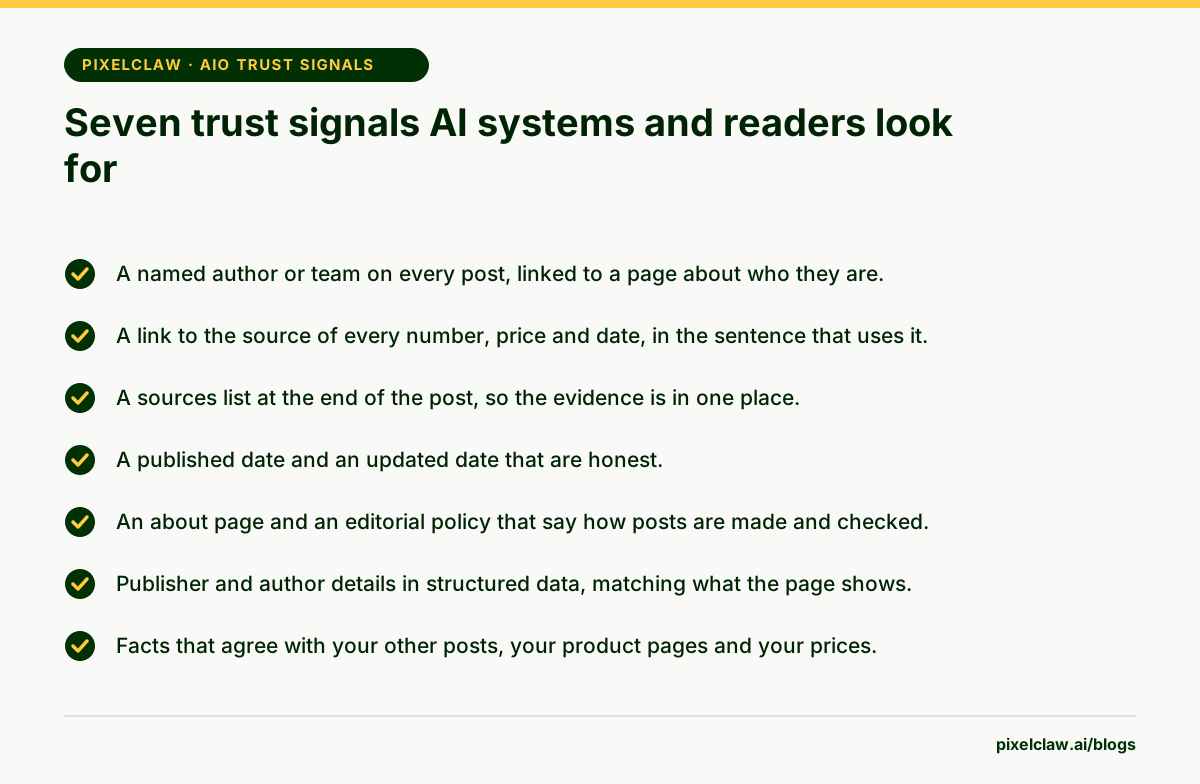
The trust signals every AIO blog needs
None of these takes long to set up, and most only need doing once for the whole blog. The rest is a habit applied to each post.
Sources: how many, which kind, and where to put them
Cite the source of anything a reader might doubt: numbers, prices, dates, quotes and claims about what a product or law does. Link it in the sentence that uses it, so the reader can check without hunting, and repeat it in a sources list at the end.
Prefer primary sources. The vendor's own pricing page beats a review site's summary of it. The regulator's guidance beats a news story about the guidance. Google's own documentation beats an SEO blog's interpretation of it, including ours.
PixelClaw keeps the sources its research found attached to each post and pins them when the post is published, so the list a reader sees matches what the draft was written from. A blog-wide switch lets you show or hide that list at the end of each post.
Accuracy is the trust signal you can't fake
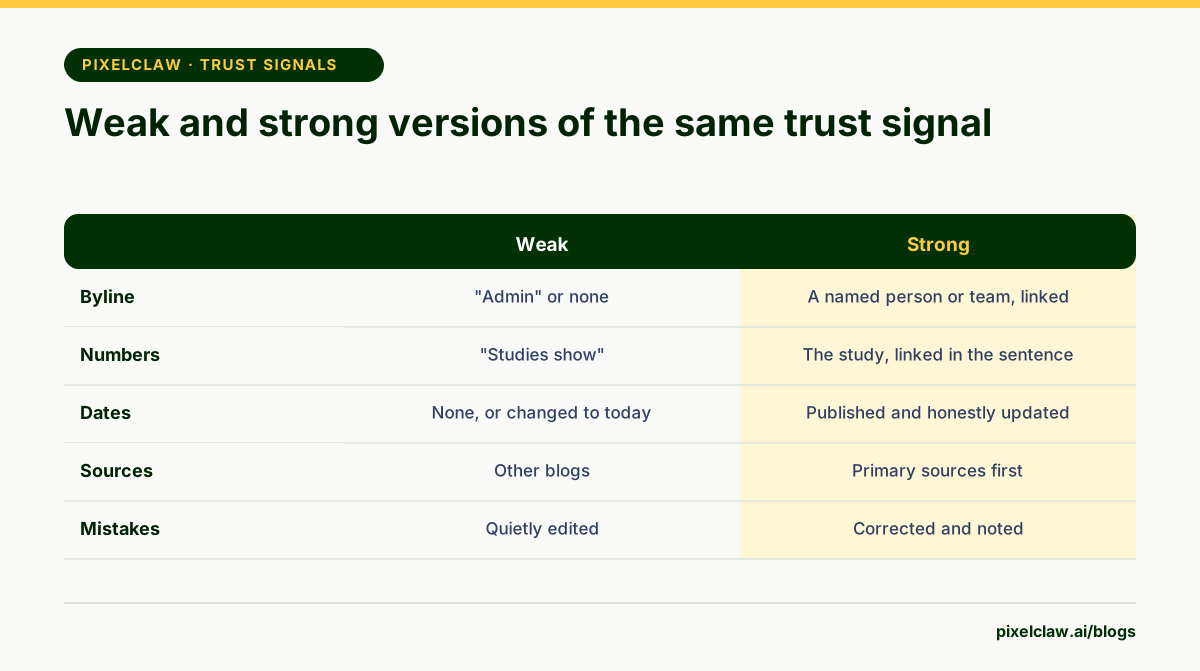
Everything above helps an AI system decide whether to trust a post before it reads the claims. Accuracy decides whether that trust lasts. A blog that is wrong about prices or product details gets contradicted by other sources, and systems that compare sources notice.
AI drafting makes this more important, not less. A draft can state a wrong figure fluently, and a quality score cannot catch it: PixelClaw's score checks structure, sources and discoverability, not whether a claim is true. That check is still yours. Read every number against its source before publishing, and fix mistakes openly when readers point them out.
If you want a longer look at keeping AI drafts honest, read our guide to source-grounded AI writing.
Dates, updates and corrections
Dates are a small trust signal that blogs often get wrong. Some never show a date, which leaves readers guessing whether advice from 2019 still holds. Others change the date to today on every save, which AI systems and careful readers learn to discount.
The honest pattern is two dates: when the post was first published, and when it was last meaningfully updated. Show both on the page and put both in the structured data. A meaningful update is new information, a corrected fact or a reworked section; fixing a typo is not.
Corrections are the other half. When a reader points out an error, fix it and, for anything that changed the advice, add a short note saying what changed and when. It costs one sentence and shows the kind of care that trust signals are meant to stand for.
For AIO blogs written with AI help, keep a habit of reviewing high-traffic posts on a schedule. Prices, product features and laws change, and a post that was right in March can be wrong by November. A post with an honest updated date and current facts is exactly what an AI system looking for a reliable source wants to find.
How PixelClaw scores AIO on every post
Trust signals carry 15% of a PixelClaw score. Two checks make up the area: the post names its author, and it points to at least two sources, either in a sources block or as links to other sites. Two related checks sit in the AI discovery area: AI crawlers are allowed to read the site, and the workspace name is shared with search engines as the publisher.
These are deliberately floors. A post that passes them has its credentials showing; whether those credentials are strong is up to the people behind the blog. For the next step, making those trusted posts easy for AI to find and cite, continue with GEO blogs.
- AIO is used two ways, for AI Overviews and for AI search in general; both come down to trust.
- Name who wrote each post and link to a page that explains who they are and how you work.
- Link the source of every number in the sentence that uses it, and list your sources at the end.
- Accuracy is the one trust signal you cannot fake, so check facts before publishing, not after.
- PixelClaw's AIO checks look for a named author and at least two sources on every post.
Frequently Asked Questions
Is AIO the same as optimizing for Google's AI Overviews?+
Partly. Some people use AIO to mean AI Overviews optimization; others use it for AI optimization in general. Google says the same SEO practices apply to its AI features, and the signals that help most in both cases are trust signals: who wrote it, what backs it, and whether it is right.
Do I need a named person as the author?+
A named expert is strongest when one exists. A team byline that links to an editorial page explaining who writes and reviews the posts is an honest alternative. A made-up persona is worse than either, because it falls apart the moment anyone checks.
How many sources should an AIO blog post cite?+
Cite a source for every number, date, price or claim a reader might doubt. For most posts that is somewhere between three and ten. PixelClaw's score asks for at least two as a floor, not a target.
Does structured data help AI systems trust a post?+
It helps them read the facts about the post: the author, the publisher, the dates and the questions answered. It does not make a weak post trustworthy. Treat schema as labelling, not as proof.
Can a small business compete on trust with big publishers?+
Yes, in its own niche. A local plumber who explains pipe repairs with real prices from real jobs has more first-hand experience than a national site summarising other summaries. Say what you have done, show it, and cite the rest.
Sources
- AI features and your website — Google Search Central
- Creating helpful, reliable, people-first content — Google Search Central
- Search Quality Rater Guidelines — Google (The section on experience, expertise, authoritativeness and trust (E-E-A-T).)
Built & scored using PixelClaw.ai
More from this blog
Continue exploring autoblogging architecture, AI blog writing, and SEO / AEO / GEO playbooks.

AIO for Startups: What AI Optimization Means and How a New Brand Earns a Place in AI Overviews
AI systems summarize the sources they trust. Here is what AIO means, why it matters to startups, founders, bloggers and copywriters, and the trust signals a brand-new company can show from its first post.
PixelClaw Editorial Team
Product and search team

GEO Blogs: How to Get Your Posts Cited by ChatGPT, Perplexity and Gemini
Generative engine optimization for blogs: let the AI crawlers in, give them a map, and write passages specific enough that an AI answer quotes them with your name attached.
PixelClaw Editorial Team
Product and search team
AEO Blogs: How to Write Posts That Answer Engines Quote Word for Word
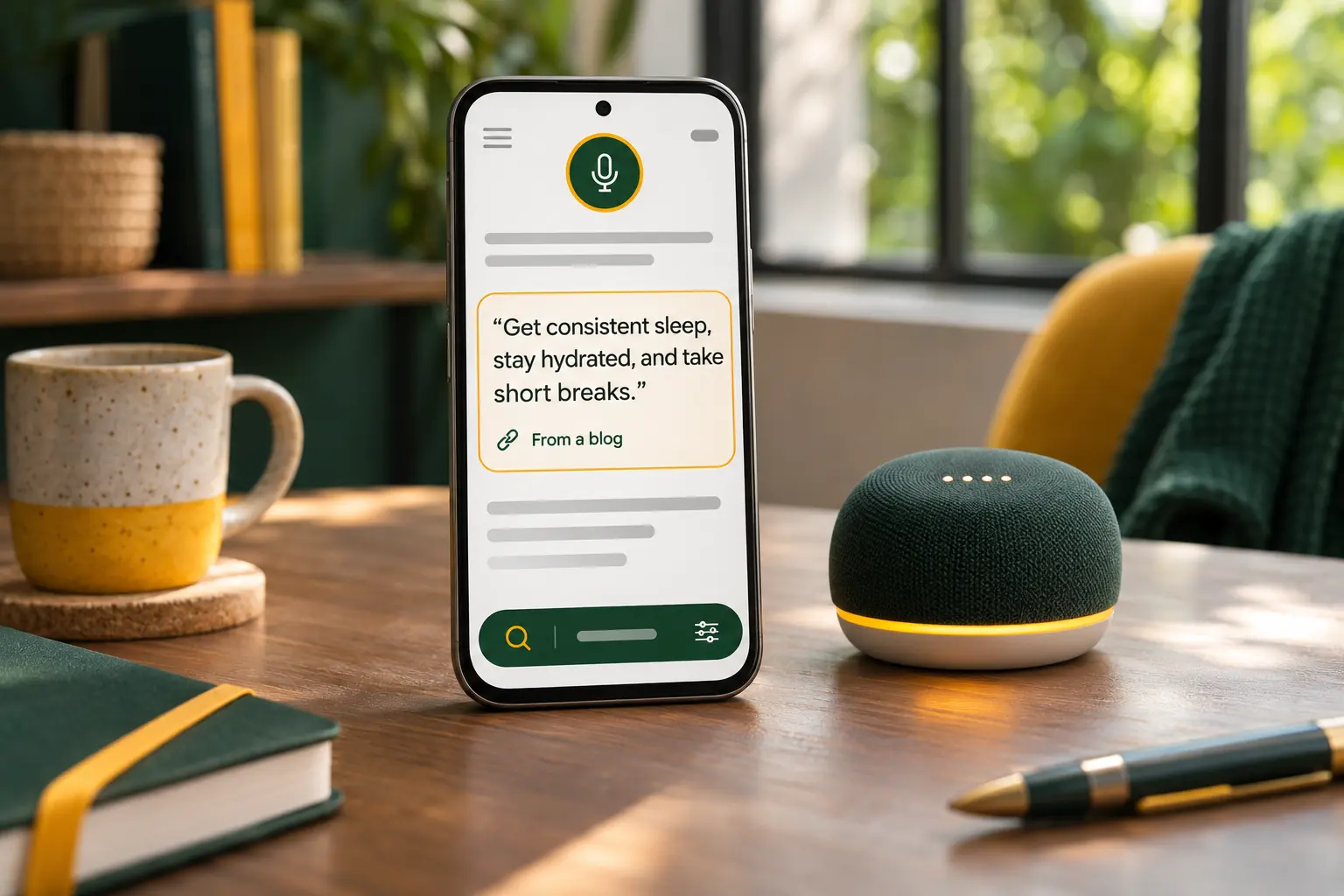
Answer engine optimization for bloggers: how to write the 40-to-60-word answer that featured snippets, voice assistants and AI chats lift straight into their replies.
PixelClaw Editorial Team
Product and search team