Tool comparison
Tool comparisonChoosing an Automated Blog Writer: Five Levels of Hands-Off, and the Best Tool at Each
From an assistant that drafts when asked to an agent that publishes daily, automated blog writers differ mostly in how much they do without you. Five levels, and the best tool at each.

On this page▸
The best automated blog writer depends on how hands-off you want to be. At level one a chat assistant drafts on request; at level three a batch tool writes many posts at once; at level five an agent plans and publishes on its own. PixelClaw covers levels two to five, with a quality score deciding what publishes alone.
Five levels of automated blog writer
"Automated" means very different things across blog writing tools. Some automate the drafting and leave everything else to you. Some automate everything, including the decision of what to publish. The most useful way to compare them is by level of automation, like the levels used to describe self-driving cars.
We describe five levels below and name the best tool at each. PixelClaw is our product and appears at more than one level, because its writing studio and Autopilot cover different ones. Every other fact comes from the vendor's own site, read on November 5, 2026.
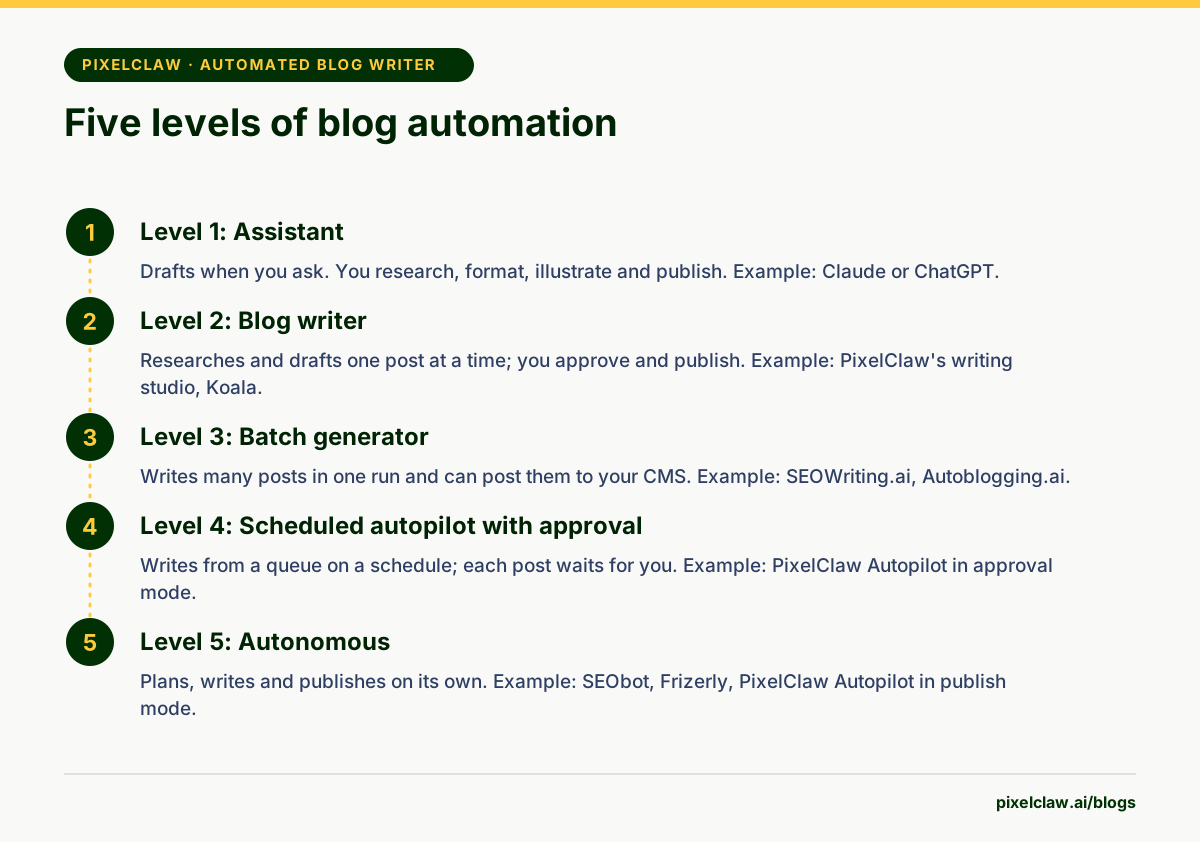
Level 1: a chat assistant that drafts on request
At level one, the automated blog writer is a general assistant. You ask, it drafts. Claude and ChatGPT are the best here: fluent, flexible and cheap, with free plans and paid tiers around $20 a month.
Everything else is yours: research, structure, images, links, formatting and publishing. That is fine for a few posts a month, and a heavy load for a steady blog.
Level 2: a blog writer that researches and drafts
A level-two tool researches the topic and drafts a structured post, but a person starts each one and publishes it. PixelClaw's writing studio works this way: it reads the ranking pages and reader questions, lets you shape the outline, drafts in your brand voice, adds a hero image and scores the post.
Koala is strong at this level for long-form and affiliate posts, selling words from $25 a month for 45,000.
Level 3: a batch generator
Level three automates volume: paste a list, get many posts, often posted to your CMS with a gap between them. SEOWriting.ai advertises bulk auto-posting of up to 100 articles to WordPress, from $14 a month billed yearly. Autoblogging.ai takes up to 500 titles per batch, from $19 a month.
Batch tools are efficient, and they put the burden of checking on you. A batch of 100 posts needs 100 reads.
If you work at level three, build the reading into the plan. Block out time the day the batch lands, read the first ten posts closely, and schedule the rest only once those pass. The posting gap matters as much as the batch size: a month of posts spread over a month looks like a working blog, while a month of posts in one day does not.
Level 4: a scheduled autopilot with approval
Level four writes from a queue on a schedule, but each finished post waits for a person. This is the sweet spot for most businesses: the writing happens without you, and nothing goes live without you.
PixelClaw's Autopilot in approval mode, its default, works this way. Posts are written about a day before their slot and booked for their time; you approve them and they go live then. RightBlogger and Outrank can also hold posts as drafts for review.
Approval takes minutes per post, not an hour. Read the opening, skim the headings, check any number or claim, and approve. If you keep changing the same thing, fix it once in the brand voice or business profile instead of in every post.
Level 5: autonomous publishing
At level five, the automated blog writer plans, writes and publishes without asking. SEObot plans content from your site and publishes weekly, from $49 a month for 9 articles. Frizerly's SEO agent auto-publishes from one post a week on its $49 Standard plan to seven a week on its top plan.
PixelClaw's Autopilot in publish mode is level five with a safety rail: a post goes live alone only if it scores 77 or more and passes every publication check, and no blog publishes more than 14 Autopilot posts a week. Weaker posts are held for review, so level five never means publishing everything.
Choosing your level, and moving up safely
Pick the level that matches your time and your trust in the output. If you write for pleasure and publish rarely, level one or two is enough. If you need a steady blog and have an hour a week, level four. If you want the blog to run itself, level five, with a quality bar and a pace cap you trust.
Move up one level at a time. Run level four until the posts arriving for approval stop needing edits, then switch to level five for that topic. For the step-by-step, read hands-free autoblogging, and for a comparison of tools by shape, the best autoblogging tools.
- Automated blog writers differ mainly in how much they do without you, from drafting on request to publishing daily.
- Level one is a chat assistant; level two a blog writer; level three a batch generator; level four a scheduled autopilot with approval; level five an autonomous agent.
- PixelClaw spans levels two to five, from the writing studio to Autopilot in publish mode.
- The more hands-off the level, the more a quality bar and a pace cap matter.
- Most blogs do best at level four for a few weeks before moving to level five.
Frequently Asked Questions
What is an automated blog writer?+
Software that writes blog posts with little or no human input per post. The term covers everything from an AI that drafts on request to an agent that chooses topics, writes and publishes on a schedule.
Can an automated blog writer publish without me?+
Several can. PixelClaw's Autopilot in publish mode, and agents such as SEObot or Frizerly, publish on a schedule. PixelClaw only publishes alone when a post scores 77 or more and passes its other checks; anything weaker waits for you.
Which level of automation is safest for SEO?+
The level where every post is still checked, by a person or a quality bar, and the pace stays sensible. Fully automatic publishing is fine with both in place and risky without them.
How long should I stay on approval before going fully automatic?+
Until the posts arriving for approval need little or no editing, usually after ten to twenty posts on a topic. Then switch that topic to automatic publishing and keep reading a weekly sample.
Sources
- Claude pricing — Anthropic (Read November 5, 2026.)
- Koala pricing — Koala (Read November 5, 2026.)
- SEOWriting.ai pricing — SEOWriting.ai (Read November 5, 2026.)
- SEObot pricing (help center) — SEObot (Read November 5, 2026.)
- Frizerly pricing — Frizerly (Read November 5, 2026.)
Built & scored using PixelClaw.ai
More from this blog
Continue exploring autoblogging architecture, AI blog writing, and SEO / AEO / GEO playbooks.
Best Autoblogging Tools in 2026: Hosted, WordPress and Agent Options Compared
Autoblogging tools come in three shapes: a hosted blog that writes itself, a writer that auto-posts to your WordPress site, and an SEO agent that runs everything. Seven tools compared, with prices from each vendor's site.
PixelClaw Editorial Team
Product and search team

Hands-Free Autoblogging: What Autopilot Can Run Alone, and Where You Still Step In
An honest look at hands-free autoblogging: what PixelClaw's Autopilot does without you, the safety rails that hold weak posts back, and the weekly hour that keeps it working.
PixelClaw Editorial Team
Product and search team

Automated Blog Writing, Explained Step by Step With a Real Pipeline
What actually happens inside automated blog writing, from the moment a topic leaves the queue to the moment a post goes live, and the design choices that keep it reliable.
PixelClaw Editorial Team
Product and search team