SEO blogs
AI search guideSEO Blogs That Earn Clicks in 2026: How to Plan, Write and Publish Them
The on-page checklist, the length question, internal links and the technical basics, written for people who want their blog posts found rather than admired.

On this page▸
SEO blogs are posts written to answer a question people search for, structured so search engines can read them and readers can skim them. The recipe hasn't changed much: one clear question, a direct answer early, useful depth, internal links and a fast page. What changed is how much weight the answer carries.
What makes SEO blogs different from ordinary posts
An ordinary blog post is written for people who already know you. SEO blogs are written for people who don't, and who are looking for an answer right now. That changes the first paragraph, the headings, the length and how the post connects to the rest of your site.
The difference is measurable, which is the good news. A company update either gets read or it doesn't. An SEO blog post has a target query, a position in the results, impressions and clicks in Search Console, and a click-through rate you can improve by rewriting a title. You can treat it like a small product and keep improving it.
Google's own SEO Starter Guide is still the best plain-English summary of the basics, and nothing in this guide contradicts it. What follows is the version we apply to every post on PixelClaw.
Find the question before you write
Keyword research for a blog is mostly finding questions with three properties: people ask them, your business can answer them better than the current results, and the answer leads somewhere useful for you.
Start with what you already have. Search Console shows the queries your site appears for, including ones you never targeted. Customer emails and sales calls are full of questions nobody has answered well online. Then check demand: PixelClaw's Keywords tab looks up approximate monthly searches for the phrases you choose, charges only for that lookup, and reuses the results free for 30 days.
Finally, look at what ranks. If the top results are product pages, a blog post will struggle no matter how good it is. If they are guides and comparisons, you are in the right format.
- Informational questions (how, what, why) suit guides and explainers.
- Comparison questions (best, vs, alternatives) suit tables and honest trade-offs.
- Transactional searches (buy, price, near me) usually belong on a product or service page, not a blog post.
The on-page checklist for SEO blogs
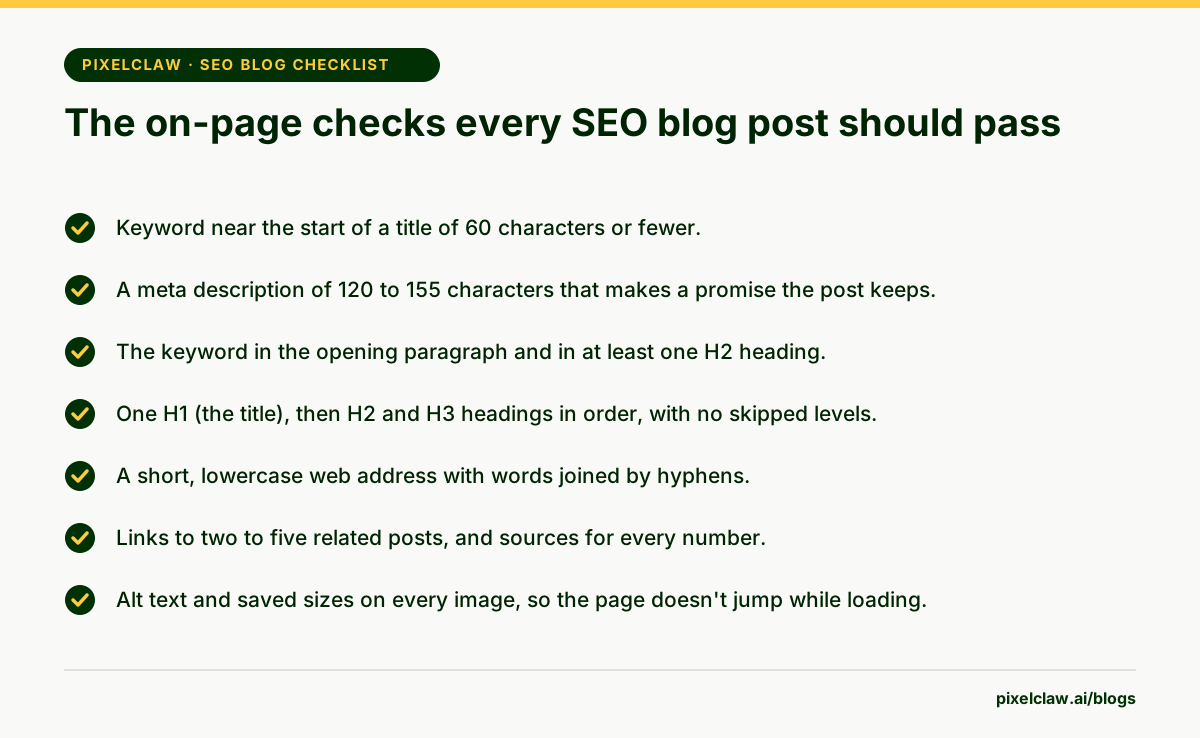
On-page SEO is a short list of things that each take a minute and together decide whether search engines understand the page. PixelClaw checks all of them on every draft, but the list is worth knowing by heart.
Titles first. Google shows roughly the first 60 characters, so put the keyword near the start and keep the title under that. The meta description is your pitch under the title; 120 to 155 characters fits most results. Google may rewrite either, as its title link documentation explains, but a good one is usually kept.
Writing SEO blog posts people finish
Ranking gets the click; the writing decides whether the reader stays, and Google notices when they don't. The structure that works is simple. Answer first. Then explain, with the specifics a beginner needs and the detail an expert checks for. Then show an example.
Keep paragraphs short on screen: two to four sentences, one idea each. Use subheadings a skimmer can read like a table of contents. Put steps in numbered lists and comparisons in tables, because people scan those first and answer engines quote them.
Write the way you would explain it to a smart customer across a desk. Name the tool, the number, the date. "Most plans start around $50 a month" is useful; "pricing varies" is not. Where you have done the thing yourself, say what happened, including what went wrong. Google's guidance asks for exactly that kind of first-hand experience, and readers trust it more than polish.
Finally, end with a next step that fits the reader's question: the related post that goes deeper, the calculator, the free trial. An SEO blog post that answers the question and then leaves the reader stranded wastes the visit you worked to earn.
How long should SEO blog posts be?
There is no right word count, only a right length for each question. A post answering "how long to boil an egg" needs a few hundred words. A post comparing project management tools for agencies needs a few thousand.
The practical method is to look at what already ranks. If the top three articles run around 1,800 words, a 600-word post probably leaves questions unanswered, and a 6,000-word post probably repeats itself. PixelClaw plans each post's length from the middle of the top-ranking articles for its keyword, between 800 and 5,000 words, and flags a draft that runs well past the longest of them.
Length follows coverage, never the other way round. Answer the questions readers ask, add the example only you can give, and stop.
Internal links and topic clusters
One post rarely ranks on its own for anything competitive. A cluster does: a broad guide linked to a set of narrower posts, each linking back. Google reads the cluster as evidence that you cover the subject, and readers follow it to the next question.
Use descriptive anchor text, the words someone would expect to find on the other page, rather than "click here". Link from posts that already get traffic to new posts that need it. And never leave a post orphaned: a page no other page links to is a page Google may barely visit.
This guide is part of such a cluster. The other four guides cover AEO blogs, AIO blogs, GEO blogs and SXO blogs, and all five hang off the main autoblogging guide.
Technical basics a blog can't skip
Most blog SEO problems are not about words. They are a missing sitemap, a robots.txt that blocks the wrong folder, a canonical tag pointing at the wrong address, or a page that loads so slowly people leave before it renders.
Google's Core Web Vitals put numbers on the last one: the largest piece of content should appear within 2.5 seconds, the page should respond to a tap within 200 milliseconds, and the layout should barely shift while loading. Images with saved dimensions and no heavy scripts get most blogs there.
On a PixelClaw blog the sitemap, robots.txt, llms.txt, canonical tags and structured data are generated and kept current for you. Paid plans also ping IndexNow when you publish, so Bing and other engines hear about new posts straight away.
Measure, then update
Publishing is the halfway point. After a few weeks, Search Console shows which queries each post appears for, at what average position, and how often people click.
Three patterns tell you what to do. High impressions and a low click rate means the title and description are not earning the click; rewrite them. A position stuck between 8 and 20 usually means the post is close but missing something the top results cover; add it. A post whose clicks fall month after month needs refreshing: new facts, a new date, maybe a merged section.
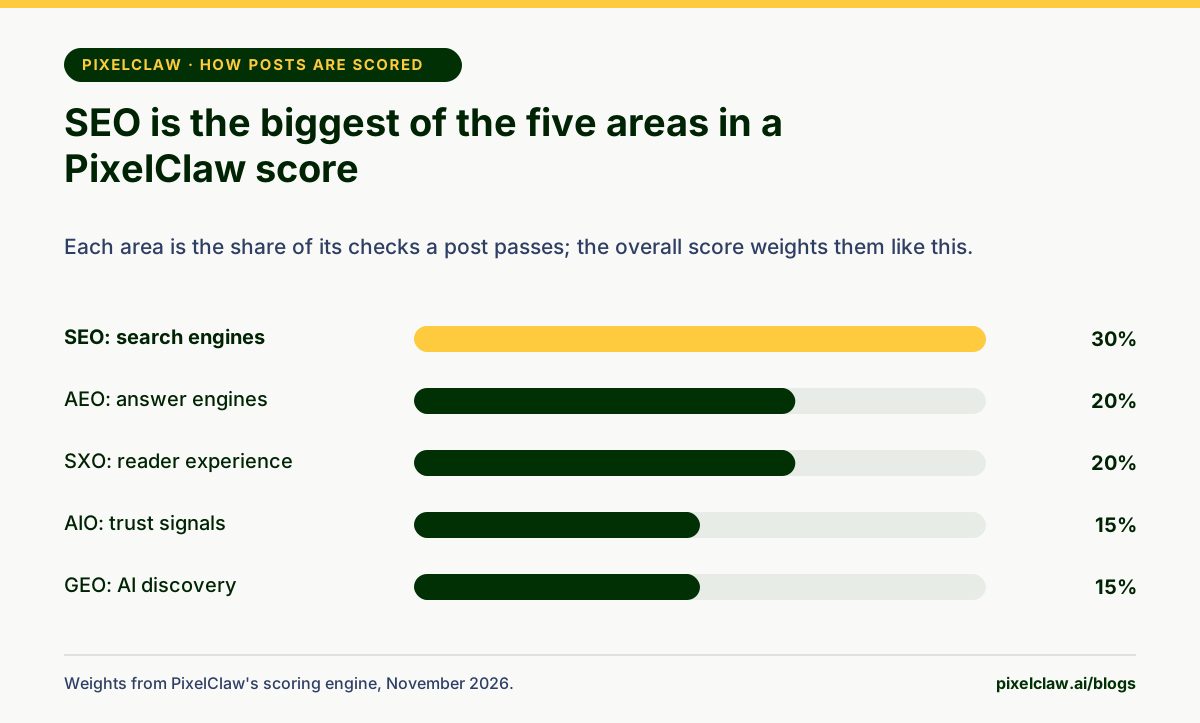
PixelClaw brings Search Console's data into each post and lists the posts losing readers, which turns this from a spreadsheet chore into a weekly ten-minute check.
SEO blog mistakes that cost the most traffic
Some mistakes cost a little; these cost a lot, and they are common on blogs that publish often.
Writing two posts for the same search is the expensive one. They split clicks and links, and Google may rank neither well. Before writing, search your own blog for the question; if a post exists, improve it instead.
Chasing volume over intent is next. A keyword with 20,000 monthly searches and a mismatched intent sends visitors who leave in seconds. A question with 300 searches and a perfect match sends readers who stay and sometimes buy.
Then there is the slow page. A hero image of four megabytes, three chat widgets and a cookie banner that covers half the screen can undo good writing. Measure the page on a phone, not your office connection.
The quiet one is never updating. A guide titled for last year, with prices from two years ago, loses to a fresher rival even if it was better when published. Put a review date in your calendar for every post that brings real traffic, and keep the date on the page honest.
- Every SEO blog post starts with one question a real person searches, not a broad topic.
- Put the keyword near the start of a title of 60 characters or fewer, in the opening paragraph and in one H2.
- Plan length from the articles already ranking, not from a word count you read somewhere.
- Link every post to two to five related ones so Google and readers can follow the cluster.
- Publishing is the start: watch Search Console and refresh the posts that slip.
Frequently Asked Questions
How often should I publish SEO blogs?+
Consistency beats volume. One to three well-researched posts a week is enough for most businesses to build topical coverage, and it leaves time to update older posts, which often brings more traffic than new ones.
Do SEO blogs still work now that AI Overviews answer questions directly?+
Yes, but the bar is higher. AI Overviews and chat answers draw on pages that answer clearly and cite sources, so the same habits that win blue links now also win mentions inside AI answers.
What keyword should a brand-new blog target first?+
Specific questions with clear intent and modest competition, usually three to six words long. A new blog will not outrank established sites for the broad term, but it can win the narrow questions around it and build from there.
Should every blog post target a keyword?+
Most should. A post with no search behind it can still be valuable for customers or news, but it will not bring search traffic, so be deliberate about which posts are for search and which are for your existing audience.
How long does it take for an SEO blog post to rank?+
Usually weeks to months. Google first has to crawl and index the page, then test it against existing results. A sitemap, internal links from posts that already get traffic and an IndexNow ping on publish help the first part along.
Sources
- Search Engine Optimization (SEO) Starter Guide — Google Search Central
- Influencing your title links in search results — Google Search Central
- Control your snippets in search results — Google Search Central
- Web Vitals — web.dev (Google)
Built & scored using PixelClaw.ai
More from this blog
Continue exploring autoblogging architecture, AI blog writing, and SEO / AEO / GEO playbooks.

SEO for Startups: A 90-Day Plan for Founders With No Marketing Team
You will not outrank the giants on their own keywords this year. You can own the specific questions your buyers search before they buy, and that is where startup SEO starts paying.
PixelClaw Editorial Team
Product and search team
AEO Blogs: How to Write Posts That Answer Engines Quote Word for Word
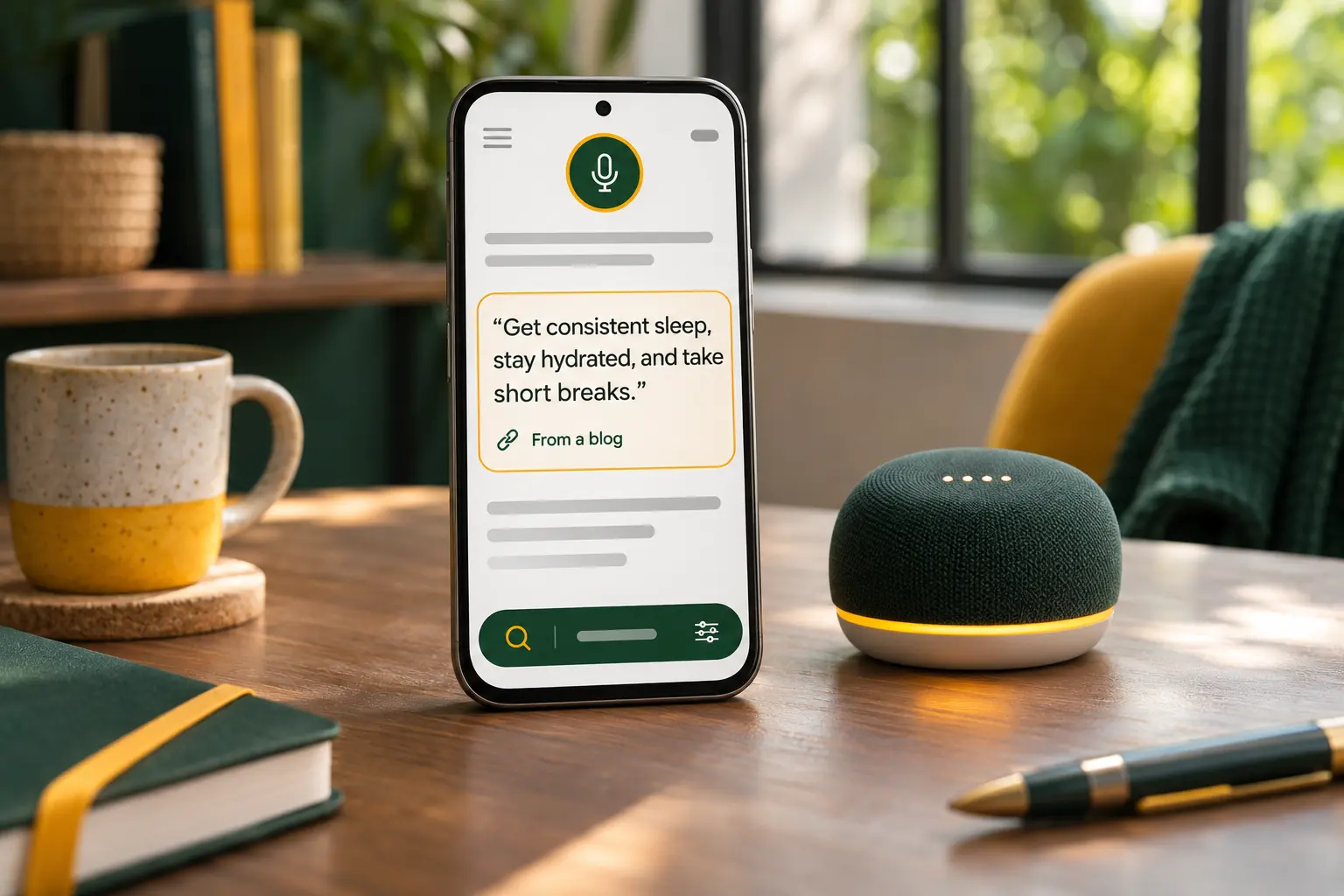
Answer engine optimization for bloggers: how to write the 40-to-60-word answer that featured snippets, voice assistants and AI chats lift straight into their replies.
PixelClaw Editorial Team
Product and search team
GEO Blogs: How to Get Your Posts Cited by ChatGPT, Perplexity and Gemini
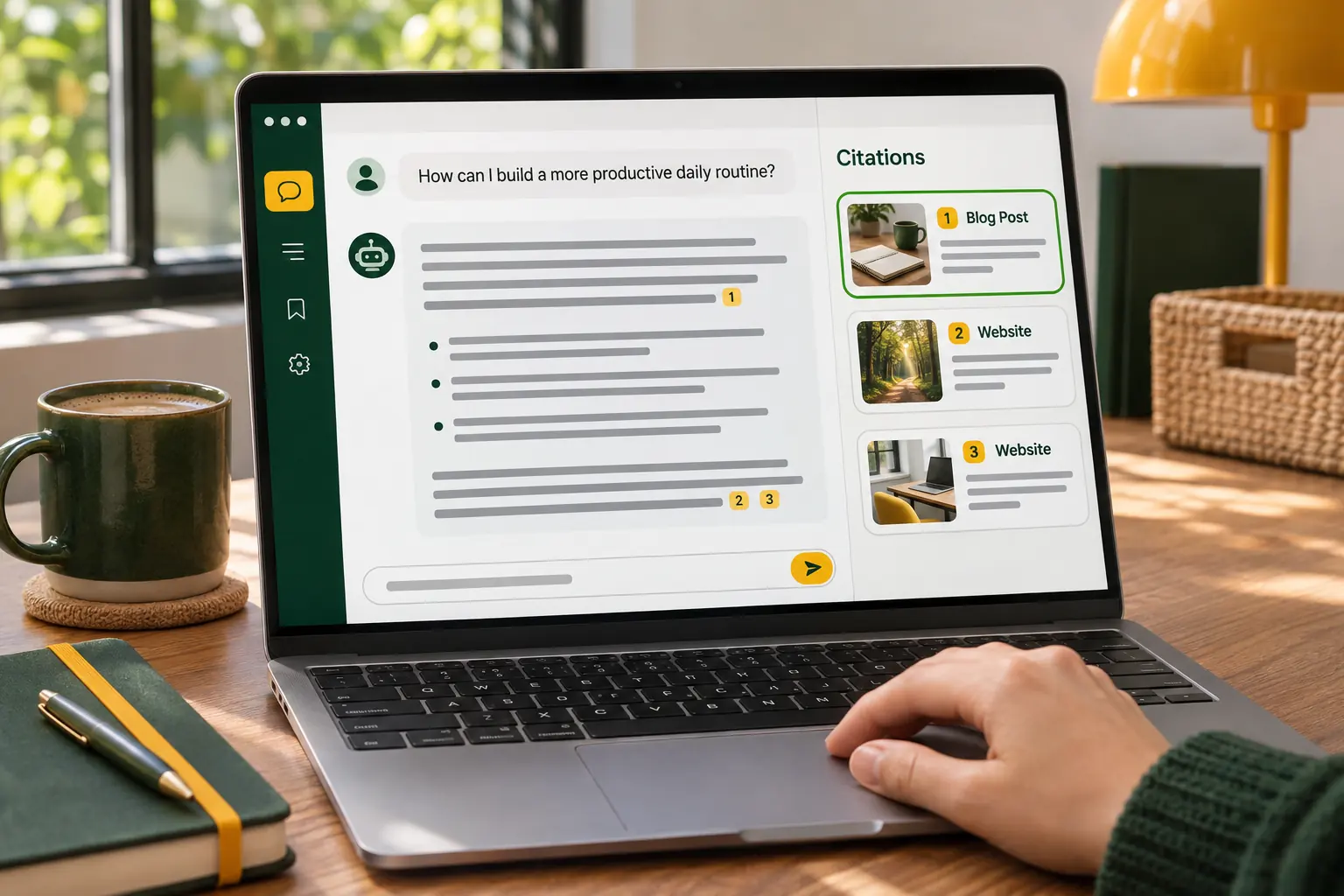
Generative engine optimization for blogs: let the AI crawlers in, give them a map, and write passages specific enough that an AI answer quotes them with your name attached.
PixelClaw Editorial Team
Product and search team