SEO for startups
Growth guideSEO for Startups: A 90-Day Plan for Founders With No Marketing Team
You will not outrank the giants on their own keywords this year. You can own the specific questions your buyers search before they buy, and that is where startup SEO starts paying.

On this page▸
SEO for startups means ranking for the specific questions your buyers search before they buy, not for the broad terms big competitors own. Pick 20 high-intent questions, answer each in a researched post, link the posts together and publish every week. PixelClaw automates the research, writing, scoring and publishing so a founder can keep it going.
Why SEO for startups is different from SEO for big brands
A startup starts SEO with three handicaps: a young domain with few links, no marketing team, and a founder whose week is already full. Copying the playbook of a large brand, with its pillar pages for every broad keyword and a link-building budget, ends in a dozen posts nobody finds.
It also starts with three advantages. You know your customer's problem in more detail than any content agency. You can publish on a narrow question tomorrow without a committee. And the questions your buyers ask are often too specific for big sites to bother with. A good SEO strategy for startups turns those advantages into rankings before trying anything broad.
Google's own SEO Starter Guide puts it plainly: make content that people find useful, help Google find and understand it, and be patient. The rest of this guide is how to do that with a few hours a week.
Keyword research for startups: choose high-intent keywords first
Search volume tells you how many people type a phrase. Intent tells you why. For a startup with limited time, intent matters more, because a post read by forty people who are comparing tools today can bring more signups than one read by four thousand students.
Find the questions in places you already have: the queries in Search Console, Google's autocomplete suggestions, your sales calls and support tickets, and the topics your competitors rank for. Write them down in the words customers use, not the words your product team uses.
PixelClaw's Keywords tab does the collecting for you. It finds keywords from Google suggestions and your Search Console data, tracks where your posts rank, compares your keywords with your competitors' and, on paid plans or with your own DataForSEO login, adds monthly search numbers so you can rank the list.
SEO for SaaS startups adds two keyword types worth prioritising early: integrations and templates. People search for your category plus the tool they already use, or for a template of the job your product does, when they are close to trying something. A page that shows exactly how your product works with the tool the buyer already pays for is often the best-converting page a SaaS blog has.
| Keyword type | Example for a scheduling startup | Why it matters |
|---|---|---|
| Alternatives and comparisons | calendly alternatives for teams | The reader is choosing a tool this week |
| Problem and how-to | how to stop meeting no-shows | Shows your expertise where the pain starts |
| Use case | scheduling software for clinics | Matches a buyer to a segment you serve |
| Pricing and cost | cost of a booking tool for a small team | Close to a decision |
| Broad category | scheduling software | Valuable later, once you have authority |
The technical SEO basics a startup cannot skip
Technical SEO for a blog is mostly about not getting in Google's way. How Google Search works describes three stages: crawling, indexing and serving. Each post has to be reachable by links, allowed by robots.txt, listed in a sitemap, fast on a phone and clear about what it is.
On a hosted PixelClaw blog these are set up when you create the blog: a sitemap.xml that lists every published post, a robots.txt that lets search engines and AI crawlers in, an llms.txt for AI assistants, and structured data for articles, FAQs, breadcrumbs and your organization. Paid plans add a custom domain and IndexNow pings for Bing and the other engines that take them.
Inside each post, SEO carries 30% of the PixelClaw score. Its checks cover a title and meta description that fit search results, a clean URL, one H1 and an orderly heading outline, a canonical address, share-card tags, structured data and links to related posts. When the post has a target keyword, they also look for it in the title, the opening and a heading, and compare the length with the pages that rank.
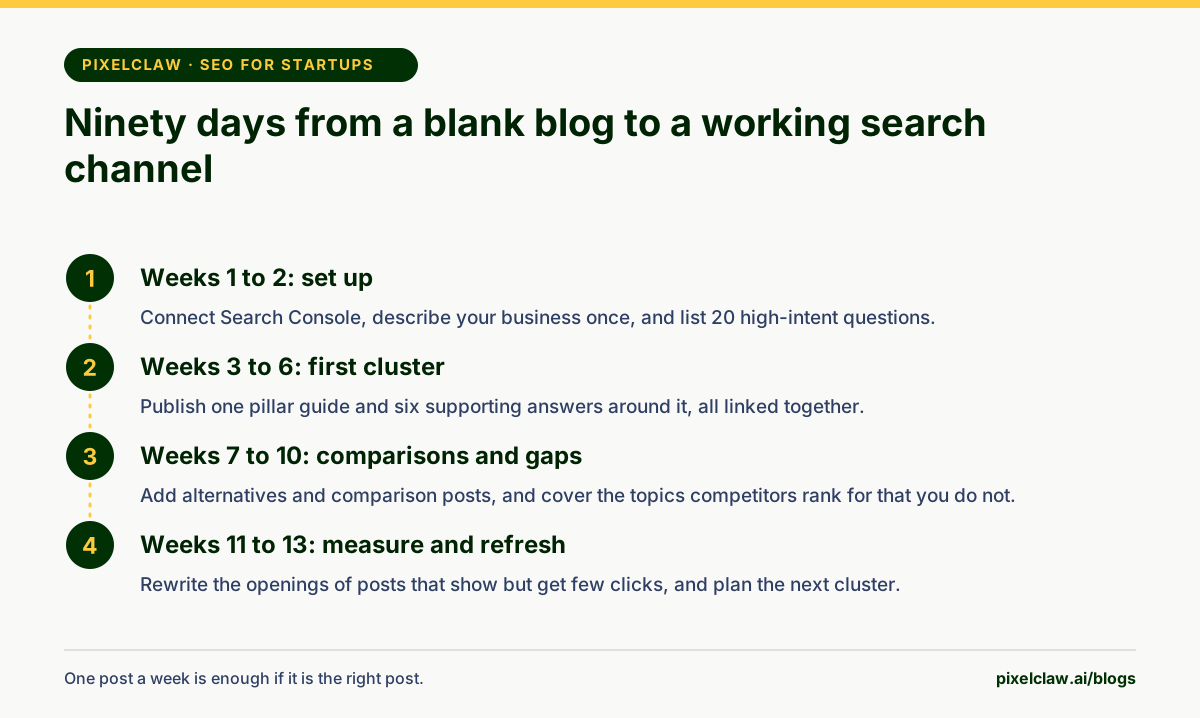
A 90-day SEO strategy for startups
The plan assumes a few hours a week. Each phase feeds the next, so you are never starting from zero.
Write posts that rank and get quoted in AI answers
A post that ranks in 2026 also has to work for the answer box and the AI chat. Put the answer to the title's question in the first 40 to 60 words, write headings as the questions people ask, cite sources for every claim, and link each post to the others in its cluster.
Those habits have names. Answering first is AEO. Being cited by ChatGPT and Perplexity is GEO. Showing the trust signals AI Overviews look for is AIO. Turning the visit into a signup is SXO. If you want the writing checklist for a single post, the guide to SEO blogs walks through it.
How PixelClaw runs startup SEO on autopilot
The bottleneck in startup SEO is rarely knowing what to do. It is finding four hours a week to do it. PixelClaw takes the repeatable parts: it reads the pages that rank for each keyword, collects the questions readers ask, plans the length from what ranks, writes a sourced draft and scores it before you see it.
Put your keyword list in the queue and Autopilot works through it at your plan's pace. Each draft is scored out of 100 from 21 checks; most failing checks come with a one-click fix, and anything under 60 is held back. Posts wait for your approval unless you switch on automatic publishing, which only publishes posts scoring 77 or more.
On paid plans, God Mode builds the whole cluster for you: describe the business and PixelClaw researches the topic, plans a pillar guide with its supporting articles and queues the ones you have not written. It is the closest thing to hiring an SEO lead for the price of a tool, and the full playbook is in our organic growth strategy guide.
SEO metrics that matter in the first 90 days
The Performance report in Search Console shows four numbers for every query and page: impressions, clicks, click-through rate and average position. In the first month, impressions are the win, because they prove the posts are indexed and shown.
From the second month, watch which queries bring impressions you did not plan for. They are your next posts. By the third, look at click-through rate on posts in positions one to five; a low rate usually means the title or opening does not answer the query, which is the cheapest fix in SEO. Track signups that start on the blog from the beginning, even when the numbers are small.
Startup SEO mistakes that waste the first year
Chasing the category keyword in month one is the classic. So is a blog full of product announcements that answer nobody's question. Both feel productive and bring almost no search traffic.
Buying links or publishing hundreds of near-identical pages is worse, because Google's spam policies treat both as manipulation. Waiting for the perfect website before publishing anything is the quiet mistake: every week without posts is a week of compounding you do not get back. If you are still deciding whether a blog is worth the effort, read is blogging still worth it first.
The last one is forgetting internal links. Every new post should link to its pillar and to two related posts, and the pillar should link back, or crawlers and readers miss half of your work.
- Startups win SEO on specificity: narrow, high-intent questions that big sites answer badly or not at all.
- Choose keywords by buyer intent first and search volume second; ten readers who are ready to buy beat a thousand who are browsing.
- Get the technical basics right once, so every post is crawlable, indexable and fast, then spend your time on content.
- Publish in clusters: one pillar guide and the supporting posts around it, all linked to each other.
- Measure impressions and queries in the first 90 days, and signups after that; SEO rewards patience more than bursts.
Frequently Asked Questions
How much does SEO cost for a startup?+
The main cost is time: researching, writing and publishing posts every week. Agencies charge for that time; tools reduce it. PixelClaw has a free plan with a hosted blog, so a startup can publish its first researched posts before spending anything.
How long does SEO take for a new startup?+
New posts usually show up as impressions in Search Console within weeks, and steady clicks follow after a few months of consistent publishing. Specific long-tail questions rank sooner than broad terms, which is why the plan below starts there.
Should a startup do SEO before product-market fit?+
Do light SEO early. Writing about the problem you solve tests which questions people actually search, and the posts you publish while finding fit keep earning traffic once you have it. Save heavy comparison and pricing content for when your positioning has settled.
Is SEO still worth it now that AI answers questions directly?+
Yes. Google says its AI features draw on pages that are indexed and eligible to appear in search, and ChatGPT and Perplexity cite pages they can find and trust. SEO is the foundation that AEO, GEO and AIO build on.
Do startups need backlinks to rank?+
Links from relevant sites help, especially for competitive terms. Earn them with useful posts, original data, partner integrations and founder interviews. Buying links breaks Google's spam policies and can cost you the rankings you already have.
Sources
- Search Engine Optimization (SEO) Starter Guide — Google Search Central
- In-depth guide to how Google Search works — Google Search Central
- Performance report (Search Console Help) — Google
- Spam policies for Google web search — Google Search Central (Covers link spam and scaled content abuse.)
Built & scored using PixelClaw.ai
More from this blog
Continue exploring autoblogging architecture, AI blog writing, and SEO / AEO / GEO playbooks.

Organic Growth Strategy for Startups: Build Traffic That Keeps Growing While You Sleep
Ads rent attention and stop the day the budget does. An organic growth strategy builds a library of posts that rank in Google, get quoted by AI answers and keep sending buyers for years.
PixelClaw Editorial Team
Product and search team

AEO for Startups: How to Become the Answer Google, ChatGPT and Siri Give
Answer engine optimization explained for founders: what AEO means, why a startup can win it before it can win page one, and how to write the answer that gets picked.
PixelClaw Editorial Team
Product and search team

GEO for Startups: What Generative Engine Optimization Means and How to Get ChatGPT to Recommend You
Buyers now ask an AI assistant which tool to use before they ever see a search result. Here is what GEO means, why it matters to startups, founders, bloggers and copywriters, and how to become the name the answer includes.
PixelClaw Editorial Team
Product and search team