Content at scale
PixelClaw toolsAI Content at Scale: Publishing More Without Being Flagged for Scaled Content Abuse
How to run AI content at scale across several blogs and a team without tripping Google's scaled content abuse policy: pace, quality bars, roles, APIs and the numbers that matter.

On this page▸
AI content at scale means producing many useful articles with AI without each one needing a writer's full time. Done safely, it pairs volume with limits: a weekly pace per site, a quality bar every piece must clear, people reviewing samples, and topics chosen for readers rather than for ranking alone.
What Google says about AI content at scale
In March 2024 Google added scaled content abuse to its spam policies: generating many pages for the primary purpose of manipulating search rankings and not helping users. The policy says this applies however the content is made, by automation, people or a mix.
Two parts of that definition matter. "Many pages" is about volume, and "primarily to manipulate rankings" is about intent. Volume alone is not the problem; news sites publish hundreds of articles a day. Volume with no reader value is. Google's announcement gave examples such as pages that pretend to answer popular searches but fail to deliver helpful content.
So the question for anyone producing AI content at scale is simple: would these pages be worth publishing if search engines did not exist?
Scale across blogs and topics, not up on one
The safest way to scale is sideways. Rather than pushing one blog to dozens of posts a day, cover more topics well, and run separate blogs for separate audiences or clients. Each blog keeps a pace a reader and a search engine can take seriously.
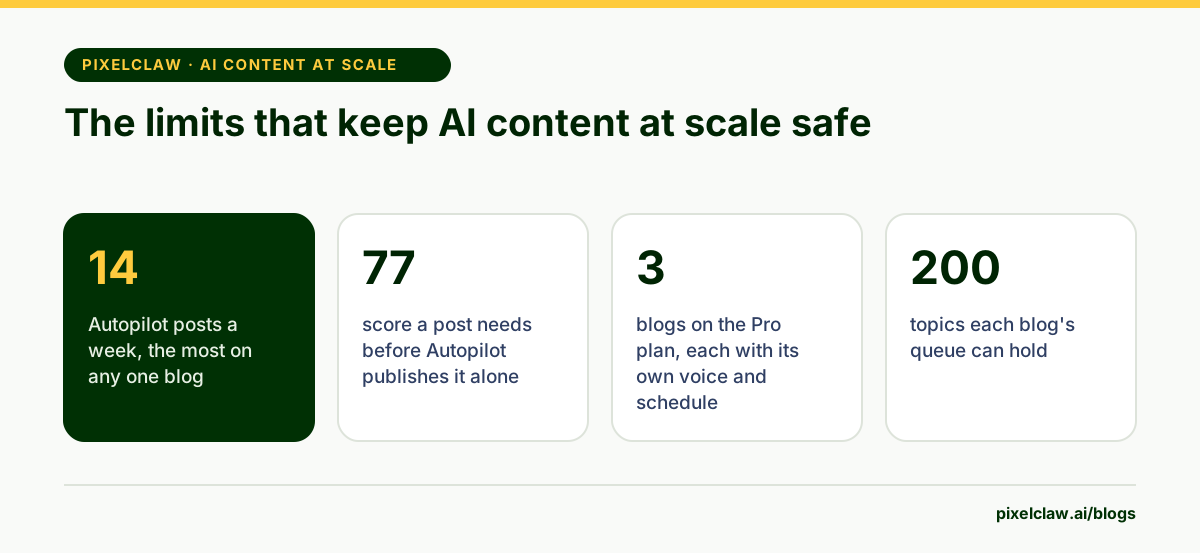
PixelClaw builds this in. Each plan sets how many posts Autopilot may publish per blog each week: one on Free, two on Starter and seven on Pro, rising to 14 on any plan while you have bought credits. No blog goes past 14. Pro covers three blogs under one account, each with its own Autopilot, queue, brand voice and business profile, sharing the account's credits.
Quality bars matter more at volume
At one post a week, an editor reads everything. At thirty posts a week across several blogs, nobody does. That is exactly when an automatic quality bar earns its keep.
Every PixelClaw post is scored out of 100 across SEO, AEO, AIO, GEO and SXO before it can go live. In Autopilot's publish mode, only posts scoring 77 or more that pass every publication check go out on their own; the rest wait in Needs review with the reasons listed. Combine that with a person reading a random sample each week and you get a quality floor that holds as volume grows.
Teams, roles and an activity log
Scale usually means more than one person. Invite teammates to each blog and choose what each can do: editors can add topics and edit posts, while only owners and admins can switch Autopilot on, change billing or publish a post that has not passed the publish check.
Sensitive actions, such as publishing a post below the publish bar, are recorded with who did them. When a dozen people touch a content operation, that log is how you find out what happened to a post without asking around. Starter includes three team members and Pro ten, counted once across all the account's blogs.
API, webhooks and MCP for bigger operations
Larger teams eventually want content to flow into their own systems. On plans with API access, PixelClaw's REST API, described in an OpenAPI document, lets your tools create and update posts, read media and categories, and start AI research, outlines and drafts. Signed webhooks tell your systems when posts are published or changed.
The MCP server goes a step further. AI assistants that speak the Model Context Protocol, such as Claude, can connect with an API key and read and write posts or start AI work through twelve tools. Every call counts against the key's API allowance, and nothing over MCP can delete content.
An operating rhythm for AI content at scale
The teams that scale AI content without trouble share a weekly rhythm. On one day they plan: new topic clusters, refreshed keyword lists, questions from customers. Every day the queue runs at its set pace. On another day they review: a sample of published posts per blog, everything held for review, and the posts losing readers in Search Console.
Monthly, they look at whole clusters rather than single posts, and decide where to add, merge or prune. That rhythm, more than any tool, is what keeps scaled content on the right side of both readers and search engines. For the mechanics of producing the volume, read the bulk article generator guide.
- Google's scaled content abuse policy targets many pages made mainly to manipulate rankings, however they were made.
- Scale across topics and blogs, not by flooding one blog: PixelClaw caps Autopilot at 14 posts a week per blog.
- A quality bar every piece must clear matters more at scale, because nobody reads everything.
- Roles, an activity log and approval steps keep a team's output consistent.
- The REST API, webhooks and MCP server let larger teams build their own workflows on top.
Frequently Asked Questions
Is publishing AI content at scale against Google's rules?+
Not in itself. Google's policy targets content produced at scale mainly to manipulate rankings, with little value for readers, whether by AI, people or both. Useful content at a sensible pace is fine; bulk pages made to catch searches are not.
How many posts a week is too many?+
There is no published number. It depends on the site and the content. PixelClaw's Autopilot stops at 14 posts a week per blog, because a business blog publishing several times a day reads as content made to rank.
How do agencies run AI content for several clients?+
One account with a blog per client keeps voices, profiles and schedules separate while sharing credits. Pro covers three blogs; larger setups are agreed one to one on Enterprise.
Can I connect my own tools to produce content at scale?+
Yes, on plans with API access. The REST API and signed webhooks let your systems create posts and start AI work, and the MCP server lets AI assistants such as Claude do the same with an API key.
Sources
- Spam policies for Google web search: scaled content abuse — Google Search Central
- What web creators should know about our March 2024 core update and new spam policies — Google Search Central Blog
- Model Context Protocol — Model Context Protocol
Built & scored using PixelClaw.ai
More from this blog
Continue exploring autoblogging architecture, AI blog writing, and SEO / AEO / GEO playbooks.

Autoblogging in 2026: How to Run a Blog That Publishes Itself and Still Ranks
What autoblogging looks like when it works: a topic queue, research before writing, a score that holds weak drafts back, and a pace Google reads as a publication rather than a content farm.
PixelClaw Editorial Team
Product and search team

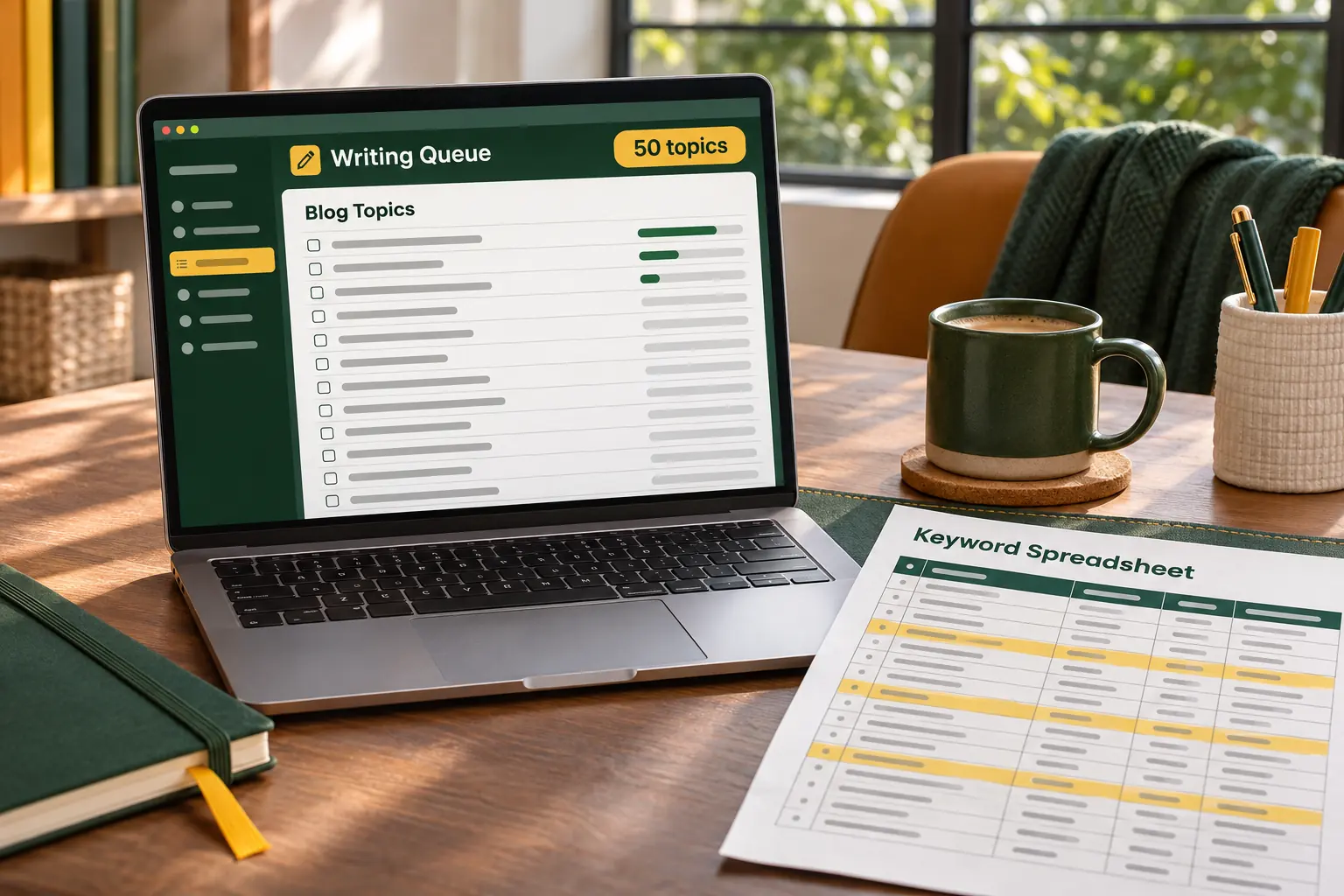
Bulk Article Generator: Queue 50 Topics at Once, Publish on a Safe Schedule
How PixelClaw turns a list of topics into researched, scored articles, why it releases them at a weekly pace instead of all at once, and what bulk generation costs.
PixelClaw Editorial Team
Product and search team
The Best AI Writer for Bulk Blog Posts, Without Tripping Google's Spam Rules
Bulk blog posts are easy to generate and easy to get wrong. Six AI writers compared on batch size, publishing pace, quality checks and price, plus the habits that keep bulk publishing safe.
PixelClaw Editorial Team
Product and search team