Autoblogging Fundamentals
Search & Content OperationsWhat Is Autoblogging? How Modern AI Autoblogging Works Without Publishing Slop
Autoblogging explained for founders and marketing teams: how modern research-first pipelines differ from old RSS scrapers, and what it takes to earn rankings and AI citations.
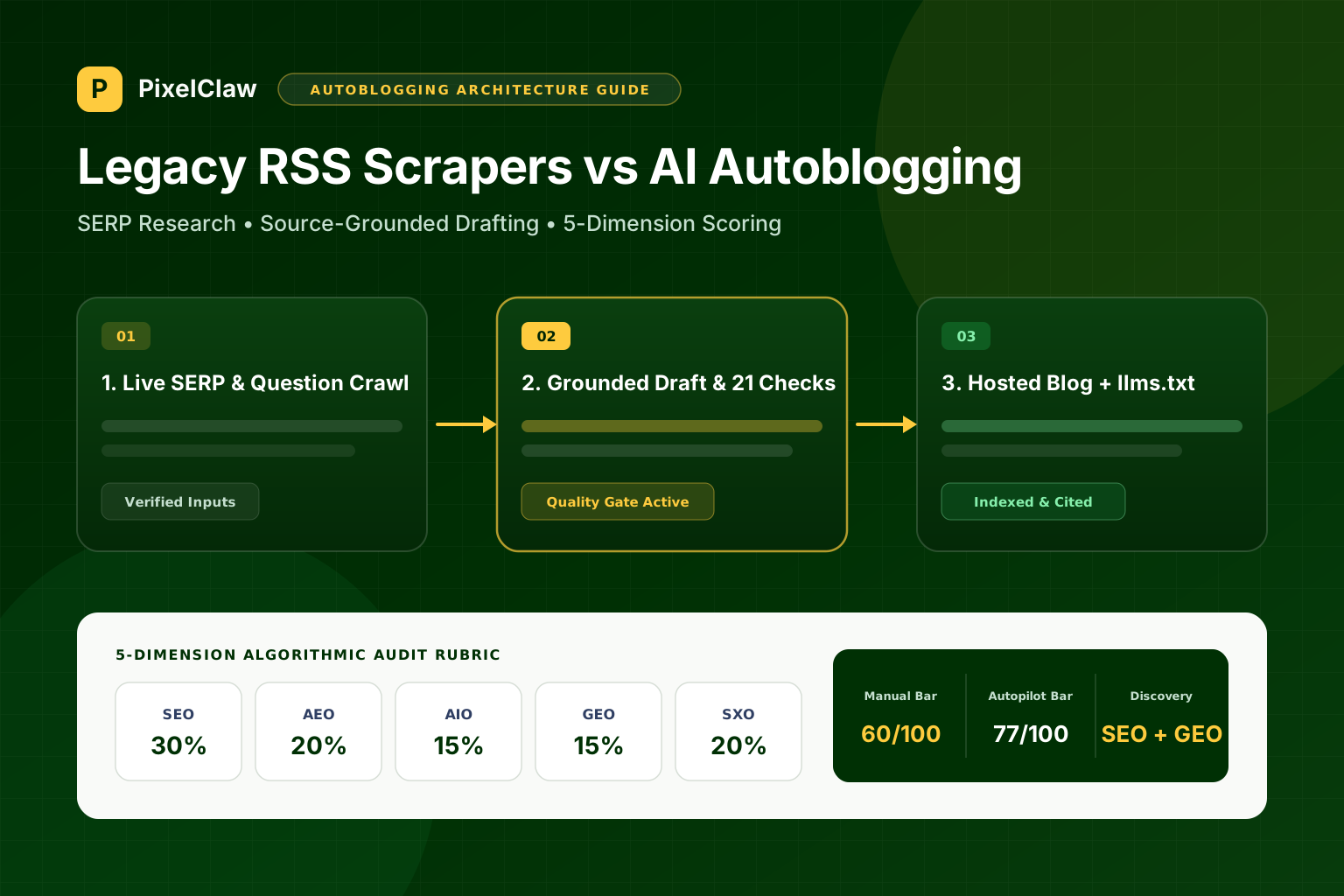
On this page▸
Autoblogging is an automated publishing workflow that researches search intent, builds structured outlines, writes source-grounded articles, and publishes them on a set schedule. Unlike legacy RSS scrapers that copied third-party feeds, modern AI autoblogging platforms enforce algorithmic quality gates before any post goes live on your domain.
What is autoblogging, and why did the old version fail?
The term autoblogging carries two very different meanings depending on when you first encountered it. Between 2010 and 2020, autoblogging meant installing a WordPress RSS aggregator plugin that pulled articles from other websites, ran the paragraphs through a synonym spinner, and reposted the mangled text to capture ad clicks.
Search engines rightly crushed that model. Duplicate text, broken grammar, and zero original reporting made RSS scraper sites easy targets for Google Panda and Subsequent Core Updates.
In 2026, what is autoblogging looks completely different. Modern AI autoblogging is an engineering workflow that automates the mechanical bottlenecks of content production—live SERP research, reader question clustering, structural outlining, schema generation, and CMS formatting—while grounding every claim in verifiable web sources.
Instead of copying someone else's post, a research-first automated blogging platform reads the top-ranking pages and the questions real buyers ask, combines them with your business profile and product facts, and writes an original guide designed to resolve the query.
- Generation 1 (2010–2020): RSS feed scraping and word-level synonym spinning that produced unreadable duplicate pages.
- Generation 2 (2022–2024): Single-prompt LLM wrappers that generated fluent but hallucinated essays with fake statistics and dead URLs.
- Generation 3 (2025–2026): Agentic AI autoblogging workflow with live Firecrawl SERP ingestion, source attribution, and deterministic 5-dimension quality gates.
How does a modern AI autoblogging workflow operate?
Treat an article like a software release. You would not deploy untested code straight to production without linting, typechecks, and integration tests. Publishing content to your domain deserves the same operational discipline.
In PixelClaw, every article moves through five sequential stages whether you guide it manually in the writing studio or run it unattended in Autopilot.
- Stage 1 — Live SERP and Question Research: The engine crawls current ranking pages for your target keyword and collects the exact follow-up questions readers ask before writing a word.
- Stage 2 — Structured Outline Synthesis: It plans a 40-to-60-word direct opening answer, logical H2 and H3 question headings, a Key Takeaways summary, a comparison table, and an FAQ module.
- Stage 3 — Source-Grounded Drafting: The writer drafts in your configured brand voice using only verified evidence from the research packet and your workspace knowledge store.
- Stage 4 — 5-Dimension Quality Gate Scoring: The deterministic scoring engine audits 21 core checks (plus up to 6 keyword and question checks) across SEO, AEO, AIO, GEO, and SXO.
- Stage 5 — Publication and Crawler Notification: Passing posts publish to your hosted blog or headless webhook, updating sitemap.xml, feed.xml, and llms.txt while telling Google through the sitemap and Bing through IndexNow.
Legacy RSS autoblogging vs prompt wrappers vs scored autoblogging
When evaluating how automated publishing affects your domain reputation, compare the underlying mechanics across the three generations of tools:
| Workflow Dimension | Legacy RSS Scrapers | Raw Prompt Wrappers | PixelClaw Scored Autoblogging |
|---|---|---|---|
| Information Source | Copied RSS feeds | Unverified LLM memory | Live SERP crawl + workspace evidence |
| Factual Accuracy | Duplicate content risk | Frequent hallucinated stats | Source-grounded claims with URLs |
| Quality Enforcement | None | None (publishes anything) | 60 manual bar / 77 Autopilot bar |
| Answer Engine Format | Wall of text | Generic 5-paragraph essay | 40–60 word opening answer + tables + FAQs |
| Technical Hosting | Requires external CMS | Manual copy-paste or plugin | Built-in hosted blog + custom domain + API |
| AI Crawler Discovery | No machine feeds | Rarely configured | Automatic sitemap.xml, robots.txt & llms.txt |
Why do quality gates matter before a post goes live?
The fastest way to ruin a domain is to let an automated script publish thin, unverified drafts while you sleep. Without an objective quality gate, a bad prompt or a sparse topic can push an incomplete article straight into Google's index.
PixelClaw prevents that failure mode with deterministic quality gate scoring. Every post receives a composite score out of 100 weighted across Search Engine Optimization (30%), Answer Engine Optimization (20%), Search Experience and Flow (20%), AI Trust and Attribution (15%), and Generative Engine Optimization (15%).
If a draft forgets to include a 40-to-60-word direct opening answer, skips image dimensions, or lacks external citations, the score drops and the failing check points directly to the block that needs work. One-click fixes suggest targeted repairs for you to review.
When should you use the writing studio versus Autopilot?
Not every article on your site should be written the same way. High-stakes product launches, original customer case studies, and opinionated founder essays benefit from hands-on guidance in the writing studio, where you can reorder the outline, inject first-hand screenshots, and refine specific arguments before drafting.
Autopilot shines when you have a validated backlog of 20 to 100 buyer questions, integration tutorials, or glossary comparisons. You load the topic queue, select your preferred model (using included plan credits or your own API key from Anthropic, OpenAI, Google Gemini, or OpenRouter), and set a weekly schedule.
By default, Autopilot leaves finished drafts in your review queue so an editor can sign off in a few minutes. Once you trust your brand voice and evidence setup, turning on automatic publishing lets posts that clear the 77/100 Autopilot bar and pass all publication checks go live on schedule.
How do hosted blogs and headless APIs handle search discovery?
Writing a strong article is only half the job; search crawlers and AI assistants still have to fetch, parse, and index it cleanly. Every PixelClaw workspace includes a hosted blog that serves clean server-rendered HTML, automatic BlogPosting and FAQPage JSON-LD, responsive layouts, and native translations.
If your engineering team runs a custom Next.js, Astro, or Shopify storefront, you can connect a custom subdomain like blog.yourdomain.com in minutes, or pull structured blocks headlessly over the REST API and HMAC-SHA256 signed webhooks. Either way, your sitemap.xml and llms.txt stay synchronized automatically.
- First-generation autoblogging failed because it scraped RSS feeds and spun existing articles without adding original value or verified sources.
- Modern AI autoblogging separates research, outlining, drafting, and quality scoring into distinct pipeline stages with measurable thresholds.
- A two-tier publish bar protects domain equity: drafts below 60 out of 100 stay in review, while unattended Autopilot scheduling requires 77 or higher.
- Every published post needs technical discovery infrastructure alongside prose: Schema.org JSON-LD, XML sitemaps, IndexNow pings, and an llms.txt index.
- Sustainable velocity beats bulk dumping: publishing up to 7 or 14 verified articles per week compounds topical authority without triggering spam filters.
Frequently Asked Questions
What is the difference between autoblogging and an AI writing prompt?+
A single AI writing prompt generates unverified text from model memory without checking live search results, formatting metadata, or hosting the page. An automated blogging platform manages the entire lifecycle: live SERP research, question extraction, outline synthesis, source-grounded drafting, 5-dimension quality scoring, and publication to a hosted blog or headless API.
Is autoblogging legal and compliant with search engine guidelines?+
Yes, when the platform generates original prose grounded in cited sources rather than scraping copyrighted articles verbatim. Both Google and Bing permit AI-assisted publishing when articles answer real user questions accurately and avoid scaled spam.
How many articles per week should an autoblogging schedule publish?+
A steady cadence of 3 to 7 high-scoring posts per week builds reliable crawl frequency for most business domains. On PixelClaw, Autopilot writes up to 7 posts per week on standard plans, or up to 14 per week with purchased credits, preventing sudden index bloat.
Do I need a WordPress site to start autoblogging?+
No. While older plugins required self-hosted WordPress maintenance, PixelClaw provisions a hosted blog address immediately with built-in SSL, sitemap.xml, robots.txt, and llms.txt, and supports custom domains or headless REST API delivery.
Can I review automated blog posts before they go live?+
Yes. Finished Autopilot drafts wait for human approval by default. Even when automatic publishing is enabled, any post that scores below 77 out of 100 or fails a publication check is held back in the review queue.
Sources
- Google Search Central: Creating Helpful, Reliable, People-First Content — Google Search Central (Explains how Google evaluates originality, source attribution, and reader utility regardless of how a draft is produced.)
- Google Search Central: Guidance on AI-Generated Content — Google Search Central (Clarifies that automation is permitted when used to produce helpful content rather than manipulate search rankings.)
- Bing Webmaster Guidelines: Content Quality and IndexNow — Microsoft Bing (Details Bing's indexing requirements, structured data parsing, and automated URL submission standards.)
Built & scored using PixelClaw.ai
More from this blog
Continue exploring autoblogging architecture, AI blog writing, and SEO / AEO / GEO playbooks.

Best Autoblogging Tools in 2026: Hosted, WordPress and Agent Options Compared
Autoblogging tools come in three shapes: a hosted blog that writes itself, a writer that auto-posts to your WordPress site, and an SEO agent that runs everything. Seven tools compared, with prices from each vendor's site.
PixelClaw Editorial Team
Product and search team
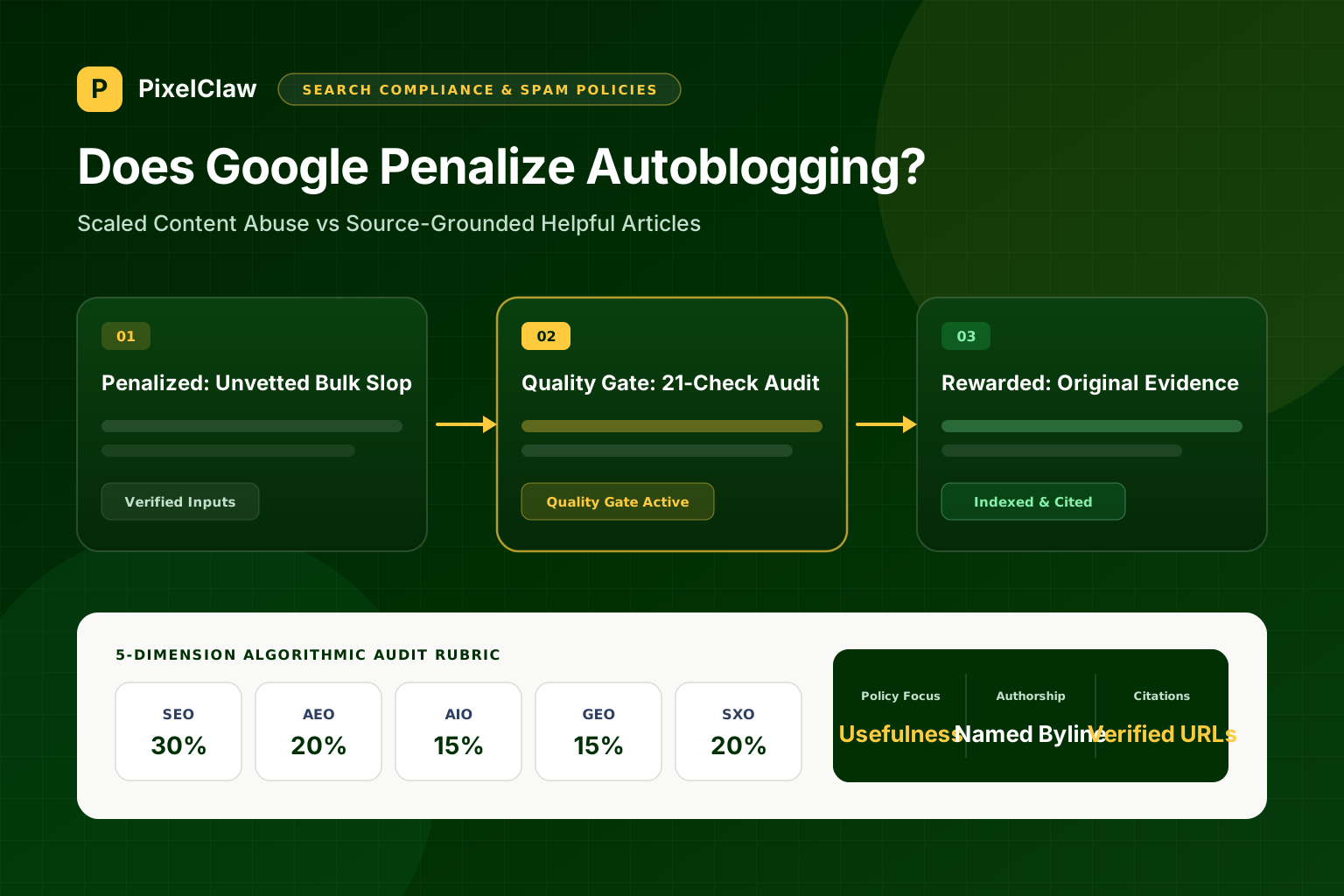
Does Google Penalize Autoblogging? What Search Spam Policies and Helpful Content Systems Actually Target
Separating SEO myth from Google Search Central documentation: why scaled content abuse penalties hit unvetted bulk sites, and how source-grounded autoblogging stays compliant.
Dr. Arthur Pendelton
Compliance & Editorial Director
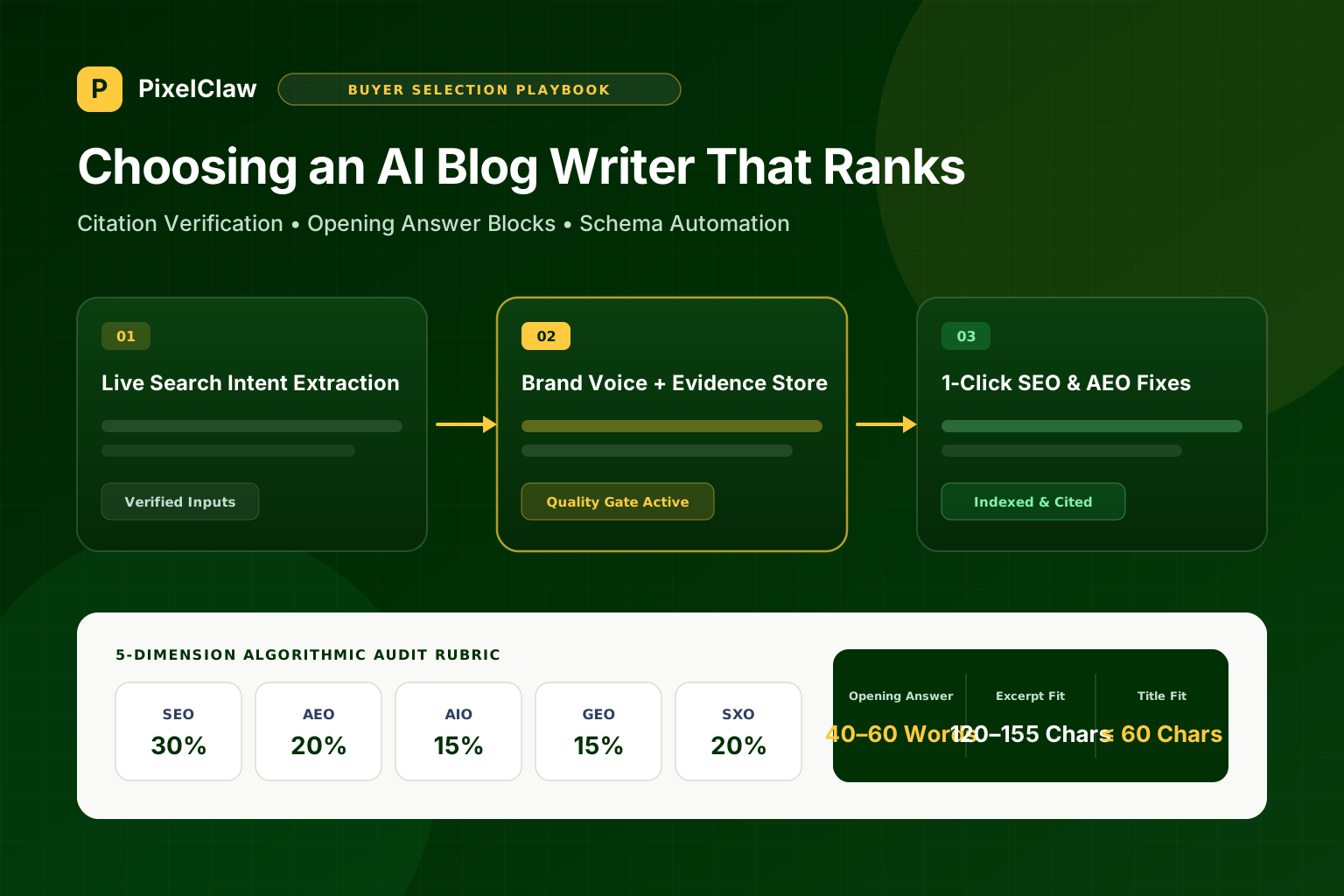
How to Choose an AI Blog Writer That Actually Ranks on Google, Bing, and AI Search
Most AI blog writers produce generic essays that stall on page four. Here is the exact technical checklist for selecting an AI blog writer engineered for search rankings and AI citations.
Sophia Lin
E-Commerce & Content Strategy Director