Autoblogging
AI search guideAutoblogging in 2026: How to Run a Blog That Publishes Itself and Still Ranks
What autoblogging looks like when it works: a topic queue, research before writing, a score that holds weak drafts back, and a pace Google reads as a publication rather than a content farm.

On this page▸
Autoblogging is the practice of letting software research, write and publish blog posts on a schedule. Done well in 2026, it means a queue of topics, posts grounded in sources, a quality score that holds weak drafts back, and a pace slow enough that Google reads the blog as a publication, not a content farm.
What autoblogging means in 2026
Ask ten marketers what autoblogging means and you get two very different answers. The older one is a WordPress plugin pulling other people's RSS feeds, running the text through a synonym spinner and reposting it for ad clicks. Google spent most of the 2010s burying those sites, and it was right to.
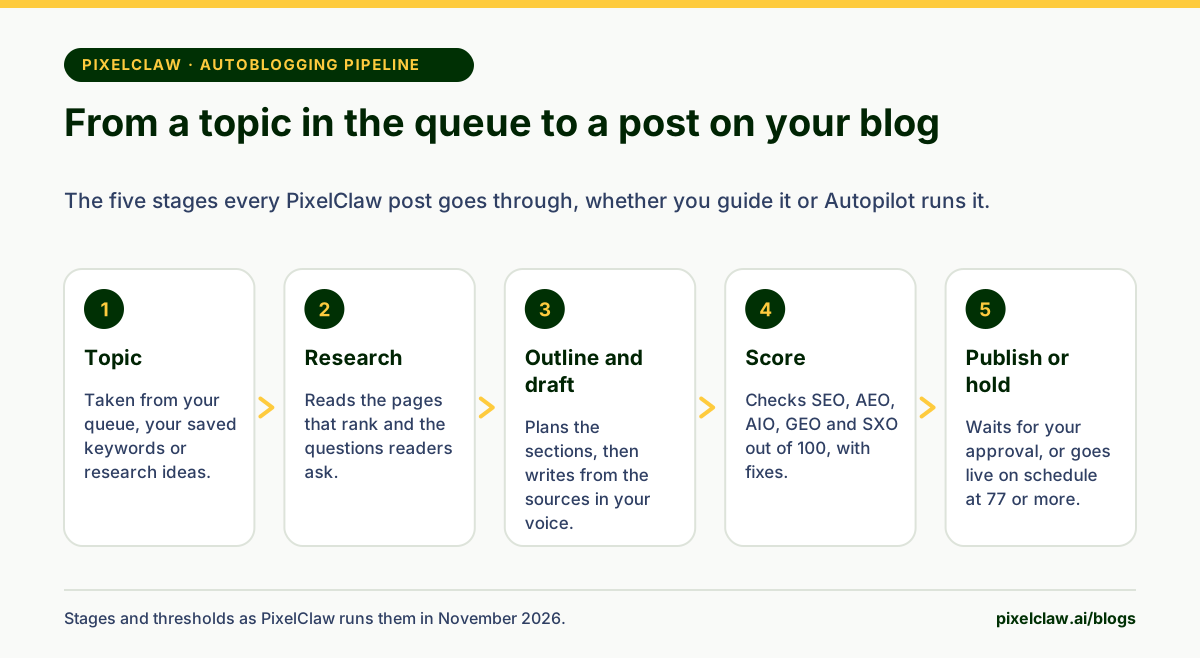
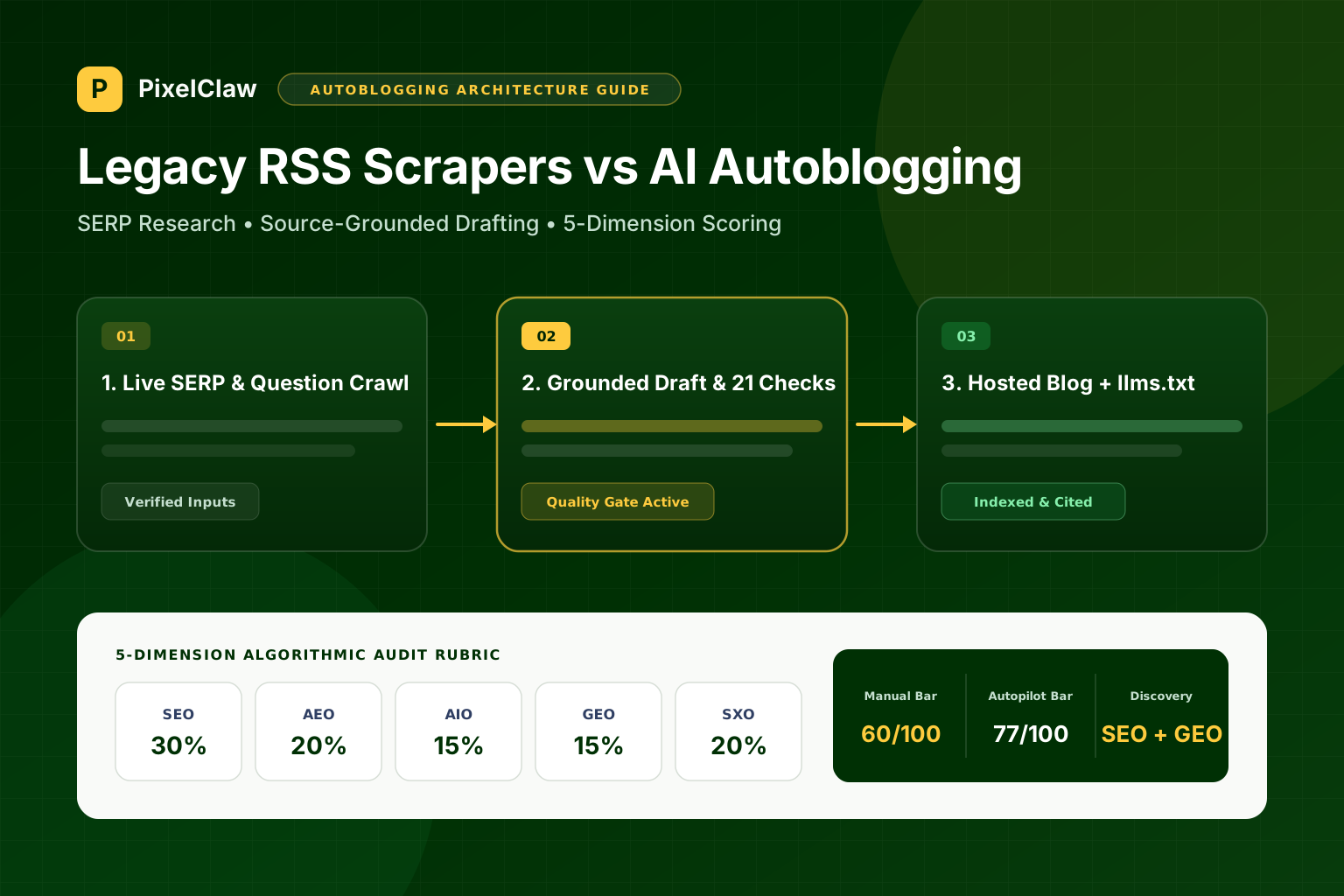
The newer meaning is a pipeline. Software picks the next topic from a queue, reads the pages that already rank for it, collects the questions readers ask, plans an outline, writes an original draft from those sources, checks the draft against a list of quality rules and only then publishes it. A person stays in the loop for as much or as little of that as they want.
That second version is what this guide covers, and it is what AI autoblogging tools sell today. The difference matters because Google's rules were written with the first version in mind. Its spam policies call out scaled content abuse: many pages generated mainly to manipulate rankings, whether a person, a script or a model produced them. A good autoblogging tool is built to stay on the right side of that line by default.
If you want the longer history, from RSS scrapers to prompt wrappers, read what autoblogging is and where it came from. The rest of this guide is about running one well.
How an autoblogging pipeline works, stage by stage
Every serious autoblogging software follows the same five stages, even when the marketing page hides them. Knowing them helps you judge any tool in ten minutes, because you can ask where each stage happens and who checks it.
Research comes first and decides most of the quality. A post that starts from the top results and the questions people type will cover what searchers expect. A post that starts from a model's memory will sound fluent and miss half of it.
The outline is where an editor's time goes furthest, and the cheapest place to fix a post. Moving a section or cutting a weak heading takes seconds before the draft exists and much longer after. In PixelClaw's writing studio you can rename, reorder, add or remove sections and leave notes for the writer before a word is drafted; Autopilot builds the outline itself.
Scoring is the stage most tools skip. PixelClaw rates every draft out of 100 across five areas (search engines, answer engines, trust signals, AI discovery and reader experience) and lists each check that failed with a one-click fix you review before it is applied.
Is autoblogging safe for SEO?
Google has been unusually clear about this. Its 2023 note on AI-generated content says appropriate use of automation is not against its guidelines, and that what it rewards is helpful content, however it was produced. The same note says that using automation mainly to manipulate rankings is spam.
So the question is not whether a machine wrote the post. It is whether the blog looks like a publication or like a pile of pages. The March 2024 update made that concrete: Google said it would act on scaled content abuse whether the pages came from automation, people or a mix.
In practice, the autoblogs that get hurt share the same habits. They publish hundreds of near-identical posts in a week, target keywords with no real question behind them, skip internal links, and never update anything. The ones that do well publish fewer posts, each answering a real question with sources, and link them into clusters a reader can follow.
- Publish at a pace a small editorial team could plausibly keep up.
- Give every post a question a real reader asks, and answer it in the first paragraph.
- Cite sources a reader can click, and name who stands behind the blog.
- Link each new post to two to five related ones so nothing is left orphaned.
- Review a sample of posts every week, even when automatic publishing is on.
How many posts a week should an autoblog publish?
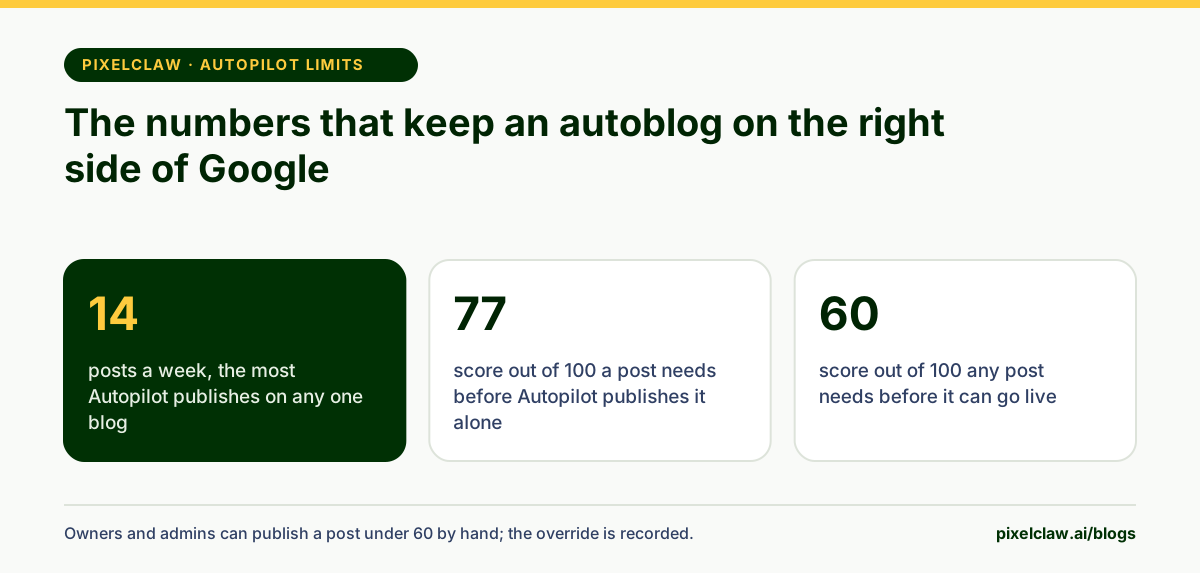
Fewer than most people expect. For a business blog, two to seven posts a week is plenty to build topical coverage in a few months, and it is a pace a reader, and a search engine, can take seriously.
PixelClaw builds that judgment into the product. Each plan sets how many posts Autopilot may publish on each blog per week: one on Free, two on Starter and seven on Pro. Buying extra credits lifts any blog to 14, and no blog ever goes past 14, whatever the plan. We chose that ceiling because Google's spam policies go after sites that publish lots of pages mainly to rank, and a business blog posting several times a day reads that way.
The ceiling covers Autopilot only. Posts you write and publish yourself, or send in through the API, are up to you.
What it costs to run an autoblog
There are three ways to pay for an autoblog, and the cheapest per post is rarely the cheapest per post you keep. The real cost includes the time you spend fixing drafts, and a tool that saves a dollar on writing can cost an hour on editing.
With PixelClaw a standard post's credits cover research, the outline, the draft with its polish pass, and the hero image. The Free plan includes 50 credits a month, enough for two complete posts. Starter at $49.99 a month includes 250 credits a month and Pro at $99.99 includes 1,000. Paid plans put no limit on the posts you keep: the credits decide how many you write, and bought credits add more. If you connect your own AI, research and image keys, that work uses no credits and you pay your providers directly.
| Approach | What you pay for | Where the hidden cost sits |
|---|---|---|
| Credits in a plan | A monthly allowance; each post uses a known amount | Running out mid-month if your pace is higher than the plan |
| Your own AI keys | Your provider bills, often cents per post | Managing keys and keeping an eye on provider limits |
| Per-article pricing | A fixed price per finished article | Paying the same for a weak draft as for a strong one |
Choosing an autoblogging tool: the questions that matter
Feature lists all look alike, so ask questions that separate the tools instead. Where does the blog live? Who checks a draft before it goes out? What happens when a post is weak? How fast can it publish, and can you slow it down?
The biggest fork is hosting. Plugin-style tools post into a WordPress, Shopify or Webflow site you already run, which is right if your blog must stay there. Hosted tools give you the blog as well, with nothing to install or patch. PixelClaw is the second kind: every plan gets a blog at its own address, with the sitemap, robots.txt, llms.txt and structured data handled for you, and paid plans can use your own domain. It does not post into WordPress, so if that is a hard requirement, pick a plugin tool.
We compare the main options side by side in the best autoblogging tools for 2026, with prices read from each vendor's own pricing page.
- Does it research the live search results before writing, or write from memory?
- Can you approve the outline before the draft is written?
- Does every draft get a score, and does a weak one stay unpublished?
- Can you cap the pace per week, and does it stop on its own when credits run out?
- Can you take your content with you through an API or export?
Setting up your first autoblog in an afternoon
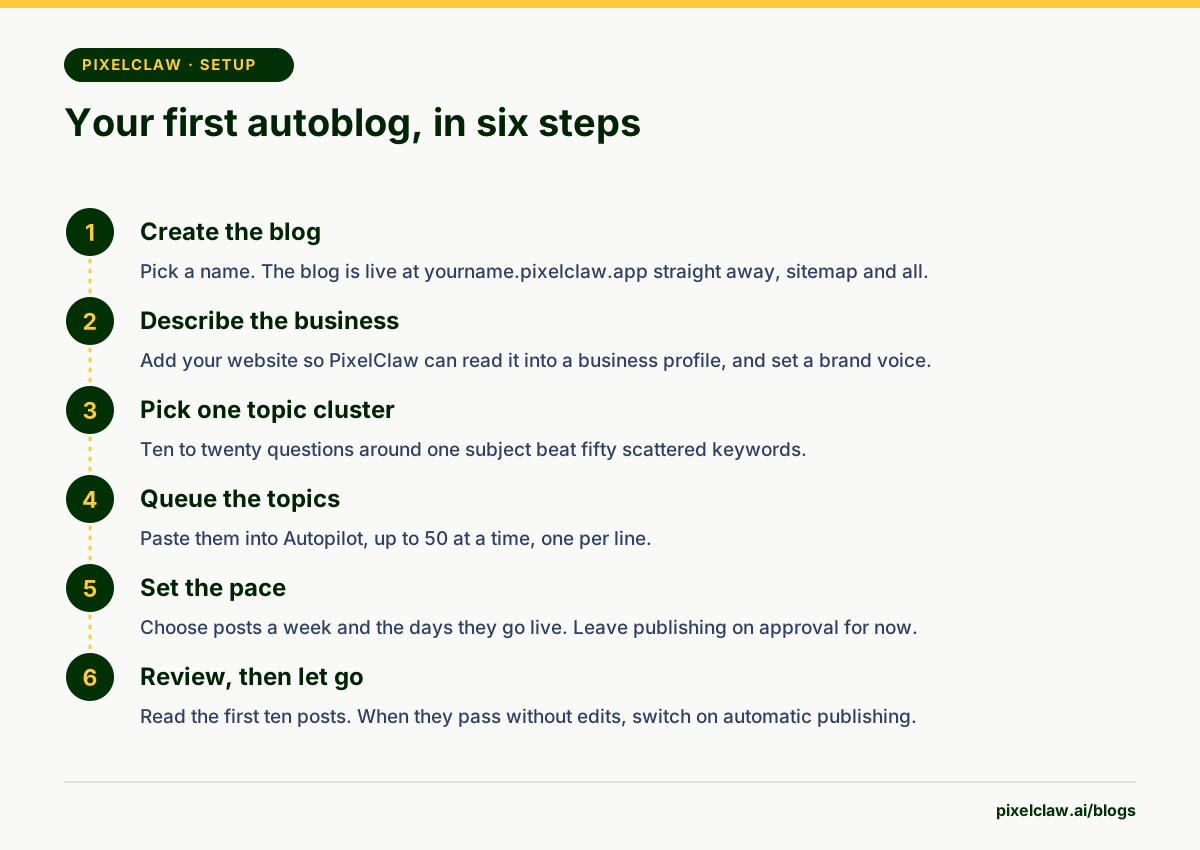
The setup that works best is boring on purpose. Start narrow, check the first posts yourself, and widen only when the posts you are getting are posts you would have written.
In PixelClaw that looks like the steps below. None of them needs a paid plan, though the free plan's two included posts will feel tight once you are past the first week.
Where autoblogging goes wrong, and how to avoid it
Most failed autoblogs fail the same way: too many posts, too little reason for each one to exist. The fixes are not glamorous, but they are cheap.
Watch for keyword cannibalization first. Two posts chasing the same search split the clicks and confuse Google about which one to rank. Before queueing a topic, check whether an older post already answers it and update that one instead.
Then watch the facts. AI drafts can carry wrong prices, wrong names or claims the sources do not support. A score checks structure, sources and discoverability; it cannot tell whether a claim is true. That part is still yours, which is why the first weeks of reading every post are worth the time.
Finally, use your data. Connect Google Search Console, look at which posts are losing readers, and refresh them. An autoblog that only ever adds posts ends up with a long tail of stale ones. If you want the deeper dive on each of the five scores, start with SEO blogs and GEO blogs.
- Autoblogging is now a research-first pipeline, not the RSS scraping it started as, and Google judges the output, not the tool.
- Google's scaled content abuse policy targets volume made to manipulate rankings, so pace and usefulness matter more than speed.
- A score that holds weak drafts back is the single most useful safeguard an autoblog can have.
- Most business blogs do well on two to seven posts a week; PixelClaw never lets one blog publish more than 14.
- Start with one topic cluster, review the first ten posts yourself, then let automatic publishing take over the drafts that pass.
Frequently Asked Questions
Is autoblogging allowed by Google?+
Yes, as long as the posts exist to help readers. Google says appropriate use of automation is not against its guidelines, while pages produced mainly to manipulate rankings break its spam policies however they were made.
Can an autoblog rank on a brand-new domain?+
It can, but slowly. A new site has no history for Google to lean on, so expect months rather than weeks, and help it along with a sitemap, internal links between related posts and a steady weekly pace instead of a launch-day flood.
Do I need WordPress to start autoblogging?+
No. PixelClaw hosts the blog for you at yourname.pixelclaw.app, with sitemap.xml, robots.txt and llms.txt already set up, and paid plans can put it on your own domain. If your blog must stay in WordPress, a plugin-based autoblogging tool is the better fit.
How much editing does an autoblogged post need?+
Plan on reading every post for the first few weeks. Once you trust the voice and the sources, a quick check of facts, prices and names is usually enough, and PixelClaw's score tells you which structural fixes are still open.
What is the difference between autoblogging and programmatic SEO?+
Programmatic SEO fills one template with rows of data, such as a page for every city. Autoblogging writes individual articles, each researched for its own question. Many sites use both: templates for data pages and autoblogging for editorial posts.
Sources
- Spam policies for Google web search: scaled content abuse — Google Search Central (Defines scaled content abuse as many pages made mainly to manipulate rankings, however they were produced.)
- Google Search's guidance about AI-generated content — Google Search Central Blog (Automation is fine when it serves people; using it mainly to manipulate rankings is spam.)
- What web creators should know about our March 2024 core update and new spam policies — Google Search Central Blog
- Creating helpful, reliable, people-first content — Google Search Central
Built & scored using PixelClaw.ai
More from this blog
Continue exploring autoblogging architecture, AI blog writing, and SEO / AEO / GEO playbooks.
What Is Autoblogging? How Modern AI Autoblogging Works Without Publishing Slop
Autoblogging explained for founders and marketing teams: how modern research-first pipelines differ from old RSS scrapers, and what it takes to earn rankings and AI citations.
Marcus Vance
Head of Growth Architecture
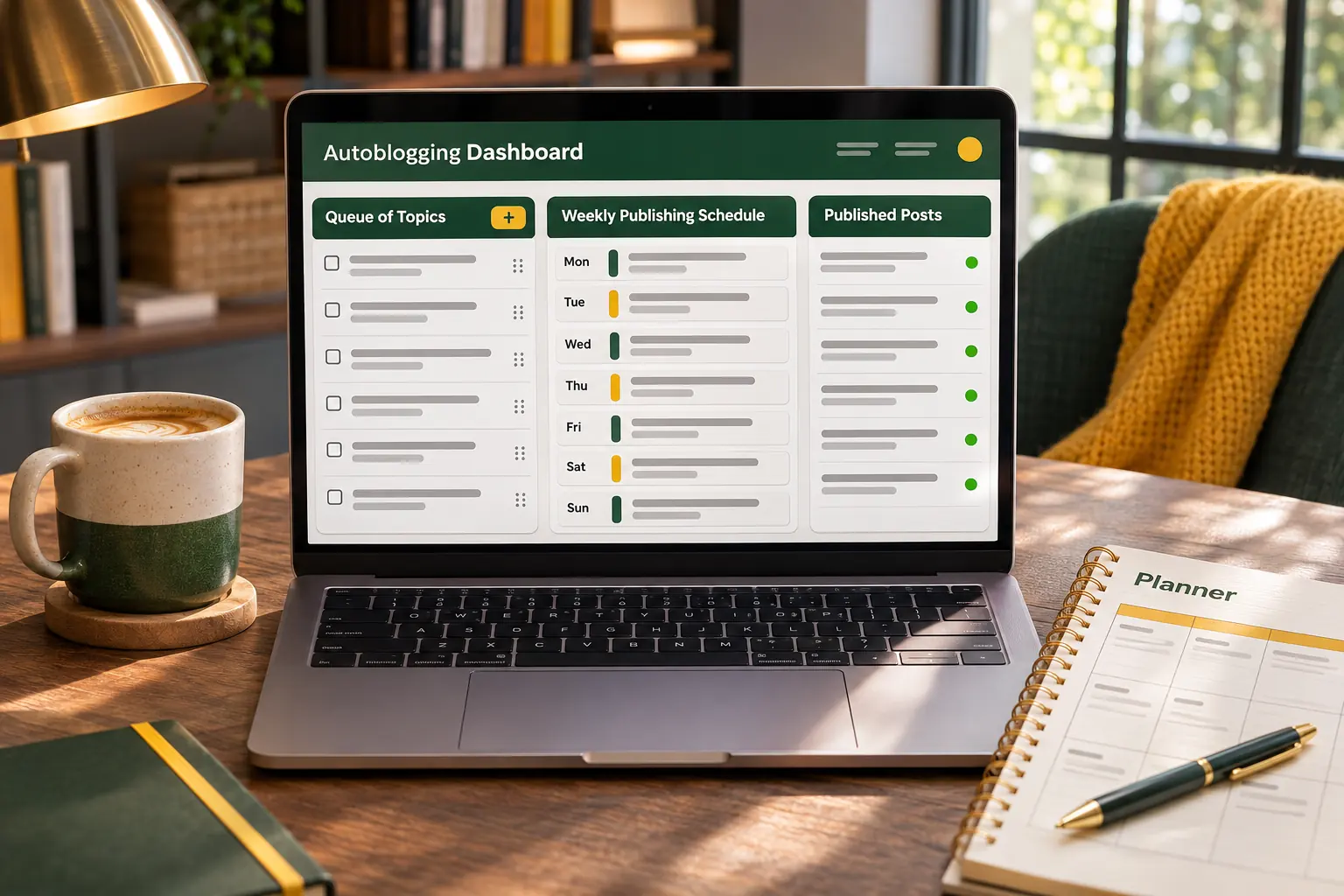
Best Autoblogging Tools in 2026: Hosted, WordPress and Agent Options Compared
Autoblogging tools come in three shapes: a hosted blog that writes itself, a writer that auto-posts to your WordPress site, and an SEO agent that runs everything. Seven tools compared, with prices from each vendor's site.
PixelClaw Editorial Team
Product and search team
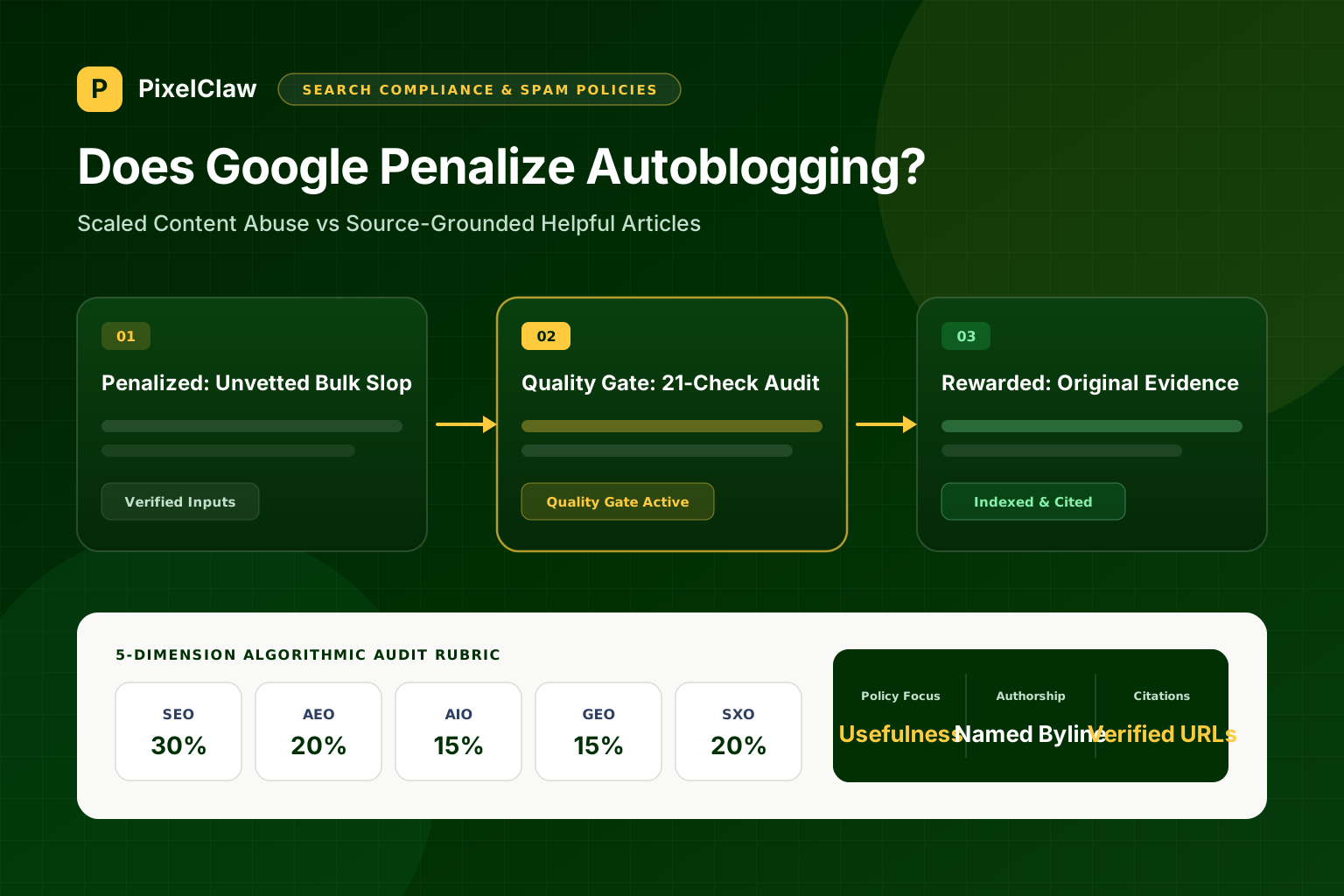
Does Google Penalize Autoblogging? What Search Spam Policies and Helpful Content Systems Actually Target
Separating SEO myth from Google Search Central documentation: why scaled content abuse penalties hit unvetted bulk sites, and how source-grounded autoblogging stays compliant.
Dr. Arthur Pendelton
Compliance & Editorial Director