AIO for startups
Growth guideAIO for Startups: What AI Optimization Means and How a New Brand Earns a Place in AI Overviews
AI systems summarize the sources they trust. Here is what AIO means, why it matters to startups, founders, bloggers and copywriters, and the trust signals a brand-new company can show from its first post.

On this page▸
AIO for startups means AI optimization: earning the trust AI systems need before they summarize, cite or recommend you, including Google's AI Overviews. It matters because a new brand starts with no reputation. Show who wrote each post, link sources for every claim, keep facts consistent and prove first-hand experience.
What AIO means: AI optimization, defined
AIO stands for AI optimization. You will see it used in two ways. Broadly, it means preparing content so AI systems such as ChatGPT, Gemini, Perplexity and Google's AI features can understand it, trust it and credit it. Narrowly, some marketers use AIO for Google's AI Overviews, the AI-written summary that now sits above many search results.
Both meanings land in the same place: trust and attribution. Before an AI system summarizes your advice or names your product, it needs reasons to believe the page is accurate and that a real, accountable source stands behind it. AIO is the work of making those reasons visible.
It sits next to its siblings. SEO gets the page ranked, AEO gets a passage quoted, GEO gets the brand cited in generated answers, and AIO is the credibility all three depend on.
Why AIO matters to startups, founders, bloggers, copywriters and organic growth
For startups, trust is the missing asset. An established brand gets the benefit of the doubt; a company founded last year does not. AI summaries make that gap sharper, because the summary above the results often decides which two or three sources the reader ever sees. AIO is how a new name earns one of those spots on evidence rather than reputation.
For founders, AIO turns personal expertise into a ranking asset. Google's guidance asks who created the content and what first-hand experience they have. A founder who has lived the customer's problem has more of that than any content agency, as long as the post says so.
For bloggers, AIO is about the habits that make a post checkable: an author byline, a published and an updated date, links to the sources behind each claim, and corrections when facts change. For copywriters, it is the discipline of claims that can be backed up, because an AI system that cannot verify a claim tends to leave it out of the summary or attribute it to someone else.
For anyone responsible for organic growth, AIO protects the traffic SEO earns. When an AI Overview answers the query, the supporting links inside it are where the remaining clicks go. Being one of those links is the difference between losing a query to AI and being credited by it.
How Google's AI Overviews choose their sources
Google's documentation on AI features and your website is unusually direct. There are no additional requirements to appear in AI Overviews and no special optimizations needed. To be shown as a supporting link, a page must be indexed and eligible to appear in Google Search with a snippet.
After that, the same systems that rank helpful, reliable content decide what appears. That is why AIO for startups is less about tricks and more about the fundamentals in Google's guide to helpful, reliable, people-first content: who made the content, how it was made, and why it exists.
Google's Search Quality Rater Guidelines describe the same idea as E-E-A-T, experience, expertise, authoritativeness and trust, and call trust the most important of the four.
AIO for a brand-new startup: borrow the trust you have not built yet
A young company cannot fake ten years of reputation, but it can borrow credibility honestly. Put the founder's name and relevant experience on the posts they shaped. Use customer stories, with permission, that show the product working. Publish small pieces of original data, such as what you learned from a hundred onboarding calls. Cite recognised authorities when you make a claim, and link to them.
Publish how you work. An editorial policy that explains how posts are researched, how AI assistance is used and how errors are corrected answers the "how" question before anyone asks it. PixelClaw publishes its own editorial policy for exactly that reason.
Then keep your facts consistent. The same product description, pricing language and company details on your blog, your docs and your listings elsewhere make it easy for an AI system to be sure it has the right company.
An AIO checklist for your next post
Before you publish, run the post through these questions. Each one closes a gap that an AI system, or a careful reader, would notice.
If any answer is no, fix that before adding more posts. One trustworthy post that AI systems are willing to cite does more for a young brand than five they quietly skip.
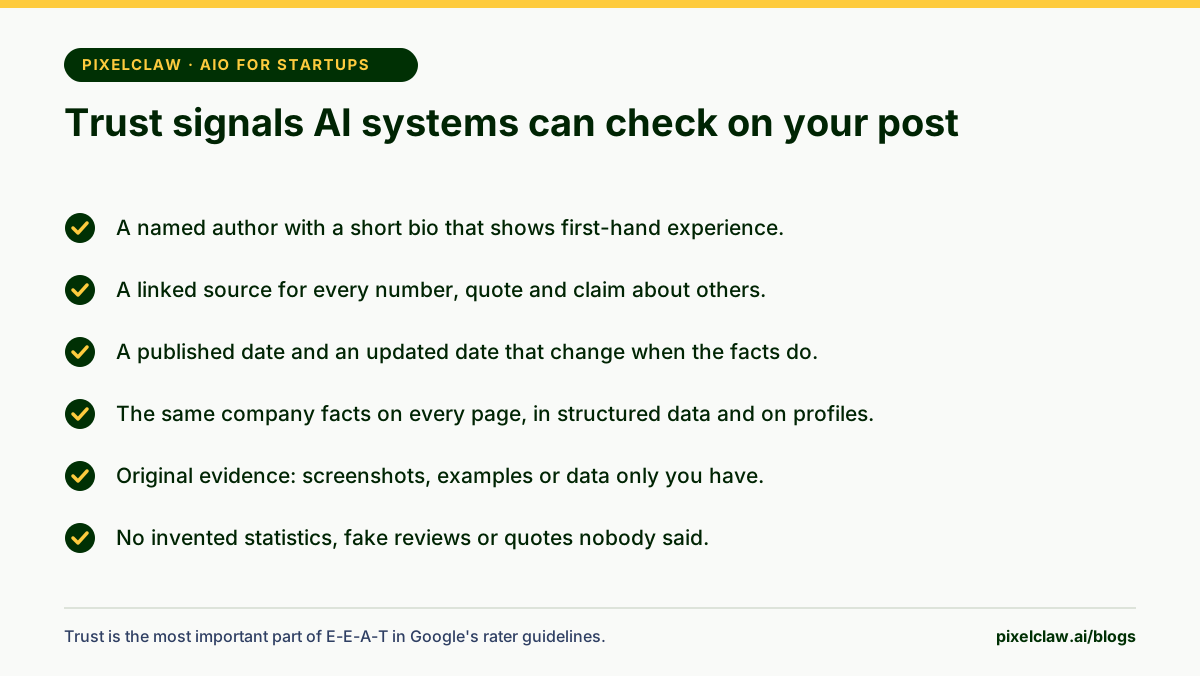
- Does the post name a real author, with one line on why they know this subject?
- Can every number, quote and claim about another company be clicked through to its source?
- Is there at least one thing only your team could know: a screenshot, an example or a number from your own data?
- Do the product facts match your pricing page and docs today, not six months ago?
- Would you be comfortable hearing a customer read the post aloud to you on a sales call?
- If AI helped write it, did a person check it, and does your editorial policy say how you work?
How PixelClaw builds trust signals into every post
In the PixelClaw score, AIO carries 15% and checks the two signals that are most often missing: a named author on the post, and sources behind its claims. A draft without them loses points, and the score names what is missing before you publish.
Research comes first. Each draft is written from the pages research read, and those sources stay attached to the post so readers and AI systems can check them. Your business profile, built from your own website, and the knowledge files you upload give the writer your real product facts instead of guesses.
Every post goes out with structured data that names the author and the publisher, and shows its dates. Posts wait for your review by default, and a post that scores under 60 is held back, so a human decides what carries your name. For the writing side in more depth, see our guide to AIO blogs.
AIO mistakes that cost a startup its credibility
The fastest way to lose trust is an invented number. A statistic without a source, or a quote nobody said, may survive one reader, but it gives AI systems a reason to skip the page and gives competitors a reason to point at it.
Anonymous posts come second: "Admin" as an author tells readers and machines that nobody is accountable. Stale facts come third, especially prices and feature lists that changed months ago. Last is volume without care. Google's guidance on AI-generated content does not punish AI assistance, but pages made at scale to game rankings are spam whoever wrote them.
AIO is one part of an organic growth strategy that works across every front door. After trust, the next lever is what happens once the reader arrives, covered in SXO for startups.
- AIO stands for AI optimization, and is also used for Google's AI Overviews; both meanings come down to being a source AI systems trust.
- Google says there is no special markup for AI Overviews: a page must be indexed, eligible for a snippet and genuinely helpful.
- Trust signals are concrete: a named author with real experience, linked sources, dates, consistent company facts and no invented numbers.
- A new startup can borrow trust it has not built yet through founder expertise, customer stories, original data and citations of authorities.
- PixelClaw checks every draft for a named author and sources for its claims, and keeps the research sources attached to the post.
Frequently Asked Questions
What does AIO stand for?+
AIO most often stands for AI optimization: making content that AI systems can trust, attribute and summarize. Some marketers use it for Google's AI Overviews specifically. In PixelClaw's score, AIO is the area that checks authorship and sources.
Is AIO the same as E-E-A-T?+
They overlap. E-E-A-T, experience, expertise, authoritativeness and trust, is the framework Google's quality raters use to judge pages. AIO applies the same idea to AI systems that decide which sources to summarize and credit.
Do I need special markup to appear in AI Overviews?+
No. Google says there are no extra requirements or special optimizations for AI Overviews. A page has to be indexed and eligible to appear with a snippet, and then the same systems that judge helpful, reliable content decide what is shown.
Can AI-assisted posts earn AI trust?+
Yes, when they are accurate, sourced and useful. Google judges content by its quality, not by how it was produced, and suggests explaining how content was made when readers would reasonably ask. A clear editorial policy and a human review before publishing both help.
Does a startup need a famous author to build trust?+
No. It needs a real one. A founder who has solved the problem first-hand, named on the post with a short bio, shows exactly the experience trust signals are meant to capture.
Sources
- AI features and your website — Google Search Central (No special optimization is required; supporting links must be indexed and eligible to show with a snippet.)
- Creating helpful, reliable, people-first content — Google Search Central
- Search Quality Rater Guidelines — Google
- Google Search's guidance about AI-generated content — Google Search Central Blog
Built & scored using PixelClaw.ai
More from this blog
Continue exploring autoblogging architecture, AI blog writing, and SEO / AEO / GEO playbooks.

Organic Growth Strategy for Startups: Build Traffic That Keeps Growing While You Sleep
Ads rent attention and stop the day the budget does. An organic growth strategy builds a library of posts that rank in Google, get quoted by AI answers and keep sending buyers for years.
PixelClaw Editorial Team
Product and search team

GEO for Startups: What Generative Engine Optimization Means and How to Get ChatGPT to Recommend You
Buyers now ask an AI assistant which tool to use before they ever see a search result. Here is what GEO means, why it matters to startups, founders, bloggers and copywriters, and how to become the name the answer includes.
PixelClaw Editorial Team
Product and search team

SXO for Startups: What Search Experience Optimization Means and How to Turn Search Visits Into Signups
Ranking gets the click. What happens next decides whether the visit becomes a customer. Here is what SXO means, why it matters to startups, founders, bloggers and copywriters, and the fixes that pay first.
PixelClaw Editorial Team
Product and search team