Organic growth
Growth guideOrganic Growth Strategy for Startups: Build Traffic That Keeps Growing While You Sleep
Ads rent attention and stop the day the budget does. An organic growth strategy builds a library of posts that rank in Google, get quoted by AI answers and keep sending buyers for years.

On this page▸
An organic growth strategy wins customers through search and AI answers instead of paid ads. For a startup that means publishing researched posts on the questions buyers ask, every week, so each one keeps bringing visitors long after it goes live. PixelClaw runs that loop for you: research, writing, scoring and publishing, even while you sleep.
What an organic growth strategy is, and what it is not
Organic growth is the customers you win without paying for each visit: people who find you in Google, hear your name in an AI answer, or arrive through a link someone shared. An organic growth strategy is the plan that makes that happen on purpose instead of by luck.
For most startups the engine of that plan is content in search. Your buyers type questions long before they talk to sales: how to fix a problem, which tool to pick, what something costs. Every one of those questions is a chance to be the page they land on, or the source an AI assistant quotes.
It is not a viral trick, and it is not a one-off launch. Product Hunt days and lucky tweets are welcome, but they spike and fade. Organic growth is the slow, boring line that keeps rising under the spikes, and the reason it works is the same reason it is hard: it rewards whoever keeps publishing useful answers week after week.
Why organic growth compounds for startups
Paul Graham's essay Startup = Growth opens with the line "A startup is a company designed to grow fast." He calls 5 to 7% a week a good rate during Y Combinator. Few channels can sustain that for long on a seed budget, and paid ads usually get more expensive as you scale them.
Content behaves differently. A post that ranks this month is still there next month, and the month after, adding visitors on top of the posts you publish next. Ten posts become fifty, fifty become a hundred, and each one is a door into the product. The cost per visitor falls as the library grows, which is the opposite of what happens when you buy clicks.
That is also why organic growth is the one growth hack that gets better with age. An ad account is worth nothing the day you pause it. A blog that answers your market's questions is an asset you own.
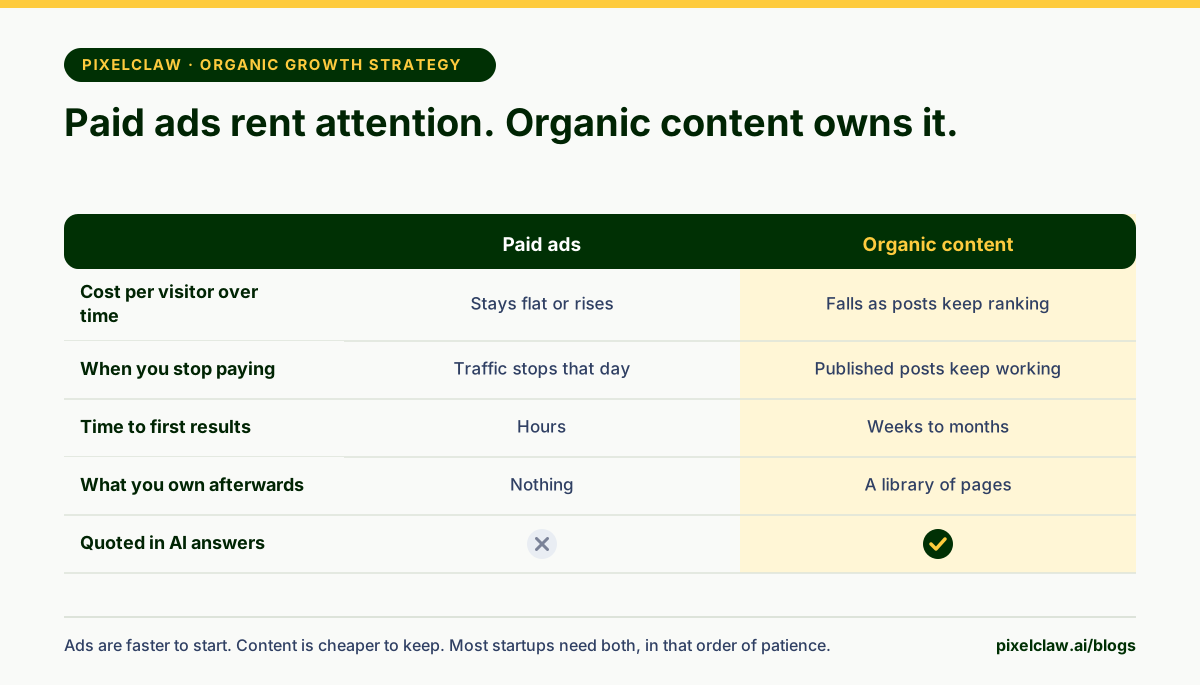
The five front doors to grow organic traffic: SEO, AEO, GEO, AIO and SXO
Search used to have one front door, the list of ten blue links. Now it has several, and a post that only works for one of them leaves traffic on the table. Each door has a short name you will see everywhere, and each has its own guide in this series.
SEO, search engine optimization, gets your post ranked in the list of results. It is still where most clicks come from, and the foundation for everything else. Start with SEO for startups, a 90-day plan for teams with no marketing hire.
AEO, answer engine optimization, gets one passage of your post lifted as the answer itself: a featured snippet, a voice reply, a quote in a chat. AEO for startups shows how to write the 40 to 60 word answer that gets picked.
GEO, generative engine optimization, gets your brand named and cited when ChatGPT, Perplexity or Gemini write an answer. For a startup this is the new word of mouth. Read GEO for startups.
AIO, AI optimization, is the trust layer: the authorship, sources and accuracy that make Google's AI Overviews and other AI systems willing to rely on you. AIO for startups covers the signals that matter.
SXO, search experience optimization, is what happens after the click: whether the reader finds the answer, trusts it and takes the next step. SXO for startups turns search visits into signups.
A 90-day organic growth plan for a small team
The plan below assumes one founder or marketer with a few hours a week and no agency. It works because each month builds on the last instead of starting over.
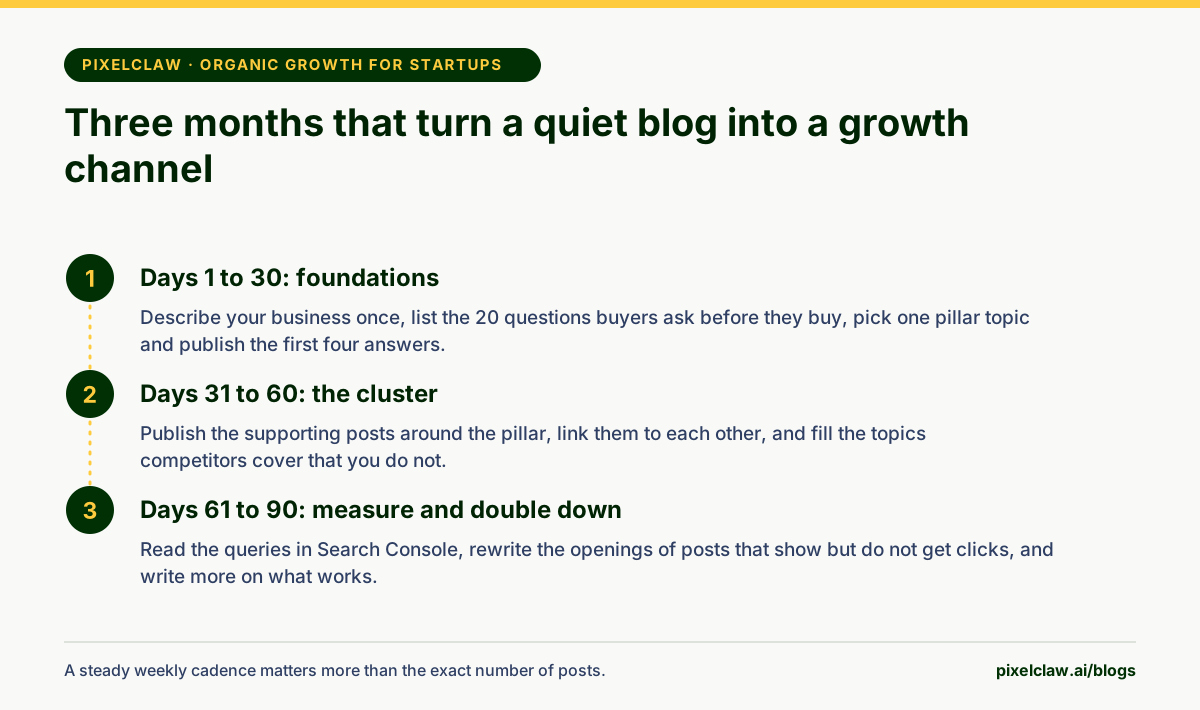
How PixelClaw runs the organic growth loop while you sleep
The plan above is simple. Keeping it going is the hard part, because research and writing take hours that founders do not have. Orbit Media's 2026 survey of 1,042 content marketers put the average blog post at 3 hours and 20 minutes to write, before research, images and publishing. PixelClaw exists to take those hours off your week.
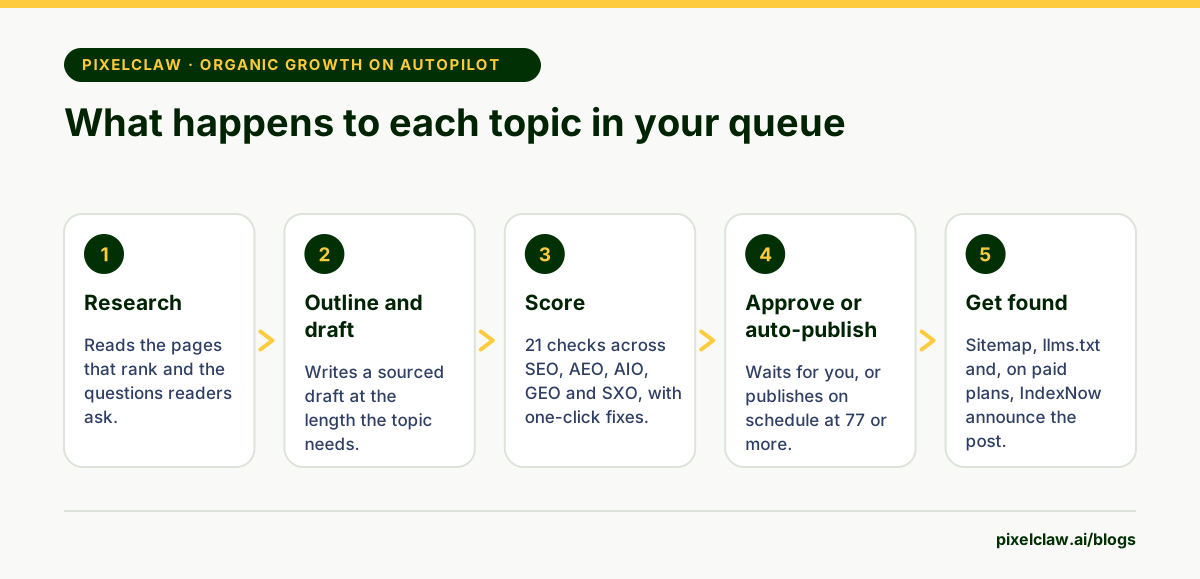
Each post starts with research: PixelClaw reads the pages that already rank for the topic and collects up to eight questions readers ask, then plans the post's length from what ranks. It builds an outline you can edit, writes a draft grounded in the sources it read, and adds a hero picture with alt text.
Then it checks the draft the way search engines and AI assistants will read it: 21 checks across SEO, AEO, AIO, GEO and SXO, combined into one score out of 100. For most failing checks, a one-click fix writes the missing piece and shows it to you before anything changes. A post under 60 is held back.
Autopilot repeats all of that for every topic in your queue and can refill the queue from saved keywords and research ideas. By default finished posts wait for your approval. Switch on automatic publishing and Autopilot publishes only the posts that score 77 or more and pass the remaining checks, on the schedule you set. That is the growth hack in one sentence: the blog keeps its schedule on the nights you do not.
Every plan includes a hosted blog with a sitemap, robots.txt and llms.txt, so Google and AI crawlers can find new posts from the first day. On paid plans, God Mode turns a description of your business into a pillar guide and its supporting articles, queued for Autopilot, and IndexNow tells Bing and the other engines that take part about each new post as soon as it goes live. On Pro and higher plans, Competitor Spy lists the topics your competitors write about that your blog has no post on yet. The features page shows each part, and pricing shows which plan includes what.
What to measure in the first 90 days
Judge an organic growth strategy on leading signals first and revenue last, or you will quit just before it starts working.
- Impressions in Search Console come first, because they prove Google indexed the posts and shows them for real queries.
- Queries you never planned for tell you what your market actually asks, and what to write next.
- Clicks per post show which posts deserve updates, more internal links and a translation.
- Visits from chatgpt.com, perplexity.ai and similar sites are small today, and the clearest sign you are being cited.
- Signups or demo requests that start on the blog are the number that justifies the whole program.
Mistakes that stall organic growth
The first is publishing in bulk without research. Google's spam policies call it scaled content abuse when many pages exist mainly to manipulate rankings, and its guidance on AI content is clear that quality, not the tool, is what counts. Fifty thin posts do less than ten useful ones.
The second is chasing big keywords too early. A new blog will not outrank established sites for "project management software" in its first quarter, but it can own "how to run a sprint review with a remote team of five". Narrow questions bring buyers, and they build the authority that wins broader terms later.
The third is stopping at week six. Most of the posts that will matter have not been indexed and tested yet. The fourth is publishing posts that link to nothing, so neither readers nor crawlers find the rest of your work.
If you are weighing this against faster tactics, read growth hacking for startups and is blogging still worth it. If your bottleneck is time, founder-led content shows how to keep your voice without writing every word, and SEO copywriting covers the writing that turns readers into customers.
- Organic growth compounds: a post that ranks keeps sending visitors for months, while an ad stops the day the budget does.
- The strategy has three parts: choose the questions buyers ask, publish complete answers on a steady schedule, and make every post easy for Google and AI assistants to read and quote.
- Search now has two front doors, the results page and the AI answer, so each post has to work for SEO, AEO, GEO, AIO and SXO at the same time.
- A modest weekly cadence held for a year usually beats a month of heroics followed by silence.
- PixelClaw automates the slow parts, from research to scoring and publishing, so a founder can keep the schedule without writing every post.
Frequently Asked Questions
How long does an organic growth strategy take to work?+
Expect impressions in Google Search Console within weeks of publishing, and steady clicks after a few months of weekly posts. Competitive keywords take longer than specific buyer questions, which is why a new startup should start with the narrow, high-intent questions its customers ask.
Is organic growth cheaper than paid ads?+
Over time, yes, because a published post keeps working without a bill per click. The cost moves from money to hours of research and writing. Automating those hours is what makes organic growth realistic for a small team.
Can AI-written posts grow organic traffic?+
Google says it rewards helpful content however it is produced, and treats mass-produced pages made to game rankings as spam. AI posts grow traffic when they are researched, sourced, accurate and written for a real question. They hurt when they are thin copies of what already ranks.
What does "while you sleep" mean with PixelClaw?+
Autopilot researches, outlines, drafts and scores queued topics without you at the desk. Finished posts wait for your approval by default. If you switch on automatic publishing, only posts scoring 77 or more that pass the remaining checks go live on their own.
Do I need a website or a developer to start?+
No. Every PixelClaw plan includes a hosted blog with its own address, sitemap.xml, robots.txt and llms.txt from the moment you create it. Paid plans can connect a custom domain such as blog.yourcompany.com.
Sources
- Startup = Growth — Paul Graham ("A startup is a company designed to grow fast", with 5 to 7% a week cited as a good growth rate during Y Combinator.)
- AI features and your website — Google Search Central
- Google Search's guidance about AI-generated content — Google Search Central Blog
- Spam policies for Google web search — Google Search Central (Scaled content abuse: many pages made to manipulate rankings rather than help people.)
- Blogging Statistics 2026: What 1,042 Content Marketers Told Us About What Works — Orbit Media Studios (Average post 1,312 words; 3 hours 20 minutes to write one.)
Built & scored using PixelClaw.ai
More from this blog
Continue exploring autoblogging architecture, AI blog writing, and SEO / AEO / GEO playbooks.

SEO for Startups: A 90-Day Plan for Founders With No Marketing Team
You will not outrank the giants on their own keywords this year. You can own the specific questions your buyers search before they buy, and that is where startup SEO starts paying.
PixelClaw Editorial Team
Product and search team

Growth Hacking for Startups in 2026: Why a Blog on Autopilot Is the Hack That Compounds
Most growth hacks work for a month and then everyone copies them. Content is the rare one that gets stronger the longer you run it, and automation finally makes it fast enough for a startup.
PixelClaw Editorial Team
Product and search team

GEO for Startups: What Generative Engine Optimization Means and How to Get ChatGPT to Recommend You
Buyers now ask an AI assistant which tool to use before they ever see a search result. Here is what GEO means, why it matters to startups, founders, bloggers and copywriters, and how to become the name the answer includes.
PixelClaw Editorial Team
Product and search team