SEO writing software
PixelClaw toolsSEO Writing Software That Checks Every Post Before It Goes Live
What to expect from SEO writing software in 2026, from the editor to the checks and the publish step, and how PixelClaw's writing studio handles each part.

On this page▸
SEO writing software helps you write posts that search engines understand and rank. The useful kind combines research, an editor built for web posts, checks that run as you write and a publish step that stops weak posts. PixelClaw's writing studio does all four, and scores each post out of 100 before it can go live.
What SEO writing software should do in 2026
A few years ago SEO writing software meant a text box with a keyword counter. The job has grown. A post now has to rank in the list of results, be quotable by answer engines, be trusted by AI systems, and read well on a phone. Writing software has to help with all of it, or you end up with four tools and a lot of copying.
The useful pieces are research before writing, an editor built for web posts rather than documents, checks that explain themselves, and a publish step that stops weak posts and handles the technical details. PixelClaw's writing studio is built around those four.
Research where you write
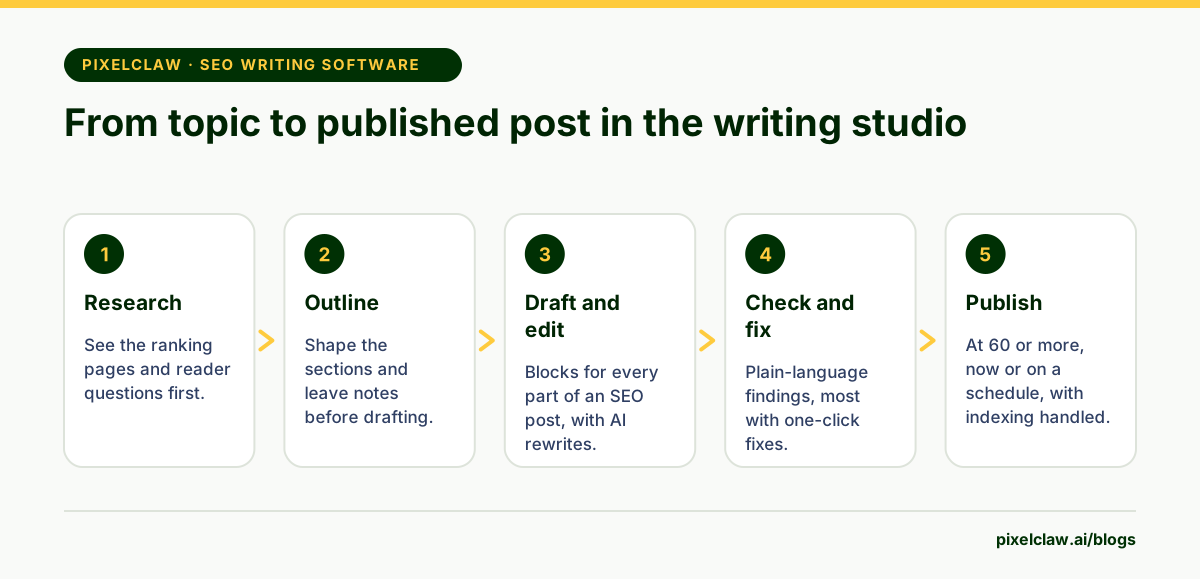
Before a draft exists, PixelClaw shows what the research found: the pages that rank for the topic and up to eight questions readers ask. You can open each source. That context is what makes the outline, and then the post, cover what searchers expect.
In the writing studio you approve and shape the outline before drafting: rename sections, reorder them, add or remove them, and leave notes for the writer. Then the draft lands in the editor, sources attached.
An editor built for SEO posts
Web posts are not documents. They need headings in a strict order, FAQ blocks, comparison tables, callouts, key takeaways and calls to action, and they need them in forms that search engines and answer engines can read. PixelClaw's block editor has each of those as a block, so structure is never a formatting hack.
Move blocks up or down with the toolbar or the keyboard. Select text and ask the AI to rewrite it, or regenerate a whole section with a note. Preview the post exactly as readers will see it. Earlier versions are kept, so you can always go back.
- Blocks for headings, paragraphs, lists, tables, callouts, FAQs, key takeaways, images and calls to action.
- Move blocks with the toolbar or Alt+Shift+Up and Down (Control+Shift on a Mac).
- Rewrite a selection or a section with an instruction, for a few credits.
- Preview before publishing; earlier versions are kept.
Checks that explain themselves
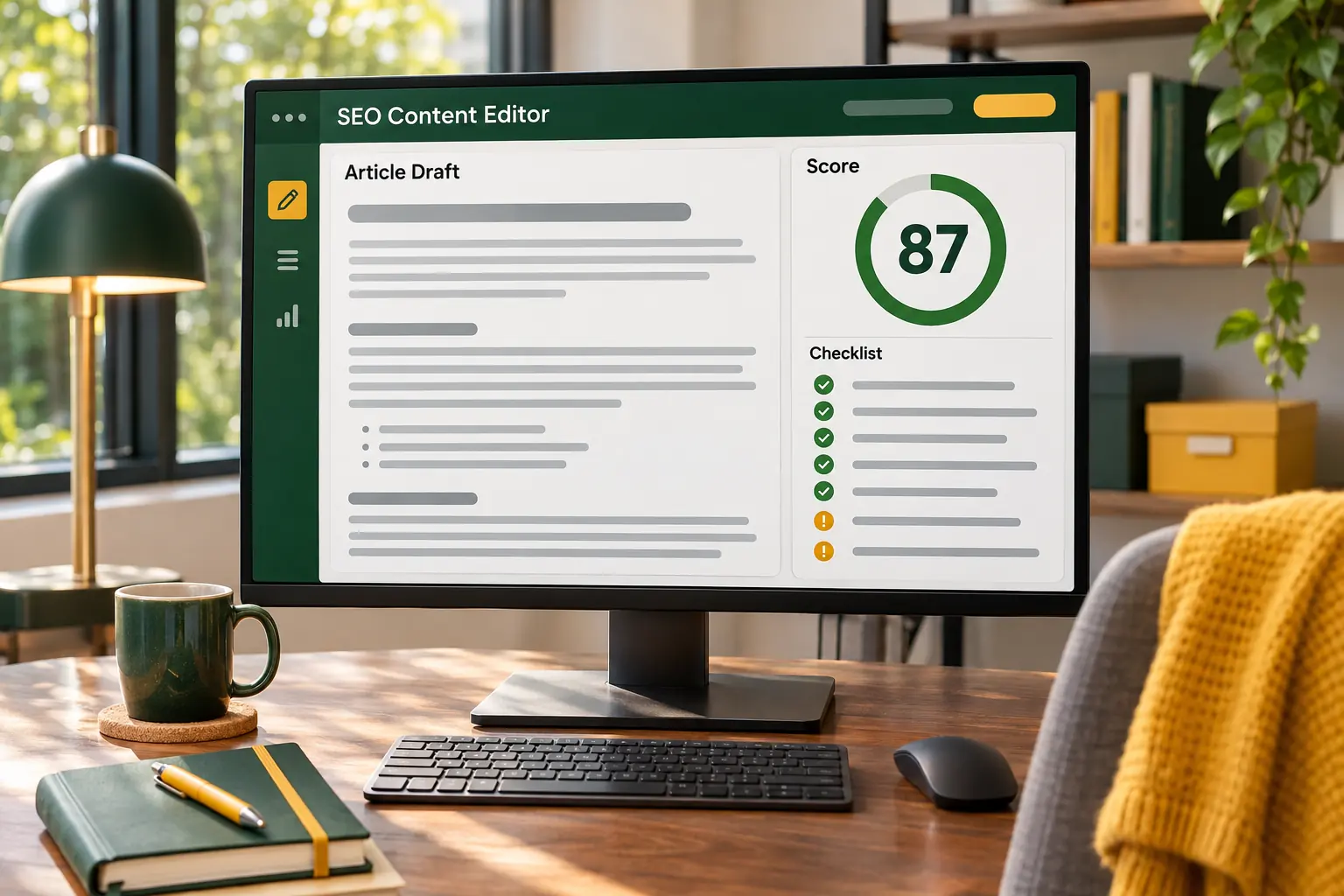
Every post is checked against the same rules: title length and keyword placement, a description that fits search results, an opening answer, heading order, links to related posts, sources, image descriptions and sizes, a contents list on long posts, and more. Each check passes or fails with a sentence saying why.
Most failed checks come with a fix. Click it and the AI writes the missing piece, then shows you the change before it is applied. If you would rather write it yourself, the explanation tells you exactly what is needed.
A publish bar, not just a score
Scores are easy to ignore. A publish bar is not. In PixelClaw, a post needs 60 or more out of 100 to be published. Below that it is held, with the list of what failed. An owner or admin can publish it anyway when they mean to, and the override is recorded with who did it.
That small piece of friction changes habits. Teams stop publishing posts with no description or no links, not because someone told them to but because the button asks them to look first.
Publishing, with the technical work handled
When you publish, the post goes live on your hosted blog with structured data for the article, its FAQ and its breadcrumbs, and the sitemap and llms.txt update. On paid plans you can schedule it for a date and time, and IndexNow notifies Bing and other participating engines.
For a broader view of the scoring side, read the content optimization tool, and for how PixelClaw compares with other tools, the best AI SEO writing tools.
Choosing SEO writing software: questions to ask
Most SEO writing software looks similar in a demo. The differences show up in daily use, so ask about the daily parts. Where does the research come from, and can you see the sources? Can you change the outline before a draft is written? Do the checks explain themselves, or just give a grade? Is there anything stopping a weak post from going live? And what happens after you click publish: does the tool handle structured data, the sitemap and indexing, or do you?
Then look at cost per finished post rather than per seat or per word, including images and the time spent fixing drafts. A tool that is cheap per word but needs an hour of editing per post is expensive. For a side-by-side look at the options, read the best AI SEO writing tools.
- SEO writing software should research, edit, check and publish in one place, not four tools.
- PixelClaw's block editor has the blocks SEO posts need: FAQs, tables, callouts, key takeaways and calls to action.
- Checks explain themselves in plain words and most have a one-click fix.
- A publish bar of 60 out of 100 stops weak posts, with a recorded override for owners and admins.
- Scheduling, structured data, sitemaps and indexing pings come with publishing.
Frequently Asked Questions
Do I need SEO writing software if I use an SEO plugin?+
An SEO plugin checks a post inside your CMS after it is written. SEO writing software helps earlier: with research, structure and drafting. Many teams use both; PixelClaw replaces both for posts on its hosted blog.
Can I write without AI in PixelClaw?+
Yes. The editor works without AI, and the score and checks apply to anything you write. AI drafting, rewriting and fixes are there when you want them.
Does the score update while I write?+
The checks run on the post as it stands, so after an edit the findings reflect what you changed. Each failed check explains what to do next.
Can teams collaborate in the writing studio?+
Yes. Invite teammates to the blog with roles that set what each can do, and sensitive actions such as publishing below the bar are recorded with who did them.
Sources
- Search Engine Optimization (SEO) Starter Guide — Google Search Central
- Influencing your title links in search results — Google Search Central
Built & scored using PixelClaw.ai
More from this blog
Continue exploring autoblogging architecture, AI blog writing, and SEO / AEO / GEO playbooks.

A Content Optimization Tool That Scores SEO, AEO, AIO, GEO and SXO Together
Most content optimization tools grade one thing: keywords. PixelClaw scores every post in five areas, explains each failed check in plain words, and fixes most of them in one click.
PixelClaw Editorial Team
Product and search team
Best AI SEO Writing Tools That Grade Your Draft Before Google Does
Seven AI SEO writing tools that check a draft before it goes live, compared on what they grade: terms and topics, structure, answer-engine readiness or AI visibility.
PixelClaw Editorial Team
Product and search team

SEO Blogs That Earn Clicks in 2026: How to Plan, Write and Publish Them
The on-page checklist, the length question, internal links and the technical basics, written for people who want their blog posts found rather than admired.
PixelClaw Editorial Team
Product and search team