Tool comparison
Tool comparisonThe Best AI Writer for Bulk Blog Posts, Without Tripping Google's Spam Rules
Bulk blog posts are easy to generate and easy to get wrong. Six AI writers compared on batch size, publishing pace, quality checks and price, plus the habits that keep bulk publishing safe.
On this page▸
The best AI writer for bulk blog posts balances batch size with control. Autoblogging.ai and SEOWriting.ai handle the biggest batches; Machined writes interlinked clusters; Byword prices predictably per article; PixelClaw queues up to 50 topics at once and releases posts at a capped weekly pace with every post scored, which keeps bulk publishing clear of scaled content abuse.
Generating bulk blog posts is easy; publishing them safely is not
Any AI writer can produce a hundred blog posts in an afternoon. The hard part is what happens next. Google's spam policies define scaled content abuse as many pages generated mainly to manipulate rankings and not to help people, however they were produced. A blog that gains three hundred thin posts in a weekend fits that description whether or not a person pressed the button.
So we compared AI writers for bulk blog posts on four things: how many posts a batch can hold, how fast posts are published, what checks run before they go live, and price. PixelClaw is our product; everything else was read from each vendor's own site on November 5, 2026.
| Writer | Batch size | Publishing pace | Checks before live | From (own site) |
|---|---|---|---|---|
| Autoblogging.ai | Up to 500 titles | Time gap you set | Optional fact checker | $19 a month |
| SEOWriting.ai | Up to 100 to WordPress | Bulk auto-post | Content score | $14 a month billed yearly |
| Machined | 30 to 750 articles a month by plan | To your CMS | Cannibalization checks | $19 a month |
| Byword | 25 to 300 articles a month by plan | To your CMS | Not stated | $99 a month |
| WordRocket AI | 20 (Pro) or 50 (Agency) per bulk run | Automations | Not stated | Free plan; lifetime deals |
| PixelClaw | 50 per paste, 200 queued | Your pace, never over 14 a week per blog | Score; weak posts held | Free; $49.99 a month |
Autoblogging.ai and SEOWriting.ai: the biggest batches
If raw volume is the goal, these two lead. Autoblogging.ai's bulk generator takes up to 500 titles per batch on paid plans and posts to WordPress and several other platforms with a time gap between posts. SEOWriting.ai generates in bulk and auto-posts up to 100 articles at a time to WordPress, with internal linking and a content score.
Both are cheap per standard article, from $19 a month for 40 credits at Autoblogging.ai and from $14 a month billed yearly for up to 50 articles at SEOWriting.ai. Both charge more for stronger models and extras.
Watch out for: set the posting gap wide. The tools will publish as fast as you let them.
Machined: bulk posts built as clusters
Machined is built for bulk with structure: it researches keywords, groups them into clusters, writes researched articles with citations and links them together, with checks against keyword cannibalization. That makes it one of the better choices when a bulk run is meant to build topical coverage rather than just add pages.
Plans run from $19 a month for 30 articles to $249 for 750, plus a bring-your-own-keys plan with 2,000 articles for $99 a month and your AI provider billed separately.
Watch out for: no refunds once a subscription is charged, per its site.
Byword and WordRocket AI: predictable or bring-your-own
Byword prices per article, from $99 a month for 25 articles with extras at $3.50, which makes bulk budgets easy to forecast. It supports programmatic SEO and connects to WordPress, Webflow, Ghost, HubSpot and Google Sheets.
WordRocket AI runs on your own AI keys and sells lifetime deals; its site lists bulk generation of 20 articles at once on Pro and 50 on Agency, publishing to WordPress and Ghost.
Watch out for: WordRocket requires your own keys on every tier, so add your provider's bill.
PixelClaw: bulk in, steady pace out
PixelClaw treats bulk as a queue rather than a dump. Paste up to 50 topics at once; the queue holds 200. Autopilot researches, writes, illustrates and scores each post on its own, and releases them at the weekly pace you set. The ceiling is 14 Autopilot posts a week per blog on any plan, because we think anything faster reads as content made to rank.
Every post is scored out of 100 across SEO, AEO, AIO, GEO and SXO, and in automatic mode only posts scoring 77 or more go live alone. The rest wait in Needs review. For the full walkthrough, see the bulk article generator.
Watch out for: if you truly need hundreds of posts live this week, PixelClaw will not do it, by design.
Choosing an AI writer for bulk blog posts
If you need the most posts for the least money and will edit them yourself, Autoblogging.ai or SEOWriting.ai. If you want bulk runs that build connected clusters, Machined. If you need predictable per-article budgets, Byword. If you want bulk input with a controlled, checked output on a blog that runs itself, PixelClaw.
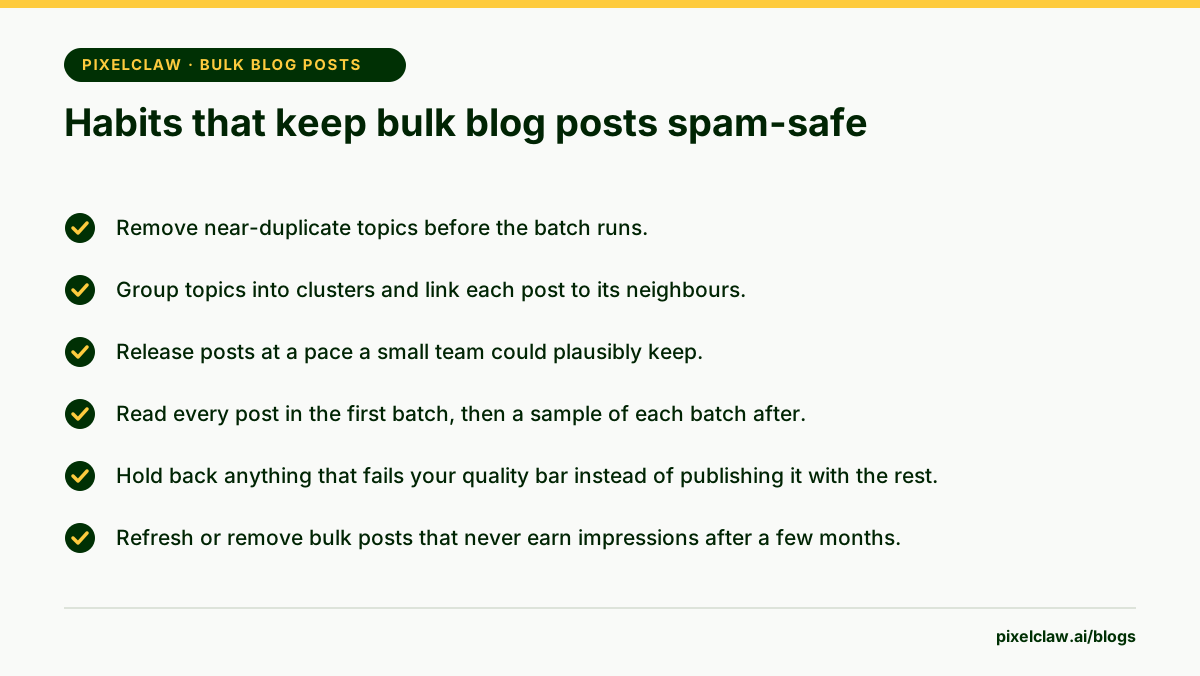
Two numbers are worth tracking for any bulk run: the share of posts you had to edit heavily, and the share that earned impressions within eight weeks. If the first is high, fix the inputs before the next batch. If the second is low, the topics were wrong, and no writer will fix that.
Whichever you choose, the habits above matter more than the tool. For the step-by-step process, read how to generate articles in bulk, and for running many blogs safely, AI content at scale.
- Batch size is easy; publishing pace and quality checks decide whether bulk posts help or hurt.
- Autoblogging.ai (500 titles a batch) and SEOWriting.ai (100 a batch to WordPress) lead on raw volume.
- Machined builds clusters with internal links and cannibalization checks, which suits bulk work.
- PixelClaw takes 50 topics at once, holds 200, scores every post and caps Autopilot at 14 a week per blog.
- Google's spam policies target many pages made mainly to rank, so pace and usefulness matter more than speed.
Frequently Asked Questions
How many blog posts can I generate in one batch?+
It depends on the tool: Autoblogging.ai lists up to 500 titles per batch, SEOWriting.ai up to 100 auto-posted to WordPress, and PixelClaw 50 topics per paste with 200 in its queue, according to their own pages on November 5, 2026.
Will Google penalize bulk AI blog posts?+
Not for being bulk or AI-written as such. Google's spam policies target many pages produced mainly to manipulate rankings. Bulk posts that answer real questions, released at a sensible pace and linked into clusters, are treated like any other content.
What is a safe publishing pace for bulk posts?+
There is no published number, but a pace a small editorial team could keep is a good test. PixelClaw never publishes more than 14 Autopilot posts a week on one blog, whatever the plan.
Do I need to read every bulk post?+
Read every post in the first batch, then a sample of each later batch. A tool that scores posts and holds weak ones back reduces how much you must read, but it cannot check facts for you.
Sources
- Autoblogging.ai pricing and bulk generation — Autoblogging.ai (Read November 5, 2026.)
- SEOWriting.ai pricing — SEOWriting.ai (Read November 5, 2026.)
- Machined pricing — Machined (Read November 5, 2026.)
- WordRocket AI — WordRocket AI (Read November 5, 2026.)
- Byword pricing — Byword (Read November 5, 2026.)
- Spam policies for Google web search: scaled content abuse — Google Search Central
Built & scored using PixelClaw.ai
More from this blog
Continue exploring autoblogging architecture, AI blog writing, and SEO / AEO / GEO playbooks.

Bulk Article Generator: Queue 50 Topics at Once, Publish on a Safe Schedule
How PixelClaw turns a list of topics into researched, scored articles, why it releases them at a weekly pace instead of all at once, and what bulk generation costs.
PixelClaw Editorial Team
Product and search team

Bulk Blog Generators Compared by How You Pay: Packs, Plans, Lifetime Deals or Your Own Keys
Bulk blog generators cost very different amounts depending on how you buy them. One-time packs, monthly plans, lifetime deals and your own AI keys each suit a different publishing rhythm.
PixelClaw Editorial Team
Product and search team

How to Generate Articles in Bulk With AI, From Keyword List to Published Posts
A seven-step process for turning a keyword list into a batch of articles that rank: clusters first, questions second, a careful first batch, then a steady publishing pace.
PixelClaw Editorial Team
Product and search team