Source-Grounded AI
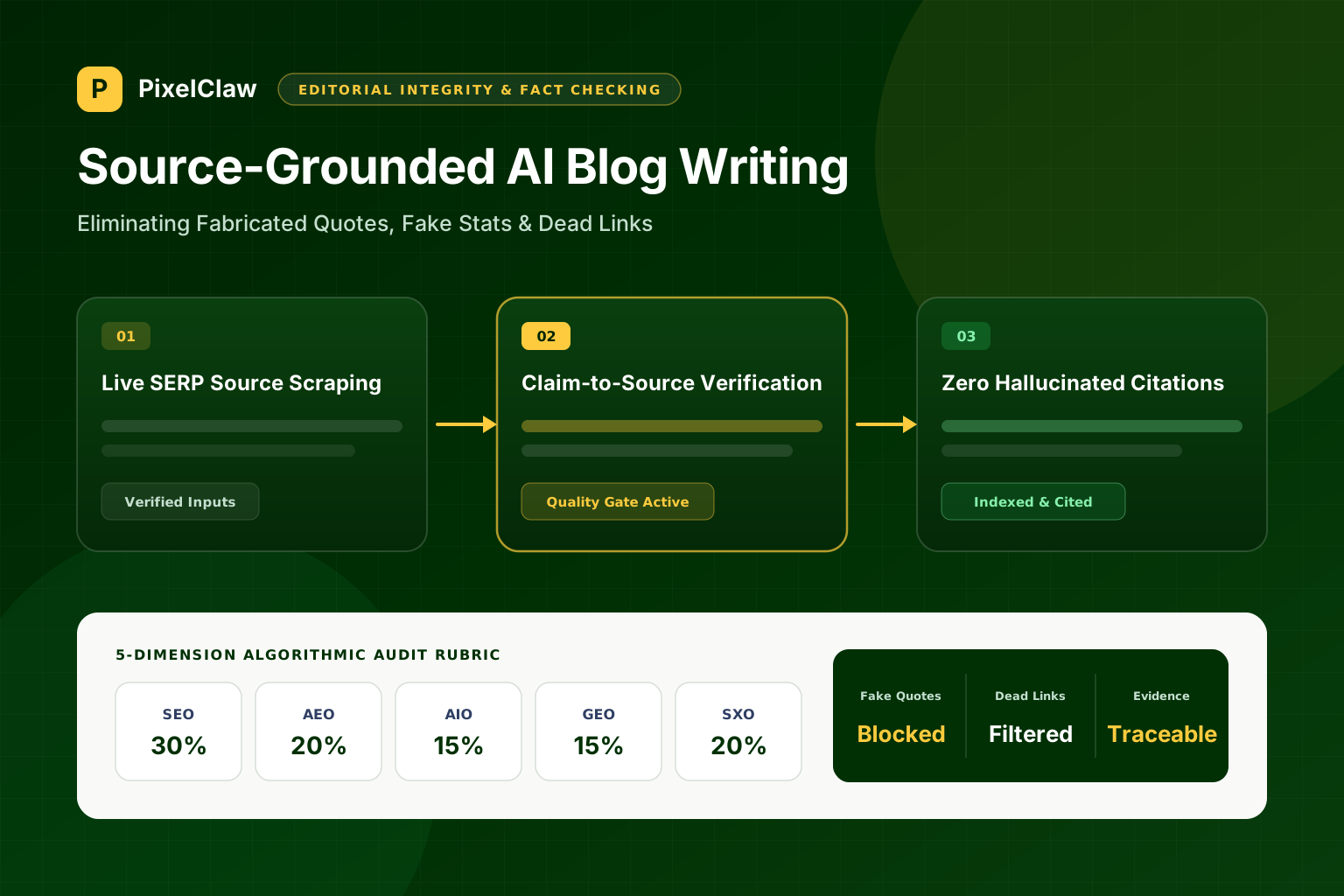
AI Engineering & Editorial QualitySource-Grounded AI Writing: How to Reduce Hallucinated Stats and Dead Links in Automated Blogs
Why raw language models invent fake percentages, nonexistent studies, and 404 URLs—and how source-grounded AI writing reduces those risks before editorial review.
On this page▸
Source-grounded AI writing reduces the risk of fabricated statistics, fake quotes, and dead links by giving the drafting model an evidence packet gathered before writing begins. The pipeline combines live sources with approved business facts and citation checks. Grounding cannot guarantee accuracy: editors still need to verify claims before publishing.
Why do raw AI blog tools invent statistics, quotes, and 404 links?
Nothing destroys buyer trust faster than clicking a citation link in a blog post and landing on a 404 page—or worse, reading a statistic attributed to Gartner or McKinsey that was completely invented.
This happens because a raw language model is a next-token predictor, not a database. When a naive prompt wrapper instructs a model to 'write a 2,000-word authoritative article with statistics and external links' without supplying any source documents in the prompt context, the model obeys the stylistic instruction by fabricating numbers and plausible-looking URL slugs.
To stop AI hallucinations in blog posts, you have to change the architecture: never ask a model to invent evidence from memory.
How does source-grounded AI writing reduce hallucination risk?
Source-grounded AI writing treats factual retrieval and prose generation as two strictly separated operations. Before the writer model is allowed to draft a single paragraph, the research worker gathers a verified evidence packet.
- Live SERP crawling: Scrapes the actual pages currently ranking for your target keyword and extracts verifiable facts, headings, and reachable URLs.
- Reader question extraction: Collects the real questions buyers ask so the outline addresses genuine confusion rather than filler subtopics.
- First-party context injection: Pulls your workspace's business profile, approved product capabilities, and valid internal post slugs.
- Strict grounding constraints: Prohibits the writer from inventing fake customer testimonials, unverified percentages, or external URLs outside the research packet.
Ungrounded prompt generation vs source-grounded AI writing
Compare how ungrounded text generators behave versus PixelClaw's source-grounded pipeline across common failure points:
| Content Element | Ungrounded AI Prompt Wrapper | PixelClaw Source-Grounded Pipeline |
|---|---|---|
| Industry Statistics | Invents plausible percentages | Uses only figures present in crawled sources |
| External Citation Links | Synthesizes fake URL slugs (404 risk) | Links only to verified URLs from the research packet |
| Customer Reviews & Quotes | Fabricates fictional testimonials | Strictly prohibits fake reviews and invented quotes |
| Internal Blog Links | Guesses non-existent /blog/... paths | Links only to verified published slugs in your workspace |
| Product Capabilities | Hallucinates features you don't sell | Grounded in your workspace business profile & evidence |
| Audit Verification | Manual link-by-link checking required | Automated AIO 'Sources for claims' & internal link checks |
How to combine external SERP sources with your own product evidence
External SERP research keeps your industry context, regulatory citations, and competitor comparisons accurate. Your first-party workspace evidence keeps your own product story honest.
In PixelClaw, you can attach specific notes, screenshots, and approved claims at the outline stage before generating the draft. When an assertion comes from an external standard—such as Google Search Central documentation, IRS publications, or W3C specifications—the writer cites that external URL in the Sources block. When an assertion describes how your own service works, it links to your verified product or pricing page.
A four-point fact-check routine before any post goes live
Before approving a draft in your review queue, run this fast four-point check: confirm the AIO 'Sources for claims' check is green; verify that every numerical benchmark traces to a named source in the Sources block; check that comparison tables state the date specs were verified; and confirm your CTA button points to the exact page promised in the text.
- Language models hallucinate when prompted to sound authoritative on topics where they have no live source text in their context window.
- The three most damaging blog hallucinations are invented industry percentages, fabricated URL paths that return 404 errors, and misstated competitor pricing.
- Source-grounded AI writing separates information retrieval (scraping live pages and workspace facts) from prose synthesis.
- PixelClaw's AIO (AI Trust & Attribution) dimension checks that every post names a real author and links to at least two verified external sources.
- Editors can inspect the exact sources attached to a post and toggle whether the public Sources block is displayed to readers.
Frequently Asked Questions
Why do AI models make up URLs that look real but return 404 errors?+
Autoregressive language models predict plausible token sequences rather than looking up a live database. Because a domain name followed by a hyphenated keyword slug looks statistically probable, an ungrounded model will stitch together a URL that never existed. Source-grounded pipelines only allow URLs that were actually crawled during the research step.
What is the difference between RAG and source-grounded AI writing?+
Retrieval-Augmented Generation (RAG) is the underlying technique of fetching relevant documents into a model's context window. Source-grounded AI writing applies RAG to the full editorial workflow: scraping live SERP pages, combining them with your verified business profile, prohibiting fabricated quotes or numbers, and auditing the final draft's citation links.
Can I hide or show the Sources list at the bottom of a published post?+
Yes. In PixelClaw, you can choose at the Outline step, in Preview, or in your blog's Appearance settings whether the Sources citation block is visible at the foot of the published article.
How does PixelClaw handle claims about my own product's pricing or features?+
You store your approved product facts, supported integrations, and CTA links in your workspace profile and knowledge store. The writer references those exact records rather than guessing what your software costs.
What happens if a draft fails the AIO sources check?+
If a draft contains fewer than two verified external links or citation items, the AIO 'Sources for claims' check fails, lowering the composite score and offering a one-click fix to ground the post in its researched sources.
Sources
- Google Search Central: Creating Helpful, Reliable, People-First Content (Trust & Evidence) — Google Search Central (Outlines why clear sourcing, verifiable evidence, and accurate authorship are essential for search trust.)
- NIST Artificial Intelligence Risk Management Framework (Generative AI Profile) — National Institute of Standards and Technology (NIST) (Details confabulation (hallucination) risks in generative models and grounding controls via retrieval-augmented generation.)
- Schema.org: Citation and CreativeWork Property Specification — Schema.org (Defines structured citation references linking an article to supporting external works.)
Built & scored using PixelClaw.ai
More from this blog
Continue exploring autoblogging architecture, AI blog writing, and SEO / AEO / GEO playbooks.
Does Google Penalize Autoblogging? What Search Spam Policies and Helpful Content Systems Actually Target
Separating SEO myth from Google Search Central documentation: why scaled content abuse penalties hit unvetted bulk sites, and how source-grounded autoblogging stays compliant.
Dr. Arthur Pendelton
Compliance & Editorial Director
How to Choose an AI Blog Writer That Actually Ranks on Google, Bing, and AI Search
Most AI blog writers produce generic essays that stall on page four. Here is the exact technical checklist for selecting an AI blog writer engineered for search rankings and AI citations.
Sophia Lin
E-Commerce & Content Strategy Director
High-Trust Autoblogging for Professional Services: Capturing Localized and High-E-E-A-T Traffic Without Compliance Risk
How law firms, accounting practices, healthcare clinics, and advisory firms generate consistent inbound clients while upholding strict regulatory and ethical standards.
Dr. Arthur Pendelton
Compliance & Editorial Director