Buyer's guide
Tool comparisonSEO Article Generation Software: A Buyer's Checklist for Teams and Agencies
Choosing SEO article generation software for a team or agency is a procurement decision. The criteria that matter, and how eight tools compare on seats, sites, approvals, API access and price.

On this page▸
Good SEO article generation software for teams and agencies does more than write. It supports several seats and sites, lets editors approve articles before they publish, checks quality automatically, exposes an API, and keeps the cost per article predictable as volume grows. Compare tools on those five points before comparing writing samples.
Buying SEO article generation software as a team
A solo blogger picks an AI writer by trying it for an afternoon. A team or agency choosing SEO article generation software is making a procurement decision: several people will use it every day, clients' brands will depend on it, and switching later is painful.
So the evaluation should look different. Writing quality still matters, but it is table stakes now. What separates software for teams is the operating layer: seats, sites, approvals, quality checks, integrations and predictable cost. We compared eight tools on those points. PixelClaw is our product; every other fact was read from the vendor's own site on November 5, 2026.
| Software | Seats and sites | Approval or review | API | From (own site) |
|---|---|---|---|---|
| PixelClaw | 3 members on Starter, 10 and 3 blogs on Pro | Approval mode; held below 60 | REST, webhooks, MCP | $49.99 a month |
| Byword | 3 seats on Standard, 10 on Scale | Not stated | Webhooks | $99 a month |
| Machined | 2 to 10 team members by plan | Not stated | Webhooks | $19 a month |
| Frase | 1 to 5 seats; up to 10 domains | Content guard, agent | Not stated | $49 a month |
| Arvow | 1, 5 or unlimited websites | Edit or draft mode | Webhooks, Zapier | $69 a month |
| SEObot | Plans by articles a month | Accept or decline list | REST API, webhooks | $49 a month |
| Jasper | Per seat | Team features on Business | Business plan | $69 a month per seat |
Criterion 1: seats, sites and separation
Count the people who will touch the software and the sites they publish to, then check how each tool counts them. Some price per seat, some per site, some per article with seats included. An agency with eight clients and four writers can find the same tool cheap or expensive depending on that model.
Separation matters as much as count. Each client needs its own voice, facts and schedule, and nobody should publish one client's article on another's site. PixelClaw separates by blog: each blog has its own brand voices, business profile, Autopilot queue and schedule, while the account shares credits and team members.
Criterion 2: approvals and audit
With more people publishing under one brand, the approval step stops being optional. Look for a mode where generated articles wait for an editor, a record of who approved what, and limits on who can publish below the quality bar.
SEObot can send a list of articles to accept or decline. Arvow can publish to your CMS as drafts. PixelClaw's Autopilot waits for approval by default, holds weak articles in Needs review even in automatic mode, and records sensitive actions, such as publishing under the bar, with who did them.
Criterion 3: automatic quality checks
Editors get tired; automatic checks don't. Software that scores every article before it goes live gives a team a shared floor. Ask what the check covers and what happens when an article fails: is it flagged, held, or published anyway?
PixelClaw scores every article out of 100 across SEO, AEO, AIO, GEO and SXO, holds anything under 60, and only publishes on its own at 77 or more. Frase scores for SEO and GEO. Many generators publish whatever they produce, which pushes all the checking onto people.
Criterion 4: API, webhooks and MCP
Teams rarely use content software in isolation. Articles flow into client portals, reporting tools, Slack channels or custom front ends. An API lets your systems create and read articles; webhooks tell them when something changes.
PixelClaw's REST API, described in an OpenAPI document, and signed webhooks are included on paid plans, along with an MCP server that lets AI assistants such as Claude work with a blog through an API key. SEObot lists a REST API and webhooks; Byword, Machined and Arvow list webhooks or Zapier.
Criterion 5: predictable cost at scale
Model your real month: how many articles, how long, with which options. Per-article pricing such as Byword's ($99 a month for 25, $3.50 each after) or SEObot's (from $49 a month for 9 articles, up to $1,050 for 300) is easy to forecast. Credit and word pricing can be cheaper but moves with research depth, images and model choice.
Also price what the software does not do. If it does not check articles, budget editor time. If it does not host or publish, budget CMS upkeep. The cheapest line item is not always the cheapest operation.
Building your shortlist
Pick three tools that pass the checklist on paper, then run the same real brief through each during their trials: one article per client voice, from keyword to published page. Note where each one makes your team copy, paste or fix.
If hosting and checks are high on your list, include PixelClaw; its Pro plan covers three blogs and ten team members. For running AI content across many sites safely, read AI content at scale, and for API-driven setups, headless AI blogging.
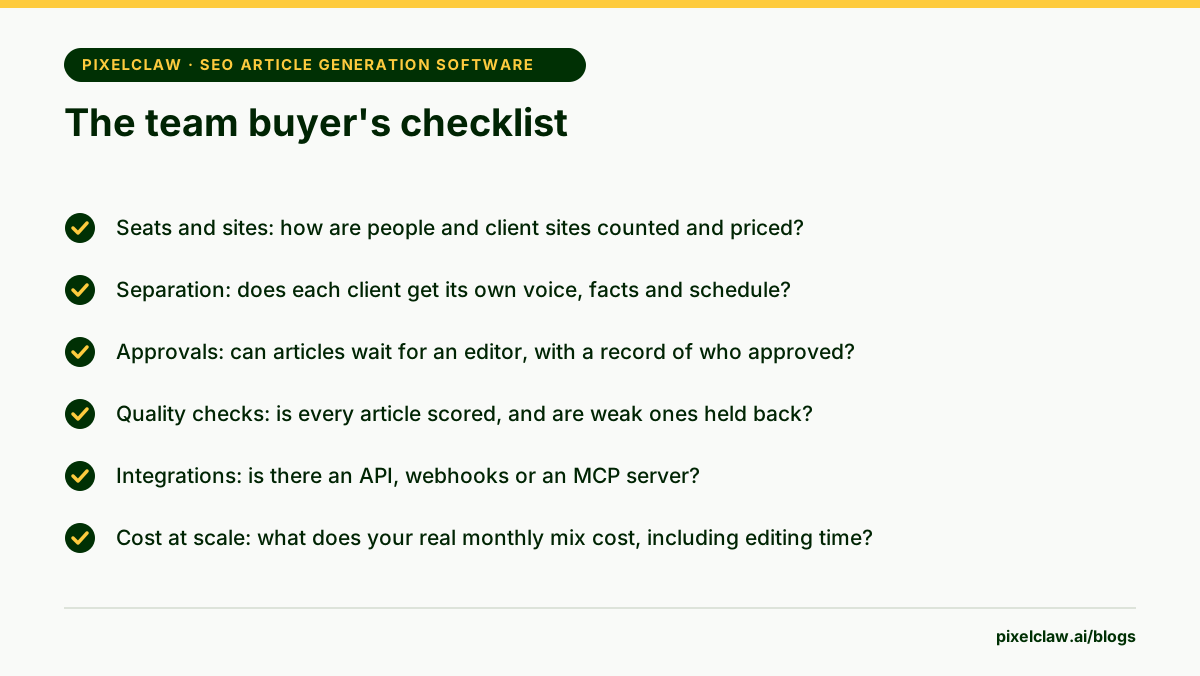
- For teams, compare seats, sites, approvals, quality checks and API access before writing quality.
- Per-article pricing (Byword, SEObot) is predictable; credit and word pricing varies with options.
- Approval steps matter more as more people publish under one brand.
- An API, webhooks or MCP server lets the software fit into your own workflow.
- PixelClaw covers teams, several blogs, approvals, a score on every article, API and MCP from Starter up.
Frequently Asked Questions
How long should a trial of SEO article software last?+
Long enough to publish and check real articles, usually one to two weeks. Run the same brief through each shortlisted tool, publish at least a few articles, and compare how much editing each one needed before it was ready.
What is the best SEO article generation software for agencies?+
One that separates clients cleanly, gives editors an approval step and keeps cost per article predictable. Byword, Machined and Arvow are built with agencies in mind; PixelClaw gives each client its own blog with its own voice and schedule under one account.
Should we choose per-article or credit-based pricing?+
Per-article pricing is easier to forecast. Credit pricing is often cheaper for standard articles but varies with options such as research depth, images and stronger models. Model your real monthly mix before deciding.
Does the software need an API?+
If articles have to flow into your own systems, a client portal or a custom front end, yes. Otherwise a solid CMS integration may be enough. Check for webhooks too, so your systems hear about changes.
How do we keep quality consistent across writers and clients?+
Brand voices per client, a shared quality bar every article must clear, and a weekly sample review. Software that enforces the bar automatically, rather than relying on each editor, scales better.
Sources
- Machined pricing — Machined (Read November 5, 2026.)
- Byword pricing — Byword (Read November 5, 2026.)
- Frase pricing — Frase (Read November 5, 2026.)
- Arvow pricing — Arvow (Read November 5, 2026.)
- SEObot pricing (help center) — SEObot (Read November 5, 2026.)
- Jasper pricing — Jasper (Read November 5, 2026.)
Built & scored using PixelClaw.ai
More from this blog
Continue exploring autoblogging architecture, AI blog writing, and SEO / AEO / GEO playbooks.

AI Content at Scale: Publishing More Without Being Flagged for Scaled Content Abuse
How to run AI content at scale across several blogs and a team without tripping Google's scaled content abuse policy: pace, quality bars, roles, APIs and the numbers that matter.
PixelClaw Editorial Team
Product and search team

Best AI SEO Content Generators: One-Click Articles Worth Publishing
One-click AI SEO content generators compared on the controls that decide whether the output is publishable: research, internal links, images, checks before posting and price per article.
PixelClaw Editorial Team
Product and search team

SEO Content Automation Software: What Each Tool Automates, Stage by Stage
Content SEO has five stages, from research to refreshing old pages. Most automation tools cover two or three of them. Here is which tool automates which stage, with prices from each vendor's own site.
PixelClaw Editorial Team
Product and search team