SXO for startups
Growth guideSXO for Startups: What Search Experience Optimization Means and How to Turn Search Visits Into Signups
Ranking gets the click. What happens next decides whether the visit becomes a customer. Here is what SXO means, why it matters to startups, founders, bloggers and copywriters, and the fixes that pay first.

On this page▸
SXO for startups means search experience optimization: making every search visit end in progress, not a bounce. It joins SEO with user experience, so the page loads fast, answers the query at once, reads easily on a phone and offers one clear next step. For a startup with modest traffic, SXO often grows signups faster than more traffic would.
What SXO means: search experience optimization, defined
SXO stands for search experience optimization. Where SEO asks "will this page rank", SXO asks "will the person who clicks get what they came for, and then do something". It treats the search result, the page and the next step as one experience to design. It is not a new discipline so much as the overlap of SEO and UX, judged by what visitors do rather than where the page ranks.
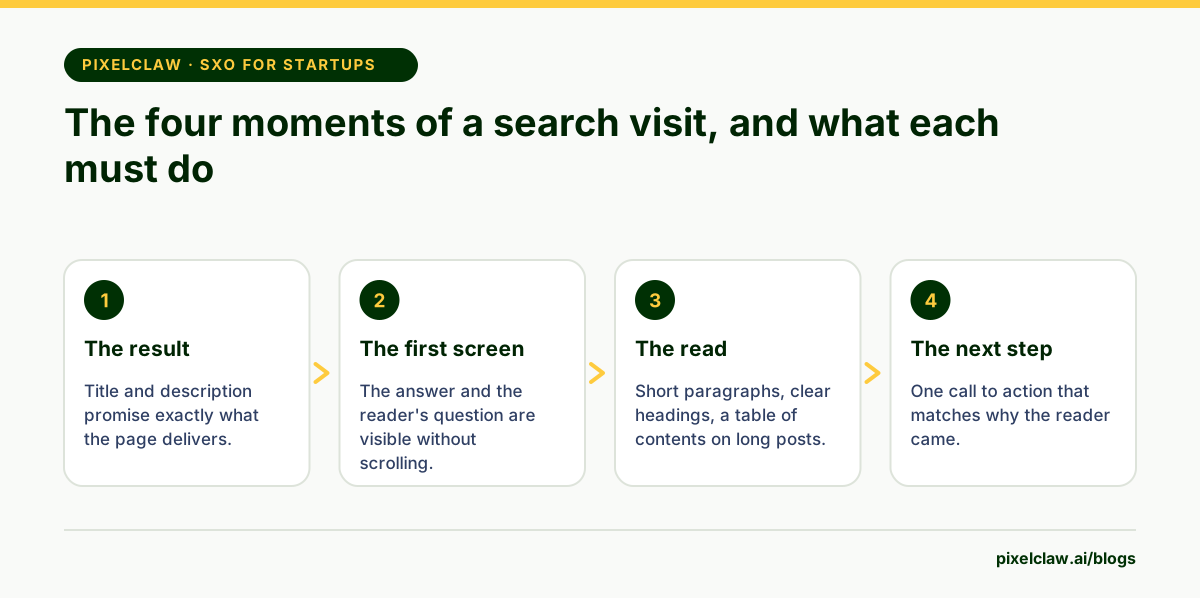
In practice SXO covers four moments. The snippet, which sets an expectation in the results. The first screen, which must confirm the reader landed in the right place. The body, which has to be easy to read and scan on a phone. And the next step, the one action that moves the reader forward.
Google's own guidance points the same way. Its notes on page experience say the core ranking systems look to reward content that gives a good page experience, and Core Web Vitals put numbers on part of it: the main content visible within 2.5 seconds, responses to taps within 200 milliseconds, and a layout that does not jump around.
Why SXO matters to startups, founders, bloggers, copywriters and organic growth
For startups, SXO multiplies small numbers. A blog with 3,000 monthly visits that converts 1% of them gets 30 signups; lift that to 2% and it gets 60, the same result as doubling traffic, usually in weeks instead of months.
For founders, SXO is where product thinking meets content. You already obsess over onboarding; the blog post is the first step of onboarding for anyone who arrives from search. Treat its first screen like the first screen of the app.
For bloggers, SXO is respect for the reader's time: the answer early, headings that explain the structure, a table of contents on long posts, images that load at the right size and say what they show. For copywriters, it is the craft of the next step, a call to action that continues the reader's own sentence instead of interrupting it.
For organic growth as a whole, SXO is what makes traffic worth having. Rankings without conversions are a vanity metric, and AI answers will take more of the simple informational clicks every year. The visits that remain are the ones with intent, and they deserve a page built to convert them.
The SXO fixes that pay first
Start where the visitors already are. In Search Console, sort your posts by impressions, then compare clicks; in your analytics, compare visits with signups. The posts with the most visits and the fewest next steps are where SXO pays first.
- Rewrite the opening so it answers the query in the first 40 to 60 words.
- Cut the first screen down to the headline, the answer and one picture that explains it.
- Break walls of text into short paragraphs under headings a skimmer can follow.
- Add a table of contents to long posts so readers jump to their question.
- Replace generic buttons with one call to action that names the reader's next step.
- Check the page on a real phone, on a slow connection, before you call it done.
Write for scanning, then for reading
Most people scan before they decide to read. Nielsen Norman Group's study Concise, SCANNABLE, and Objective rewrote one page three ways: shorter, easier to scan and free of promotional language. Combining all three measured 124% better usability than the original.
That result is decades old and still holds, because it describes people, not technology. Use headings that say what the section answers. Put the key idea first in each paragraph. Prefer a table to a paragraph of comparisons. And leave out the bragging; readers skip it, and AI systems tend to drop it from summaries anyway. Our guide to SEO copywriting covers the writing side in depth.
SXO in practice: three fixes on one startup post
Picture a post that ranks fourth for "how to onboard remote employees", brings 800 visits a month and almost no signups for the onboarding tool behind it. Three SXO fixes usually change that, and none of them needs more traffic.
First, the opening. The post spends two paragraphs on why onboarding matters before answering anything; rewriting it into a 50-word answer with the five steps keeps skimmers on the page. Second, the structure. A table of contents at the top and a checklist in the middle let readers jump to their step instead of scrolling past a wall of text.
Third, the call to action. The only offer is a generic "Book a demo" at the very bottom. Replacing it with "Get this checklist as a ready-made template in the app", placed next to the checklist itself, matches what the reader came for. That is SEO and UX working together.
Track the blog conversion rate for that post before and after the change. It is the clearest way to turn blog readers into customers without writing a single new post, and the same three fixes usually work on the next post with traffic and no signups.
How PixelClaw builds SXO into every post
SXO carries 20% of the PixelClaw score. Its four checks cover the things readers notice first: image sizes saved, so the page does not jump while it loads; descriptions on every image; a table of contents on long posts; and a call to action. When a check fails, the score says what to add before the post goes live.
The hosted blog does the rest of the technical work. Pages are rendered on the server, images load as readers scroll, and layouts adapt to any screen, phones included. Paid plans add a premium post template with a highlighted takeaway box, contents navigation and a sticky offer built from your post's own call to action.
Because every draft opens with a 40 to 60 word answer and carries a key takeaways box, the first screen already does most of what SXO asks. What stays with you is the offer: decide what a reader of each post should do next, and PixelClaw puts it where they will see it. For a deeper look at the reading experience, read our guide to SXO blogs.
How to measure SXO on a startup blog
Track three numbers per post: click-through rate from search, the share of visitors who scroll past the first screen, and signups or trial starts that begin on the post. A high click-through rate with a fast exit means the snippet promised something the page did not deliver. Good engagement with no signups means the call to action is missing or mismatched.
SXO is the last of the five front doors in an organic growth strategy, and the one that turns the others into revenue. Pair it with the trust work in AIO for startups, and the visits you earn will have every reason to stay.
- SXO, search experience optimization, covers the whole path from the search result to the next step, not only the ranking.
- For a startup with modest traffic, raising the share of visits that turn into signups is often cheaper than doubling the traffic.
- Answer the query in the opening, make the page easy to scan, and keep it fast on a phone: LCP within 2.5 seconds, INP of 200 ms or less, CLS of 0.1 or less.
- Every post needs one clear call to action that matches what the reader came to do.
- PixelClaw checks image sizes, alt text, a table of contents on long posts and a call to action, and hosts the blog on fast server-rendered pages.
Frequently Asked Questions
What does SXO stand for?+
SXO stands for search experience optimization. It combines search engine optimization with user experience: getting the right visitor to the page, then making sure the page answers them quickly and leads them to a useful next step.
Is SXO a ranking factor?+
Not as a single signal. Google says its core ranking systems look to reward content that provides a good page experience, and measures parts of it with Core Web Vitals. Most of SXO's payoff, though, shows up in signups rather than positions.
What is a good conversion rate for a startup blog?+
It depends on what you count. Compare your own posts with each other rather than chasing an industry number: find the posts with traffic and few signups, and fix their first screen and their call to action first.
Should every blog post have a call to action?+
Yes, one that fits the reader's stage. A reader comparing tools wants a trial; a reader learning the basics wants the next guide. One clear offer converts better than three competing ones.
Sources
- Understanding page experience in Google Search results — Google Search Central
- Web Vitals — web.dev (Good thresholds: LCP within 2.5 seconds, INP of 200 milliseconds or less, CLS of 0.1 or less.)
- Concise, SCANNABLE, and Objective: How to Write for the Web — Nielsen Norman Group (A concise, scannable and objective version of a page measured 124% better usability.)
Built & scored using PixelClaw.ai
More from this blog
Continue exploring autoblogging architecture, AI blog writing, and SEO / AEO / GEO playbooks.

Organic Growth Strategy for Startups: Build Traffic That Keeps Growing While You Sleep
Ads rent attention and stop the day the budget does. An organic growth strategy builds a library of posts that rank in Google, get quoted by AI answers and keep sending buyers for years.
PixelClaw Editorial Team
Product and search team

SEO Copywriting in 2026: How to Write Blog Copy That Ranks, Gets Quoted and Sells
Good copy used to have two readers, the search engine and the person. Now it has three, because AI answers quote it too. Here is how to write for all three without sounding like a robot or a billboard.
PixelClaw Editorial Team
Product and search team

AIO for Startups: What AI Optimization Means and How a New Brand Earns a Place in AI Overviews
AI systems summarize the sources they trust. Here is what AIO means, why it matters to startups, founders, bloggers and copywriters, and the trust signals a brand-new company can show from its first post.
PixelClaw Editorial Team
Product and search team