Alternatives
AlternativesDashword vs PixelClaw: Optimizing What Your Team Writes, or Publishing What Is Checked for You
Dashword helps writers you already have: briefs, a live content score and monitoring. PixelClaw does the writing: research, drafting, scoring and publishing on a hosted blog. Here is how they compare, and who should pick which.

On this page▸
Dashword and PixelClaw do different jobs. Dashword gives writers you already have briefs, a content score and monitoring, from $99 a month for 30 reports. PixelClaw does the writing: it researches, drafts, scores and publishes posts on a hosted blog, from a free plan. Pick Dashword for an in-house team and PixelClaw to have the blog produced.
Two tools for two kinds of content team
Comparing Dashword with PixelClaw is useful mainly because it clarifies what you need. Dashword assumes you have writers. It gives them a brief built from the pages that rank, a score that updates as they write, and monitoring once the page is live. PixelClaw assumes you do not, or that your writers have better things to do. It researches, writes, illustrates, scores and publishes the post on a blog it runs.
PixelClaw is our product, so we have kept to facts: Dashword's are from its own site, read on November 5, 2026.
| Dashword | PixelClaw | |
|---|---|---|
| Built for | Teams with writers | Teams that want the blog produced |
| Research | Briefs from the ranking pages | Ranking pages and reader questions, before every post |
| Writing | AI Writer alongside your writers | Every post drafted in your brand voice |
| Scoring | Real-time content score | Score out of 100 across SEO, AEO, AIO, GEO and SXO, with one-click fixes |
| Publishing | Not described; Google Docs add-on | Hosted blog on its address or your domain |
| After publishing | Traffic alerts, weekly keyword reports, rank tracker | Search Console sync, posts losing readers, rank checks |
| API and MCP | Every plan | Starter and higher |
| Price | $99 a month (30 reports); from $349 (100 reports) | Free; $49.99; $99.99 a month |
What Dashword does
Dashword's brief builder reads the pages ranking for a keyphrase and turns them into a brief: the topics, questions and terms a writer should cover. Its editor scores the draft in real time against that brief. After publishing, monitoring imports your pages, alerts you to traffic changes, sends weekly keyword reports and tracks rankings. An AI Writer, a Google Docs add-on, and an API and MCP server on every plan round it out.
Startup is $99 a month for 30 content reports, around 30 pieces optimized, with 5 seats. Business is from $349 a month for 100 reports, 10 seats and bulk report creation. The first report is free with no card, and its FAQ mentions a 20% discount for annual billing.
What PixelClaw does
PixelClaw starts from a topic or keyword. It reads the ranking pages and the questions readers ask, plans an outline you can change, writes the draft in your brand voice, adds a hero image with alt text and scores the post out of 100 across SEO, AEO, AIO, GEO and SXO. Posts below 60 cannot publish, and one-click fixes repair what the score flags. Autopilot can run the whole loop on a weekly schedule, holding posts for your approval by default.
Posts publish to a blog PixelClaw hosts, with sitemap, robots.txt, llms.txt and structured data handled. The free plan includes enough credits for two posts; Starter is $49.99 a month with three teammates, and Pro is $99.99 with ten teammates and three blogs.
Where Dashword and PixelClaw overlap
Both read the pages that already rank before any writing starts, both score content against what search needs, and both watch pages after they go live. Both also expose their data to other software: Dashword through its API and MCP server on every plan, PixelClaw through a REST API, signed webhooks and an MCP server on Starter and higher.
The overlap ends at the draft. Dashword's score guides a person; PixelClaw's score decides whether its own draft may publish.
If you were comparing Dashword with Autoblogging.ai
Dashword is often compared with Autoblogging.ai, but the two hardly overlap. Autoblogging.ai writes articles in bulk, up to 500 titles per batch, and posts them to WordPress, Shopify, Wix, Webflow, Ghost and other platforms, from $19 a month for 40 credits. That is a writing tool, like PixelClaw, not an optimization tool like Dashword. Our page on PixelClaw vs Autoblogging.ai compares those two directly.
Using Dashword and PixelClaw together
The two can sit side by side. A team with writers can keep Dashword for the pieces people write, such as product pages and thought leadership, and let PixelClaw's Autopilot produce a steady flow of researched posts on its own blog, each waiting for approval.
Their scores answer different questions. Dashword's tells a writer what the ranking pages cover that the draft does not. PixelClaw's checks the whole post against the rules that decide whether it may publish, from the opening answer to the image descriptions. Keep the two on separate topics so they never target the same keyword, and link between them where the subjects meet.
Which should you choose?
Choose Dashword if you employ writers, publish on your own CMS and want every piece briefed, scored and monitored by one tool your whole team can share. Choose PixelClaw if nobody on your team has time to write, or if you want a blog that researches, writes and checks itself, with you approving what goes live.
Some teams need neither in full. For other options on each side, see Dashword alternatives and our guide to autoblogging.
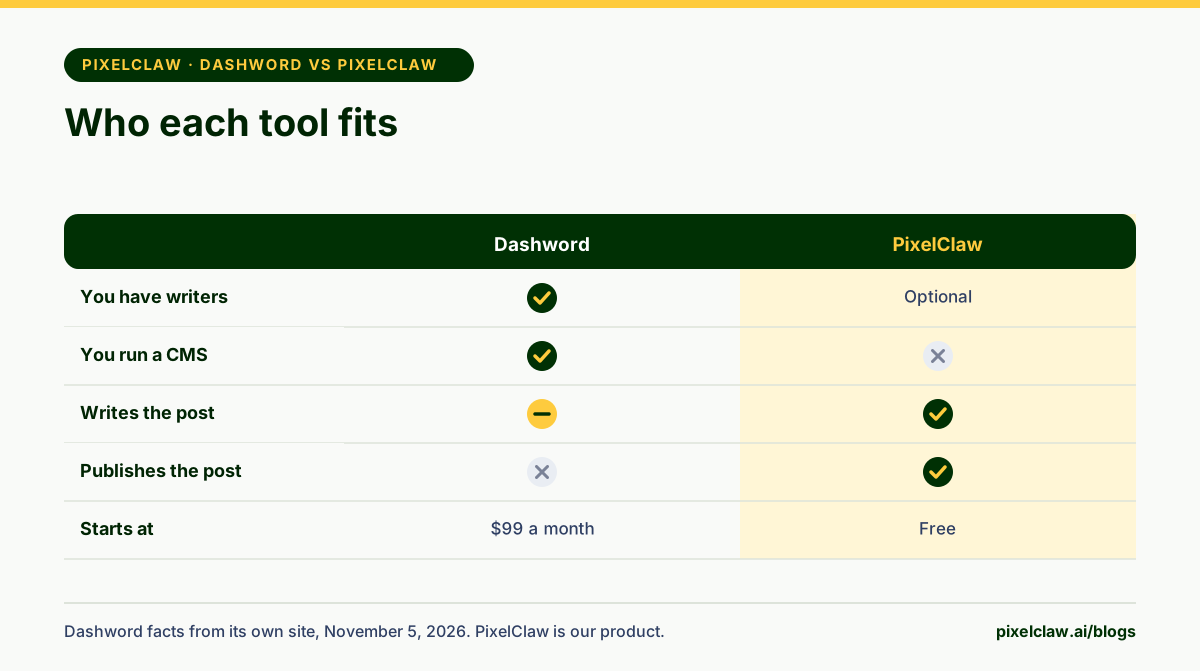
- Dashword is a content research and optimization tool for teams that write; PixelClaw is an AI blog platform that writes and publishes.
- Dashword prices by content reports: 30 a month for $99 with 5 seats, 100 for $349 with 10 seats.
- PixelClaw has a free plan, then Starter at $49.99 and Pro at $99.99 a month, priced in credits.
- Both offer an API and an MCP server: Dashword on every plan, PixelClaw on Starter and higher.
- Autoblogging.ai, often compared with Dashword, is a bulk writer for your CMS, closer to PixelClaw's job than to Dashword's.
Frequently Asked Questions
Is Dashword an AI writer?+
It includes an AI Writer, but its core is briefs built from the ranking pages, real-time content scoring and monitoring of published pages. It is built for teams whose writers do the writing.
Which is cheaper, Dashword or PixelClaw?+
PixelClaw starts lower: a free plan, then $49.99 a month. Dashword starts at $99 a month for 30 content reports. They price different things, though: Dashword prices optimization reports, PixelClaw prices finished posts in credits.
Do Dashword or PixelClaw publish to WordPress?+
Neither publishes into WordPress. Dashword's pages describe briefs, scoring, monitoring and a Google Docs add-on rather than CMS publishing. PixelClaw publishes to a blog it hosts, on its own address or your domain.
How does Dashword compare with Autoblogging.ai?+
They solve different problems. Dashword helps writers optimize content; Autoblogging.ai writes articles in bulk and posts them to WordPress, Shopify and other platforms, from $19 a month. Autoblogging.ai is the closer match to PixelClaw.
Sources
- Dashword pricing — Dashword (Read November 5, 2026.)
- Dashword — Dashword (Read November 5, 2026.)
- Autoblogging.ai pricing — Autoblogging.ai (Read November 5, 2026.)
Built & scored using PixelClaw.ai
More from this blog
Continue exploring autoblogging architecture, AI blog writing, and SEO / AEO / GEO playbooks.

Dashword Alternatives: 6 Content Optimization Tools, From Budget Editors to Full Writers
Dashword builds briefs, scores drafts and monitors published pages, priced by content reports. These six alternatives fit teams that want a cheaper editor, deeper strategy, AI visibility tracking or the writing done too.
PixelClaw Editorial Team
Product and search team

Best AI SEO Writing Tools That Grade Your Draft Before Google Does
Seven AI SEO writing tools that check a draft before it goes live, compared on what they grade: terms and topics, structure, answer-engine readiness or AI visibility.
PixelClaw Editorial Team
Product and search team

A Content Optimization Tool That Scores SEO, AEO, AIO, GEO and SXO Together
Most content optimization tools grade one thing: keywords. PixelClaw scores every post in five areas, explains each failed check in plain words, and fixes most of them in one click.
PixelClaw Editorial Team
Product and search team