Content Economics
Marketing Operations & ROIAI Blog Writer vs Human Content Agency: Real Cost, Turnaround, and Organic Pipeline Benchmarks
Should you pay a content agency $6,000 a month for six posts, hire freelancers, or run an AI blog writer with in-house expert review? Here is the honest operational breakdown.
On this page▸
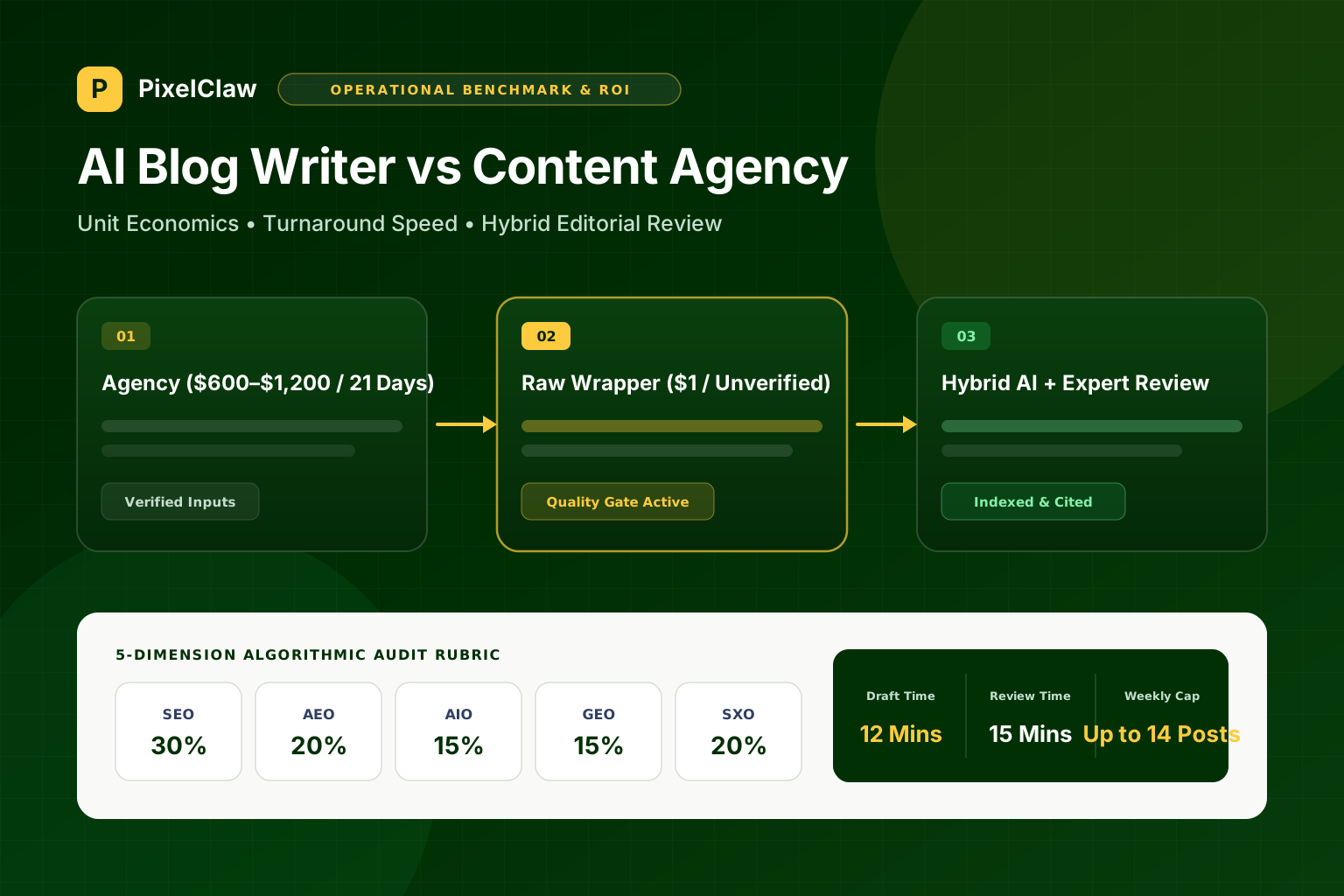
In the AI blog writer vs human writer debate, the highest-performing teams no longer choose one extreme. Traditional content agencies charge $500 to $1,200 per post with three-week turnarounds, while unreviewed AI output lacks first-hand experience. A hybrid workflow—automated research and source-grounded drafting paired with a 15-minute expert review—wins on both cost and quality.
Why do traditional content agencies struggle with technical and niche topics?
Every founder who has hired a traditional SEO content agency knows the honeymoon-to-frustration cycle. Month one starts with a polished keyword spreadsheet. By month three, your senior engineer or operations lead is spending Friday afternoons rewriting drafts because the agency's freelance writer misunderstood how your product actually works.
The problem is structural, not personal. A generalist writer billing $0.25 per word across six different clients cannot afford to spend two days learning your API rate limits, your local building codes, or your e-commerce material specifications. Instead, they skim the top three search results and paraphrase them.
Paraphrasing top search results manually in three weeks is a losing proposition when an automated SERP research pipeline can synthesize those same sources, extract every reader question, and build a cited outline in under two minutes.
AI blog writer vs human writer: what does each do best?
Framing the decision as AI blog writer vs human writer misses how modern editorial teams actually operate. The two have completely complementary strengths.
A source-grounded AI blog writer is unmatched at exhaustive structural discipline: reading twenty ranking pages without fatigue, ensuring every H2 answers a distinct buyer query, writing a 40-to-60-word direct opening answer, formatting comparison tables, checking character limits on titles and meta descriptions, and wiring up JSON-LD schemas.
A human subject-matter expert is unmatched at proprietary judgment: sharing what broke during last month's customer migration, explaining why a popular industry shortcut fails in production, and supplying original screenshots or job-site photos.
- Delegate to PixelClaw: SERP crawling, question clustering, outline scaffolding, source-grounded drafting, 21-check SEO/AEO scoring, and multilingual translation.
- Keep with your internal expert: Supplying proprietary product facts, approving the outline on high-stakes pages, and doing a 15-minute final accuracy pass.
Side-by-side comparison: Content agency vs freelance writer vs PixelClaw hybrid workflow
Here is how the unit economics and operational realities compare across a 12-post monthly publishing schedule:
| Operational Metric | Traditional Content Agency | Freelance Marketplace Writer | PixelClaw Hybrid Workflow |
|---|---|---|---|
| Direct Cost per Article | $600 to $1,200 | $150 to $400 | Included in plan credits or BYOK |
| Turnaround per Post | 14 to 28 days | 5 to 10 days | Under 15 minutes (draft + review) |
| Internal SME Time Needed | 45 mins (brief + heavy rewrite) | 60 mins (managing + editing) | 10 to 15 mins (outline/draft sign-off) |
| On-Page SEO & AEO Audit | Manual checklist (inconsistent) | Rarely included | Automated 21-check score out of 100 |
| 10-Language Localization | $300+ extra per language | Requires separate translators | Built-in localized slugs & hreflang |
| CMS Formatting & Schema | Extra fee or manual upload | Delivered as Google Doc | Published directly with JSON-LD & llms.txt |
How does the 15-minute internal expert review work?
Instead of asking an engineer, clinician, or founder to stare at a blank cursor for four hours, give them a researched, 90+-scoring draft in PixelClaw's review queue.
Because the scoring engine has already verified the title length, meta description, opening direct answer, heading hierarchy, internal links, and FAQ schema, the reviewer never wastes time on formatting mechanics. They spend fifteen minutes checking three things: are the product claims accurate, are the cited sources appropriate, and does the call to action point to the right next step?
How translation economics shift the ROI equation even further
If your business serves customers in Spanish, French, German, Brazilian Portuguese, or Japanese, traditional agency economics become prohibitive. Translating and localizing twelve articles a month across five languages through an agency easily exceeds $15,000 per month.
In PixelClaw, once an English article is approved and published, you can generate linked translations with localized URL slugs, native typography and UI chrome, and automatic hreflang alternate tags—turning one reviewed article into global search coverage.
- Outsourcing to a generalist content agency often gives you the worst of both worlds: high retainers ($4,000–$10,000/month) and junior freelancers who do not know your product.
- An AI blog writer excels at the first 80% of the work: scraping top SERP results, clustering reader questions, structuring tables, and drafting grounded prose.
- Human subject-matter experts excel at the final 20%: verifying edge cases, injecting real customer examples, and signing their byline.
- PixelClaw's two-tier publish bar (60 manual / 77 Autopilot) enforces structural quality automatically so human reviewers never waste time fixing H2 tags or meta descriptions.
- Teams using a hybrid AI + expert review workflow typically publish 4x more high-intent pages per quarter at less than 15% of agency retainer costs.
Frequently Asked Questions
Can an AI blog writer completely replace human editors?+
For low-risk informational and comparison topics that clear the 77/100 Autopilot bar, unattended publishing works reliably. For regulated industries (legal, medical, financial) or deeply technical product tutorials, a 15-minute review by a practitioner adds first-hand credibility that no external freelancer or standalone model can invent.
How much does a human content agency cost compared to PixelClaw?+
B2B and technical content agencies typically charge $500 to $1,200 per 2,000-word article ($4,000 to $9,600 per month for 8 posts). PixelClaw includes a free starter tier and paid plans that cover research, drafting, scoring, and hosting for a fraction of the cost of a single freelance article.
Why do agency drafts often require heavy internal rewriting anyway?+
Agency writers rarely use your product or speak with your customers. They research by reading the top three Google results—the exact step PixelClaw automates in seconds—which means your internal product manager still has to correct technical inaccuracies.
How does PixelClaw help agencies that manage multiple client blogs?+
Many modern SEO agencies use PixelClaw's multi-tenant workspaces, per-blog brand voices, and review queues to handle research and first drafts, freeing their strategists to focus on client positioning, original evidence, and conversion tracking.
What happens if a translated post needs an update when the English article changes?+
PixelClaw tracks translation freshness across linked language versions so editors can see which translated posts need a sync when the English source article is updated.
Sources
- Google Search Central: Quality Rater Guidelines & E-E-A-T Overview — Google Search Central (Explains how first-hand Experience and Expertise differentiate trustworthy articles from generic summaries.)
- U.S. Bureau of Labor Statistics: Occupational Outlook for Technical Writers and Editors — U.S. Bureau of Labor Statistics (Provides baseline compensation benchmarks for technical writing and editorial review roles.)
- Schema.org: Person and Author Markup Specification — Schema.org (Defines structured author attribution fields used to communicate subject-matter credentials to search engines.)
Built & scored using PixelClaw.ai
More from this blog
Continue exploring autoblogging architecture, AI blog writing, and SEO / AEO / GEO playbooks.
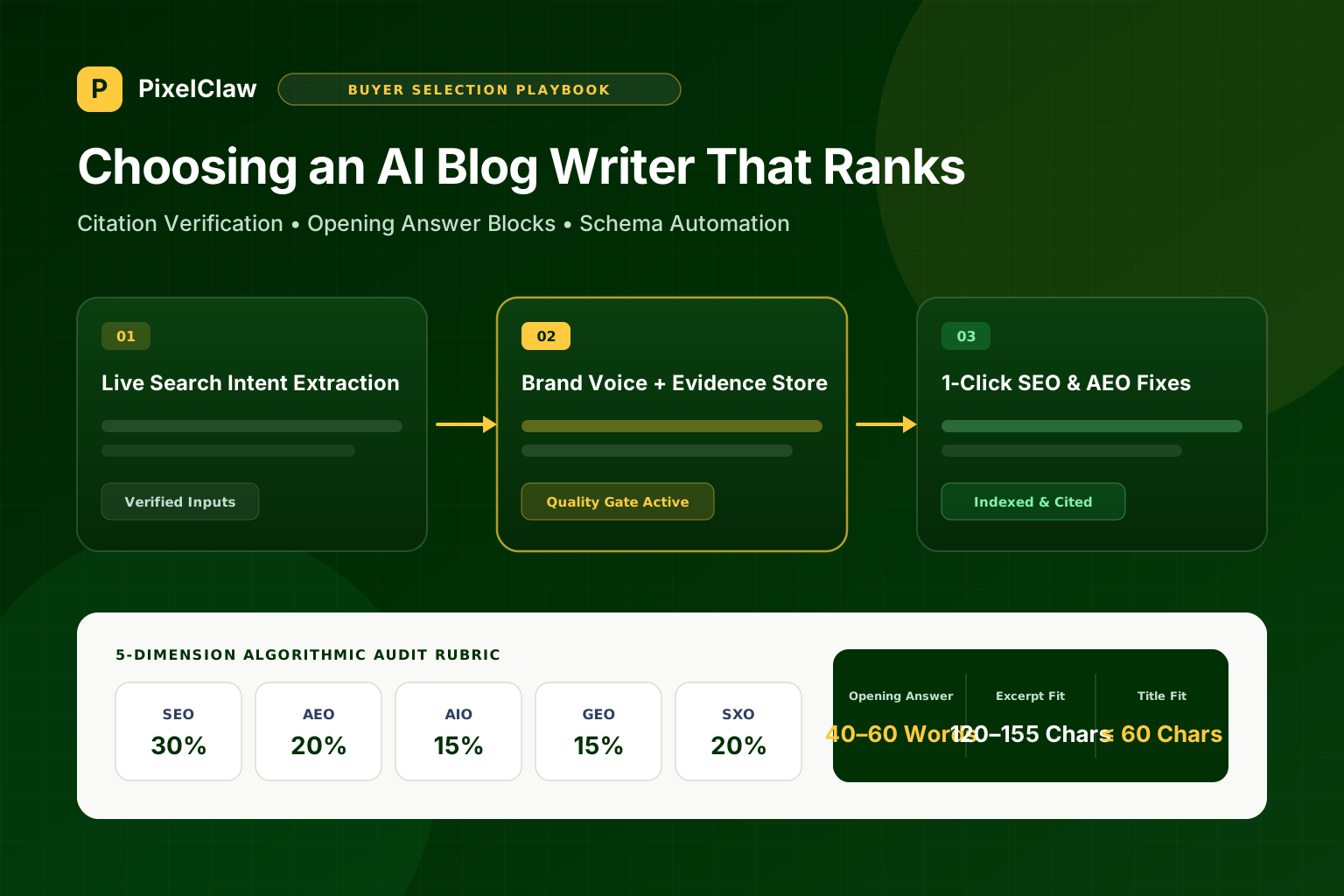
How to Choose an AI Blog Writer That Actually Ranks on Google, Bing, and AI Search
Most AI blog writers produce generic essays that stall on page four. Here is the exact technical checklist for selecting an AI blog writer engineered for search rankings and AI citations.
Sophia Lin
E-Commerce & Content Strategy Director
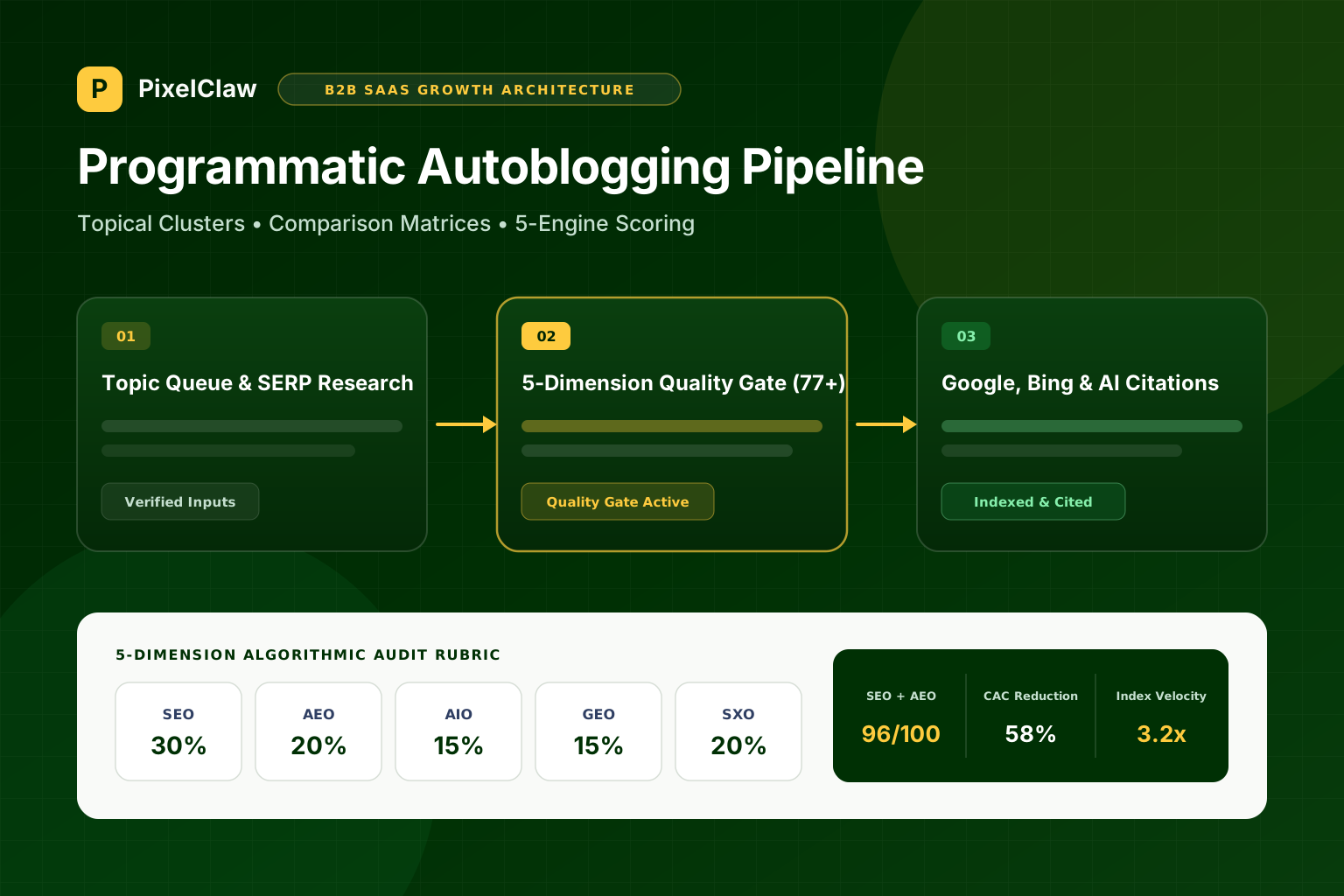
Scaling B2B SaaS Organic Pipeline: How Programmatic Autoblogging Drives 10x More Qualified Demos
From thin comparison pages to definitive technical authority: How modern B2B SaaS engineering and marketing teams win across Google Search, Perplexity, and Gemini AI Overviews.
Marcus Vance
Head of Growth Architecture
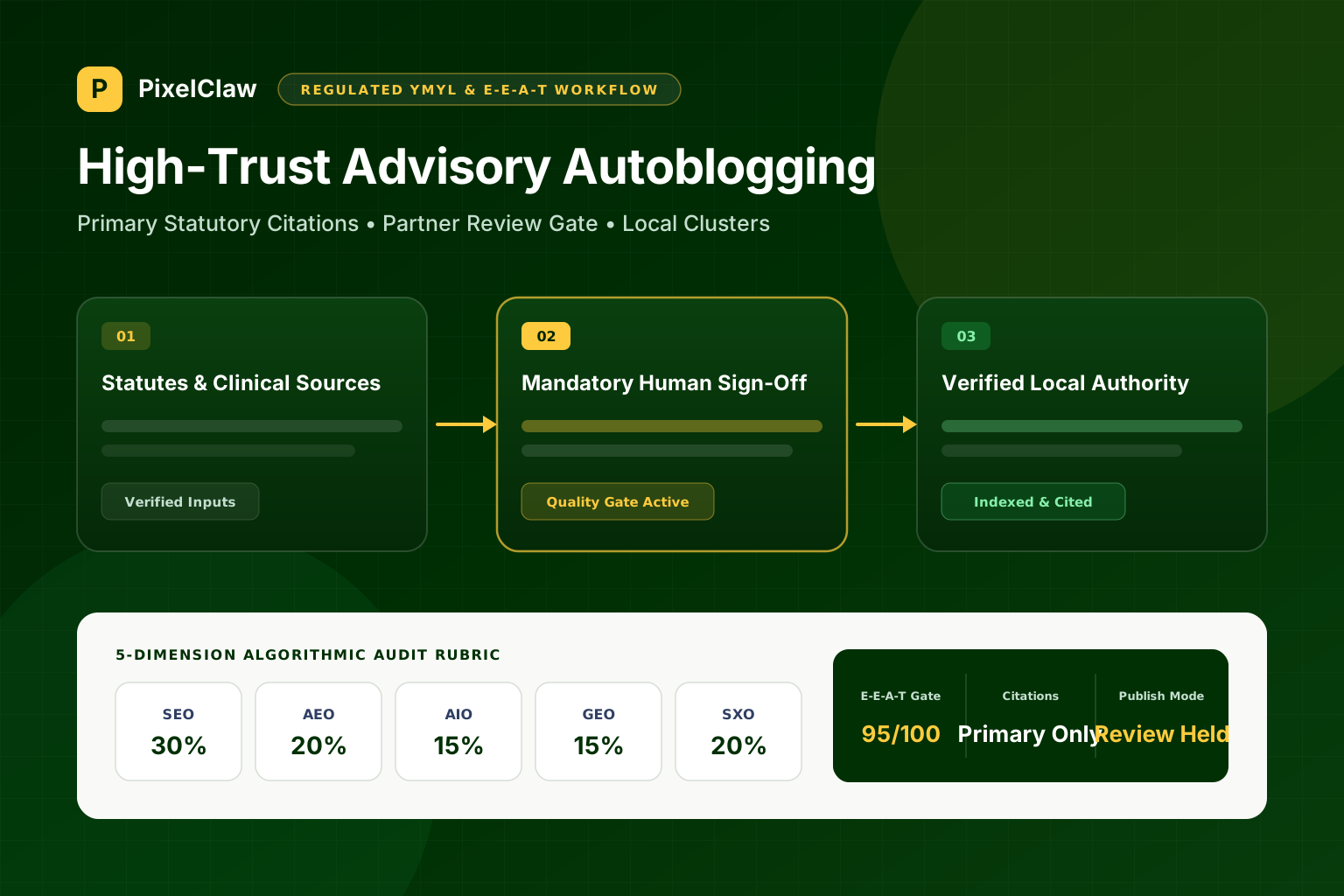
High-Trust Autoblogging for Professional Services: Capturing Localized and High-E-E-A-T Traffic Without Compliance Risk
How law firms, accounting practices, healthcare clinics, and advisory firms generate consistent inbound clients while upholding strict regulatory and ethical standards.
Dr. Arthur Pendelton
Compliance & Editorial Director