Blogging
Growth guideIs Blogging Still Worth It in 2026? Yes, If You Blog for Search and AI Answers
Most blogs are not working, and the 2026 numbers say so plainly. The ones that do work have something in common, and none of it is writing faster.
On this page▸
Is blogging worth it in 2026? For a business, yes, when each post answers a question your buyers actually search. Search and AI assistants still send readers to useful pages, and posts keep working for years. What no longer pays is generic blogging: Orbit Media's 2026 survey found only 13.9% of content marketers report strong results.
Is blogging worth it? The short answer for businesses
Blogging is worth it when three things are true. Your buyers search for answers before they buy. You can publish useful posts on a steady schedule. And you will judge results over months, not weeks. If all three hold, a blog is one of the few marketing assets that keeps paying after you stop spending on it.
Blogging is not worth it as a diary, a press release archive or a stream of posts written to hit a word count. Those blogs were already failing before AI arrived. AI has only made them cheaper to produce and easier for search engines to ignore.
The rest of this guide is the evidence for both halves of that answer, and what the blogs that work do differently.
What the 2026 numbers say about blogging
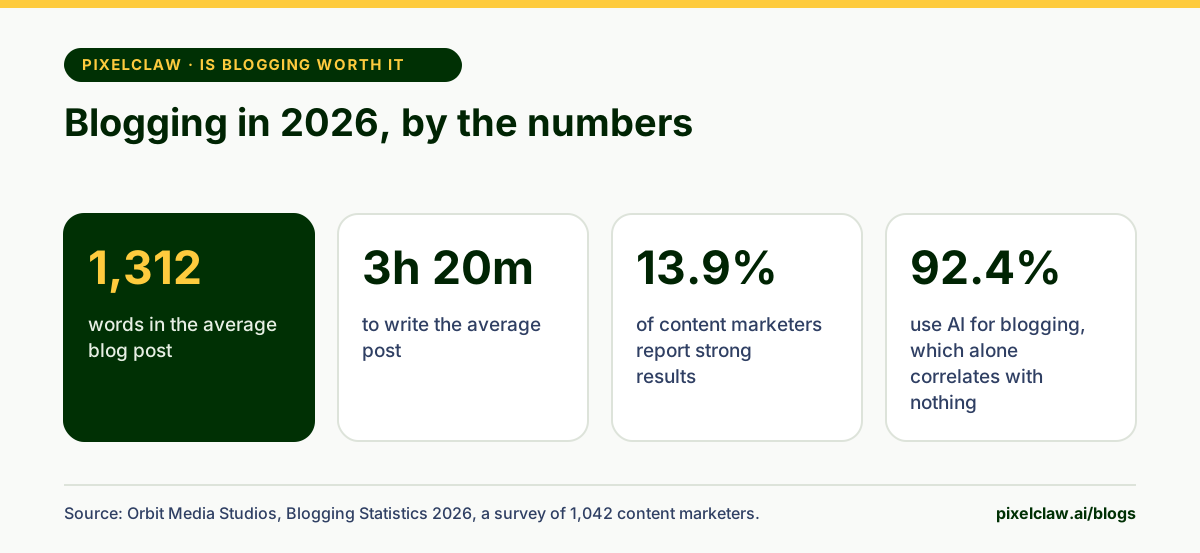
The most useful long-running data on blogging comes from Orbit Media's annual survey. Its 2026 edition asked 1,042 content marketers how they write and what results they see, and the headline is uncomfortable.
The average post is 1,312 words, down from a peak of 1,427 in 2023, and takes 3 hours and 20 minutes to write, down from 4 hours 10 minutes in 2022. Bloggers got faster. Yet only 13.9% say their blog delivers strong results, an all-time low, down from about one in four a few years ago.
The survey's most important line is about AI: 92.4% of respondents now use it for blogging, and that use correlates with nothing. Writing faster did not make blogs work better. What did correlate with strong results were the slower habits: keyword research, publishing original research, a formal editing process and paying attention to analytics. Marketers who used six or more of the eight strategies it tracks were nearly three times as likely to report strong results.
Why blogging still works when AI answers the question
The fear is reasonable: if Google's AI Overviews and ChatGPT answer the question, why would anyone visit a blog? The answer is that AI answers are made from blogs. Google says its AI features show supporting links to pages that are indexed and eligible to appear in search, and chat assistants that browse the web cite the pages they read.
That changes what a good post is for. A blog post is now both a page people visit and a source machines quote. The posts that win are the ones with the clearest answer, the best evidence and a brand worth naming, which are covered in AEO for startups and GEO for startups.
Simple factual questions will send fewer clicks than they used to. Questions that need judgment, comparison or experience still send readers, and those readers arrive closer to a decision.
When blogging is not worth it
Be honest about these before you start. If your buyers do not search for answers, because you sell to a handful of named accounts who never use Google to find vendors, a blog is a support asset at best. If you cannot publish at least a couple of times a month for a year, the compounding never starts.
If the plan is to mass-produce posts on every keyword, Google's guidance on AI content is clear that content made mainly to manipulate rankings is spam, however it was written. And if you need customers next week, a blog is the wrong tool for that week; run it alongside sales and paid tests, not instead of them.
The benefits of blogging for business, and when each shows up
The benefits of business blogging arrive in a predictable order. The first ones are not traffic.
| Benefit | What it does | When it shows up |
|---|---|---|
| Sales enablement | Answers prospects' questions with a link instead of a call | From the first post |
| Search impressions | Shows you which questions your market asks | Within weeks |
| Search traffic | Brings readers who are looking for what you sell | After a few months |
| AI citations | Gets your answers and brand named by AI assistants | As your library and reputation grow |
| An owned asset | Keeps working without a budget, unlike ads | Grows every month you publish |
How to make blogging worth it: do what the 14% do
The blogs that report strong results are not the ones that write the most. They research keywords before writing. They research the topic itself and add something original. They edit before they publish. They read their analytics and act on it. Each of those habits costs time, which is exactly why so many teams have dropped them as AI made drafting fast.
Put them back and blogging becomes worth it again. Choose questions from keyword and Search Console data. Write from sources and first-hand experience. Check every post against a standard before it goes live. Publish on a schedule you can keep, and update the posts that earn impressions but not clicks. The organic growth strategy guide turns that into a 90-day plan.
A two-minute test: is blogging worth it for your business?
Answer these honestly. Four or more yeses mean a blog is very likely worth it; two or fewer mean your time is better spent elsewhere for now.
The questions are deliberately practical. Blogging rarely fails because the writing is bad. It fails because nobody searches for the topic, nobody keeps publishing, or nobody waits long enough for the compounding to start. If you answered yes to the fourth question only because a tool will do the writing, that still counts: the commitment that matters is reviewing and approving, not typing.
Two or three yeses is the most common result for early startups. In that case start small: one cluster of five posts on the question your sales calls raise most, judged after a quarter.
- Do your buyers search Google or ask an AI assistant before they contact a vendor like you?
- Do prospects ask the same questions on sales calls again and again?
- Do you know something about your customers' problem that most articles get wrong?
- Can someone publish, or approve, one useful post a week for the next twelve months?
- Would one extra customer a month from search pay for the time a blog takes?
- Are you willing to judge results after six months rather than six weeks?
How PixelClaw makes blogging worth the time
PixelClaw is built around the habits that correlate with results rather than the ones that just save keystrokes. Keyword research feeds the topic queue. Research comes before writing: it reads the pages that rank, collects the questions readers ask and plans the length from what ranks. The draft is written from those sources.
Editing is built in. Every draft gets a score out of 100 from 21 checks across SEO, AEO, AIO, GEO and SXO, most failing checks come with a one-click fix, and posts under 60 are held back. Analytics and Search Console data are there on paid plans, so you can see which posts earn their place.
The time cost is what changes. The 3 hours and 20 minutes of writing, plus research, images and publishing, become a review of a finished draft. Autopilot can keep the schedule for you, and the autoblogging guide explains how far you can safely let it run on its own. You can try all of it on the free plan, with a hosted blog included, before deciding whether blogging is worth it for you.
- Blogging is worth it for businesses whose buyers search before they buy, as long as each post answers a real question better than what already ranks.
- Orbit Media's 2026 survey of 1,042 content marketers found 13.9% report strong results, an all-time low, even though 92.4% now use AI for blogging.
- Using AI did not correlate with results in that survey; keyword research, original research, editing and analytics did, and using six or more proven strategies made strong results nearly three times as likely.
- AI search has not killed blogging; AI answers are built from web pages, and the clearest, best-sourced posts are the ones they cite.
- The winning approach is fewer, researched, checked posts on a steady schedule, which is what PixelClaw automates.
Frequently Asked Questions
Is blogging dead in 2026?+
No, but generic blogging is struggling. Posts that repeat what already ranks get fewer clicks as AI answers cover the basics. Posts that answer specific questions with real research and experience still rank, still get cited by AI assistants and still bring customers.
How long does a business blog take to get traffic?+
Usually a few months of steady publishing. New posts often show impressions in Search Console within weeks; clicks grow as the library and the site's authority grow. Specific questions rank sooner than broad topics.
Is it better to blog or post on social media?+
Do both, for different jobs. A social post reaches people fast and fades within days. A blog post can rank and be cited for years. Publish the full answer on your blog and use social posts to send people to it.
Can I blog with AI and still rank?+
Yes. Google rewards helpful content however it is produced, and treats mass-produced pages made to manipulate rankings as spam. AI helps when it does the research and drafting for posts a person has planned and checked.
How many blog posts do I need before it works?+
There is no magic number. Start with one cluster: a pillar guide and the supporting posts around it, linked together. When that cluster earns impressions and clicks, build the next one around a related topic.
Sources
- Blogging Statistics 2026: What 1,042 Content Marketers Told Us About What Works — Orbit Media Studios (1,312-word average post; 3 hours 20 minutes to write; 13.9% report strong results; 92.4% use AI for blogging.)
- AI features and your website — Google Search Central
- Google Search's guidance about AI-generated content — Google Search Central Blog
Built & scored using PixelClaw.ai
More from this blog
Continue exploring autoblogging architecture, AI blog writing, and SEO / AEO / GEO playbooks.

Organic Growth Strategy for Startups: Build Traffic That Keeps Growing While You Sleep
Ads rent attention and stop the day the budget does. An organic growth strategy builds a library of posts that rank in Google, get quoted by AI answers and keep sending buyers for years.
PixelClaw Editorial Team
Product and search team
Growth Hacking for Startups in 2026: Why a Blog on Autopilot Is the Hack That Compounds
Most growth hacks work for a month and then everyone copies them. Content is the rare one that gets stronger the longer you run it, and automation finally makes it fast enough for a startup.
PixelClaw Editorial Team
Product and search team
SEO Copywriting in 2026: How to Write Blog Copy That Ranks, Gets Quoted and Sells
Good copy used to have two readers, the search engine and the person. Now it has three, because AI answers quote it too. Here is how to write for all three without sounding like a robot or a billboard.
PixelClaw Editorial Team
Product and search team