AEO & GEO Playbook
Search & AI DiscoveryAEO vs GEO vs SEO: How to Structure Blog Posts So Perplexity, ChatGPT, and Google AI Overviews Cite You
Search visibility now spans traditional blue links, direct answer snippets, and generative AI citations. Here is how SEO, AEO, AIO, GEO, and SXO work together on every post.
On this page▸
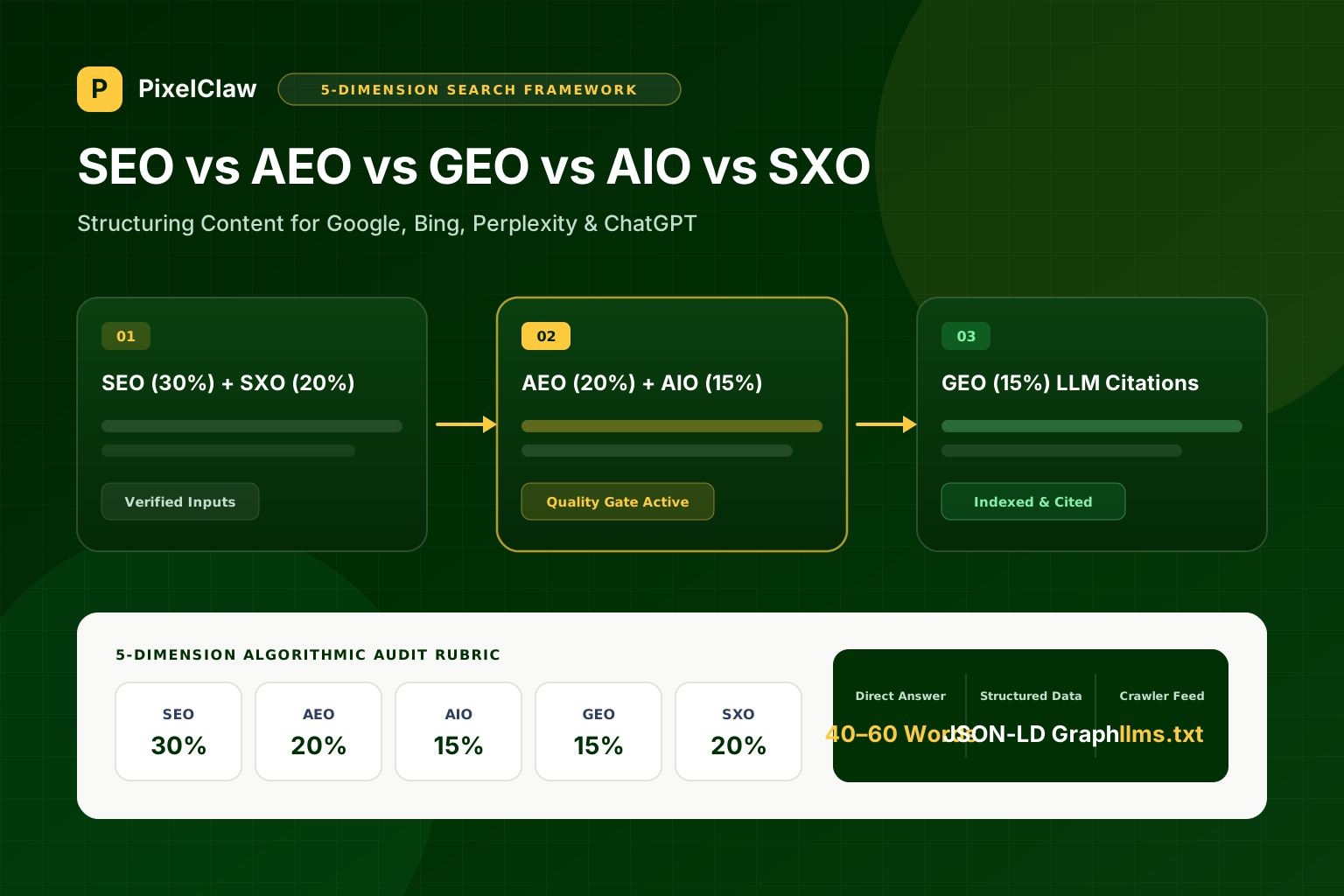
When comparing AEO vs GEO vs SEO, each discipline targets a distinct layer of discovery. SEO helps traditional crawlers index and rank your page; Answer Engine Optimization (AEO) formats 40-to-60-word direct answers and FAQs for instant extraction; and Generative Engine Optimization (GEO) provides cited facts and crawler access so AI assistants cite you.
AEO vs GEO vs SEO: what do all five acronyms actually mean?
Marketing teams are drowning in three-letter acronyms. Every week brings another thread claiming that traditional SEO is dead and replaced by AEO or GEO. In reality, modern search retrieval relies on five complementary layers working together.
Here is what each acronym means in plain operational terms, without the hype:
- SEO (Search Engine Optimization — 30% weight in PixelClaw): The technical and topical foundation that lets Google and Bing crawl, index, and rank your URL. Includes title and excerpt lengths, slug format, single H1, sequential headings, canonical URLs, Open Graph tags, JSON-LD schema, and internal links.
- AEO (Answer Engine Optimization — 20% weight): Structuring content so featured snippets, voice assistants, and answer engines can extract a direct answer immediately. Includes the 40-to-60-word opening answer, Key Takeaways box, scannable lists or tables, FAQ section, and reader question coverage.
- AIO (AI Trust & Attribution — 15% weight): Proving human accountability and factual integrity through a named author byline and at least two verifiable external sources.
- GEO (Generative Engine Optimization — 15% weight): Making your publication discoverable and citable to LLM crawlers via open robots.txt rules (GPTBot, ClaudeBot, PerplexityBot), llms.txt feeds, and publisher organization schema.
- SXO (Search Experience & Flow — 20% weight): Keeping human readers engaged once they click, with saved image width and height attributes, alt text descriptions, a table of contents on posts over 1,200 words, and a clear call to action.
The 5-dimension search matrix side by side
Use this reference table to see what each dimension optimizes for and the exact checks PixelClaw runs on every draft:
| Dimension | Weight | Primary Target | Core Checks Verified Before Publish |
|---|---|---|---|
| SEO | 30% | Google & Bing Crawlers | Title ≤60 chars, excerpt 120–155 chars, slug, single H1, heading order, canonical, OG, JSON-LD, ≥2 internal links |
| AEO | 20% | Answer Boxes & RAG Chunks | 40–60 word opening answer, Key Takeaways box, FAQ block, lists/tables, ≥80% reader questions answered |
| SXO | 20% | Human Reader Experience | Saved image width/height (zero CLS), image alt text, TOC on >1,200-word posts, clear CTA |
| AIO | 15% | Trust & E-E-A-T Evaluators | Named author byline, ≥2 external source links or Sources citation block |
| GEO | 15% | ChatGPT, Perplexity & Claude | AI crawlers permitted in robots.txt, publisher Organization schema, llms.txt index |
How do Perplexity, ChatGPT Search, and AI Overviews pick sources to cite?
Understanding how to get cited by Perplexity and ChatGPT starts with how retrieval-augmented generation (RAG) works under the hood. When a buyer asks an AI assistant a complex software or service question, the assistant does not read the entire web from scratch. It runs a fast search query, retrieves the top candidate pages, splits those pages into semantic passages around H2 and H3 headings, and synthesizes an answer from the clearest, best-supported passages.
If your article buries the answer under 400 words of narrative throat-clearing, the retrieval ranker scores your passage poorly. Conversely, when your H2 heading matches the buyer's question and the very first sentences beneath it state a clear conclusion backed by a comparison table and a primary source link, your passage becomes the easiest block for the model to cite.
What does an AI-citable blog post look like block by block?
When you open any post on a PixelClaw blog using the Guide layout, the DOM order is intentionally arranged for both human skimmers and machine parsers:
- Header & Byline: H1 title, concise dek summary, named author with initials avatar, publication date, reading time, and language switcher links.
- Opening Direct Answer: A 40-to-60-word paragraph before the first H2 that directly answers the headline question.
- Sticky Table of Contents: Question-based H2 anchor links beside the article on desktop and in a compact disclosure menu on phones.
- Structured Body Sections: H2 headings paired with short paragraphs, bulleted checklists, and a side-by-side HTML table.
- Key Takeaways & FAQ Blocks: Scannable bullet takeaways followed by native details/summary FAQ items mirrored in FAQPage JSON-LD.
- Sources & Call to Action: Numbered external references verifying claims, followed by a single relevant next step for the reader.
How to verify your visibility across search and AI assistants
Do not rely on vanity traffic metrics alone. Connect Google Search Console in PixelClaw to track which queries generate impressions and clicks, use PixelClaw's cookieless analytics to measure total page views across your posts and translations, and run periodic visibility checks to see whether AI assistants cite your domain for your core commercial questions.
- SEO, AEO, AIO, GEO, and SXO are not competing fads; they are five structural layers of the same well-engineered article.
- Place a 40-to-60-word direct answer immediately before your first H2 heading so retrieval-augmented generation (RAG) systems can quote your conclusion without truncation.
- Comparison tables and bulleted decision lists are extracted by Google AI Overviews and Perplexity far more reliably than dense multi-topic paragraphs.
- Blocking GPTBot, ClaudeBot, or PerplexityBot in robots.txt makes your site invisible to generative answer engines.
- PixelClaw scores all five dimensions out of 100 before you publish, weighting SEO (30%), AEO (20%), SXO (20%), AIO (15%), and GEO (15%).
Frequently Asked Questions
What is the main difference between AEO and GEO?+
Answer Engine Optimization (AEO) focuses on formatting concise, self-contained answers—such as a 40-to-60-word opening paragraph, a Key Takeaways box, tables, and FAQ accordions—that answer boxes can quote directly. Generative Engine Optimization (GEO) focuses on crawler eligibility (allowing GPTBot, ClaudeBot, and PerplexityBot), llms.txt discovery, publisher identity, and verifiable primary citations that large language models trust when synthesizing multi-source responses.
Does optimizing for AEO and GEO hurt traditional Google SEO?+
No—it strengthens traditional SEO. Clear opening answers, descriptive H2 questions, structured tables, fast-loading images with saved dimensions, and verified external links improve reader engagement and satisfy Google's Helpful Content criteria.
Why is the 40-to-60-word opening answer so specific?+
Fewer than 40 words rarely provides enough context to stand alone as a complete answer, while more than 60 words gets truncated by featured snippet boxes and RAG chunking windows. Hitting 40 to 60 words before the first H2 gives answer engines a clean, quotable unit.
Do I need special proprietary meta tags for Google AI Overviews?+
No. Google states that standard search indexing, helpful content with clear evidence, and valid Schema.org structured data (BlogPosting, FAQPage, Organization, BreadcrumbList) are what make pages eligible for AI Overviews.
How does PixelClaw calculate the composite score across these five areas?+
PixelClaw runs 21 core checks (plus up to 6 conditional keyword, length, and reader-question checks) and computes the weighted composite: SEO (30%) + AEO (20%) + SXO (20%) + AIO (15%) + GEO (15%).
Sources
- Google Search Central: AI Features and Your Website — Google Search Central (Explains how Google's AI Overviews and AI Mode select and link to supporting web pages.)
- Schema.org: SpeakableSpecification and FAQPage Markup — Schema.org (Defines machine-readable selectors identifying sections of an article best suited for direct answer playback and extraction.)
- OpenAI Documentation: Overview of OpenAI Crawlers (GPTBot and OAI-SearchBot) — OpenAI (Documents how OAI-SearchBot and ChatGPT-User surface and cite web pages in ChatGPT Search.)
Built & scored using PixelClaw.ai
More from this blog
Continue exploring autoblogging architecture, AI blog writing, and SEO / AEO / GEO playbooks.
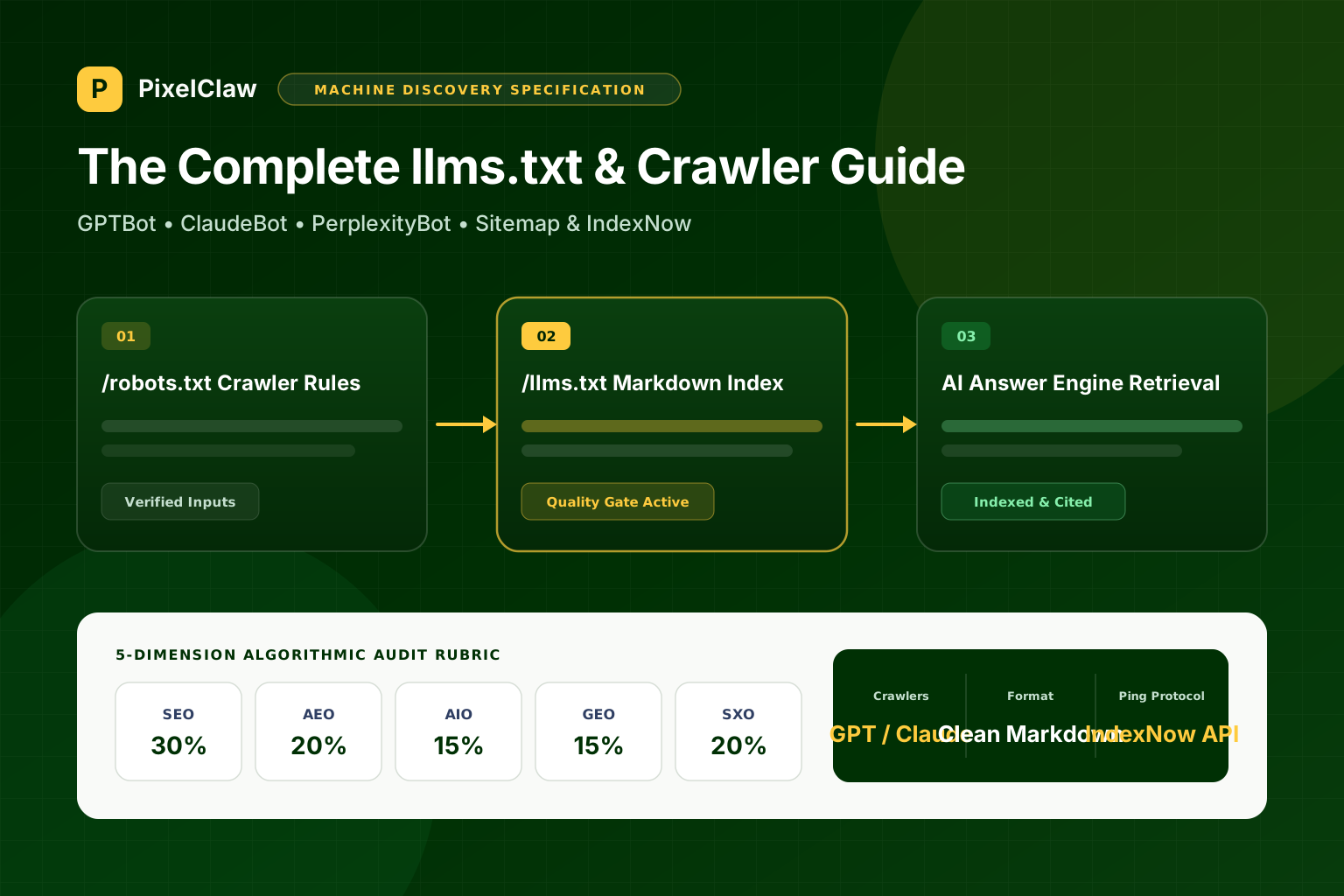
The Complete llms.txt Guide: How to Configure Your Blog for GPTBot, ClaudeBot, and PerplexityBot
Why AI agents struggle with JavaScript-heavy marketing sites, how the llms.txt specification works alongside robots.txt and sitemap.xml, and how to set it up automatically.
Marcus Vance
Head of Growth Architecture
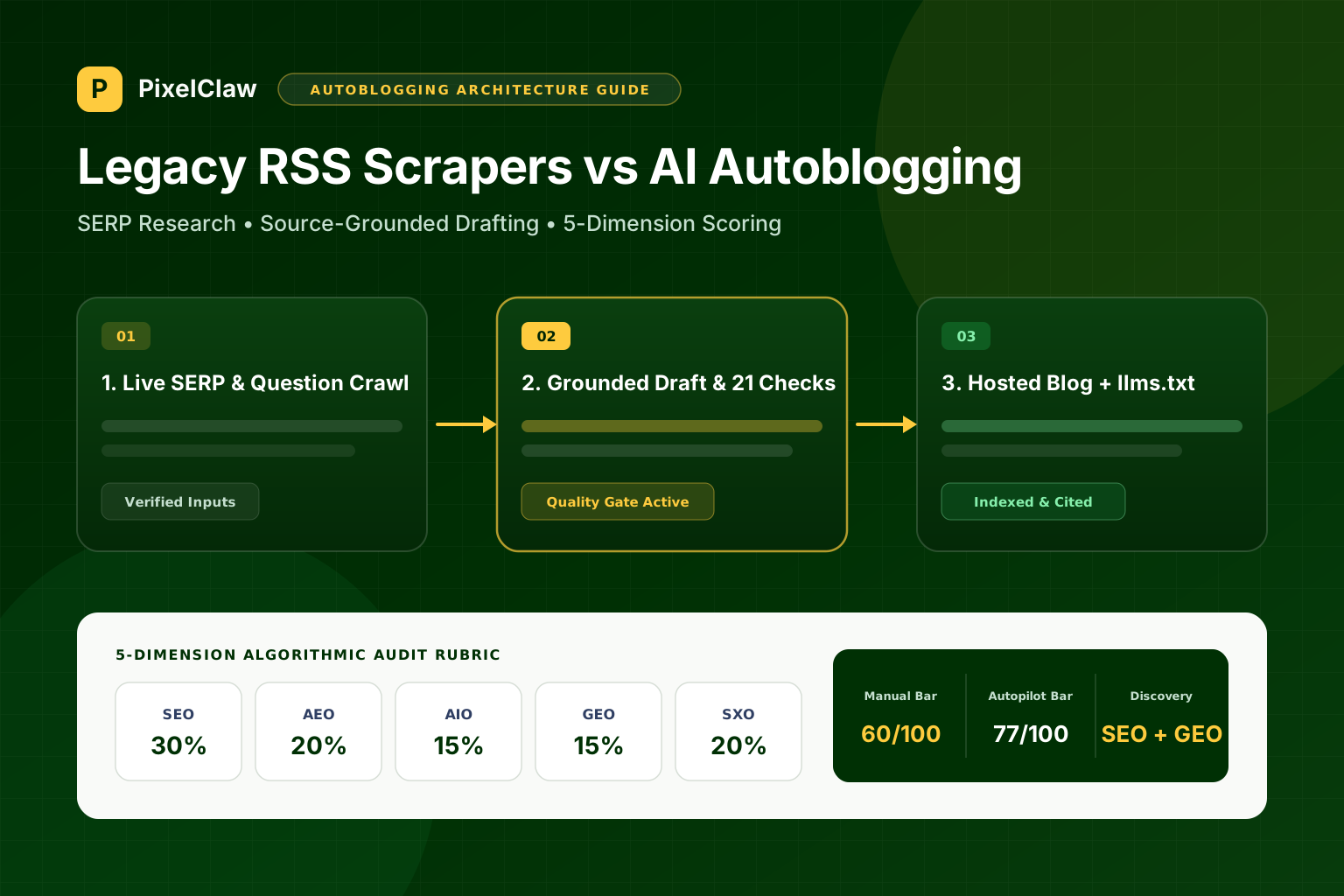
What Is Autoblogging? How Modern AI Autoblogging Works Without Publishing Slop
Autoblogging explained for founders and marketing teams: how modern research-first pipelines differ from old RSS scrapers, and what it takes to earn rankings and AI citations.
Marcus Vance
Head of Growth Architecture
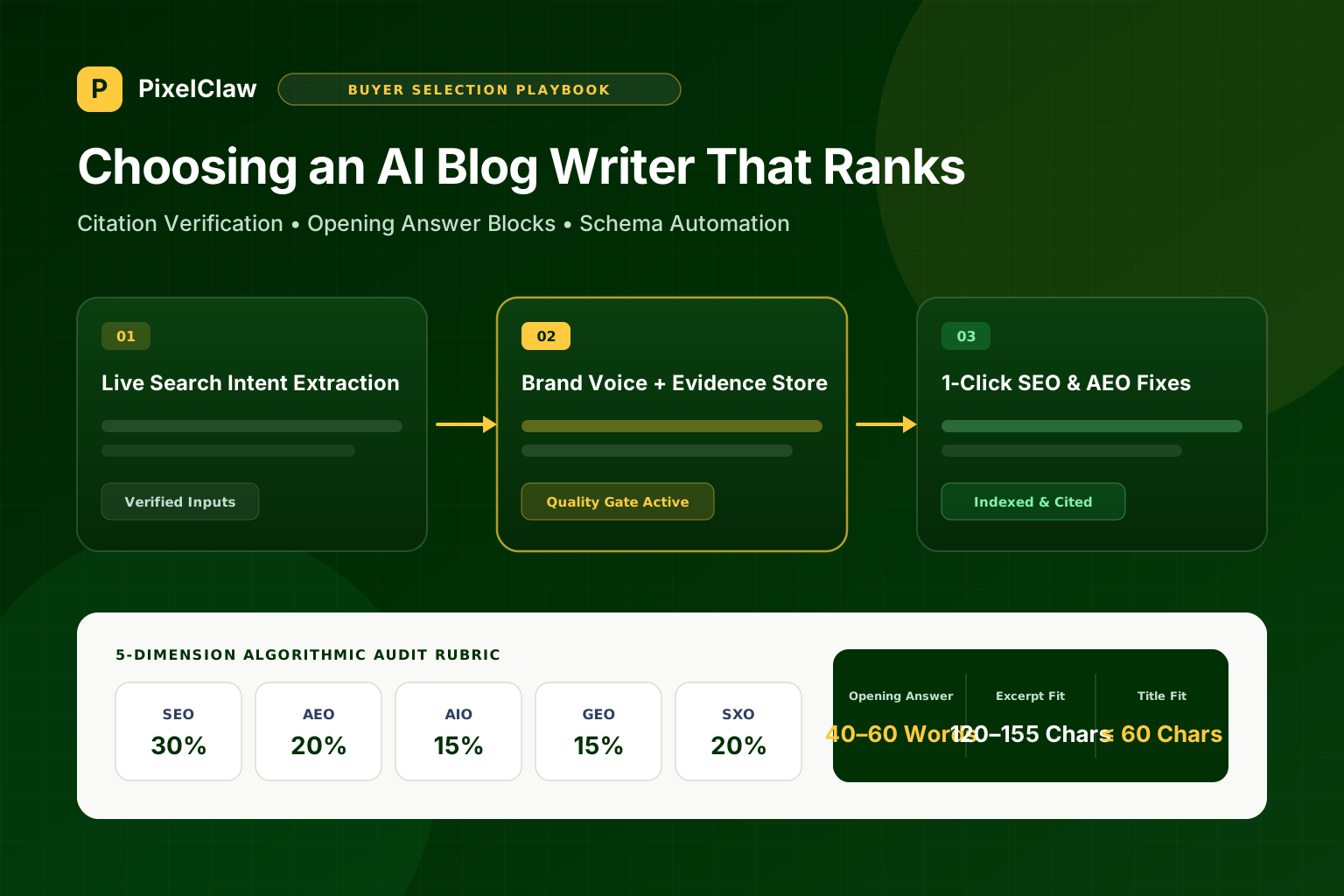
How to Choose an AI Blog Writer That Actually Ranks on Google, Bing, and AI Search
Most AI blog writers produce generic essays that stall on page four. Here is the exact technical checklist for selecting an AI blog writer engineered for search rankings and AI citations.
Sophia Lin
E-Commerce & Content Strategy Director