Google Policy & E-E-A-T
Search Compliance & GovernanceDoes Google Penalize Autoblogging? What Search Spam Policies and Helpful Content Systems Actually Target
Separating SEO myth from Google Search Central documentation: why scaled content abuse penalties hit unvetted bulk sites, and how source-grounded autoblogging stays compliant.
On this page▸
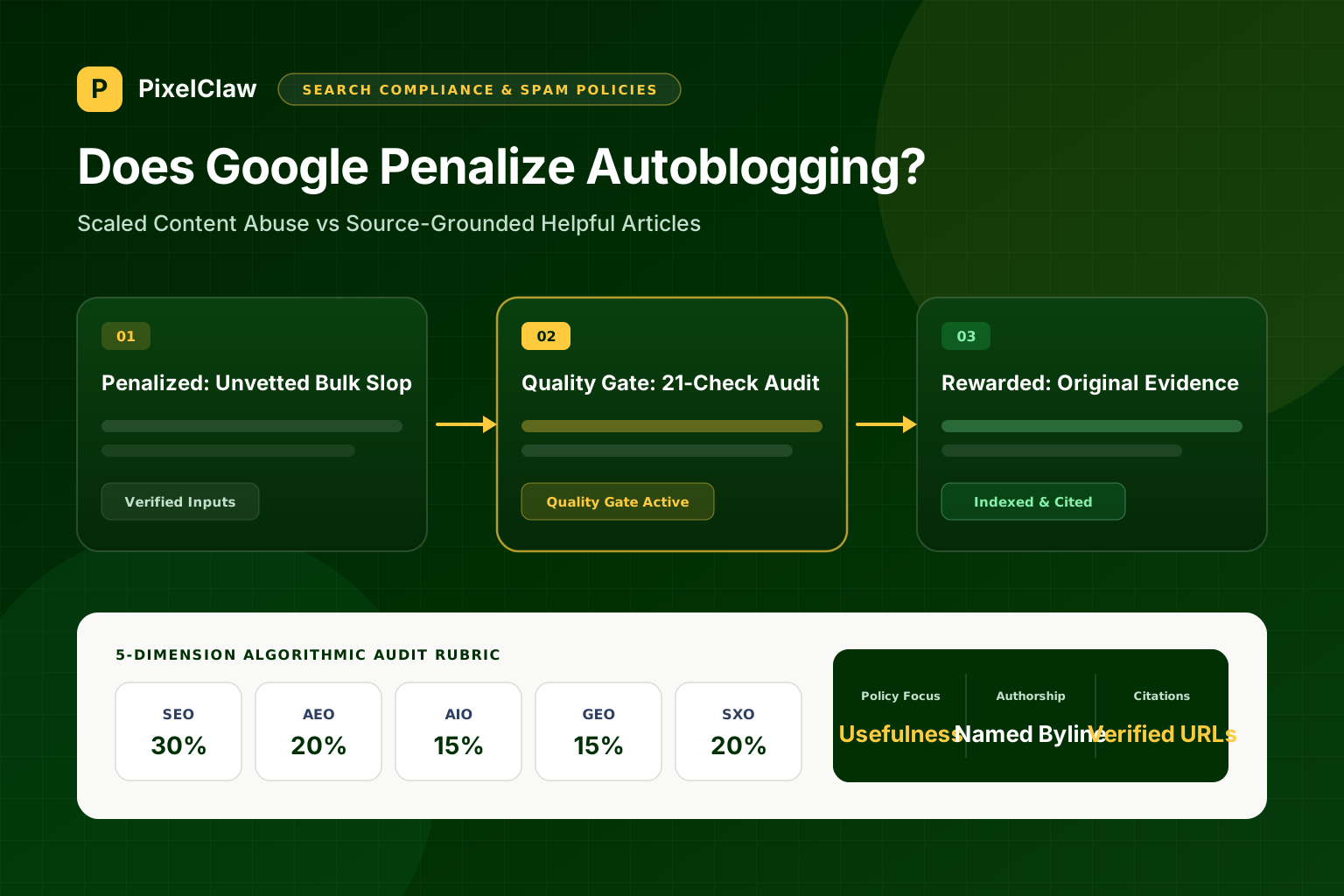
So, does Google penalize autoblogging? Google does not penalize a page simply because AI or automation helped research and draft it. Instead, Google's Scaled Content Abuse policy penalizes mass-published, unverified pages that add no value for readers. Autoblogging that grounds claims in real sources, enforces quality thresholds, and pacing rules ranks safely.
Does Google penalize autoblogging, or does it penalize scaled spam?
Whenever a site owner asks does Google penalize autoblogging, they are usually reacting to horror stories of domains that published 2,000 unedited ChatGPT articles over a weekend and lost all organic traffic the following month.
Look closely at Google Search Central's official guidance on AI-generated content and the March 2024 Scaled Content Abuse update. Google makes a sharp distinction between the authoring mechanism and the resulting page quality. Automation has powered legitimate weather reports, sports scores, financial summaries, and structured product guides for over a decade.
What Google penalizes is scaled content abuse: generating large numbers of pages that contain no original synthesis, invent facts, or stitch together search keywords without answering the underlying human question.
What triggers a Scaled Content Abuse demotion in practice?
When we audit domains that suffered algorithmic demotions after using first-generation bulk writers, the same four failure modes appear almost every time:
- Zero-research hallucination: The tool wrote from a bare keyword prompt, inventing statistics, quoting non-existent studies, and linking to 404 pages.
- Programmatic keyword swapping without substance: Publishing fifty identical articles where only the city name or industry noun changed while 95% of the paragraphs remained identical.
- Sudden unnatural velocity spikes: A domain that published two articles a year suddenly dumping 400 URLs into its sitemap in 48 hours.
- Missing trust and attribution signals: No named author, no external sources, no FAQ or structured schema, and broken mobile layouts.
Penalized bulk AI spam vs compliant source-grounded autoblogging
Compare the signals emitted by a penalized bulk-generation setup against a governed autoblogging workflow in PixelClaw:
| Search Quality Signal | Penalized Bulk AI Spam | PixelClaw Governed Autoblogging |
|---|---|---|
| Pre-Draft Research | None (prompt-only generation) | Live SERP & reader question crawl before outlining |
| Source Attribution | Zero links or hallucinated URLs | Verified external sources + dedicated Sources block |
| Publish Threshold | Publishes 100% of generated drafts | Holds <60 drafts; requires ≥77 for Autopilot |
| Publishing Cadence | Hundreds of URLs dumped at once | Paced schedule (up to 7–14 posts/week max) |
| Authorship & E-E-A-T | Anonymous or fake personas | Named workspace author + published/updated dates |
| Reader Experience (SXO) | Walls of unformatted text | 40–60 word direct answer, TOC, tables & FAQs |
Five technical guardrails that keep autoblogging compliant
To build durable organic traffic with google helpful content AI blogging, configure five operational guardrails before turning on scheduled publishing.
First, ground every article in live search evidence and your own business profile. Second, enforce the 21-check quality rubric so no post goes live without a concise opening answer, sequential headings, at least two internal links, and at least two verified external sources.
Third, keep human-in-the-loop review active for Your Money Your Life (YMYL) topics in healthcare, law, finance, and safety-critical services. Fourth, connect Google Search Console to your workspace so you can monitor impressions, clicks, and indexing coverage alongside page views.
Fifth, maintain transparent editorial standards by linking to your editorial policy and updating articles when underlying facts or product specs change.
Why pacing and weekly publishing caps protect your crawl budget
More is not always better in search indexing. Even large editorial publications rarely publish more than one or two deeply researched guides per day on a single blog.
That is why PixelClaw limits Autopilot to 7 posts per week on standard plans—one post a day—or up to 14 posts per week while you have purchased credits. Enforcing a steady, human-scale cadence ensures search crawlers index each new URL promptly and keeps your editorial quality bar high.
- Google's official documentation explicitly states that appropriate use of AI or automation is not against search guidelines.
- Manual actions and algorithmic demotions target Scaled Content Abuse: flooding an index with hundreds of thin, repetitive, or hallucinated pages.
- Four signals trigger quality demotions on automated blogs: fabricated citations, identical city/keyword-swapped templates, anonymous authorship, and unnatural publishing spikes.
- PixelClaw enforces a hard cap of up to 7 Autopilot posts per week (or up to 14 with purchased credits) per blog so no workspace can accidentally flood its domain.
- Every post should display a real author byline, publication and modification dates, and traceable external sources.
Frequently Asked Questions
Can Google detect if an article was written by an AI blog writer?+
Google does not rely on brittle AI-detector scores to rank pages, because high-quality technical writing and AI-assisted editing share similar statistical patterns. Instead, Google evaluates whether the page satisfies user intent, links to credible sources, demonstrates product or domain experience, and avoids repetitive thin templates.
What is Google's Scaled Content Abuse policy?+
Updated in March 2024, Scaled Content Abuse targets the creation of large volumes of unoriginal, low-value pages intended to manipulate search rankings rather than help readers—regardless of whether those pages were produced by automation, human content mills, or a combination of both.
Why does PixelClaw cap Autopilot at 14 posts per week per blog?+
Publishing 500 posts overnight is the fastest way to exhaust crawl budget and trigger quality reviews. Capping Autopilot at 7 posts a week on standard plans (and never more than 14 a week even with purchased credits) keeps your indexing velocity natural and sustainable.
Should we disclose AI assistance in our editorial policy?+
Yes. Publishing a clear editorial policy and AI disclaimer—explaining how your team uses research automation, source verification, and human review—builds trust with both readers and search quality raters.
How do we recover if our site previously published low-quality AI posts?+
Audit your existing URLs, unpublish or consolidate thin posts that have zero impressions or lack verified sources, and raise your minimum publish bar so every remaining and future article answers its target query with real evidence.
Sources
- Google Search Central: Google Search's Guidance About AI-Generated Content — Google Search Central (Explicitly states that Google rewards high-quality content however it is produced, focusing on E-E-A-T rather than the authoring tool.)
- Google Search Central: March 2024 Core Update and Scaled Content Abuse Policy — Google Search Central (Clarifies that scaled content abuse applies to generating many unoriginal pages with no value to users, whether by humans, automation, or both.)
- Google Search Central: Creating Helpful, Reliable, People-First Content — Google Search Central (Provides Google's self-assessment questions for originality, substantiation, and reader satisfaction.)
Built & scored using PixelClaw.ai
More from this blog
Continue exploring autoblogging architecture, AI blog writing, and SEO / AEO / GEO playbooks.
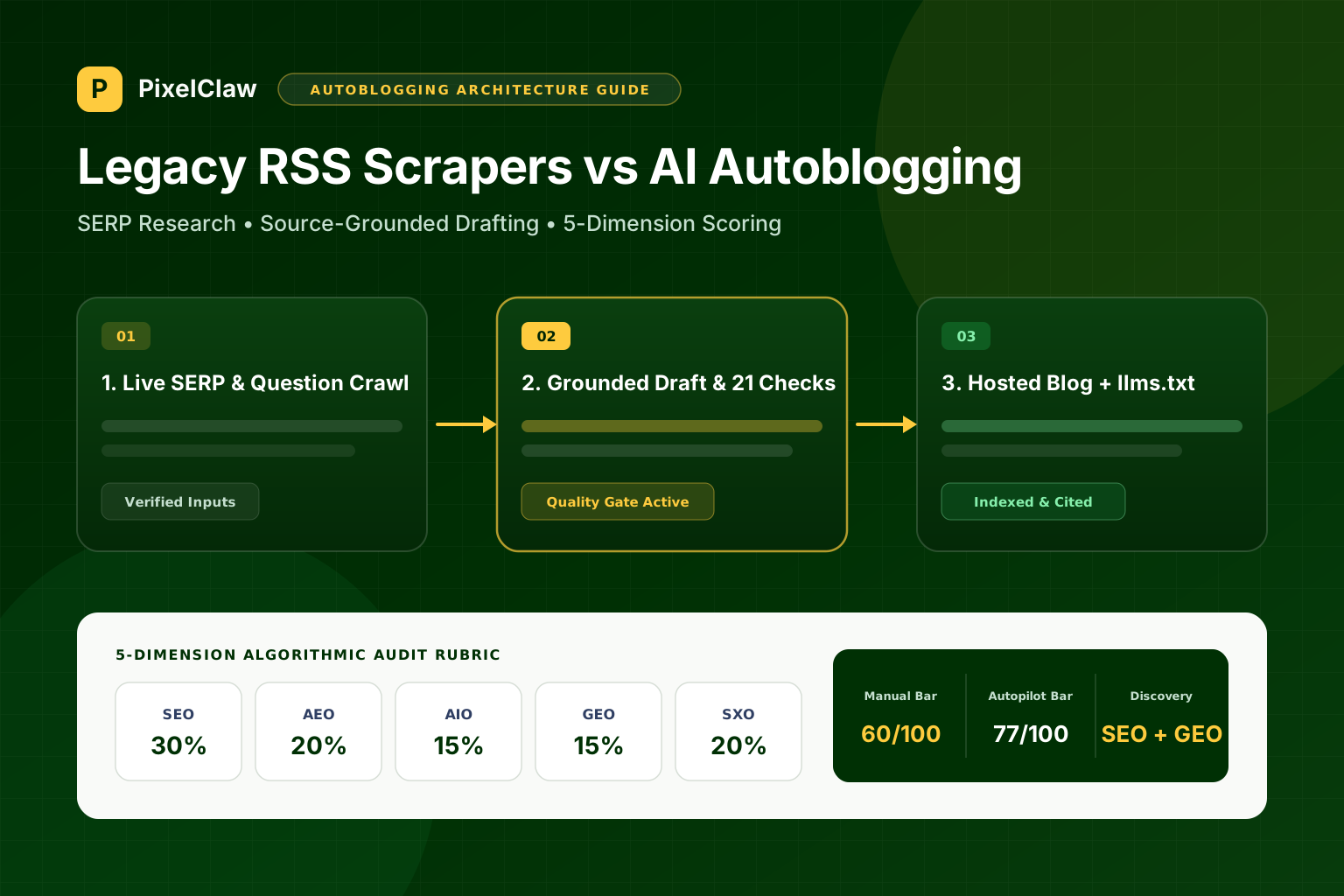
What Is Autoblogging? How Modern AI Autoblogging Works Without Publishing Slop
Autoblogging explained for founders and marketing teams: how modern research-first pipelines differ from old RSS scrapers, and what it takes to earn rankings and AI citations.
Marcus Vance
Head of Growth Architecture
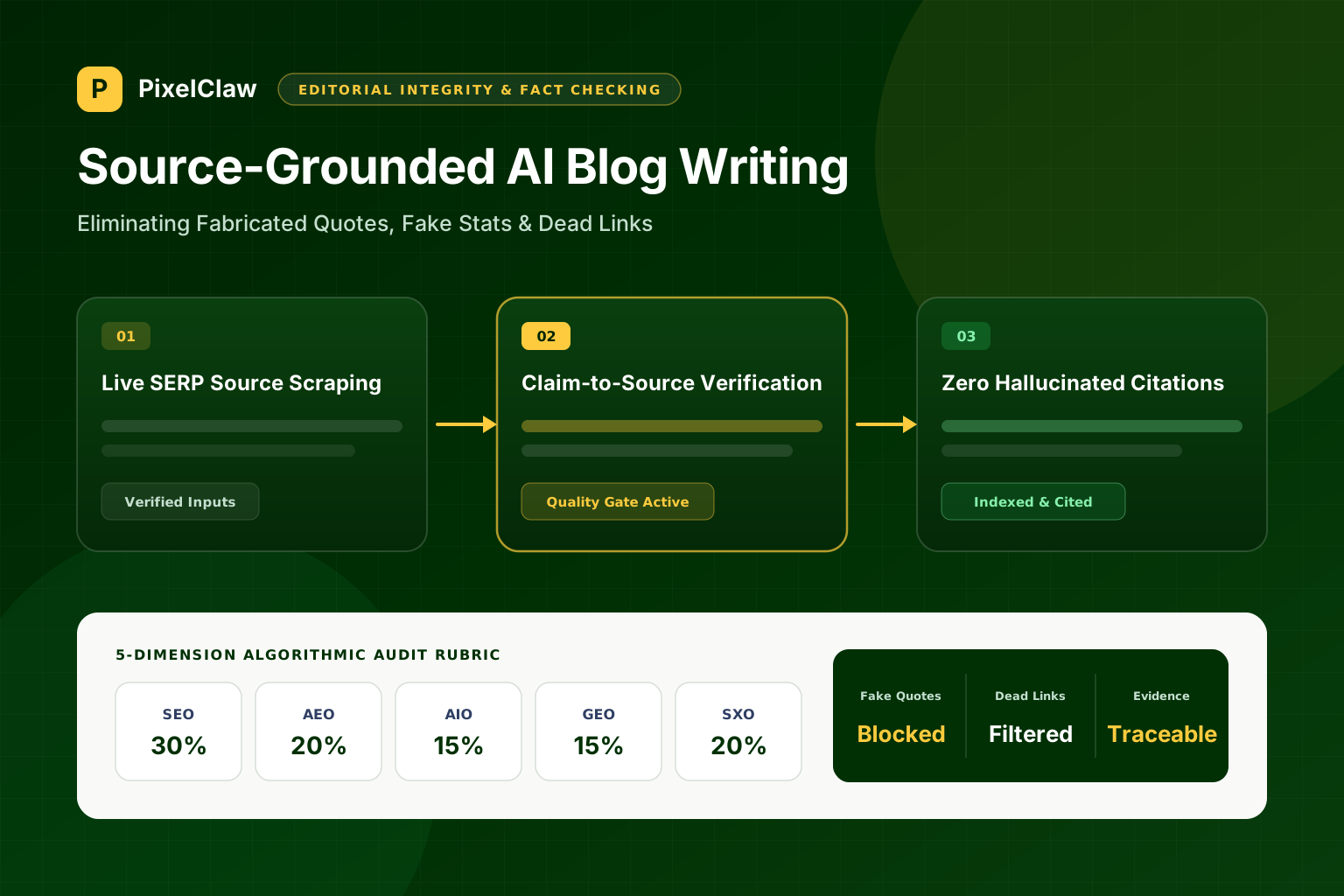
Source-Grounded AI Writing: How to Reduce Hallucinated Stats and Dead Links in Automated Blogs
Why raw language models invent fake percentages, nonexistent studies, and 404 URLs—and how source-grounded AI writing reduces those risks before editorial review.
Dr. Arthur Pendelton
Compliance & Editorial Director
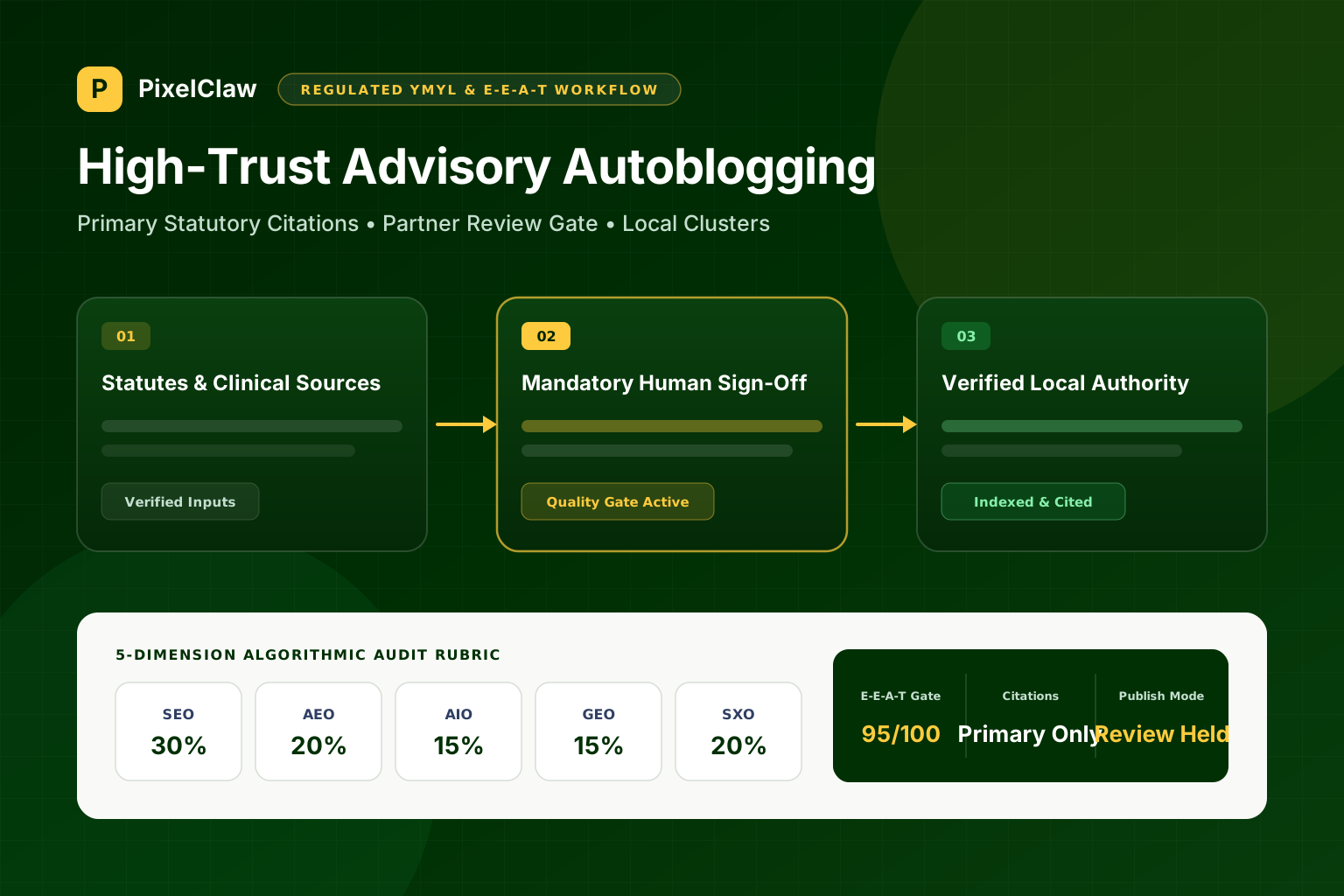
High-Trust Autoblogging for Professional Services: Capturing Localized and High-E-E-A-T Traffic Without Compliance Risk
How law firms, accounting practices, healthcare clinics, and advisory firms generate consistent inbound clients while upholding strict regulatory and ethical standards.
Dr. Arthur Pendelton
Compliance & Editorial Director