Organic Strategy
Growth Engineering & SEOProgrammatic SEO vs Autoblogging: Which Architecture Builds Stronger Organic Traffic?
Programmatic SEO templates and AI autoblogging solve different acquisition problems. Learn when to use a database-driven template, when to use researched editorial guides, and how to combine them.
On this page▸
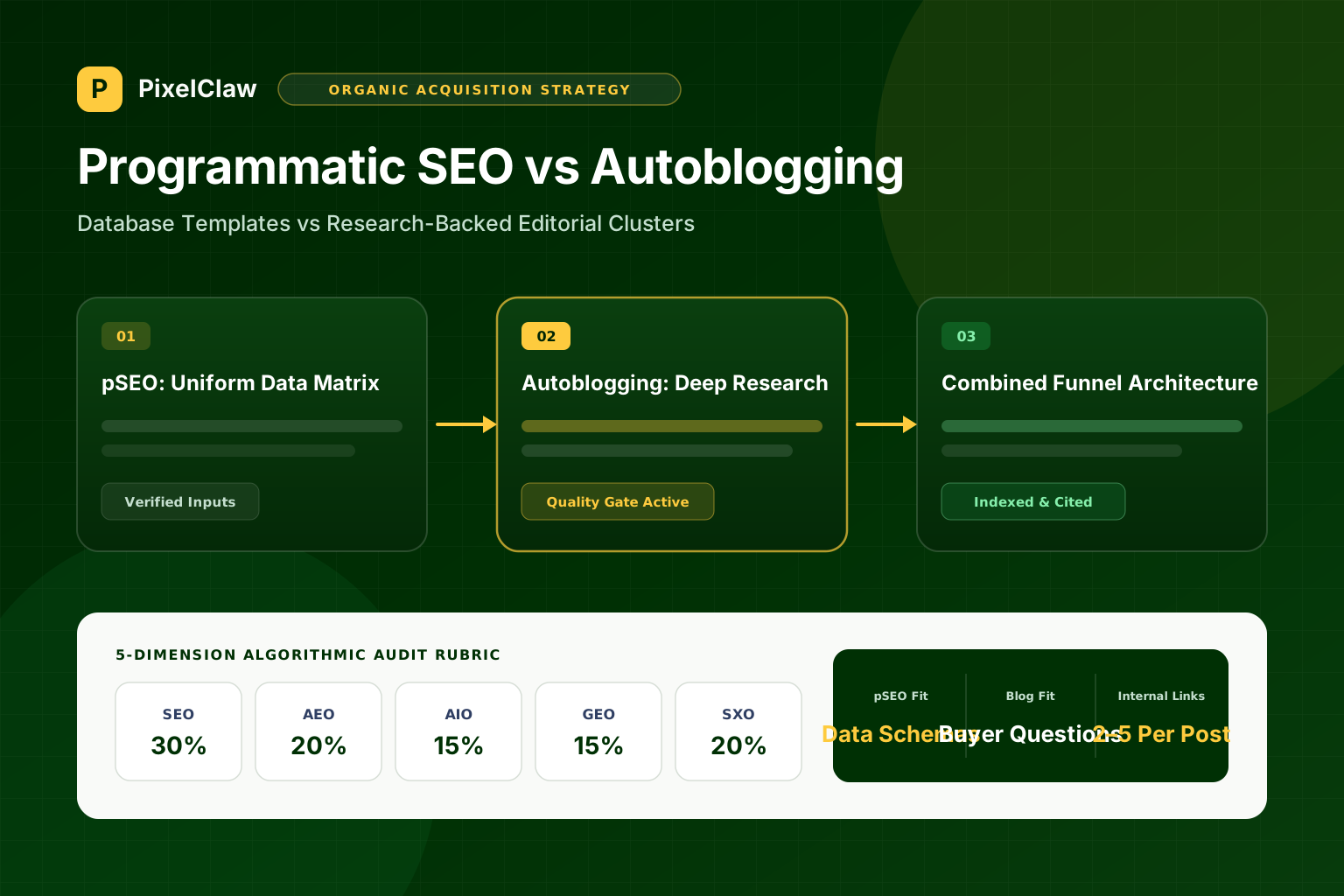
When evaluating programmatic SEO vs autoblogging, choose by the structure of your underlying evidence. Programmatic SEO renders uniform database rows—such as flight routes, currency pairs, or API connectors—into a fixed page template. Autoblogging researches and writes unique, long-form editorial articles for nuanced buyer questions where each topic needs its own outline and sources.
Programmatic SEO vs autoblogging: what is the core architectural difference?
Founders frequently conflate programmatic SEO and autoblogging because both use automation to grow organic search traffic. In practice, they sit at opposite ends of the content engineering spectrum.
Programmatic SEO starts with a structured relational database—say, 300 software integrations or 1,000 zip-code weather stations—and binds those columns into a single React or HTML page component. Every page shares the exact same layout and heading structure; only the data variables change.
Autoblogging starts with a queue of distinct human questions. A buyer asking how to migrate from Postgres to Supabase needs a completely different outline, argument sequence, code example, and comparison table than a buyer asking how row-level security affects query latency. Autoblogging automates the research, outlining, drafting, and quality scoring for each unique article.
Why do so many programmatic SEO projects get de-indexed?
Programmatic SEO fails when marketers try to fake a database they do not actually have. If you generate 200 pages for 'Best Accounting Software for [Industry]' where the only difference between the plumbing page and the bakery page is swapping the industry noun twelve times, search engines classify the entire folder as doorway spam.
Whenever the real value of a page lies in nuanced trade-offs, step-by-step instructions, regulatory context, or side-by-side decision criteria, a rigid fill-in-the-blank template is the wrong tool. You need a researched article.
- Use programmatic SEO when: You own a structured dataset with at least 5 to 10 unique numerical or categorical attributes per row (e.g., Zillow property data, Zapier app pairs, Wise exchange rates).
- Use AI autoblogging when: Each query represents a distinct problem, workflow, comparison, or troubleshooting scenario that requires live SERP synthesis and unique headings.
Side-by-side comparison: Programmatic SEO templates vs AI autoblogging
Compare the two approaches across engineering effort, search intent fit, and maintenance:
| Dimension | Programmatic SEO (pSEO) | AI Autoblogging (PixelClaw) |
|---|---|---|
| Primary Input | Relational database / CSV schema | Target keyword queue + live SERP research + brand evidence |
| Page Structure | 1 fixed HTML template for all URLs | Custom outline, headings, tables & FAQs per article |
| Best Search Intent | Uniform lookups (X to Y, city stats, SKU specs) | How-to guides, comparisons, buyer objections, troubleshooting |
| Engineering Setup | High (custom DB schema + frontend routes) | Zero (turnkey hosted blog or headless REST API) |
| Doorway Penalty Risk | High if data rows lack unique substance | Low (enforced 60/77 quality bars + paced weekly limits) |
| AI Answer Citations | Low unless paired with explanatory copy | High (40–60 word opening answer + verified sources) |
How do B2B SaaS and e-commerce teams combine both strategies?
The smartest organic growth teams do not treat programmatic SEO vs autoblogging as an either/or choice. They use programmatic pages for their bottom-of-funnel catalog or integration directory, and use PixelClaw autoblogging to build the surrounding educational and comparison moat.
For example, an e-commerce brand keeps its structured product collection pages on Shopify, while using PixelClaw to publish deeply researched buying guides, material comparisons, and care tutorials that link shoppers directly to the right product page.
How to wire internal links across a topical cluster
An isolated blog post is an orphan in search engine link graphs. When planning automated content clusters, group your topic queue into themes of 5 to 8 related buyer questions. As each post publishes, link it to at least two sibling posts in the same cluster and one core commercial page. PixelClaw's internal-links check verifies that every linked slug points to a live published post in your workspace.
- Programmatic SEO (pSEO) succeeds only when every generated URL has distinct, proprietary dataset values (prices, specs, coordinates, or live inventory).
- Using pSEO Mad-Libs templates for editorial questions produces thin doorway pages that Google demotes.
- Research-first autoblogging treats each keyword as a standalone editorial investigation with its own SERP crawl, outline, comparison table, and FAQs.
- The strongest growth engines combine both: programmatic directory or integration pages linked from deep, autoblogged implementation and decision guides.
- Every cluster page should link to at least 2 to 5 related articles so search crawlers and readers can traverse the topic.
Frequently Asked Questions
What is a classic example of programmatic SEO vs autoblogging?+
A currency converter rendering 500 pages for 'USD to EUR', 'USD to JPY', and 'GBP to CAD' using live exchange rate tables is programmatic SEO. Publishing a 2,000-word researched guide on 'How SaaS CFOs Hedge Multi-Currency Stripe Payouts' with tax citations and a comparison table is autoblogging.
Why do programmatic SEO pages struggle to get cited by ChatGPT and Perplexity?+
Many programmatic pages consist of sparse data widgets or repetitive boilerplate sentences without a clear 40-to-60-word direct answer, explanatory prose, or verified external citations. Answer engines prefer pages that explain the 'why' and 'how' alongside structured data.
How does PixelClaw prevent keyword cannibalization across a blog?+
Before drafting, PixelClaw researches the live SERP and reader questions for the target keyword and checks your workspace's existing post slugs and internal links so each article covers a distinct buyer decision.
How many internal links should each autoblogged article contain?+
PixelClaw's SEO scoring engine requires at least 2 links to related published posts on your blog (and recommends 2 to 5), ensuring no article is published as an orphan page.
Can we connect PixelClaw articles to our programmatic product pages?+
Yes. You can configure CTA blocks and inline links in your PixelClaw articles to point directly to your interactive calculators, integration directories, or product category pages.
Sources
- Google Search Central: Doorway Abuse and Thin Affiliate Pages — Google Search Central (Explains why generating near-identical pages for slight keyword or location variations violates doorway page rules.)
- Google Search Central: Link Best Practices and Internal Anchor Text — Google Search Central (Details how crawlable internal links and descriptive anchor text establish topical hierarchy across a domain.)
- Schema.org: BreadcrumbList Structured Data — Schema.org (Defines hierarchical page relationships for search result breadcrumbs and site structure parsing.)
Built & scored using PixelClaw.ai
More from this blog
Continue exploring autoblogging architecture, AI blog writing, and SEO / AEO / GEO playbooks.
Scaling B2B SaaS Organic Pipeline: How Programmatic Autoblogging Drives 10x More Qualified Demos
From thin comparison pages to definitive technical authority: How modern B2B SaaS engineering and marketing teams win across Google Search, Perplexity, and Gemini AI Overviews.
Marcus Vance
Head of Growth Architecture
E-Commerce Search Dominance: Using Autoblogging for Programmatic Category Guides, Gift Roundups, and GEO Answer Engines
How Direct-to-Consumer (D2C) brands escape the paid ad margin trap by turning product catalogs into hundreds of high-converting, answer-engine-optimized buying guides.
Sophia Lin
E-Commerce Strategy Director
What Is Autoblogging? How Modern AI Autoblogging Works Without Publishing Slop
Autoblogging explained for founders and marketing teams: how modern research-first pipelines differ from old RSS scrapers, and what it takes to earn rankings and AI citations.
Marcus Vance
Head of Growth Architecture