LLM SEO
AI search guideLLM SEO (LLMO): How to Get Language Models to Find and Cite Your Pages
A language model can know your business from its training or from a live search. Here is what you control in each case, and the crawler settings that decide it.

On this page▸
LLM SEO is the work of getting large language models such as ChatGPT, Claude, Gemini and Perplexity to find, use and cite your pages. A model can know you in two ways: from its training data, or by searching the web while it answers. LLM SEO, also called LLMO, covers both, and the second is where you have control.
What LLM SEO means
People now ask ChatGPT which accounting software suits a freelancer, ask Perplexity how to fix a leaking tap, and read Google's AI Overview instead of opening a result. Each of those answers is written by a large language model, and each one mentions some businesses and sources and leaves out the rest.
LLM SEO is the name for trying to be among the ones mentioned. The older name for the same idea is LLMO, large language model optimization. Neither is a formal discipline with agreed rules. What exists is a handful of things the model makers have documented, some research, and a lot of guesswork sold as certainty. This guide sticks to the first two.
Two doors into an answer: memory and retrieval
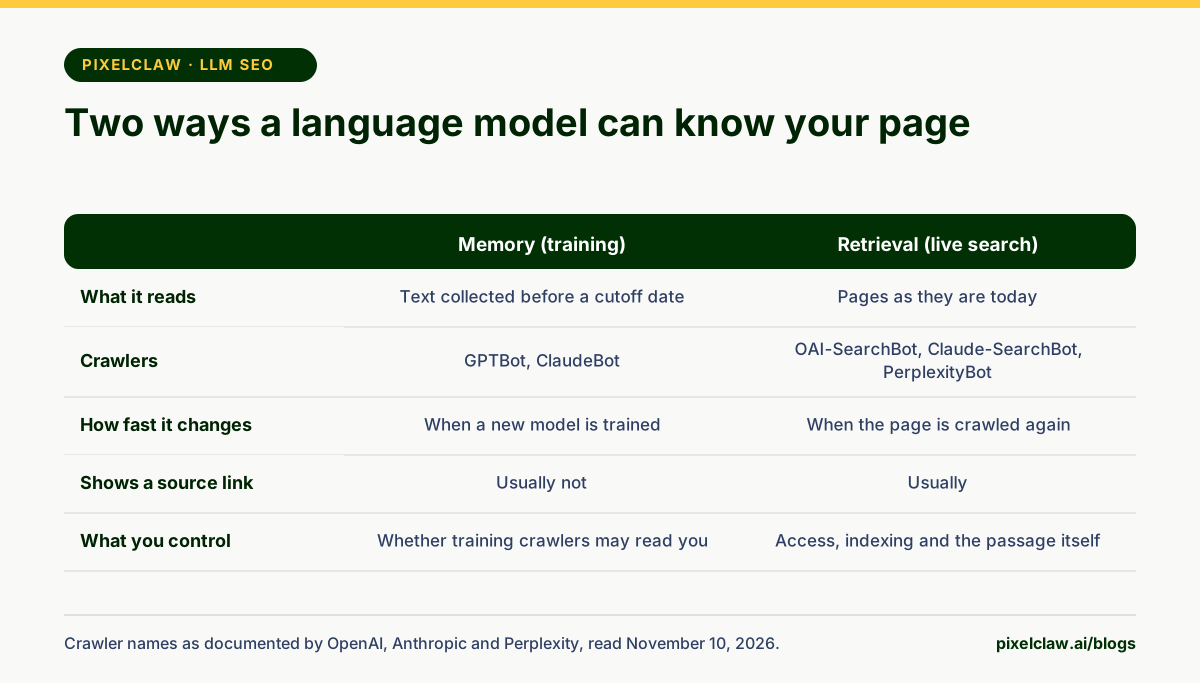
Everything in LLM SEO follows from one distinction. A language model can use your content in two different ways, and they work on different clocks.
The first is memory. A model is trained on a very large body of text collected up to a cutoff date. If your business was written about widely before that date, the model may know it without looking anything up. You cannot edit that memory, and it only refreshes when a new model is trained.
The second is retrieval. Most assistants can now search the web while they answer, read a few pages and cite them. This is how ChatGPT search, Perplexity and Google's AI features work. Retrieval sees what is on your site today.
The practical upshot: if you changed your prices last month, memory is wrong and retrieval is right. A model answering from memory may also describe a competitor's product as yours. Retrieval is where a small site can compete, because the engine is choosing between pages, not between reputations.
The retrieval door: what you control this week
Retrieval has three gates, and a page has to pass all of them.
Access comes first. The crawler has to be allowed to fetch the page. That means robots.txt, and it also means whatever sits in front of your site. Google's guidance on AI features says to make sure crawling is allowed by any CDN or hosting infrastructure, and OpenAI and Perplexity both ask sites to let their published IP ranges through. Bot protection that challenges unknown visitors is the usual culprit.
Indexing is second. Google's AI Overviews and AI Mode draw on the ordinary Google index, so a page must be indexed and eligible to show a snippet. ChatGPT search and Perplexity also send their own crawlers, OAI-SearchBot and PerplexityBot, to find pages. A page nobody links to, missing from your sitemap, may simply never be found.
The passage is third. The engine pulls a few paragraphs from each candidate page and keeps the ones that answer the question. Writing for that step is the part most sites skip, and it gets its own section below.
The memory door: slower, and mostly about being talked about
You cannot submit your site to a model's memory. What a model remembers about a business comes from everything written about it: its own pages, reviews, directory listings, forum threads, news and other people's articles. A business described the same way in twenty places is remembered more reliably than one described once.
Two things are worth doing. Keep the basic facts identical wherever you appear: the name, what you sell, who it is for, where you are. Contradictions are how a model ends up confidently wrong about you. And earn mentions in places a model is likely to have read, such as industry directories, comparison articles and community discussions where your customers ask for recommendations.
Then decide about training crawlers. Allowing them is the only direct way your own words get into the next round of training. Declining is a reasonable choice too, and it costs you nothing in live search.
A robots.txt that says what you mean
Each company uses separate crawlers for separate jobs, and the names are documented. OpenAI says disallowing OAI-SearchBot means a site will not be shown in ChatGPT search answers, though it may still appear as a plain navigational link. Anthropic says blocking Claude-SearchBot may reduce a site's visibility in search results inside Claude. Perplexity says PerplexityBot is not used to train foundation models.
Google is the odd one out. Its AI features run on Googlebot's index, so there is no separate search crawler to allow. The Google-Extended token controls use for Gemini, and Google says it does not affect inclusion in Search.
The example below allows search and user-requested fetches and declines training. Change the second group to Allow if you want your writing in future models.
| Crawler | Company | What it is for |
|---|---|---|
| OAI-SearchBot | OpenAI | Surfacing sites in ChatGPT search |
| ChatGPT-User | OpenAI | Fetching a page during a user's request |
| GPTBot | OpenAI | Collecting content that may be used in training |
| Claude-SearchBot | Anthropic | Indexing content for search results in Claude |
| Claude-User | Anthropic | Fetching a page when a user asks a question |
| ClaudeBot | Anthropic | Collecting content that may be used in training |
| PerplexityBot | Perplexity | Surfacing and linking sites in Perplexity results |
| Perplexity-User | Perplexity | Fetching a page during a user's request |
| Google-Extended | A control for Gemini; no effect on Google Search |
User-agent: OAI-SearchBot
User-agent: ChatGPT-User
User-agent: Claude-SearchBot
User-agent: Claude-User
User-agent: PerplexityBot
Allow: /

User-agent: GPTBot
User-agent: ClaudeBot
User-agent: Google-Extended
Disallow: /
Writing for a model that reads in chunks
A retrieval system does not read your article the way a person does. It cuts the page into passages and scores each one against the question. A passage that opens with "It also helps with this" is useless out of context, because nobody knows what "it" or "this" refers to.
So write passages that survive being cut out. Name the subject in the first sentence of each section. State the fact, the number and where it comes from together. Use the same name for a thing every time; a model may treat "the Pro plan", "our premium tier" and "Pro" as three different things.
The GEO research paper measured which edits made pages more visible in generated answers. Adding citations, quotations and statistics were among the changes that helped most, with gains of up to 40% for the best methods, and the effect varied by subject. Keyword repetition did little.
Keep the important content in plain text. A price inside an image, a comparison that only appears after a click, or a specification loaded by a script may never reach the model. Google makes the same point for its own AI features.
- Open each section with a sentence that names the subject and answers the heading.
- Put a number, date or named source in every claim that can carry one.
- Use one name for each product, plan and feature across the whole site.
- Give each page a visible date and update it when the facts change.
- Say plainly what your product does not do. Assistants are asked that constantly.
LLM SEO tools: what they do, and whether you need one
Most products sold as LLM SEO tools are trackers. You give them a list of prompts, they ask several assistants on a schedule, and they report how often your brand is mentioned, which sources were cited and how you compare with competitors. Entry prices on the vendors' own pages run from $29 a month for Otterly.AI's Lite plan to $95 for Peec AI's Starter and $250 for Scrunch's Core plan. AthenaHQ has a free plan with 300 credits.
A tracker tells you where you stand. It does not change your pages. For a site that has not yet fixed access and openings, a monthly list of ten questions asked by hand gives the same signal for free. A tracker earns its fee once you publish enough that manual checks stop scaling. Our comparisons of GEO tools and AEO tools cover the options by price and by job.
For the page itself, the free AEO and GEO checker reads one URL and reports which AI crawlers your robots.txt allows and which answer-ready parts the page has. PixelClaw is our product, and the checker is free to use once a day.
What LLM SEO cannot do
Ask the same question twice and an assistant may cite different sources each time. Answers also change with the wording, the user's location and the model version. There is no position one to hold, only a share of answers you appear in.
No model maker publishes ranking factors for citations. Anyone promising a guaranteed mention in ChatGPT is selling something they do not control. What the documentation and the research support is narrower and less exciting: be reachable, be indexed, be specific, be sourced, and be described consistently across the web. Our ChatGPT SEO guide applies those five to one assistant in detail.
- A model reaches your content through memory (training data) or retrieval (a live search). Retrieval is the one you can change this week.
- Search crawlers and training crawlers have different names, so you can allow one and decline the other.
- A firewall or CDN can block AI crawlers even when robots.txt allows them.
- Models read in chunks, so every passage should name its subject and carry its own fact and source.
- No tool can promise a citation. Answers change between runs, and no model publishes ranking factors.
Frequently Asked Questions
What does LLMO stand for?+
Large language model optimization. It means the same thing as LLM SEO: making your pages easy for language models to find, understand and cite. You will also see GEO, AEO and AI SEO used for overlapping work. The names differ more than the tasks do.
Is LLM SEO different from GEO and AEO?+
Mostly in emphasis. AEO focuses on how an answer is written. GEO focuses on being cited by generative search. LLM SEO puts the model at the centre and so includes training data, which the other two rarely discuss. In day-to-day work the checklist is nearly the same.
Should I allow GPTBot?+
That depends on how you feel about training. OpenAI documents GPTBot as the crawler that collects content for training its models, and OAI-SearchBot as the one that surfaces sites in ChatGPT search. Blocking GPTBot does not remove you from ChatGPT search. Blocking OAI-SearchBot does.
Does llms.txt matter for LLM SEO?+
A little, and only for tools that choose to read it. It is a proposed convention, not a standard that the large assistants have committed to. Google says its AI features need no AI text file. It is cheap to publish, so publish one, but do not expect it to move anything by itself.
How do I check whether ChatGPT knows my business?+
Ask twice. First ask with web search switched off, which shows what the model remembers. Then ask with search on, which shows what it can find today. If the first answer is wrong or empty and the second is right, your pages are fine and your wider footprint on the web is thin.
Sources
- Overview of OpenAI crawlers — OpenAI
- Does Anthropic crawl data from the web, and how can site owners block the crawler? — Anthropic
- Perplexity crawlers — Perplexity
- Google's common crawlers, including Google-Extended — Google Search Central
- AI features and your website — Google Search Central
- GEO: Generative Engine Optimization — Aggarwal et al., KDD 2024
Built & scored using PixelClaw.ai
More from this blog
Continue exploring autoblogging architecture, AI blog writing, and SEO / AEO / GEO playbooks.

ChatGPT SEO: How to Get Your Pages Cited by ChatGPT Search
Six steps, in order, from letting OpenAI's search crawler in to checking whether your page is the one ChatGPT links, with what OpenAI itself has documented.
PixelClaw Editorial Team
Product and search team
GEO vs SEO: What Changes, What Stays and What to Do First
Generative engine optimization builds on search engine optimization. Here is where the two overlap, where they pull apart, and the order to work in.
PixelClaw Editorial Team
Product and search team
GEO Blogs: Help Readers and AI Assistants Find Your Sources
Check which search crawlers can reach your blog, and make important claims easy to verify with examples and sources.
PixelClaw Editorial Team
Product and search team