Tool comparison
Tool comparisonBest AEO Tools in 2026: Check, Write and Track Answer Engine Visibility
Answer engine optimization tools do three different jobs. Eight options sorted by the job, with the prices on each vendor's own page.
On this page▸
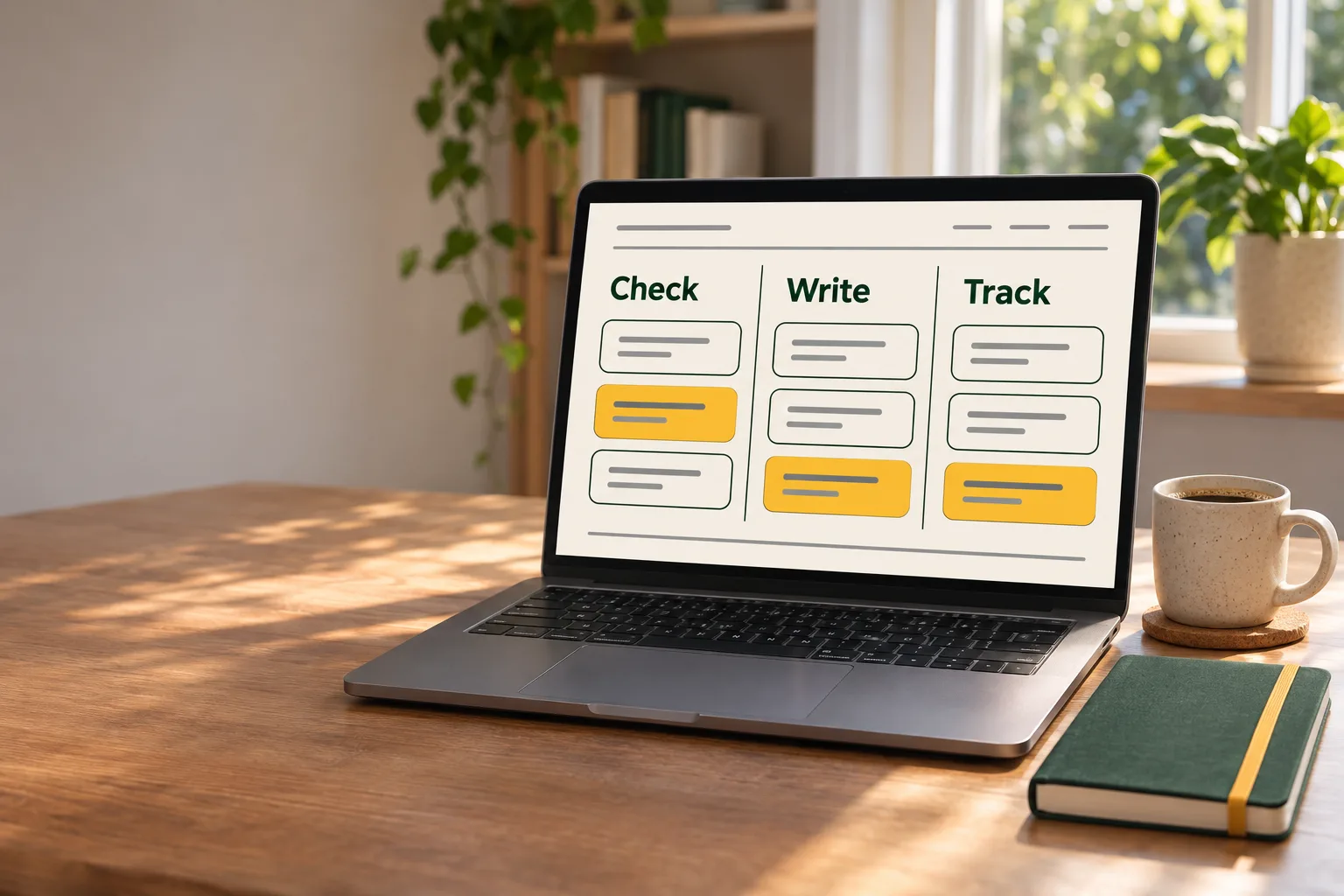
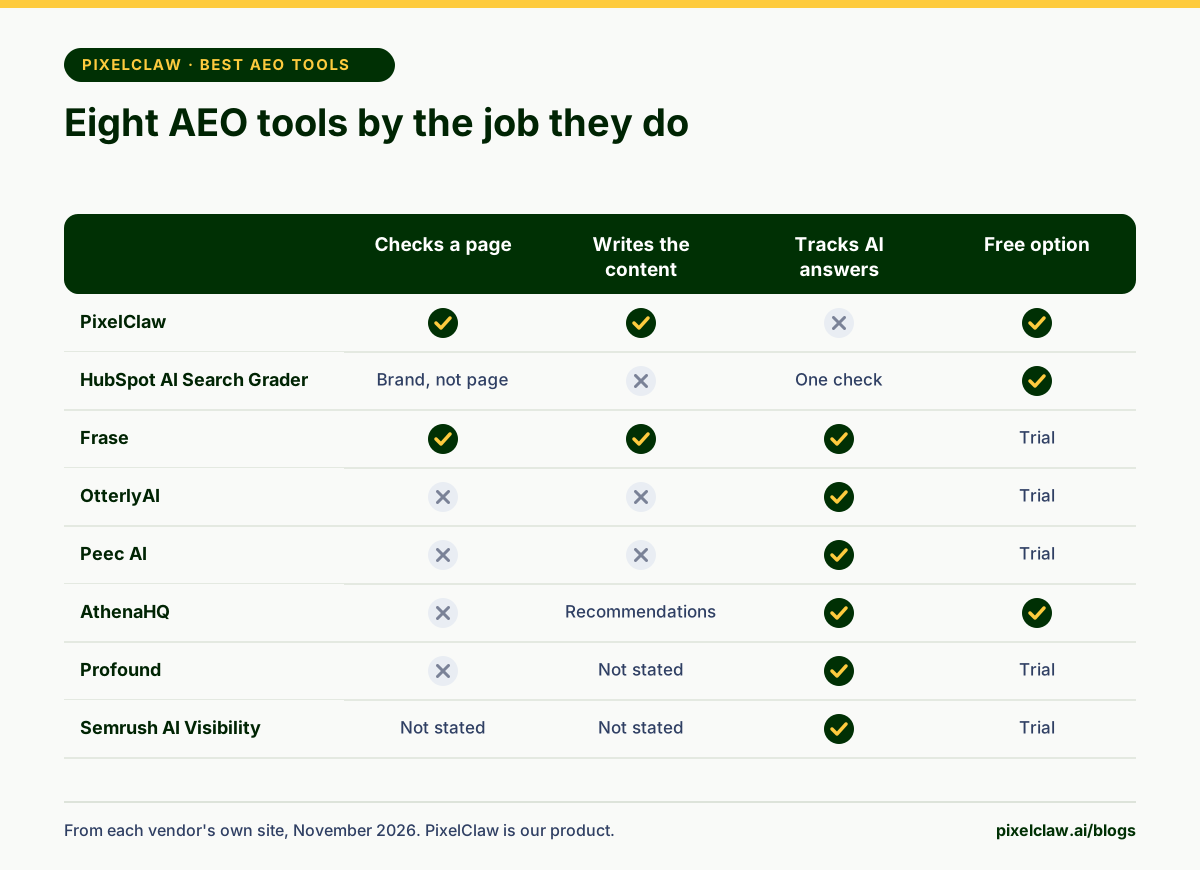
The best AEO tools depend on the job. To check a page for free, use PixelClaw's AEO and GEO checker or HubSpot's AI Search Grader. To write answer-ready posts, PixelClaw and Frase build the structure into the draft. To track AI answers, OtterlyAI, Peec AI, AthenaHQ, Profound and Semrush report who gets cited.
AEO tools do three different jobs
Search for AEO tools and you get lists that mix free graders, writing software and enterprise analytics as if they were alternatives to each other. They are not. They do different jobs, and most teams need them in a particular order.
Checking comes first: can answer engines reach the page, and does it have the parts they lift? Writing comes second: producing posts that open with the answer and carry their sources. Tracking comes third: watching which brands AI answers cite for the questions you care about. This page sorts eight tools by those jobs. Every price and feature below comes from the vendor's own site on November 10, 2026, except Frase, read on November 5. PixelClaw is our product.
Job one: check a page
PixelClaw's AEO and GEO checker is free and needs no account. Paste a URL and it reads the page, the site's robots.txt and its llms.txt. It reports whether the page opens with a direct answer, uses question headings, has an FAQ, names an author and sources, and carries structured data, and it lists which AI search crawlers the site allows. One result a day.
Watch out for: it reads one page at a time and does not ask any AI assistant about you.
HubSpot's AI Search Grader takes the opposite approach. You enter a company name, location, products and industry, and it asks ChatGPT, Perplexity and Gemini about the brand. The report is a score out of 100 across sentiment, presence quality, brand recognition, share of voice and market competition. It is free, with no account required.
Watch out for: it grades what the models say about your brand. It does not read your pages or tell you which one to fix.
Job two: write the answer
PixelClaw researches a topic, including the questions readers ask, and drafts the post with a 40 to 60 word opening answer, an FAQ, a key takeaways box and sources. Each post is scored out of 100 in five areas, one of which is answer engines, and a one-click fix writes any missing piece for your approval. It publishes to a blog it hosts or to WordPress. The free plan includes a hosted blog and credits for two posts; Starter is $49.99 a month.
Watch out for: PixelClaw does not track where AI answers mention you.
Frase builds each article from the pages that rank, scores it for SEO and for AI search, and adds AI visibility tracking. Starter is $49 a month, or $39 billed yearly, for 10 articles and 50 audit pages, with a 7-day trial.
Watch out for: the Starter plan stops at its monthly limits. For more writers judged on answer structure, see our comparison of AI SEO writers.
Job three: track AI answers
Trackers all work the same way. You supply prompts, the tool asks several AI engines on a schedule, and you get mention counts, cited sources and competitor comparisons. They differ in price, in how many prompts you get and in which engines are included.
OtterlyAI has the lowest listed entry price here: Lite at $29 a month, then Standard at $189 and Premium at $489. Plans cover three of its seven engines, which include ChatGPT, Google AI Overviews, Perplexity and Copilot.
Peec AI starts at $95 a month for 50 prompts tracked daily across three models of your choice, with unlimited users. Pro is $245 for 150 prompts and Advanced $495 for 350.
AthenaHQ lists a free Essential plan with 300 credits, where one credit is one AI response, and a Starter plan at $295 a month with 3,600 credits across 11 models.
Profound's pricing page shows a free 7-day trial that runs 50 prompts daily on ChatGPT, Gemini and Google AI Overviews, and an Enterprise plan at a custom price covering up to nine answer engines.
Semrush AI Visibility tracks mentions, competitors and sentiment across Google and AI search and can be tried free. The page we read shows no price.
Watch out for: prompt allowances are small on entry plans, and an answer can change between two runs of the same prompt. Read trends over weeks, not single results.
| Tracker | Entry plan | What it includes |
|---|---|---|
| OtterlyAI | Lite, $29 a month | 3 of 7 engines, daily tracking |
| Peec AI | Starter, $95 a month | 50 prompts, 3 models, unlimited users |
| AthenaHQ | Essential, free | 300 credits, five engines |
| Profound | 7-day free trial | 50 prompts daily, three engines |
| Semrush AI Visibility | Free to try | Price not shown on the page read |
How to choose, in order
Start with what is free. Run your three most important pages through a page checker and fix what it finds: a blocked crawler, a missing opening answer, no sources. Google's guidance on AI features asks for nothing more exotic than a page that is crawlable, indexed and clear.
Then look at how your content gets written. If each post still needs its opening, FAQ and sources added by hand, a writer that builds them in saves more time than any report.
Add a tracker last, and pick it on two numbers: how many prompts you need to watch, and which engines your customers use. A local service business watching twenty questions needs a different plan from a software company watching three hundred. Our guide to AEO vs SEO explains where this work sits next to ordinary search, and the GEO tools comparison goes deeper on trackers.
- AEO tools do one of three jobs: check a page, write answer-ready content, or track which brands AI answers cite.
- Two useful checks are free: PixelClaw's checker reads a page and its crawler rules, and HubSpot's grader asks three assistants about your brand.
- Trackers start at $29 a month on OtterlyAI's pricing page and reach custom enterprise pricing at Profound.
- A tracker reports where you stand. Only editing your pages changes it.
- Fix access and openings first, then pay for tracking once you publish enough to need it.
Frequently Asked Questions
What is an AEO tool?+
Software that helps a page become the answer an engine gives. Some tools check a page for the parts answer engines read, such as a direct opening, an FAQ and open crawler access. Some write content with those parts built in. Others ask AI assistants a list of questions on a schedule and report which brands are cited.
Are AEO tools and GEO tools the same thing?+
Largely. Vendors use AEO, GEO and AI visibility for the same products, and most trackers on this page describe themselves with more than one of those words. We keep a separate comparison of GEO tools that goes deeper on engine coverage and price per prompt.
Is there a free AEO tool?+
Yes, several. PixelClaw's AEO and GEO checker reads one page a day for free. HubSpot's AI Search Grader gives one free brand check with no account. AthenaHQ lists a free plan with 300 credits, and most paid trackers offer a trial.
Do I need an AEO tracker to start?+
No. Ten questions asked by hand in ChatGPT, Perplexity and Google once a month show the same thing a tracker would at small scale. A tracker is worth paying for when you publish enough, or compete in a crowded enough category, that manual checks no longer keep up.
Sources
- AI Search Grader — HubSpot (Read November 10, 2026.)
- OtterlyAI pricing — OtterlyAI (Read November 10, 2026.)
- Peec AI pricing — Peec AI (Read November 10, 2026.)
- AthenaHQ plans and pricing — AthenaHQ (Read November 10, 2026.)
- Profound pricing — Profound (Read November 10, 2026.)
- Semrush AI Visibility — Semrush (Read November 10, 2026.)
- Frase pricing — Frase (Read November 5, 2026.)
- AI features and your website — Google Search Central
Built & scored using PixelClaw.ai
More from this blog
Continue exploring autoblogging architecture, AI blog writing, and SEO / AEO / GEO playbooks.
Best GEO Tools in 2026: Trackers and Writers Compared on Price and Engines
Ten generative engine optimization tools, split into the trackers that watch AI answers and the writers that build citable pages, with entry prices from each vendor's site.
PixelClaw Editorial Team
Product and search team
AEO vs SEO: How Answer Engine Optimization Differs and When It Matters
SEO gets a page found. AEO gets a passage from it given as the answer. See what differs, one section written both ways, and which to work on first.
PixelClaw Editorial Team
Product and search team
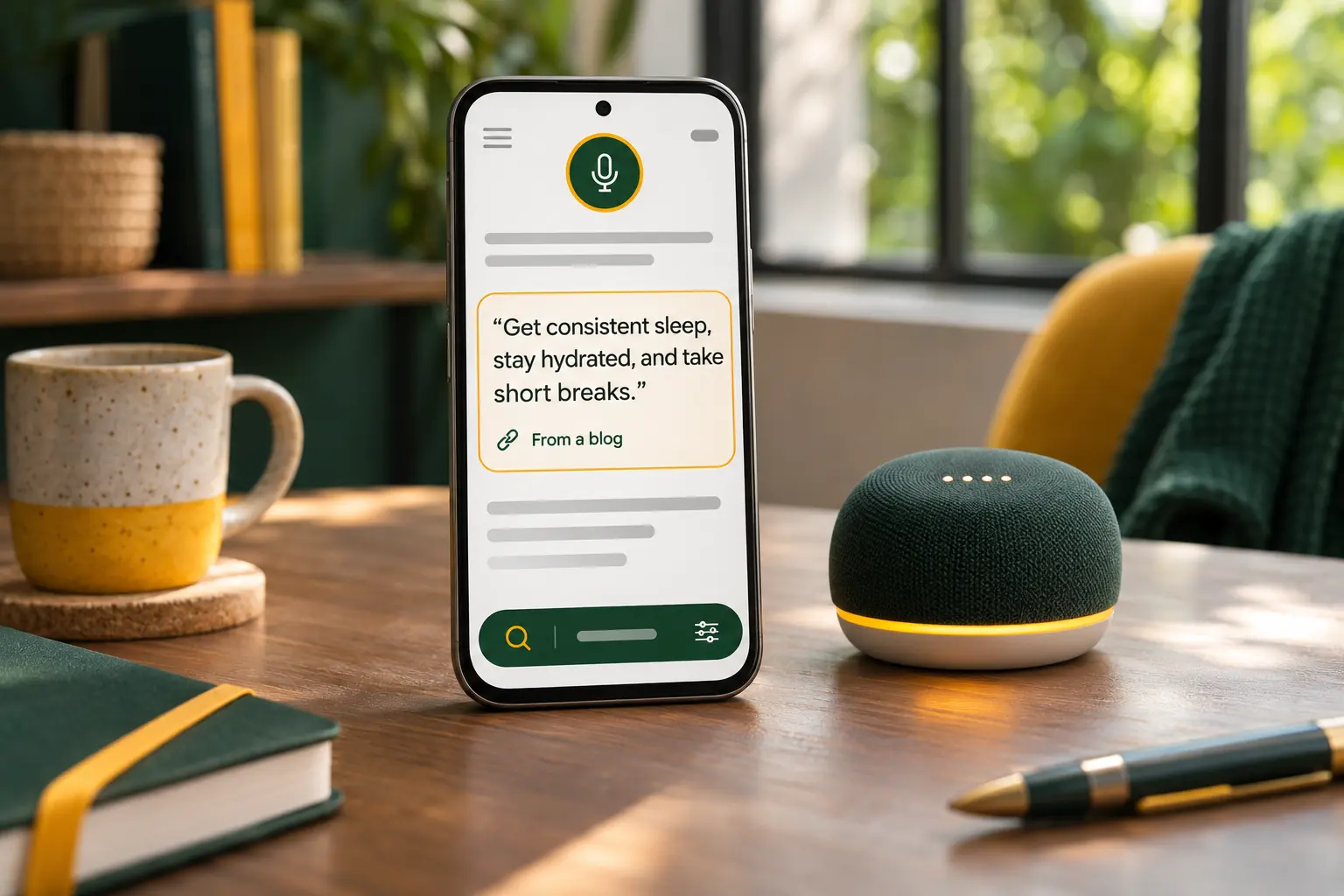
AEO Blogs: How to Write Clear Answers to Reader Questions
Start with the answer, support it with evidence, and use headings that match the questions people ask.
PixelClaw Editorial Team
Product and search team