GEO vs SEO
AI search guideGEO vs SEO: What Changes, What Stays and What to Do First
Generative engine optimization builds on search engine optimization. Here is where the two overlap, where they pull apart, and the order to work in.
On this page▸
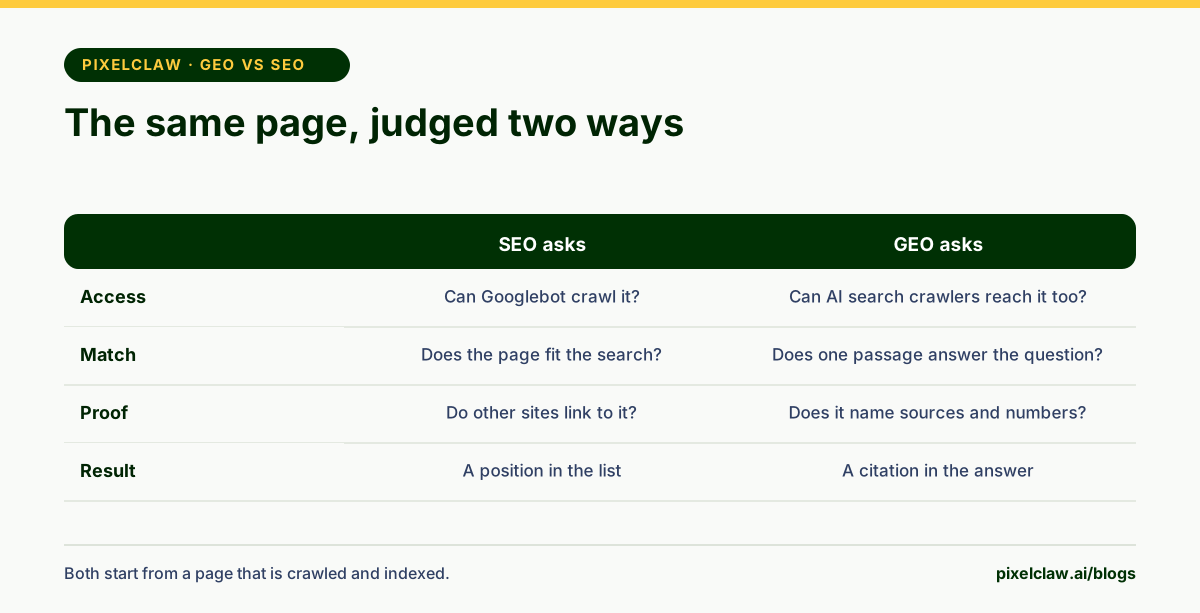
GEO vs SEO comes down to where the reader meets your page. SEO earns a place in a list of results that people click. GEO, generative engine optimization, earns a place inside an AI answer as a quoted and linked source. GEO builds on SEO: a page still has to be crawled, indexed and trusted first.
GEO vs SEO at a glance
Search engine optimization is the work of getting a page into the list of results for a search, as high as possible, so that people click it. Generative engine optimization, GEO for short, is the work of getting that same page used as a source when an AI system writes the answer itself: Google's AI Overviews and AI Mode, ChatGPT search, Perplexity, Copilot and Gemini.
The two share most of their plumbing. They differ in what wins. In a list of ten results, position matters and every result gets a title and a link. In a written answer there may be three sources or none, and the engine picks passages, not pages.
| What differs | SEO | GEO |
|---|---|---|
| Where you appear | A list of results | Inside one written answer |
| What you compete for | A position on the page | A citation or a link in the answer |
| Unit that wins | The page | The passage |
| Who reads it first | Googlebot and Bingbot | Those, plus AI search crawlers |
| What it rewards | Relevance, links, page experience | Clear claims, sources, agreement with other pages |
| How you measure | Position, clicks, impressions | Citations seen, referral visits from assistants |
First, a naming problem: GEO is not local SEO
Search for this comparison and half the discussion is people asking about geographic targeting. That is a different subject. Geo-targeting and local SEO are about showing up for searches tied to a place. GEO, as marketers have used the term since a 2023 research paper gave it the name, means generative engine optimization.
You will also see the same work called AEO, AI SEO, LLM SEO or LLMO, depending on who is selling it. The labels overlap heavily. Our comparison of AEO, GEO and SEO sorts out which word means what, and AEO vs SEO covers the answer-box side.
What stays the same
More than the sales pages suggest. Google's own guidance on AI features is blunt about it: to appear as a supporting link in AI Overviews or AI Mode, a page must be indexed and eligible to be shown in Search with a snippet. There are no extra technical requirements, no special markup and no AI text file to create.
The same document lists the practices that carry over. Allow crawling in robots.txt and in whatever CDN or hosting sits in front of the site. Make pages easy to find through internal links. Keep the important content in text. Make structured data match what a visitor can see. None of that is new, and all of it is SEO.
So a blog that already publishes useful, well-organised posts on a fast site has done most of the groundwork for GEO without calling it that. A blog with crawl errors and thin pages has an SEO problem, and GEO will not get it around that.
What changes with generative engines
Four things are different enough to change how you write and how you check your site.
The first is the unit. A generative engine lifts a paragraph or two, so each passage has to stand alone: name its subject, answer one question and carry its own evidence. A page that only makes sense read top to bottom gives the engine nothing to quote.
The second is how the search happens. Google describes a technique it calls query fan-out, where one question is broken into several related searches across subtopics before the answer is written. Your page may be pulled in for a sub-question nobody typed. Posts that cover the neighbouring questions properly get more chances than posts that chase one phrase.
The third is evidence. In the GEO research paper, a team tested edits to web pages and measured how visible each page became in generated answers. The best methods raised visibility by up to 40%, and the paper found the effect varies from one subject area to another. Adding sources, quotations and statistics helped. Repeating keywords did little.
The fourth is the crawlers. OpenAI uses OAI-SearchBot to surface sites in ChatGPT search, and Perplexity uses PerplexityBot. Both companies ask you to allow the crawler in robots.txt and to let their published IP ranges through. Googlebot being welcome says nothing about whether a security rule is turning these away.
Where SEO and GEO pull in different directions
Most advice says the two never conflict. They do in places, and it is better to choose with open eyes.
Clicks are the obvious one. Pew Research Center followed the browsing of 900 US adults in March 2025. When a Google results page showed an AI summary, people clicked a traditional result on 8% of visits, against 15% without one. They clicked a link inside the summary itself on 1%. Being cited keeps your name in front of the reader, but it does not send the traffic a top position used to.
Format is another. A long, complete guide still does well in classic results. A generative engine wants the answer in the first two sentences of a section. You can serve both by opening each section with the answer and putting the detail underneath, which costs some storytelling.
Then there is access. Allowing every AI crawler helps you get cited and also lets your writing train models. The crawler names let you split the decision, since search and training use different ones, but it is a decision.
Last, where the effort goes. SEO has long rewarded links to your site. Generative engines also weigh whether other sources say the same thing about you, linked or not. Time spent being mentioned in directories, reviews and other people's articles pays in GEO in a way a link count does not capture.
What to do first: five moves that serve both
If you have an afternoon, spend it in this order. The first three help classic rankings as much as AI answers.
- Check access. Read your robots.txt for OAI-SearchBot, PerplexityBot and Claude-SearchBot, then check that your CDN or firewall is not challenging them.
- Fix the opening of your ten best posts. Each should answer its question in the first 40 to 60 words, naming the subject.
- Add the evidence. Give every important claim a number, a date or a named source, linked in the sentence that uses it.
- Turn headings into the questions people ask, and add a short FAQ for the ones the body did not cover.
- Publish one thing only you can know: your prices, your test, your data. Engines have to cite the page that has it.
How to measure each
SEO measurement is mature. Search Console gives you impressions, clicks and average position for every search, and Google counts appearances in its AI features inside the same Performance report, under the Web search type. You cannot split them out, which is a real limit, but the traffic is in there.
GEO measurement is younger. The honest method is a list of ten questions your posts answer, asked once a month in the assistants your customers use, with a note of who gets cited. Your analytics add a second signal: visits referred from chatgpt.com, perplexity.ai and gemini.google.com. Paid trackers automate the asking. Our roundup of GEO tools covers what they cost and which engines each one watches.
Where PixelClaw fits
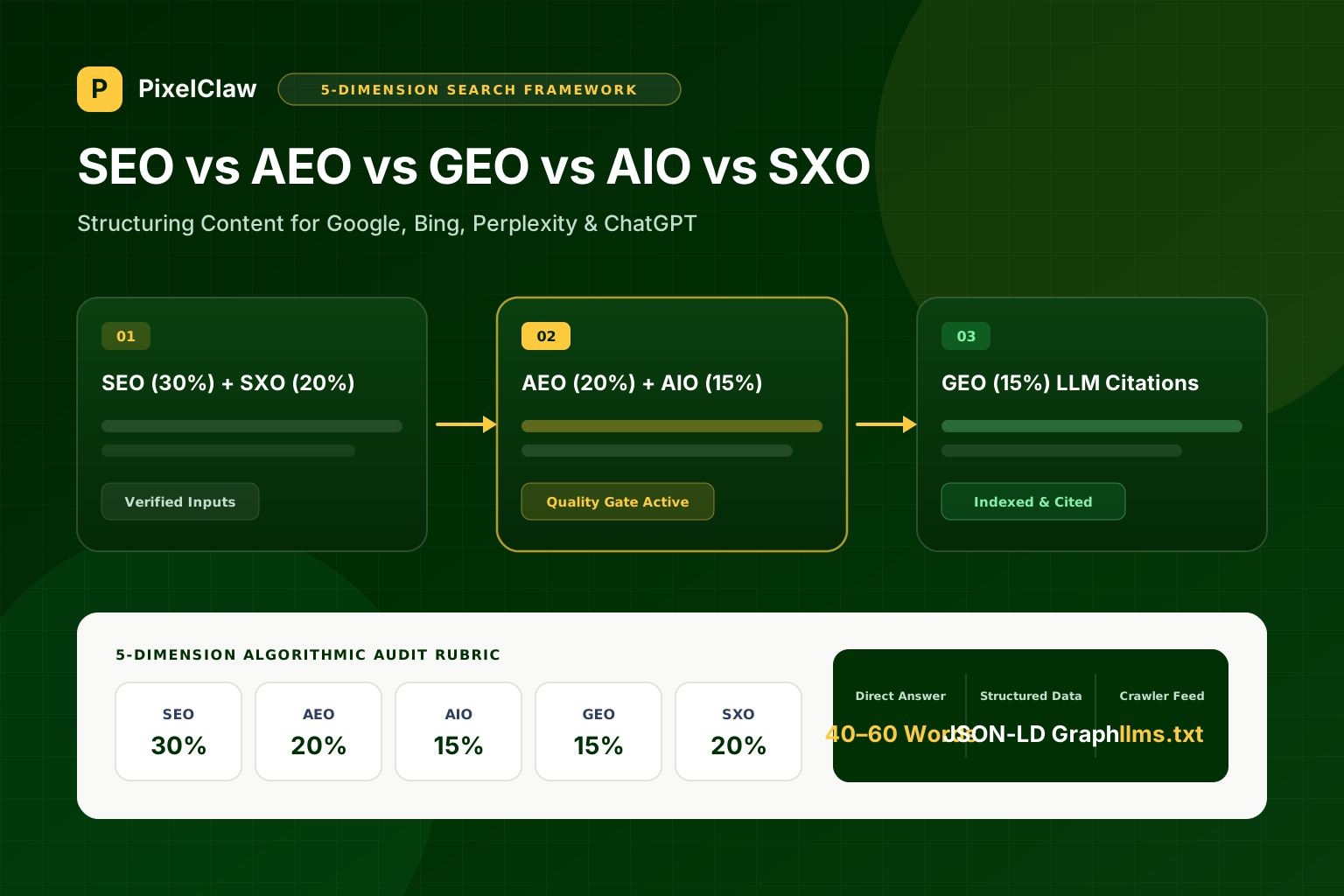
PixelClaw is our product, so read this part as a description, not a review. It scores every post out of 100 in five areas, and the split mirrors this article. Search engines carry 30% of the score. Answer engines carry 20%, trust signals 15% and AI discovery 15%, and those three are the GEO side: an opening answer, an FAQ, a named author, at least two sources and AI crawlers that are allowed in.
On a blog it hosts, PixelClaw also writes the robots.txt, sitemap, llms.txt and structured data, with separate switches for AI search crawlers and training crawlers. It does not track where AI answers mention you. It works on the half you control, which is the page. The GEO blogs guide goes through the writing habits in detail.
- SEO competes for a position in a list of results; GEO competes to be a source inside one written answer.
- Google says its AI features need no special markup: a page must be indexed and eligible to show a snippet.
- The unit GEO rewards is the passage, a paragraph that answers one question with a number and a named source.
- AI search crawlers are separate from Googlebot, and a firewall can block them without touching robots.txt.
- Do the shared work first: crawl access, clear answers, sources. Then add the GEO-only habits.
Frequently Asked Questions
Is GEO replacing SEO?+
No. Generative engines find pages through search indexes, so a page that is not crawled and indexed cannot be cited. GEO is a second layer on the same foundation. What changes is the prize: a mention inside an answer, where far fewer people click through than on a classic results page.
Is GEO the same as local or geographic SEO?+
No, and the shared letters cause real confusion. GEO in this sense stands for generative engine optimization, the work of being cited by AI answers. Geo-targeting and local SEO are about ranking for searches in a place, such as plumbers in Columbus. A local business can need both.
Do I need an llms.txt file for GEO?+
It is optional. llms.txt is a proposed convention that lists a site's most useful pages for language models, and no assistant is obliged to read it. Google says its AI features need no AI text file. Publish one if it costs you minutes, and spend the real effort on crawl access and sourced passages.
Does blocking GPTBot hurt my GEO?+
Not directly. OpenAI documents GPTBot as its training crawler and OAI-SearchBot as the one that surfaces sites in ChatGPT search. You can decline training and still allow search. Blocking OAI-SearchBot is the setting that removes you from ChatGPT search answers.
How long does GEO take to show results?+
Crawler changes are quick: OpenAI and Perplexity both say a robots.txt change takes about a day to register. Being cited takes longer, because it depends on your page being indexed and on other sources agreeing with it. Check the same ten questions monthly and expect to judge progress over a quarter.
Sources
- AI features and your website — Google Search Central
- GEO: Generative Engine Optimization — Aggarwal et al., KDD 2024
- Google users are less likely to click on links when an AI summary appears in the results — Pew Research Center (Published July 22, 2025, from the browsing of 900 US adults in March 2025.)
- Overview of OpenAI crawlers — OpenAI
- Perplexity crawlers — Perplexity
Built & scored using PixelClaw.ai
More from this blog
Continue exploring autoblogging architecture, AI blog writing, and SEO / AEO / GEO playbooks.

GEO Blogs: Help Readers and AI Assistants Find Your Sources
Check which search crawlers can reach your blog, and make important claims easy to verify with examples and sources.
PixelClaw Editorial Team
Product and search team

AEO vs SEO: How Answer Engine Optimization Differs and When It Matters
SEO gets a page found. AEO gets a passage from it given as the answer. See what differs, one section written both ways, and which to work on first.
PixelClaw Editorial Team
Product and search team
AEO vs GEO vs SEO: What Each One Means for Your Blog
Search visibility now spans traditional blue links, direct answer snippets, and generative AI citations. Here is how SEO, AEO, AIO, GEO, and SXO work together on every post.
PixelClaw Editorial Team
Product and search team