ChatGPT SEO
AI search guideChatGPT SEO: How to Get Your Pages Cited by ChatGPT Search
Six steps, in order, from letting OpenAI's search crawler in to checking whether your page is the one ChatGPT links, with what OpenAI itself has documented.
On this page▸
ChatGPT SEO is the work of getting your pages found and cited when ChatGPT searches the web to answer a question. Allow OpenAI's search crawler, OAI-SearchBot, in robots.txt and through your firewall, make sure the page is indexed, and answer the question in a short, sourced passage. No setting guarantees a citation.
Two meanings of ChatGPT SEO
The phrase gets used for two unrelated things. One is using ChatGPT as a helper for SEO work: writing title tags, grouping keywords, drafting outlines. The other is the reverse, getting ChatGPT to find your website and cite it when someone asks a question you can answer.
This guide is about the second. It covers what OpenAI has published about how ChatGPT search reads the web, then six steps in the order they should be done. Nothing here is a trick. OpenAI publishes no ranking factors for citations, and anything presented as one is a guess.
How ChatGPT search reads the web
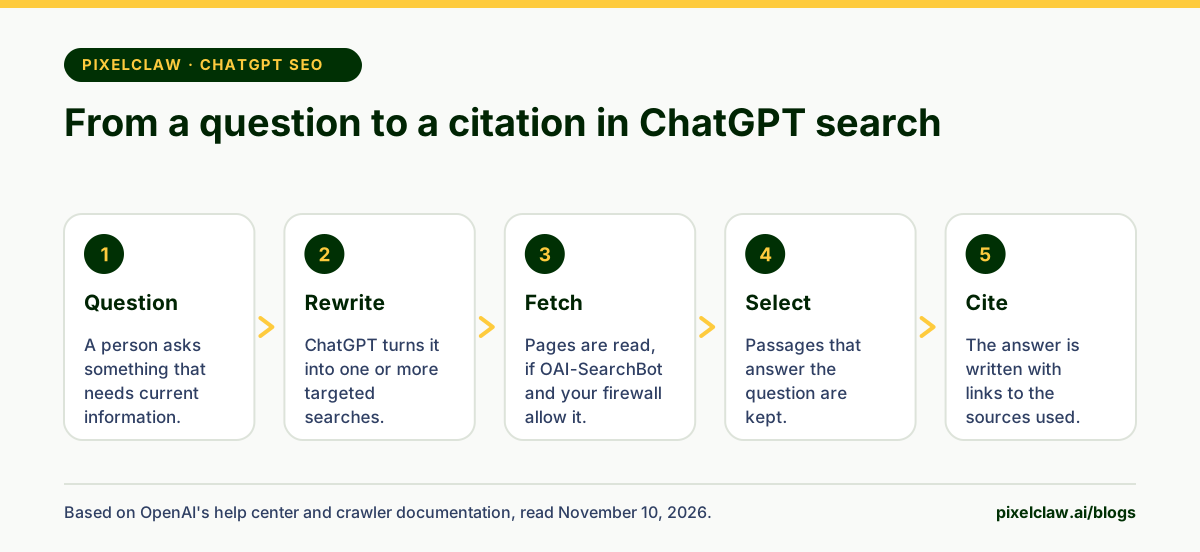
ChatGPT answers some questions from what the model already knows and searches the web for others. OpenAI's help center says it may search automatically when a question would benefit from current information. When it searches, it typically rewrites the question into one or more targeted queries, reads the results and writes an answer that may include citations.
Three OpenAI agents can visit your site, and they do different jobs. OpenAI's crawler documentation describes them. OAI-SearchBot surfaces websites in ChatGPT's search features. ChatGPT-User fetches a page when a person's request calls for it. GPTBot collects content that may be used to train models.
Only the first two bear on being cited today. That separation is useful: a publisher who does not want to feed training can decline GPTBot and lose nothing in search.
Step 1: let OAI-SearchBot in
OpenAI's advice is specific. To help a site appear in search results, allow OAI-SearchBot in robots.txt and allow requests from OpenAI's published IP ranges. It adds that disallowing OAI-SearchBot means the site will not be shown in ChatGPT search answers, though it may still appear as a navigational link.
Check both halves. Open yoursite.com/robots.txt and look for a Disallow rule under OAI-SearchBot, or under the wildcard group that applies to every crawler. Then look at your CDN or security plugin. Bot protection often challenges visitors it does not recognise, and a crawler cannot solve a challenge page. The free AEO and GEO checker reads your robots.txt and lists which AI crawlers it allows.
After a change, wait a day. OpenAI says its systems take about 24 hours to adjust to a robots.txt update.
Step 2: be in the indexes it draws on
ChatGPT cannot cite a page no search system has found. OpenAI says ChatGPT search sometimes partners with other search providers, and names Microsoft among them. Many site owners have only ever set up Google Search Console.
Add your site to Bing Webmaster Tools and submit your sitemap there as well. If your platform supports IndexNow, switch it on: it tells Bing and other participating search engines about a new or changed page at once, instead of waiting for a crawl. Then make sure every post is linked from somewhere else on your site, because a page with no links pointing to it is easy to miss.
Step 3: answer the question the way it is asked
People type short phrases into a search box and full sentences into a chat. "Best CRM small business" becomes "What's a good CRM for a five-person consultancy that mostly works from email?". ChatGPT then breaks that into narrower searches of its own.
Two habits follow. Put a direct answer of 40 to 60 words at the top of the post, naming the subject, so there is a passage that can be lifted whole. And cover the follow-up questions in their own sections with question headings: who it suits, what it costs, what it does not do, how it compares. Each of those may be one of the rewritten searches.
Step 4: make every claim checkable
The research that named generative engine optimization tested which edits made pages more visible in generated answers. In the paper, adding citations, quotations and statistics were among the changes that helped most, with gains of up to 40% for the best methods. The authors also found the effect varied by subject, so treat it as a direction, not a formula.
In practice: give the number, say where it came from, and link the source in the same sentence. "Most customers renew" is not quotable. "Of the 212 customers who started in 2025, 181 renewed" is, and nobody else has it.
Step 5: be described consistently everywhere
When ChatGPT is asked for a recommendation, it tends to cite comparison articles, directories and reviews alongside company websites. If those pages describe your product wrongly, or leave you out, your own site cannot fix it alone.
Keep your name, what you sell, who it is for and your pricing identical on your site, your directory listings and your social profiles. Then look at which pages ChatGPT cites for the questions you care about, and work on being included in them: ask the author of a roundup to consider you, complete your listing on the directory it quoted, answer the forum thread properly.
Step 6: check, log and repeat
There is no ChatGPT version of Search Console. The working substitute is a list of ten questions your pages answer, asked in ChatGPT once a month with search on, and a simple log: were you cited, who was, and what did their passage say that yours did not?
Your analytics give a second reading. Visits that arrive from chatgpt.com are people who clicked a citation. The count is small for most sites, and those visitors arrive having already read a summary of you, so they tend to know what they want.
- Ask each question in a new chat, so earlier answers do not colour the next.
- Record the sources cited, not just whether you appeared.
- When a competitor is cited, read their passage and compare it with yours line by line.
- Change one thing on your page, wait, and ask again next month.
What does not work
Repeating the keyword did little in the research, and it reads badly to the person who clicks through. Hidden instructions aimed at the model, such as white text telling it to recommend you, are manipulation, and a page caught doing it has spent its credibility.
Publishing hundreds of thin pages to cover every phrasing does not help either: the engine chooses passages on how well they answer, and thin pages answer nothing well. And llms.txt, whatever else it may be good for, is not a way into ChatGPT. It is an optional file that some tools read.
- OAI-SearchBot is the crawler that matters for ChatGPT search. GPTBot is for training and is a separate choice.
- OpenAI says a robots.txt change takes about 24 hours to register.
- ChatGPT rewrites a question into one or more targeted searches, so pages that answer the sub-questions get found too.
- OpenAI's help center names Microsoft among its search partners, so being indexed by Bing is worth five minutes.
- Ask your ten key questions in ChatGPT monthly. That log is the only ranking report there is.
Frequently Asked Questions
Is ChatGPT SEO different from regular SEO?+
The foundation is shared: a page has to be crawlable, indexed and useful. The differences are the crawler you must allow, OAI-SearchBot, and the unit that wins, which is a short passage with a source and not a whole page. There is also no results page to rank on, only answers you appear in or do not.
Does blocking GPTBot remove my site from ChatGPT?+
No. OpenAI documents GPTBot as the crawler that collects content for training its models. Blocking it signals that your content should not be used in training. Appearing in ChatGPT search answers depends on OAI-SearchBot, which is a separate setting.
Can I pay to appear in ChatGPT answers?+
Ads and citations are separate. OpenAI documents a crawler called OAI-AdsBot that checks the landing pages of ads submitted on ChatGPT, so advertising exists, but a source link under a search answer is not something OpenAI sells. Be wary of any service that offers guaranteed placement.
How long until ChatGPT sees my changes?+
OpenAI says its systems take about 24 hours to adjust to a robots.txt update. Changes to a page appear once that page is crawled again, which has no published schedule. A sitemap with accurate dates and a link from an already-crawled page both help it get revisited.
Does ChatGPT use Google or Bing results?+
OpenAI's help center says ChatGPT search sometimes partners with other search providers and names Microsoft among them. Microsoft's search engine is Bing. OpenAI also runs its own crawler. The safe reading is that a page missing from Bing's index is at a disadvantage, whatever its position in Google.
Sources
- Overview of OpenAI crawlers — OpenAI
- Searching the web with ChatGPT — OpenAI Help Center
- GEO: Generative Engine Optimization — Aggarwal et al., KDD 2024
- IndexNow documentation — IndexNow
Built & scored using PixelClaw.ai
More from this blog
Continue exploring autoblogging architecture, AI blog writing, and SEO / AEO / GEO playbooks.

LLM SEO (LLMO): How to Get Language Models to Find and Cite Your Pages
A language model can know your business from its training or from a live search. Here is what you control in each case, and the crawler settings that decide it.
PixelClaw Editorial Team
Product and search team

GEO for Startups: What Generative Engine Optimization Means and How to Get ChatGPT to Recommend You
Buyers now ask an AI assistant which tool to use before they ever see a search result. Here is what GEO means, why it matters to startups, founders, bloggers and copywriters, and how to become the name the answer includes.
PixelClaw Editorial Team
Product and search team
How to Rank in Google's AI Overviews: What Google Says and What to Change
Google has published what it takes to appear as a supporting link in AI Overviews and AI Mode. Here is that guidance in plain words, the myths to drop and the edits worth making.
PixelClaw Editorial Team
Product and search team