Tool comparison
Tool comparisonBest GEO Tools in 2026: Trackers and Writers Compared on Price and Engines
Ten generative engine optimization tools, split into the trackers that watch AI answers and the writers that build citable pages, with entry prices from each vendor's site.

On this page▸
The best GEO tools in 2026 are trackers that show where AI answers cite you, and writers that build citable pages. Among trackers, OtterlyAI is the cheapest listed at $29 a month, Peec AI and Scrunch suit teams, and AthenaHQ has a free plan. Among writers, Writesonic, Scalenut, Frase and PixelClaw build generative engine optimization into the draft.
What a GEO tool measures, and what it cannot
A GEO tracker works by sampling. You give it prompts, such as "best payroll software for a ten-person company". It sends each prompt to a set of AI engines on a schedule, reads the answers, and counts how often your brand is mentioned, which pages were cited and how competitors did.
That is useful, and it has limits worth knowing before you pay. The tool sees answers to the prompts you chose, not the questions real people asked. An engine can answer the same prompt differently an hour later. And nobody outside the engine knows how often a given question is asked, so any prompt volume figure is an estimate. Read the reports as a trend line.
Every price and feature below was read on the vendor's own site on November 10, 2026, except Writesonic, Scalenut and Frase, read on November 5. PixelClaw is our product.
GEO trackers compared on price and engines
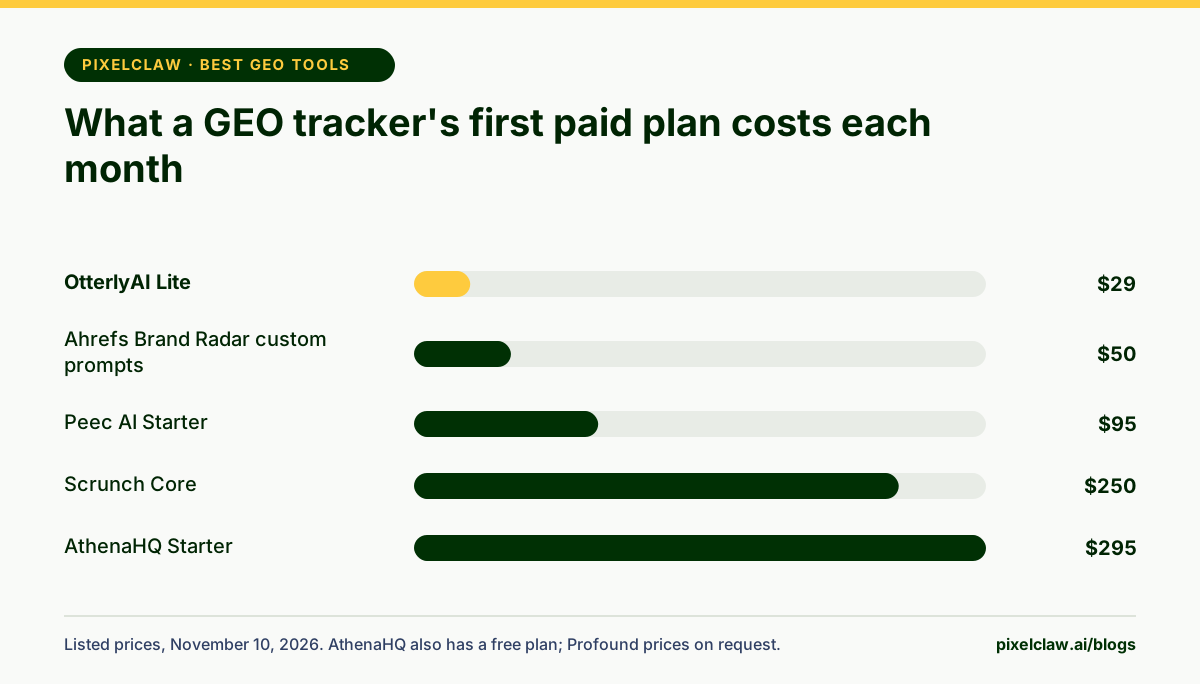
OtterlyAI lists the lowest entry price in this group. Lite is $29 a month, Standard $189 and Premium $489, and each of those covers three of its seven engines: ChatGPT, Google AI Overviews, Perplexity, Microsoft Copilot, Google AI Mode, Gemini and Claude. It suits a small business that wants to watch a short list of questions.
Peec AI's Starter plan is $95 a month for 50 prompts tracked daily on three models you choose, with unlimited users and one project. Pro is $245 for 150 prompts and Advanced $495 for 350, adding multi-country tracking. Unlimited seats make it a fair fit for agencies and marketing teams.
Scrunch starts higher. Core is $250 a month for 125 prompts across four engines, ChatGPT, Perplexity, Google AI and Copilot, with five site audits a month and five user licences. Enterprise adds its Agent Experience Platform and nine engines.
AthenaHQ has a free Essential plan with 300 credits, one credit being one AI response, on five engines. Starter is $295 a month for 3,600 credits across 11 models and adds a content optimization agent.
Profound is aimed at large brands. Its pricing page shows a free 7-day trial running 50 prompts a day on ChatGPT, Gemini and Google AI Overviews, then Enterprise at a custom price for up to nine answer engines, with SSO and SOC 2.
Ahrefs Brand Radar sits inside an SEO suite. Ahrefs lists custom prompt tracking from $50 a month and its AI Visibility Index from $199 a month, drawing on a database of more than 500 million prompts. Check its page for what your Ahrefs plan already includes.
| Tracker | Entry price | Prompts or credits | Engines on that plan |
|---|---|---|---|
| OtterlyAI | $29 a month | See pricing page | 3 of 7 |
| Ahrefs Brand Radar | From $50 a month | Custom prompts | See product page |
| Peec AI | $95 a month | 50 prompts, daily | 3 of your choice |
| Scrunch | $250 a month | 125 prompts | 4 |
| AthenaHQ | Free, then $295 a month | 300 credits, then 3,600 | 5, then 11 |
| Profound | Free trial, then custom | 50 prompts daily on trial | 3 on trial, up to 9 |
Writers with GEO built in
A tracker shows the gap. Someone still has to write the page that closes it. Four tools put generative engine optimization into the writing itself.
Writesonic calls itself an AI search visibility platform. Its Starter plan, $79 a month billed yearly, tracks 50 prompts, runs site audits and includes 15 AI articles a month. Scalenut is built the same way at a lower price: Starter is $59 a month for 10 tracked prompts and 5 GEO articles.
Frase scores each article for SEO and for AI search in one editor and adds visibility tracking. Starter is $49 a month, or $39 billed yearly, for 10 articles.
PixelClaw takes the page side only. It researches and writes each post with a direct opening answer, named sources and an FAQ, scores it in five areas including AI discovery, and on a hosted blog sets up robots.txt, llms.txt and structured data. The free plan covers two posts; Starter is $49.99 a month. It does not track AI answers, so pair it with a tracker if you need reports. The GEO writing tool page shows how the drafting works.
The research behind the term supports spending on the writing. In the GEO paper, adding sources, quotations and statistics to a page were among the edits that raised its visibility most, by up to 40% for the best methods.
Free GEO tools worth using first
Three things cost nothing and answer the first questions.
- PixelClaw's free AEO and GEO checker reads a page and reports which AI search crawlers its robots.txt allows, whether an llms.txt exists and which citable parts the page has.
- PixelClaw's free llms.txt generator drafts an llms.txt file for a site, for the tools that read one.
- AthenaHQ's free Essential plan gives 300 credits of real tracking, enough to see where you stand on a handful of prompts.
How to pick
Count your prompts first. List the questions a customer would ask before buying from you. Twenty questions fit the cheapest plans. Three hundred need a mid-tier plan or better.
Then match engines to customers. If your buyers live in Google, make sure AI Overviews and AI Mode are on the plan. If they are developers or researchers, Perplexity and Claude may matter more than Copilot.
Finally, decide who will act on the report. A tracker nobody reads is the most expensive kind. If you have no one to turn findings into pages, start with a writer and a monthly manual check, and add tracking later. Our guide to GEO vs SEO covers where this fits beside ordinary search, and the AEO tools comparison sorts the same market by job.
- GEO tools split into trackers, which measure AI answers, and writers, which produce pages worth citing.
- Entry prices for trackers run from $29 a month at OtterlyAI to $295 at AthenaHQ, with Profound priced on request.
- Entry plans often cover three or four engines. Check that yours includes the ones your customers use.
- A tracker samples answers to the prompts you choose. It cannot see what real people asked.
- Free options exist: AthenaHQ's free plan, and PixelClaw's llms.txt generator and AEO and GEO checker.
Frequently Asked Questions
What is a GEO tool?+
Software for generative engine optimization, the work of being cited in AI-written answers. Most GEO tools are trackers: they send a list of prompts to engines such as ChatGPT, Perplexity and Google's AI Overviews and report which brands and pages appear. A second group writes or edits content so it is easier to cite.
How much do GEO tools cost?+
On the vendors' own pages in November 2026, tracker entry plans were $29 a month at OtterlyAI, $95 at Peec AI, $250 at Scrunch and $295 at AthenaHQ, which also has a free plan. Profound lists a free trial and custom enterprise pricing. Writers with GEO features started at $49 to $79 a month.
Can a GEO tool get my site cited by ChatGPT?+
Not by itself. A tracker reports; it does not change what an engine says. Citations follow from pages that are reachable, indexed, specific and sourced. The value of a tool is in showing which questions you are missing from and which sources are cited instead, so you know what to write or fix.
Do I need a GEO tool if I already have an SEO tool?+
They measure different things. An SEO tool reports positions in a list of results. A GEO tracker reports presence in written answers, where there are no positions. Some SEO suites now include both: Ahrefs has Brand Radar and Semrush has AI Visibility, so check what your current subscription already covers.
Sources
- OtterlyAI pricing — OtterlyAI (Read November 10, 2026.)
- Peec AI pricing — Peec AI (Read November 10, 2026.)
- Scrunch pricing — Scrunch (Read November 10, 2026.)
- AthenaHQ plans and pricing — AthenaHQ (Read November 10, 2026.)
- Profound pricing — Profound (Read November 10, 2026.)
- Ahrefs Brand Radar — Ahrefs (Read November 10, 2026.)
- Writesonic pricing — Writesonic (Read November 5, 2026.)
- Scalenut pricing — Scalenut (Read November 5, 2026.)
- Frase pricing — Frase (Read November 5, 2026.)
- GEO: Generative Engine Optimization — Aggarwal et al., KDD 2024
Built & scored using PixelClaw.ai
More from this blog
Continue exploring autoblogging architecture, AI blog writing, and SEO / AEO / GEO playbooks.

Best AEO Tools in 2026: Check, Write and Track Answer Engine Visibility
Answer engine optimization tools do three different jobs. Eight options sorted by the job, with the prices on each vendor's own page.
PixelClaw Editorial Team
Product and search team

GEO vs SEO: What Changes, What Stays and What to Do First
Generative engine optimization builds on search engine optimization. Here is where the two overlap, where they pull apart, and the order to work in.
PixelClaw Editorial Team
Product and search team

GEO Blogs: Help Readers and AI Assistants Find Your Sources
Check which search crawlers can reach your blog, and make important claims easy to verify with examples and sources.
PixelClaw Editorial Team
Product and search team