GEO writing tool
PixelClaw toolsA GEO Writing Tool for Posts AI Search Can Reach, Trust and Cite
How PixelClaw handles generative engine optimization: crawler access and llms.txt set up for a hosted blog, sources and authorship checked on every post, and passages written to be lifted.

On this page▸
A GEO writing tool produces posts that generative engines can reach, trust and cite. PixelClaw writes each post with named sources and specific facts, scores it on AI discovery and trust signals, and on a hosted blog sets up robots.txt for AI search crawlers, llms.txt and structured data. It does not track citations.
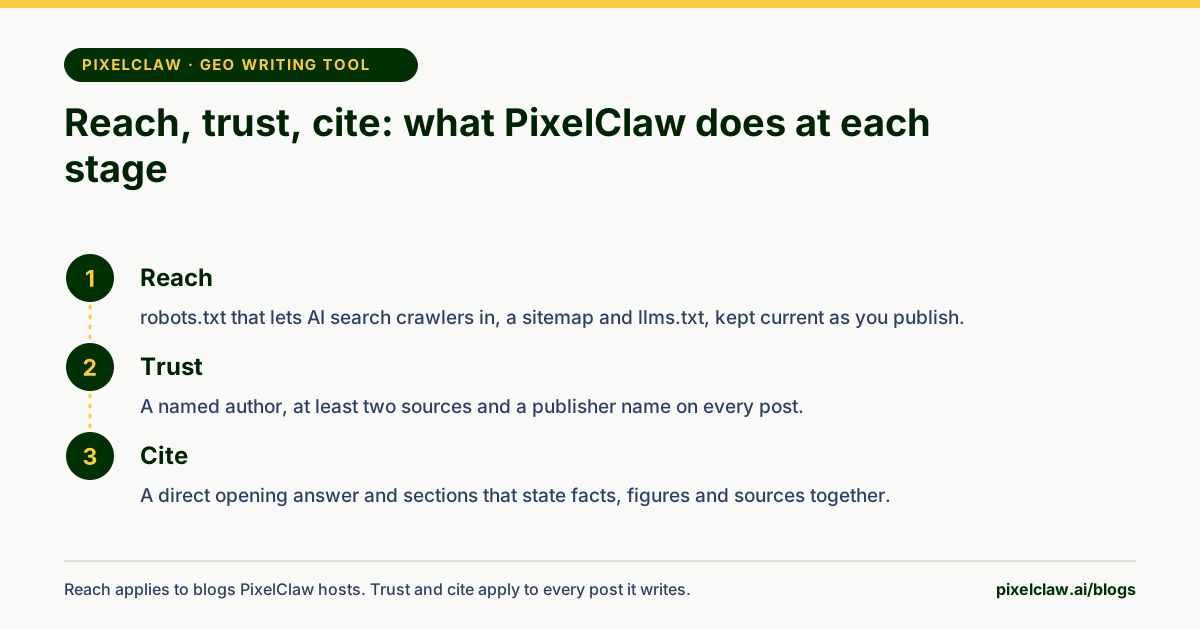
Three things a generative engine needs from a page
When ChatGPT, Perplexity or Google's AI features answer a question from the web, a page has to get through three stages. The engine's crawler has to reach it. The engine has to trust it enough to use. And it has to find a passage that answers the question cleanly enough to cite.
Most AI writers work on a slice of the third stage and nothing else. A GEO writing tool should cover all three, because a well-written post behind a blocked crawler is invisible, and an open site full of unsourced claims is ignored. PixelClaw is our product. Here is what it does at each stage, and where it stops.
Reach: the setup most writers leave to you
A generative engine cannot cite a page its crawler was turned away from. OpenAI says so directly: a site that disallows OAI-SearchBot will not be shown in ChatGPT search answers.
On a blog PixelClaw hosts, that setup is done for you. The robots.txt names the AI search crawlers and lets them in: OAI-SearchBot, ChatGPT-User, Claude-SearchBot, Claude-User, PerplexityBot and Perplexity-User. Training crawlers such as GPTBot, ClaudeBot and Google-Extended sit under a second switch, so you can decline training and stay open to search. Both are allowed until you change them.
The sitemap and llms.txt are rewritten when you publish, and paid plans ping IndexNow so participating search engines hear about a new post at once. In the score, a check called "AI crawlers allowed" fails if the blog asks answer engines to stay away, which catches the setting being switched off by mistake.
Trust: sources, authorship and a named publisher
An engine building an answer prefers material it can stand behind. Two checks in the trust signals area cover the basics: the post names its author, and it points to at least two sources, either in a sources list or as links to other sites in the text. A third, in AI discovery, confirms the publisher's name is shared with search engines.
Research supplies the raw material. Each topic is researched from the pages that rank before the draft is written, and the draft names the sources it draws on. Your part is the facts nobody else has. Add your own figures, prices or test results to the outline, and the post carries evidence an engine cannot get anywhere else.
Cite: passages written to be lifted
Generative engines quote passages, not pages. The study that named the field, GEO: Generative Engine Optimization, tested which edits made a page more visible in generated answers. Adding citations, quotations and statistics were among the changes that helped most, by up to 40% for the best methods. Repeating keywords did little.
PixelClaw's drafts follow that evidence. Each post opens with a direct answer of 40 to 60 words. Sections are planned from the questions research found. The writing rules favour exact numbers, dates and names over general statements, and sources are linked where they are used. As a GEO content generator it is aiming for paragraphs that still make sense when cut out of the page, because that is how they will be read.
| Area | Share of score | What is checked |
|---|---|---|
| AI discovery | 15% | AI crawlers allowed; publisher name shared with search engines |
| Trust signals | 15% | Author named; at least two sources |
| Answer engines | 20% | Opening answer, FAQ, key takeaways, a list or table, reader questions answered |
What a GEO writing tool cannot do for you
Half of generative engine optimization happens away from your site. Engines weigh whether other sources describe you the same way you describe yourself, so listings, reviews and mentions in other people's articles matter. No writing tool earns those. That work is outreach, and it is yours.
PixelClaw also does not track citations. It cannot report how often Perplexity linked to you this month. Trackers do that, and our comparison of GEO tools lists six with their prices.
And no tool can promise a citation. Google states that its AI features have no special requirements beyond an indexed page that can show a snippet, in its guidance on AI features. Everything past that is doing the ordinary things well.
Who it suits
A business with no SEO staff gets the most from it, because the technical setup that usually needs a developer is already done on a hosted blog. An agency gets consistency: every client post goes through the same checks. A team on WordPress gets the writing and the score, and keeps control of its own crawler rules.
If you are a GEO content writer working by hand, the score is the useful part: it shows what a draft is missing before a client or an engine does.
- Start free: a hosted blog and two posts, no card.
- Test a page you already have with the free AEO and GEO checker.
- Read the method in the GEO blogs guide, and the answer-engine side on the AEO writing tool page.
- Generative engine optimization has three stages: the engine has to reach the page, trust it and find a passage worth citing.
- On a hosted blog, PixelClaw writes robots.txt, the sitemap, llms.txt and structured data, with separate switches for AI search and AI training crawlers.
- Every post is checked for a named author and at least two sources.
- AI discovery and trust signals each carry 15% of a post's score.
- Mentions on other sites and citation tracking are outside what a writing tool does.
Frequently Asked Questions
What is a GEO writing tool?+
An AI writer built for generative engine optimization. It drafts posts with the things AI search systems look for, such as direct answers, exact figures and named sources, and it checks the technical side: whether AI crawlers may read the site and whether the publisher is identified. A plain AI writer covers only the text.
Is there a free GEO writing tool?+
PixelClaw's free plan includes a hosted blog and credits for two researched, scored posts, with no card. Two free tools sit beside it for sites hosted elsewhere: an AEO and GEO checker that reads a page and its crawler rules, and an llms.txt generator.
Does PixelClaw create llms.txt?+
Yes, for every blog it hosts. The file is written and updated as you publish, alongside the sitemap and robots.txt. llms.txt is a proposed convention that some tools read, not a requirement of any search engine, so treat it as a courtesy to those tools and not as a ranking lever.
Can I block AI training and still be cited in AI search?+
Yes. The crawlers are different. On a PixelClaw blog, one switch covers AI search crawlers such as OAI-SearchBot and PerplexityBot, and another covers training crawlers such as GPTBot and ClaudeBot. Both are allowed by default, and you can turn training off without touching search.
Does it work for a site that PixelClaw does not host?+
The writing and scoring do. On Starter and higher plans, posts sync to WordPress through the plugin. The crawler rules, sitemap and llms.txt of a site you host yourself stay under your control, so check them with the free AEO and GEO checker.
Sources
- GEO: Generative Engine Optimization — Aggarwal et al., KDD 2024
- Overview of OpenAI crawlers — OpenAI
- The /llms.txt file — llmstxt.org
- AI features and your website — Google Search Central
Built & scored using PixelClaw.ai
More from this blog
Continue exploring autoblogging architecture, AI blog writing, and SEO / AEO / GEO playbooks.

GEO Blogs: Help Readers and AI Assistants Find Your Sources
Check which search crawlers can reach your blog, and make important claims easy to verify with examples and sources.
PixelClaw Editorial Team
Product and search team
GEO vs SEO: What Changes, What Stays and What to Do First
Generative engine optimization builds on search engine optimization. Here is where the two overlap, where they pull apart, and the order to work in.
PixelClaw Editorial Team
Product and search team

Best GEO Tools in 2026: Trackers and Writers Compared on Price and Engines
Ten generative engine optimization tools, split into the trackers that watch AI answers and the writers that build citable pages, with entry prices from each vendor's site.
PixelClaw Editorial Team
Product and search team