AEO writing tool
PixelClaw toolsAn AEO Writing Tool That Drafts the Answer First and Scores It Before Publishing
How PixelClaw writes for answer engines: reader questions gathered in research, a measured opening answer, an FAQ and takeaways in every draft, and a score that shows what is missing.

On this page▸
An AEO writing tool drafts posts the way answer engines read them. PixelClaw researches the questions people ask, opens each post with a 40 to 60 word answer, adds an FAQ, a key takeaways box and sources, then scores the draft before it can publish. The free plan writes two posts.
What an AEO writing tool has to do
Ask most AI writers for a blog post and you get a warm-up paragraph, a few sections and a summary. It reads fine and gives an answer engine nothing to use, because the answer is buried in the fourth paragraph and the questions people ask are not the headings.
Answer engine optimization changes the order of work. The questions come first, in research. The answer comes first, in the draft. And the parts that engines lift, such as the opening, the FAQ and the lists, are checked as their own items instead of being hoped for. That is the difference between an AEO writing tool and an AI writer with an AEO label. PixelClaw is our product, and this page describes how it handles each stage.
It starts from the questions readers ask
Before a word is drafted, PixelClaw researches the topic: the pages that rank for it and the questions readers ask about it. Research collects up to eight of those questions, so the post is planned around them instead of patched afterwards.
The outline comes next, and you can edit it before the draft is written. Move a section, add a heading for something only your business knows, or remove a question that does not fit your reader. The draft then follows that outline in your brand voice.
After the draft, a check called "Answers what readers ask" compares the post with the research questions. It passes when the post answers most of them, and when it fails it names the ones still open.
The opening answer, written and measured
The most important AEO sentence in any post is the first one. Google's systems choose which passage makes a good featured snippet, and a short paragraph that answers the question outright is the easiest thing on a page to lift.
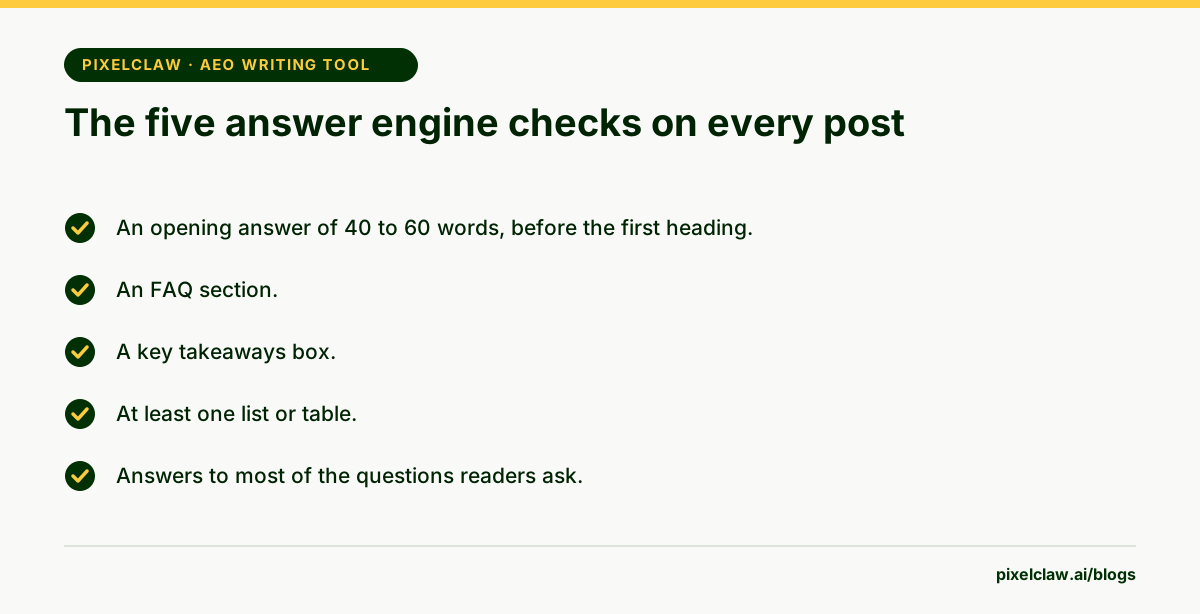
Every PixelClaw draft opens with a direct answer placed before the first heading. The check on it is specific: 40 to 60 words. Shorter than that and the answer usually lacks the detail to stand alone. Longer and it stops being quotable whole. If your edits push the opening outside the range, the score tells you the current count and what to aim for.
FAQ, takeaways, lists and tables
Four more checks cover the rest of what answer engines read.
- An FAQ section for the follow-up questions the body did not cover.
- A key takeaways box that states the main points as full sentences.
- At least one list or table, because steps and comparisons are easy to quote.
- Answers to the reader questions that research found.
A score you can read, and a bar the post must clear
Each post is scored out of 100 across five areas. Answer engines carry 20%, next to search engines at 30%, reader experience at 20%, trust signals at 15% and AI discovery at 15%. Every check is listed with a plain explanation of what passed and what did not.
A post scoring below 60 cannot publish. When a check fails, a one-click fix writes the missing piece, such as a tighter opening or an FAQ, and shows it to you before anything changes. Nothing is applied until you accept it.
On a blog PixelClaw hosts, the published page also carries Article, FAQ and breadcrumb structured data that matches the visible text, which is what Google asks of structured data in its guidance on AI features.
From one post to a schedule
Writing one answer-first post by hand is easy. Writing one every week is where the habit slips. Autopilot applies the same research and the same checks to every topic in its queue. Posts wait for your approval by default. With automatic publishing switched on, only drafts scoring 77 or more go live by themselves.
That makes it usable as AEO article writing software for a small team: the structure is consistent from post to post, and a person still decides what goes out.
What it does not do
PixelClaw does not track where AI answers mention you, so it cannot tell you that ChatGPT quoted your post last Tuesday. For that you need a tracker, and our list of AEO tools covers them.
It cannot promise that any engine will pick your passage. Nobody can. And as an AEO content generator it is only as good as the facts it has: research finds what is public, but your prices, your results and your experience have to come from you. Add them to the outline and the post has something no competitor can copy.
To check a page you have already published, use the free AEO and GEO checker. For the method behind all of this, read the guide to AEO blogs, and for the AI discovery side, the GEO writing tool page.
- AEO has to be planned into a post from the research stage. It cannot be sprayed on at the end.
- PixelClaw gathers up to eight reader questions in research and plans the post around them.
- Answer engines carry 20% of every post's score, through five checks you can read in plain words.
- A one-click fix writes a missing opening or FAQ and shows it to you before anything changes.
- It writes the page. It does not track which AI answers mention you.
Frequently Asked Questions
What is an AEO writing tool?+
An AI writer built around answer engine optimization. On top of drafting the article, it plans the post from the questions people ask, opens with a short direct answer, and adds the FAQ, takeaways and structure that featured snippets, voice assistants and AI answers lift from. A general AI writer leaves those parts to you.
Is there a free AEO writing tool?+
PixelClaw's free plan includes a hosted blog and enough credits to research, write and score two full posts, with no card. If you only want to test a page you already have, the free AEO and GEO checker reads one URL a day and reports which answer-ready parts it has.
Does it write for ChatGPT and Google's AI Overviews?+
It writes pages those systems can use. Google says its AI features need no special markup, only an indexed page that can show a snippet, and OpenAI asks sites to allow its search crawler. PixelClaw handles the page structure and, on a hosted blog, the crawler settings. No tool can make an engine choose you.
Can I use it with WordPress?+
Yes, on Starter and higher plans. PixelClaw syncs posts to WordPress through its plugin as live posts or as drafts for you to review. On the free plan, posts publish to a blog PixelClaw hosts for you.
Does writing for AEO hurt ordinary SEO?+
No. An opening that answers the question, clear headings and cited sources are also what a visitor from a normal search result wants. The same post is scored for search engines and for answer engines side by side, so you can see both.
Sources
- Featured snippets and your website — Google Search Central
- AI features and your website — Google Search Central
Built & scored using PixelClaw.ai
More from this blog
Continue exploring autoblogging architecture, AI blog writing, and SEO / AEO / GEO playbooks.
AEO Blogs: How to Write Clear Answers to Reader Questions
Start with the answer, support it with evidence, and use headings that match the questions people ask.
PixelClaw Editorial Team
Product and search team

AEO vs SEO: How Answer Engine Optimization Differs and When It Matters
SEO gets a page found. AEO gets a passage from it given as the answer. See what differs, one section written both ways, and which to work on first.
PixelClaw Editorial Team
Product and search team

Best AEO Tools in 2026: Check, Write and Track Answer Engine Visibility
Answer engine optimization tools do three different jobs. Eight options sorted by the job, with the prices on each vendor's own page.
PixelClaw Editorial Team
Product and search team