AEO vs SEO
AI search guideAEO vs SEO: How Answer Engine Optimization Differs and When It Matters
SEO gets a page found. AEO gets a passage from it given as the answer. See what differs, one section written both ways, and which to work on first.

On this page▸
AEO vs SEO is a difference of outcome. SEO works to rank a page in search results so people click through. AEO, answer engine optimization, works to have a passage from that page given as the answer itself, in a featured snippet, a voice reply or an AI summary. Most pages need both.
What an answer engine is
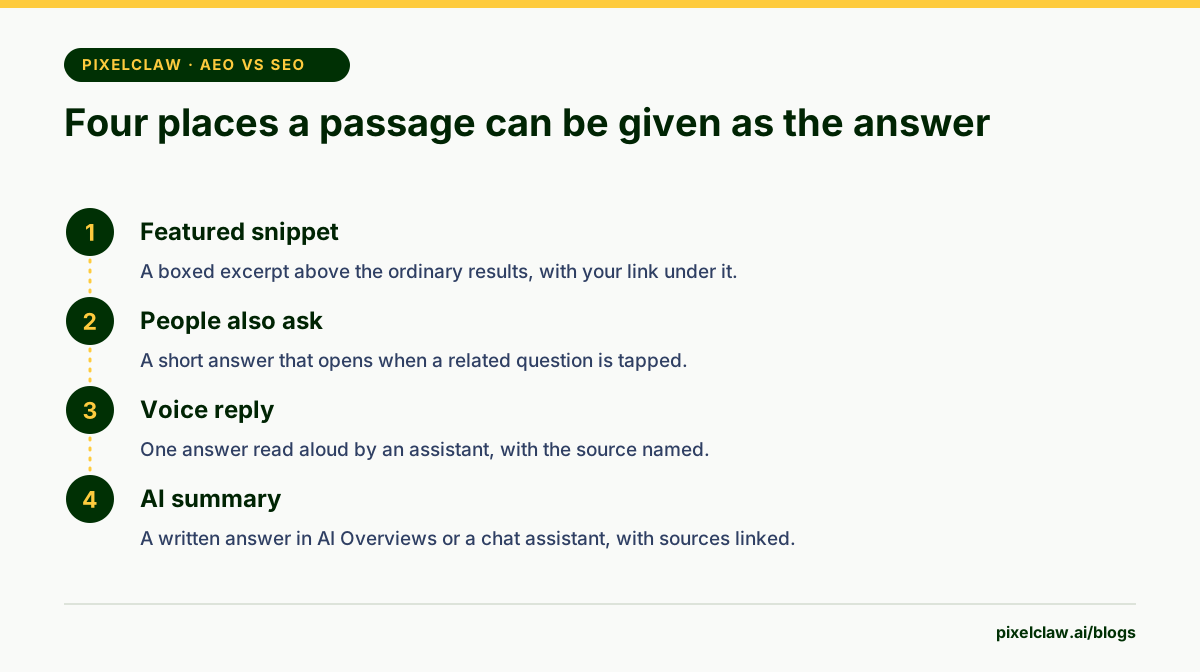
An answer engine is anything that replies to a question with the answer instead of a list of places to look. Google has shown featured snippets, the boxed excerpt above the ordinary results, for more than a decade. Siri, Alexa and Google Assistant read a single answer aloud. Google's AI Overviews, ChatGPT and Perplexity write a few paragraphs and attach sources.
The mechanics differ, but the effect on a publisher is the same each time. One passage is chosen, and everything else on the page is ignored. Answer engine optimization is the craft of writing the passage that gets chosen.
Search engine optimization is older and broader. It covers everything that helps a page get crawled, understood and ranked: site structure, speed, links, keywords and content. AEO sits inside that world and cares about one narrow question: when the engine wants a short answer, is yours ready to lift?
AEO vs SEO: the differences that change your work
Most of the difference shows up in how you plan and open a post. The table sets the two side by side.
| What differs | SEO | AEO |
|---|---|---|
| Aim | Rank the page and earn the click | Be the passage the engine gives |
| Planned around | A keyword and its variations | A question and its follow-ups |
| Winning text | The whole page | 40 to 60 words, self-contained |
| Best formats | Complete guides, comparison pages | Direct answers, steps, tables, FAQs |
| Applies to | Every kind of search | Mostly question-shaped searches |
| Measured by | Position, impressions, clicks | Whether you are quoted or cited |
One section, written twice
Take a painting company answering the question "How much does it cost to repaint a kitchen?". Here is an opening written the way many SEO posts still open.
"Thinking about giving your kitchen a fresh new look? A kitchen repaint is one of the most popular home improvement projects, and for good reason. There are many factors that go into the cost of painting a kitchen, and we will walk through them below."
It contains the keyword and says nothing. An answer engine has no sentence to lift. Now the same opening written for an answer engine, using the company's own records.
"Repainting a kitchen costs between $1,900 and $4,200 across the last 40 kitchens we painted in Columbus, Ohio. Walls and ceiling alone sit at the low end. Cabinets roughly double the price, because doors come off and are sprayed in the shop. Most jobs take three to four days."
The second version answers in its first sentence, gives a range, says where the number comes from, and names the thing that moves the price. It is also the better piece of SEO writing, because a reader who clicked through gets what they came for at once. That is the pattern across most of AEO: the edit that helps the engine helps the person.
What SEO still does that AEO cannot
AEO only has work to do when the search is a question with a short answer. A great many searches are not. Someone typing a brand name wants a website. Someone comparing two products wants a page they can study. Someone looking for a local service wants a map and reviews. Those are won by classic SEO: a fast site, pages that match the search, and other sites that vouch for you.
Pew Research Center's browsing study gives a sense of the split. Across all the Google searches it recorded in March 2025, 18% produced an AI summary. Among searches phrased as a question the share was 60%. Questions are where answer engines live, and the rest of search still looks much as it did.
SEO is also the gate. Google says a page must be indexed and eligible to show a snippet before it can appear in its AI features, and its systems decide which pages make good featured snippets. You cannot mark a page as one. A page with crawl problems has no AEO to speak of.
What AEO adds to a post
Five habits do most of the work, and none of them needs a tool.
- An opening answer of 40 to 60 words, placed before the first heading, that names the subject and answers the main question.
- Headings written as the questions readers ask, each followed straight away by its answer.
- A short FAQ for the follow-up questions the body did not cover.
- A key takeaways box that states the main points as full sentences.
- At least one list or table wherever the content is steps or a comparison.
FAQ markup: what it does now
A lot of AEO advice still tells you to add FAQ structured data to win a rich result. That advice is out of date for most sites. In August 2023 Google announced that FAQ rich results would be shown only for well-known, authoritative government and health websites.
The FAQ is still worth writing. Question-and-answer pairs are the cleanest thing on a page for an answer engine to read, and the questions often match what people type word for word. If your platform adds the markup for you, leave it on and keep it matched to the visible text. Just do not write an FAQ for the sake of a rich result that will not come.
Which to prioritise for your blog
It depends on what the blog has already earned.
A new blog with no rankings should do SEO basics first, because nothing can be quoted until it is indexed, and build the answer-first structure into every post from the start. Retrofitting openings later is tedious.
An established blog whose positions are steady while clicks fall is seeing answer boxes take the top of the page. That blog should put AEO first: rewrite the openings of its best-ranking posts and add FAQs, starting with the posts that answer questions.
A shop or a software company whose money pages are product and comparison pages should keep its weight on SEO, and use AEO on the supporting articles that answer how, why and how much.
Blogs in question-heavy fields such as home repair, health, money and law live closest to answer engines. There, AEO is not a second step. It is how the post should be drafted. Our guide to writing AEO blogs walks through a full post.
Measuring AEO next to SEO
Search Console reports featured snippets and AI features inside your ordinary Web search numbers and offers no filter for either. So the SEO numbers are exact and the AEO numbers are inferred.
Two checks make up for it. Search your ten most important questions in a private window once a month and note whether your passage is the one shown. Then ask the same questions in the assistants your customers use. A page that holds position one while its clicks drop is often being quoted without the click, and that is worth knowing before you rewrite it. If you want the asking automated, our list of AEO tools covers the trackers and what they cost.
How PixelClaw handles both
PixelClaw is our product. It scores every post out of 100, and the two halves of this article are two of its five areas. Search engines carry 30% of the score: title and excerpt length, heading order, structured data and links to related posts. Answer engines carry 20%: the 40 to 60 word opening, an FAQ, a key takeaways box, a list or table, and answers to the reader questions that research found.
When a check fails, a one-click fix writes the missing piece and shows it to you before anything changes. To see how a page you already have does on the answer-engine side, run it through the free AEO and GEO checker.
- SEO is judged by position and clicks; AEO is judged by whether your words are the answer the reader is given.
- AEO applies mostly to question-shaped searches, which are the ones most likely to show an AI summary.
- The main AEO edit is the opening: answer the question in 40 to 60 words before any background.
- FAQ markup rarely earns a rich result in Google now, but the FAQ itself still gives answer engines clean pieces to lift.
- Start with SEO basics on a new blog, and build the answer-first structure into every post from day one.
Frequently Asked Questions
Is AEO part of SEO or separate from it?+
It is best treated as a layer on top. An answer engine can only lift a passage from a page it has crawled and trusts, and that part is SEO. AEO is the editing that makes a passage easy to lift: a direct opening answer, question headings, an FAQ and clear structure.
Does AEO reduce my website traffic?+
The answer box reduces clicks whether or not you are in it. Pew Research Center found people clicked a traditional result on 8% of visits when an AI summary appeared, against 15% without one. Being the cited source at least keeps your name in front of the reader and wins the clicks that remain.
Do I need FAQ schema for AEO?+
It helps machines read the questions, but do not expect a rich result from it. Since August 2023 Google shows FAQ rich results only for well-known government and health websites. Write the FAQ for readers, mark it up if your platform does it for you, and make sure the markup matches the visible text.
How long should an AEO answer be?+
Short enough to quote whole. PixelClaw checks for an opening answer of 40 to 60 words, a range that fits in an answer box and can be read aloud in about twenty seconds. Google publishes no official length, so treat the range as a working rule, not a law.
Is AEO the same as GEO?+
They overlap. AEO grew up around featured snippets and voice assistants, and focuses on how an answer is written. GEO grew up around chat assistants, and adds crawler access, sources and being cited. Many people now use the two words for the same work.
Sources
- Featured snippets and your website — Google Search Central
- AI features and your website — Google Search Central
- Changes to HowTo and FAQ rich results — Google Search Central Blog (Published August 8, 2023.)
- Google users are less likely to click on links when an AI summary appears in the results — Pew Research Center (Published July 22, 2025, from the browsing of 900 US adults in March 2025.)
Built & scored using PixelClaw.ai
More from this blog
Continue exploring autoblogging architecture, AI blog writing, and SEO / AEO / GEO playbooks.
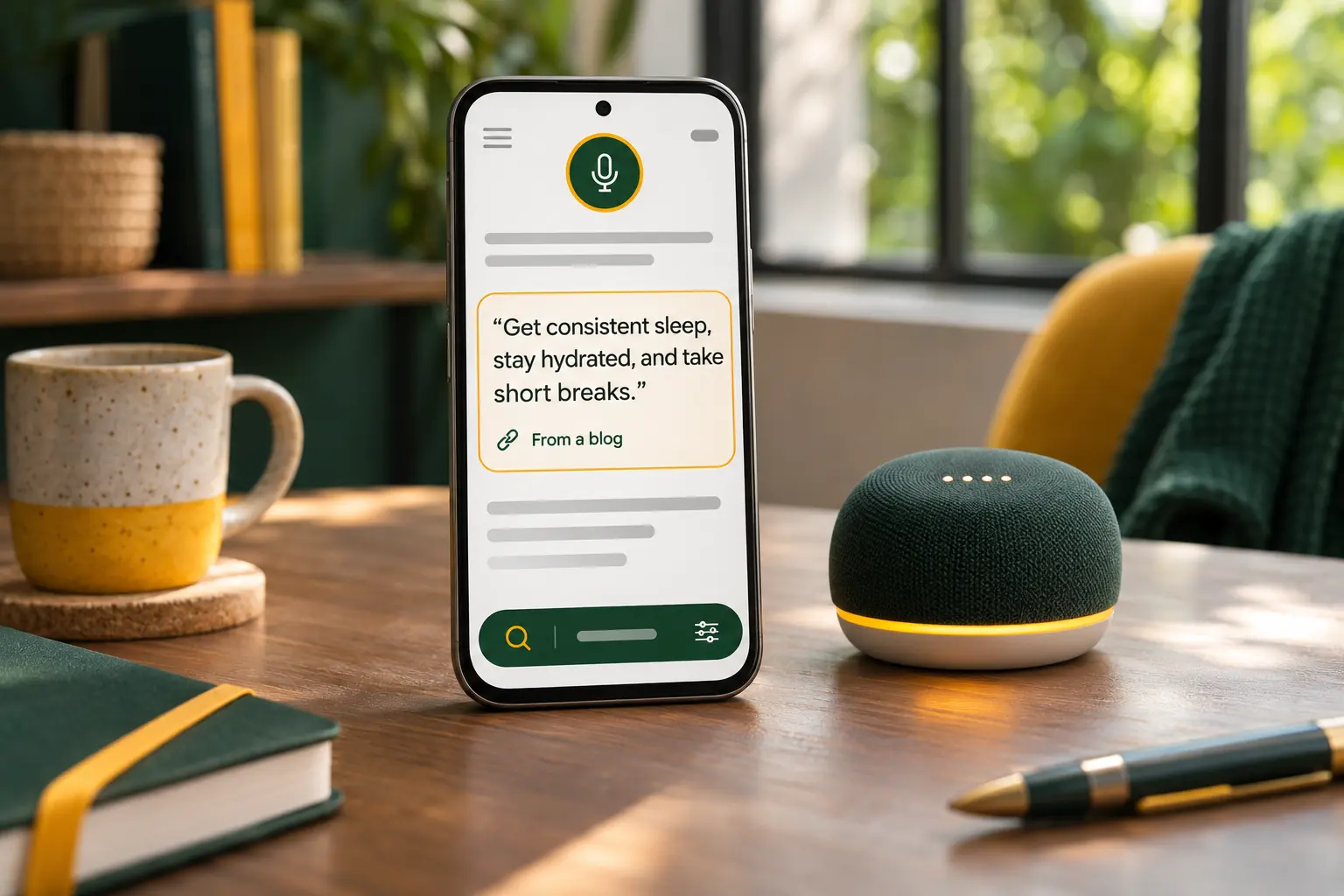
AEO Blogs: How to Write Clear Answers to Reader Questions
Start with the answer, support it with evidence, and use headings that match the questions people ask.
PixelClaw Editorial Team
Product and search team
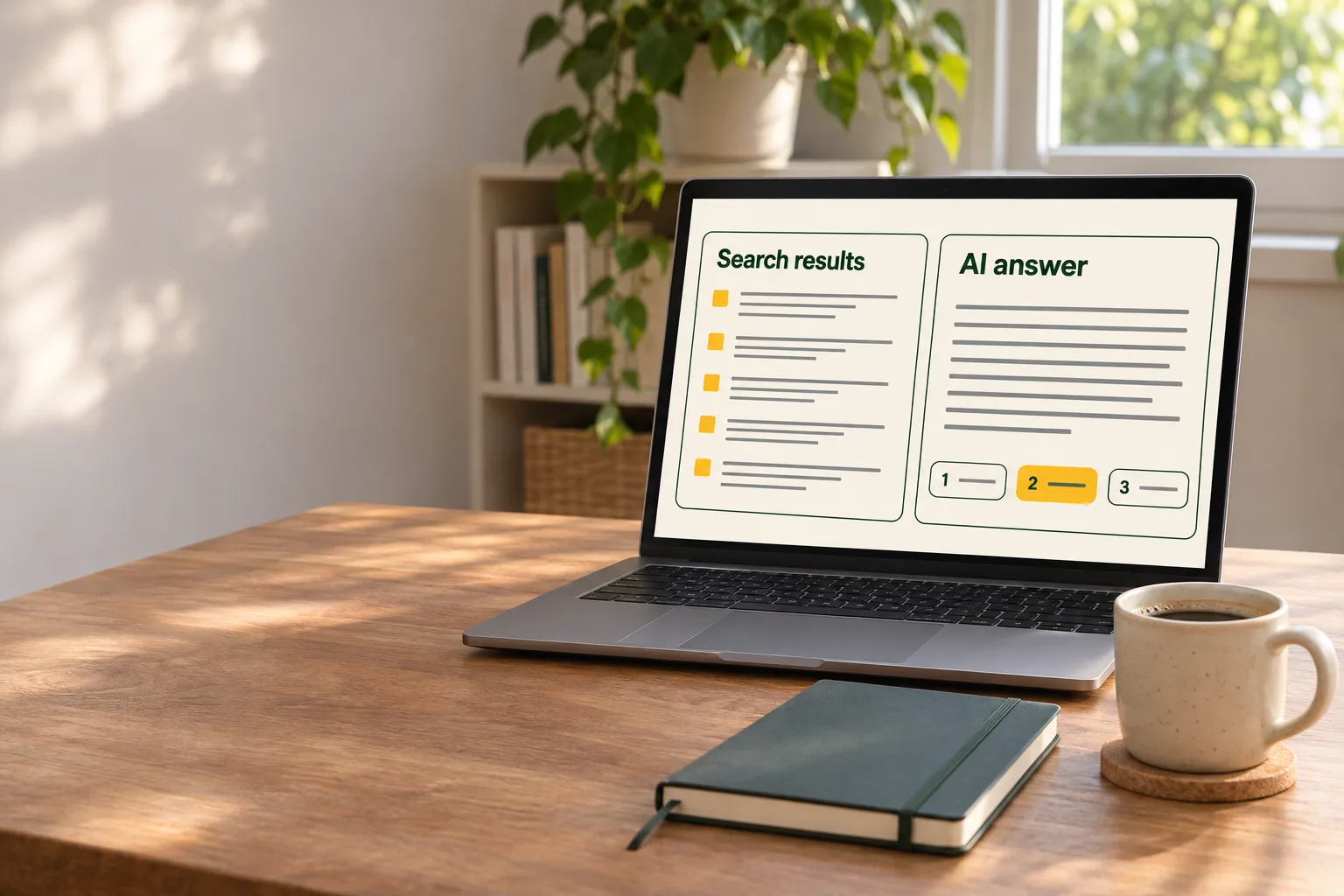
GEO vs SEO: What Changes, What Stays and What to Do First
Generative engine optimization builds on search engine optimization. Here is where the two overlap, where they pull apart, and the order to work in.
PixelClaw Editorial Team
Product and search team
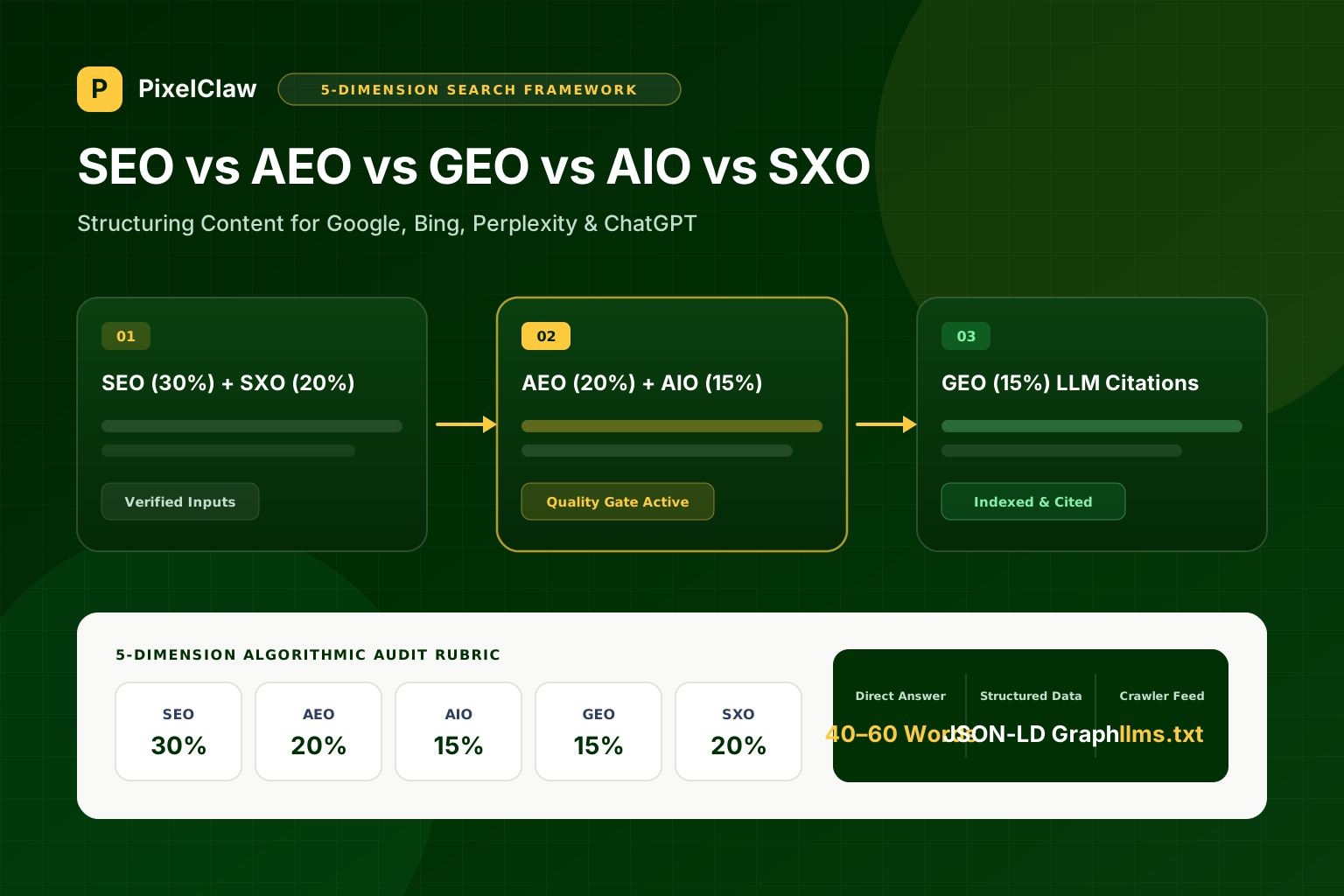
AEO vs GEO vs SEO: What Each One Means for Your Blog
Search visibility now spans traditional blue links, direct answer snippets, and generative AI citations. Here is how SEO, AEO, AIO, GEO, and SXO work together on every post.
PixelClaw Editorial Team
Product and search team