Travel blogging
Niche guideTravel Blogging Software: Keep Writing About Trips After You Come Home
What travel blogging software can research and draft, what only the traveler can add, and how to turn trip notes into posts that readers and AI answers trust.
On this page▸
Travel blogging software researches what travelers ask about a destination, writes an outline and a draft, scores the draft and publishes it on your blog. It saves the hours spent on research and formatting. It has not visited the place, so the photos, prices, opening hours and first-hand detail still come from the traveler.
What is travel blogging software?
Travel blogging software runs the repeatable part of a travel blog. It finds the questions people ask about a place, reads what already ranks, writes an outline and a draft, checks the draft and publishes it. The traveler decides what goes live and adds what only a visitor knows.
It differs from a general AI chat window. A chat window answers when asked and forgets the rest. Travel blogging software keeps a queue of topics, scores each draft and publishes on your site. It is the difference between a paragraph and a post that is live.
It also differs from a blogging platform. A platform gives you a page to publish on. The research, the writing and the checking are still yours, and those are the parts that make a travel blog stop after a few trips.
What do travelers search for and ask AI assistants?
Travelers rarely search for a destination alone. They search for the one thing that blocks the decision. How much, how long, how safe, which month, which route. People ask AI assistants the same questions in full sentences, and an assistant tends to quote a page that answers the question in its first lines.
These are the kinds of questions a travel blog can own. The right column is the part software cannot supply.
| What the reader asks | What the post needs | What only the traveler can add |
|---|---|---|
| How many days do I need in Lisbon? | A short answer, then a day-by-day outline | Which days felt rushed on your trip |
| Is the night train from Vienna worth it? | Cost, timing and what the compartments are like | A photo of the berth and the date you rode |
| Is Chiang Mai safe for a solo woman? | Sources, local advice lines and practical steps | What happened to you, honestly told |
| What is the best month to visit Iceland? | Weather and daylight by month | What the roads and crowds were like when you went |
| How much does a week in Mexico City cost? | A table of daily spending | Your receipts and the date you paid |
| Do I need a visa for Vietnam? | A link to the official page and a dated summary | Whether the process matched the rules |
| What should I pack for Patagonia? | A checklist by season | The item you wished you had brought |
| Is it worth paying for the museum pass? | A cost comparison | How many places you actually reached |
Why most travel blogs stall after a few trips
Orbit Media's 2026 survey of 1,042 content marketers puts the average post at 3 hours and 20 minutes to write. A travel post is heavier than that. There are notes to sort, photos to choose, prices to look up again and a map to build.
So the blog waits for the next trip, and then the next. The pattern is common enough to have a name among travel writers: the backlog. Notes pile up, the trip fades and the post never gets written.
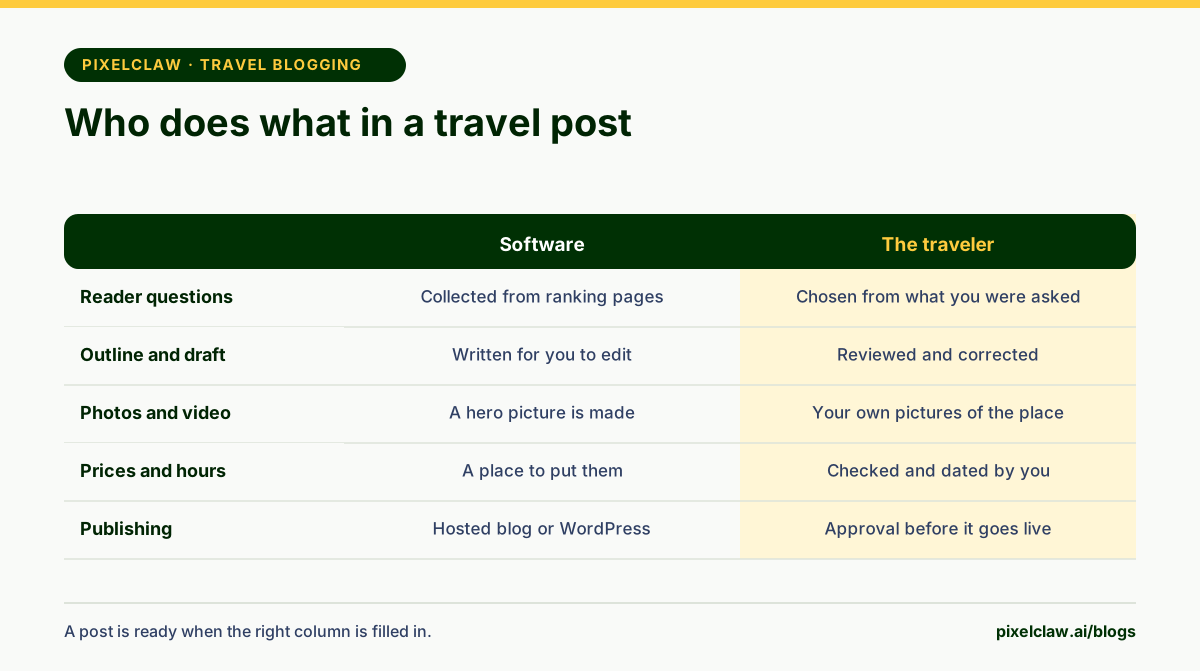
The work that software takes is the work that does not need the trip. Researching what travelers ask, outlining, drafting the background sections and publishing can all happen at a desk. The work that does need the trip stays with you.
What only the traveler can supply, and why it matters
The software has not been to the place. It has read what others wrote about it. That is useful for structure and background and useless for the thing readers actually want, which is whether it was worth going.
Four things must come from the traveler. The first is first-hand detail: the smell of the market, the length of the queue, the stairs nobody mentioned. The second is photos, because a reader trusts a picture you took. The third is prices, opening hours and dates, which must be checked and dated, since they change. The fourth is the verdict, your own opinion about who should go and who should skip it.
Google's guidance on helpful, people-first content asks whether content shows first-hand experience and who created it. A travel post that has them reads differently from a post assembled from other posts, and AI answers tend to favour the one with the specific detail.
What makes a travel post trusted by readers, Google and AI answers
Start with the answer. If the post is about three days in Porto, say in the first paragraph whether three days is enough and why. A reader who gets that answer stays, and an assistant can quote it.
Then add proof. Put the month and year of the trip near the top. Date every price. Link the official page for visas, tickets and opening hours, and say when you last checked it. Name the author and what they did, such as walked the route or took the train, so the page shows who wrote it.
Google's structured data guidance for articles lists the author and the published and modified dates as article properties. PixelClaw sets up that structured data for each post, so your job is to keep the dates honest. Update the post when something changes and say so on the page.
Disclose money. The FTC's guidance for influencers says a financial relationship counts as a material connection and the disclosure should sit with the recommendation, not behind a link or at the end. Tell readers when you earn a commission from a booking link or received a free stay.
How PixelClaw fits a travel blog
PixelClaw researches each topic by reading the pages that already rank and collecting the questions readers ask, then writes an outline and a draft. For a travel blog that means the background, the structure and the common questions are there when you sit down to add the trip.
You can guide one post at a time in the writing studio, where the outline can be edited before the draft is written. That is where you move your own route to the top and add the detail only you have. Or you put topics in a queue and let Autopilot work through them at your plan's pace, which suits a blog that needs to keep publishing while you travel.
Every draft is scored out of 100 from 21 checks in five areas: SEO carries 30% of the score, AEO 20%, AIO 15%, GEO 15% and SXO 20%. Most failing checks come with a one-click fix. A draft under 60 is held back, and finished posts wait for your approval by default. With automatic publishing switched on, a post must score 77 or more to go live on schedule.
Posts are published on a blog PixelClaw hosts for you, with sitemap.xml, robots.txt, llms.txt and structured data for articles and FAQs set up from the first day, or on an existing WordPress site through the PixelClaw plugin. Starter and higher plans can connect a custom domain, and a post can be translated into eleven languages, which helps a blog readers search in other languages. PixelClaw also makes a hero picture for each post it drafts, though your own photos should carry the post. A personal blog can skip business details at setup, so a hobby travel blog needs no company profile.
How to choose travel blogging software
Most tools look alike on a features page. Test them against five questions, and use a real trip as the test.
- Does it research before it writes? A post built from the pages that rank and the questions readers ask is specific. One written from memory repeats the same ten attractions.
- Can you edit the outline before the draft? Travel posts need your route and your order, not a generic itinerary.
- Do you approve every post? Nothing about a place should go live unchecked.
- Does it hold weak drafts back? A score with a publish bar keeps a thin post off the site.
- Does it publish for you? Hosting, the sitemap and page data should not become a second job on top of the trip.
Start a travel blog this week
Pick a narrow subject. A region, a kind of traveler or a style of trip is enough: slow trains in Europe, weekends away with toddlers, hiking without a car. Narrow subjects are easier to answer well and easier to be found for.
Write down ten questions people have asked you about it, in their words. Put the first into the writing studio as a topic and let it research and draft. Open the draft and add your own detail: the date, a price with its date, one photo, one thing that surprised you. Fix the checks that fail, approve the post and publish.
One post a week is enough to start. Our guides to autoblogging and to whether blogging is still worth it cover pace and results, and business blogging software covers the case where the travel blog is also a company.
- Travel readers search for specific, practical answers such as costs, routes, timing and safety, and a post that answers one of them first gets the visit.
- Travel blogs stall because every post needs research, writing, photo sorting and formatting on top of the trip itself.
- Software can take the research, the outline, the draft and the publishing, but it has not been to the place.
- Photos, prices, opening hours and dates must come from the traveler and be checked before a post goes live.
- Disclose affiliate links next to the link, in plain words, and put a date on anything that can change.
Frequently Asked Questions
What is the best software for a travel blog?+
The best fit is software that researches each destination question, drafts a post you can edit and lets you review before anything is published. Choose one that hosts the blog or works with your WordPress site, so publishing is not a second job. Try it on one real trip before you commit.
Can AI write my travel blog posts?+
It can draft the structure, the background and the answers to common questions. It cannot tell a reader what the queue felt like or whether the hostel was clean. Add those details yourself, because first-hand experience is what Google's guidance on helpful content asks about.
How do I start a travel blog?+
Pick one region or one kind of trip, such as budget rail travel or family weekends, and write down ten questions people ask about it. Create the blog, add the first question as a topic and publish one post. A narrow subject gets you read sooner than a general one.
Do I need to disclose affiliate links on a travel blog?+
Yes. The FTC treats a financial relationship as a material connection that should be disclosed. Place the disclosure next to the link in plain words such as "I earn a commission if you book through this link", not at the end of the post.
How do I keep travel prices and opening hours correct?+
Write the date you checked beside every price and hour, and recheck the posts that bring in the most readers. Software can flag what to recheck, but only a person can confirm what a ticket costs today. An old price in a post costs readers money and costs you their trust.
Sources
- Blogging Statistics 2026: What 1,042 Content Marketers Told Us About What Works — Orbit Media Studios (The average post takes 3 hours 20 minutes to write and runs 1,312 words.)
- Creating helpful, reliable, people-first content — Google Search Central (Asks who created the content, how, and why, and stresses first-hand experience.)
- Google Search's guidance about AI-generated content — Google Search Central Blog (Automation is fine when it serves people. Using it mainly to manipulate rankings is spam.)
- Disclosures 101 for Social Media Influencers — U.S. Federal Trade Commission (A financial relationship is a material connection, and the disclosure belongs with the recommendation, in plain words.)
- Article structured data — Google Search Central (Describes the author, datePublished and dateModified properties for articles.)
Built & scored using PixelClaw.ai
More from this blog
Continue exploring autoblogging architecture, AI blog writing, and SEO / AEO / GEO playbooks.

Business Blogging Software: How a Blog Brings Customers to Your Business
What business blogging software does, why articles bring in customers who are already searching, and how it works for a local firm, a store, a SaaS company, an agency or a practice.
PixelClaw Editorial Team
Product and search team

Autoblogging in 2026: How to Run a Blog That Publishes Itself and Still Ranks
What autoblogging looks like when it works: a topic queue, research before writing, a score that holds weak drafts back, and editorial review before a draft reaches readers.
PixelClaw Editorial Team
Product and search team

AI Blogging Without the Slop: A Working Process for Posts People Trust
Where AI earns its place in a blog, where a person still has to step in, and a five-step process that turns AI drafts into posts worth putting your name on.
PixelClaw Editorial Team
Product and search team