Business blogging
AI search guideBusiness Blogging Software: How a Blog Brings Customers to Your Business
What business blogging software does, why articles bring in customers who are already searching, and how it works for a local firm, a store, a SaaS company, an agency or a practice.

On this page▸
Business blogging software researches what your customers search for, writes articles that answer those questions, and publishes them on your website on a schedule. It replaces the hours a person spends on research, drafting and formatting, so a business gets found in Google and in AI answers without hiring a writer or learning SEO first.
What is business blogging software?
Business blogging software runs a company blog from start to finish. It finds the questions your customers type into a search box, researches each one, writes an article that answers it, and publishes the article on your website. You stay in charge of what goes live. The software does the hours of work in between.
That makes it different from the two tools people usually reach for. A blogging platform such as WordPress gives you a place to publish and leaves the writing to you. An AI writing assistant gives you paragraphs when you ask for them and leaves the rest to you: what to write about, whether it is accurate, where it goes, and whether anyone will find it. Business blogging software, sometimes called business AI blogging software because the drafting is done by AI, covers the whole job and ties it to what the business sells.
The category exists because the hard part of a business blog was never typing. It is knowing which article is worth writing, doing it every week, and making sure each one is good enough to carry your name.
Why a blog brings customers to a business
Most purchases start with a question. How much does a roof repair cost. Which accounting tool works for a five-person firm. Is this supplement safe with that medication. The person asking is not looking for an advert. They want an answer, and they will read whoever gives a good one.
A blog article is how a business gives that answer in public. Google lists the page for people who search the question. AI assistants such as ChatGPT and Perplexity read pages like it and name their sources when they answer. Either way the reader arrives on your site while they are deciding, and the article points them to the service, product or booking page that fits.
An advert stops working the day you stop paying for it. An article that answers a real question keeps being found for as long as the answer stays true. That is the whole case for a business blog, and it does not require you to know what SEO stands for.
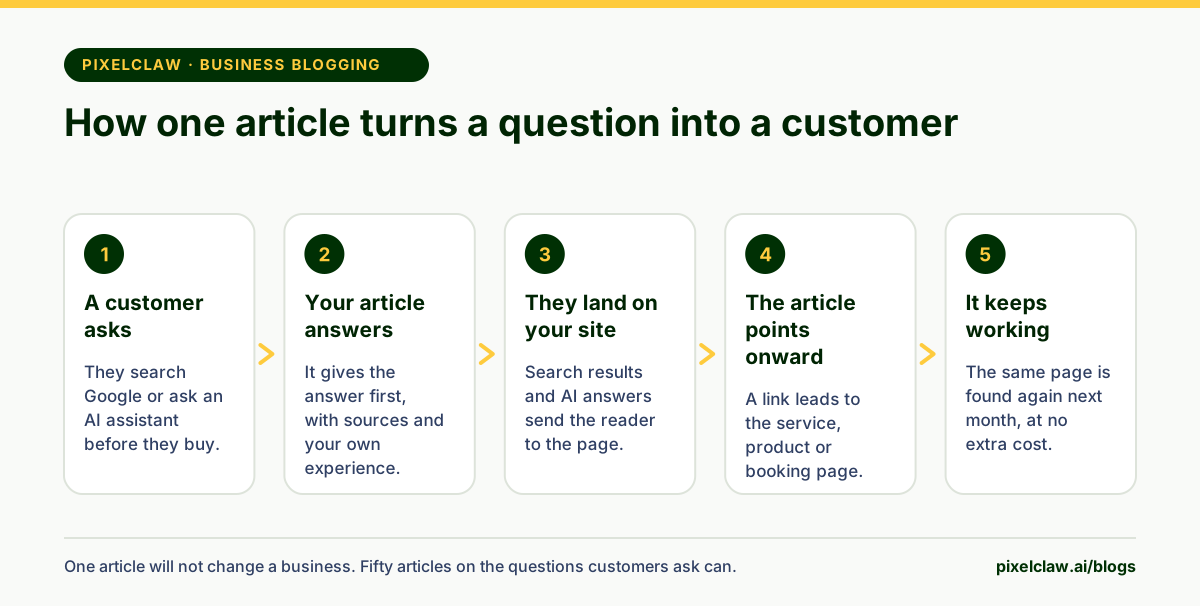
What business blogging software takes over, and what stays with you
Orbit Media's 2026 survey of 1,042 content marketers put the average blog post at 3 hours and 20 minutes to write, and those are people whose job is writing. For an owner, that is most of an evening for one post, before the research, the picture and the publishing. It is the reason most business blogs go quiet after the fourth article.
The software takes the repeatable work. You keep the part that makes the article yours.
| Job | By hand | With business blogging software |
|---|---|---|
| Choosing what to write | Guessing, or paying for keyword tools | Suggested from your business and what people search |
| Research | Reading the top results yourself | Reads the ranking pages and collects reader questions |
| Writing the draft | About 3 hours 20 minutes a post | A draft in minutes, for you to review |
| Checking quality | A reread, if there is time | A score with the weak points listed |
| Publishing and page setup | Formatting, links, sitemap, page data | Done when you approve the post |
| What only you know | Your prices, your cases, your opinion | Still yours to add: the software cannot look it up |
Who business blogging software is for
The method is the same for every business. The questions are different, and so is what a good article leads to. These are the customers PixelClaw is built for, with a field guide for each.
A local or service business writes about the jobs it wants more inquiries for and the areas it covers: what a repair involves, what affects the price, when to call. The article ends at the quote or booking page.
A B2B SaaS or tech company answers the questions buyers ask before a trial: comparisons, migrations, integrations and pricing. Each article sends the reader to the setup or pricing page they need next.
An e-commerce or D2C brand publishes buying guides and comparisons built from support tickets and return reasons, and links each one to the right product or collection.
An agency or consultant runs a separate blog and brief for each client, with a review step before anything is published, so the work scales without the quality slipping.
A healthcare or legal practice needs more care. Drafts carry a named author and a list of sources, and a qualified person reviews every article before it goes live.
A creator or digital publisher uses the topic queue to keep a weekly schedule without writing every post from a blank page.
Startups and founders use it to build a search channel while the team is busy with the product. Bloggers and copywriters use it to skip the blank page: they start from research, an outline and a scored draft, and spend their time on the edit.
SEO, AEO and GEO in plain words
You will meet three abbreviations. None of them is complicated. SEO, search engine optimization, means making a page easy for Google to find, read and list. AEO, answer engine optimization, means giving the answer in the first lines so it can be shown as the answer. GEO, generative engine optimization, means being a page that AI assistants are willing to quote: clear, sourced and open to their crawlers.
They are not three separate jobs. Google says the pages shown in its AI features must be indexed and eligible to appear in ordinary search. A page that answers the question, names its sources and shows who wrote it does well in all three, which is what Google's guidance on helpful, people-first content asks for.
Good software checks these for you. PixelClaw scores every draft out of 100 from 21 checks in five areas: SEO carries 30% of the score, AEO 20%, AIO 15%, GEO 15% and SXO 20%. AIO covers the trust signals AI summaries look for, such as an author and sources. SXO is the reading experience once someone arrives.
How PixelClaw runs a business blog
PixelClaw starts from the business. Give it your website and it builds a business profile for you to approve: what you sell, who you sell to, and the subjects you can write about with authority. Articles use that profile for your voice and for the pages they point to.
For each topic it reads the pages that already rank and collects the questions readers ask, then writes an outline and a draft. You can guide one post at a time in the writing studio, or put topics in a queue and let Autopilot work through them at your plan's pace.
Every draft is scored. Most failing checks come with a one-click fix, and a draft under 60 is held back for a person. Finished posts wait for your approval by default. If you switch on automatic publishing, a post has to score 77 or more and pass the remaining checks before it goes live on schedule.
Posts are published on a blog PixelClaw hosts for you, with the sitemap, robots.txt, llms.txt and structured data set up from the first day, or on your existing WordPress site through the plugin. On Starter and higher plans a post can be translated into eleven languages, and on plans with Competitor Spy the software shows which topics your competitors cover that you do not.
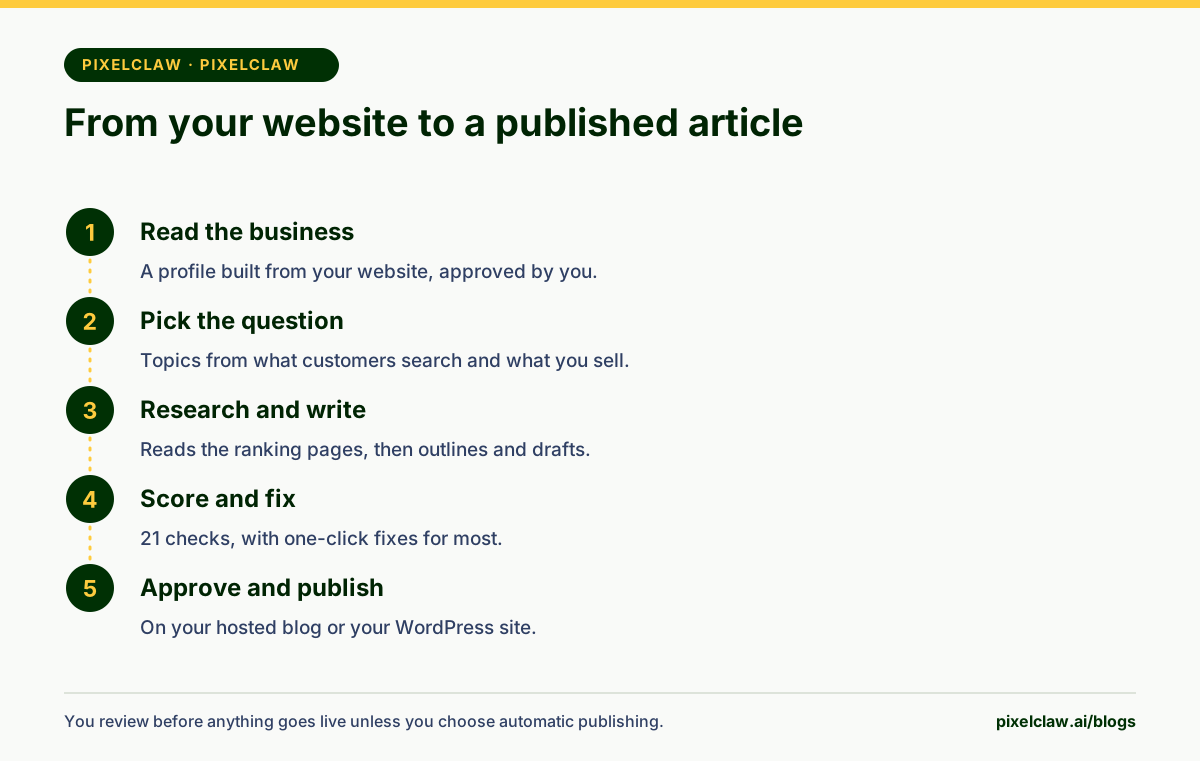
How to choose business blogging software
The tools in this category look alike on a features page. Five questions separate the ones that help a business from the ones that fill a site with pages nobody reads.
The warning sign is volume without review. Orbit Media's survey found that 92.4% of marketers now use AI for blogging while only 13.9% report strong results. The tool is not what makes the difference. The article is.
- Does it start from your business? Software that only takes a keyword will write the same article for you and your competitor.
- Does it research before it writes? An article built from the pages that rank and the questions readers ask is specific. One written from memory is generic.
- Can you review before anything is published? You should be able to read, edit and approve every post, and switch that off only by choice.
- Does it hold weak drafts back? A score with a publish bar is the safeguard that keeps a bad week off your site.
- Does it handle publishing? Hosting, the sitemap, page data and AI crawler files should not become your second job.
Start a business blog in an evening
You do not need a content plan to begin. You need five questions customers have asked you this month. Write them down in their words, not yours.
Create a blog, add your website so the software can read what you offer, and approve the business profile it writes. Add the first question as a topic and let it research and draft. Read the draft the way a customer would: is the answer in the first paragraph, is anything wrong, is there something only you would know to add. Then publish, and add the next question.
One article a week is enough to start. After a few months, Search Console will show which questions bring people in, and those tell you what to write next. Our guides to autoblogging and to whether blogging is still worth it go further into pace and results.
- A business blog works because people search for answers before they buy, and the page that answers them gets the visit.
- Business blogging software takes over the research, the draft, the formatting and the publishing; the owner supplies what only the business knows.
- Orbit Media's 2026 survey puts the average post at 3 hours 20 minutes to write, which is why most business blogs stop after a few posts.
- The same article can rank in Google and be quoted by AI assistants when it answers the question first, names its sources and shows who wrote it.
- Choose software that starts from your business, lets you review before anything goes live, and holds weak drafts back.
Frequently Asked Questions
What is business blogging software?+
It is software that runs a company blog as a process: it finds the questions customers search for, researches each one, writes the article, checks it and publishes it on the company's site. A writing assistant gives you paragraphs; business blogging software gives you published articles tied to what you sell.
Do I need to know SEO to use it?+
No. The software handles the parts SEO is made of: choosing a question people search, structuring the page so search engines can read it, and setting up the sitemap and page data. What you need to know is your own business, because that is the part no software can look up.
How does a blog bring in customers?+
People type questions into Google or ask an AI assistant before they buy: what something costs, which option suits them, how to fix a problem. An article that answers the question well is shown to them. They read it on your site, and the article links to the service, product or booking page that solves their problem.
Is AI-written content allowed by Google?+
Yes, when it is written to help people. Google says appropriate use of automation is not against its guidelines, and that pages made mainly to manipulate rankings are spam however they were produced. Review what the software writes and add what you know first-hand.
How long before a business blog brings results?+
New posts usually appear as impressions in Google Search Console within weeks, and steady visits follow after a few months of regular publishing. Articles on specific questions tend to be found sooner than articles on broad terms, so start with the questions your customers already ask you.
What does business blogging software cost?+
Plans vary by how many articles you publish. PixelClaw has a free plan that includes the editor, scoring and a hosted blog, with no card needed, so you can publish your first researched article before paying anything. Current plans are on the pricing page.
Sources
- Blogging Statistics 2026: What 1,042 Content Marketers Told Us About What Works — Orbit Media Studios (The average post takes 3 hours 20 minutes to write; 13.9% of marketers report strong results.)
- Creating helpful, reliable, people-first content — Google Search Central (Asks who created the content, how, and why, and stresses first-hand experience.)
- AI features and your website — Google Search Central (Pages shown in Google's AI features must be indexed and eligible to appear in Search.)
- Google Search's guidance about AI-generated content — Google Search Central Blog (Automation is fine when it serves people; using it mainly to manipulate rankings is spam.)
- Search Engine Optimization (SEO) Starter Guide — Google Search Central
Built & scored using PixelClaw.ai
More from this blog
Continue exploring autoblogging architecture, AI blog writing, and SEO / AEO / GEO playbooks.
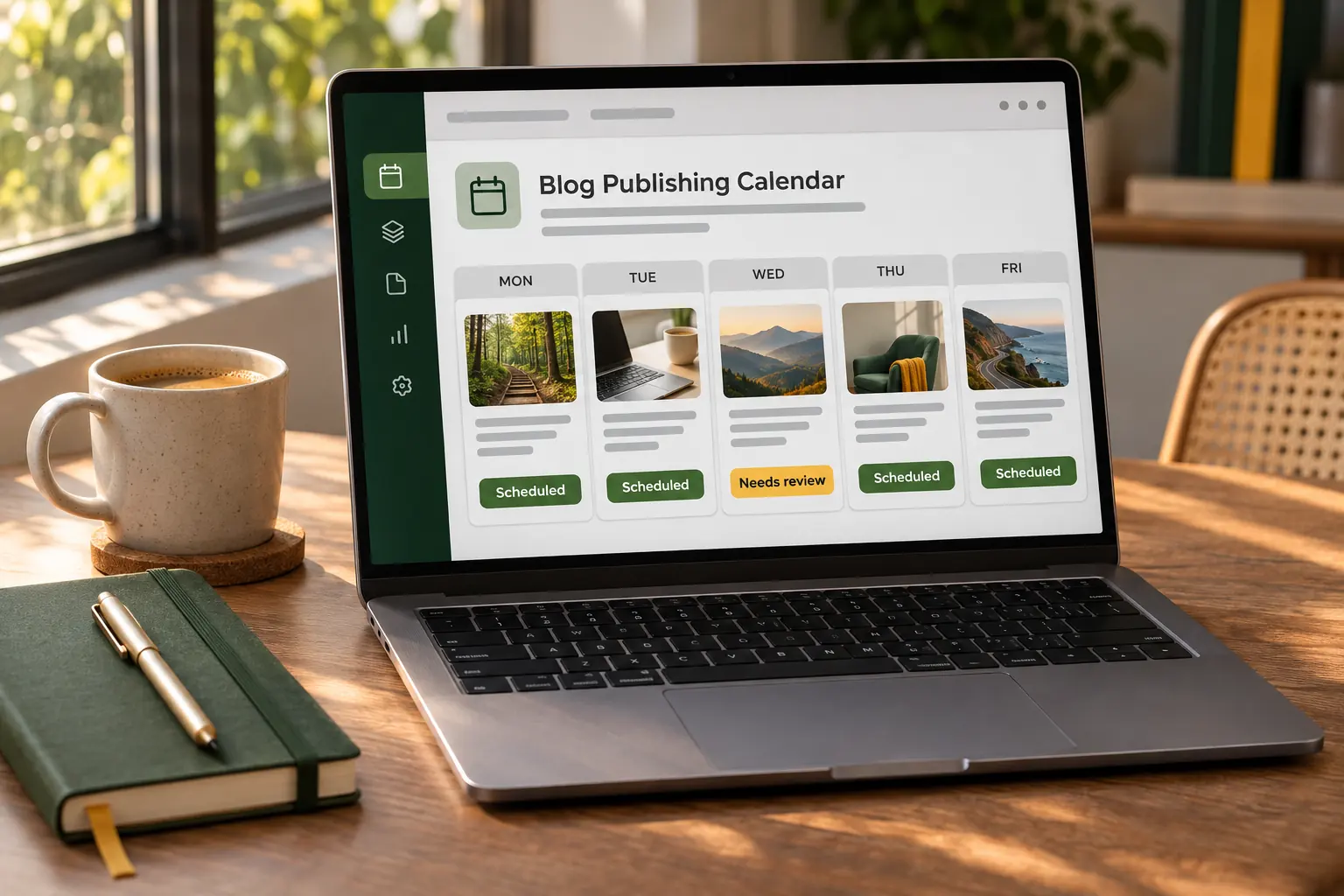
Autoblogging in 2026: How to Run a Blog That Publishes Itself and Still Ranks
What autoblogging looks like when it works: a topic queue, research before writing, a score that holds weak drafts back, and editorial review before a draft reaches readers.
PixelClaw Editorial Team
Product and search team

AI Blogging Without the Slop: A Working Process for Posts People Trust
Where AI earns its place in a blog, where a person still has to step in, and a five-step process that turns AI drafts into posts worth putting your name on.
PixelClaw Editorial Team
Product and search team

Is Blogging Still Worth It in 2026? Yes, If You Blog for Search and AI Answers
Most blogs are not working, and the 2026 numbers say so plainly. The ones that do work have something in common, and none of it is writing faster.
PixelClaw Editorial Team
Product and search team