Sports blogging
Niche guideSports Blogging Software: Publish Explainers and Previews Between Game Days
What sports blogging software can draft, why it is not a live-score tool, and how to write guides, previews and analysis that fans and AI answers trust.

On this page▸
Sports blogging software researches what fans ask about a team, a rule or a season, writes an outline and a draft, scores it and publishes it on your blog. It suits explainers, guides, history, previews and analysis. It is not a live-score tool, and every statistic in a draft must be checked.
What is sports blogging software?
Sports blogging software runs the repeatable part of a sports blog. It finds the questions fans ask, reads what already ranks, writes an outline and a draft, checks the draft and publishes it on your site. You decide what goes live and you add the knowledge that makes it yours.
It is not a score feed. It does not know who won last night, and it does not watch a match. That is a real limit and also a clear one. The software is built for the posts that stay useful for months, such as how a rule works or what a transfer window is, and for the planning work around the posts that cannot wait.
That makes it a fit for a writer who covers one team for love, a local league reporter and a coach who wants to share what they know. It does not fit a site whose whole product is the speed of the result.
What do sports fans search for and ask AI assistants?
Fans search before the match and long after it. They want a rule explained, a comparison settled or a season put in context. AI assistants get the same questions in full sentences, and they tend to quote a page that gives the answer in its opening lines.
These are the kinds of questions a sports blog can own. The third column is the part the writer has to supply.
| What the fan asks | What the post needs | What the writer supplies |
|---|---|---|
| How does the offside rule work? | A plain answer, then examples | A clip or diagram you made |
| Who has won the most league titles? | A dated list from an official source | The source and the date checked |
| How does the playoff format work? | A step-by-step explainer | The season the format applies to |
| What is a salary cap? | A short definition and how teams plan around it | A current example from your team |
| Who is better, player A or player B? | A fair comparison table | Your verdict and your reasons |
| What should I know before the season starts? | A preview built from confirmed facts | Your read on the squad |
| How do I start playing this sport as an adult? | A beginner path with equipment and costs | What you wish you had known |
| Why does the draft order work this way? | History and the reasoning | A memory of a draft that mattered |
Why most sports blogs stall
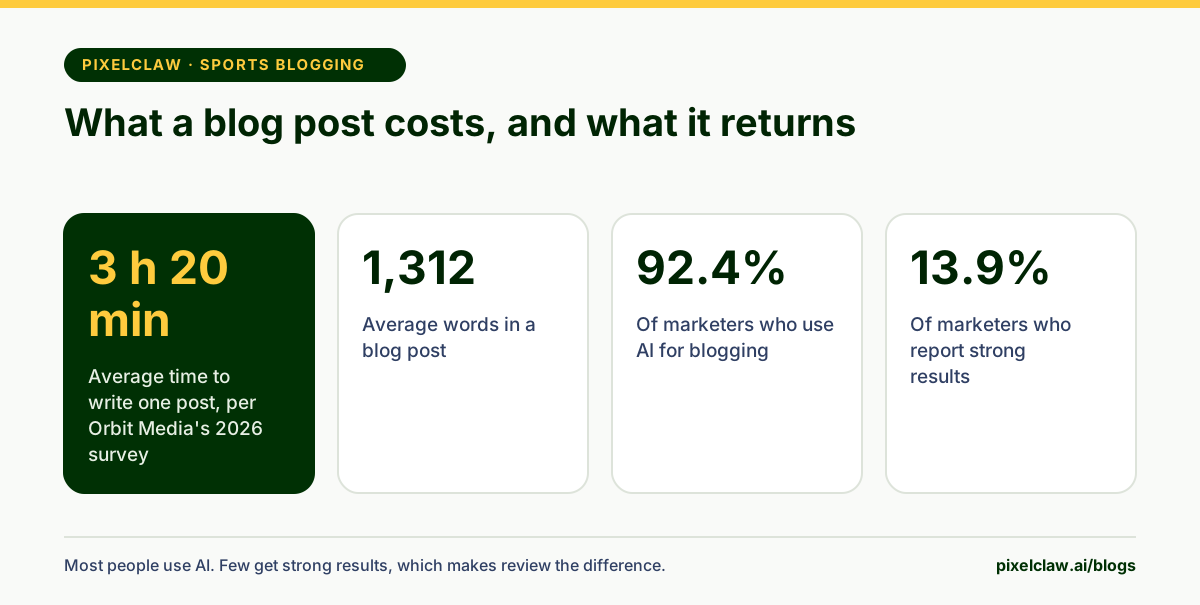
Orbit Media's 2026 survey of 1,042 content marketers puts the average post at 3 hours and 20 minutes to write. A sports post carries more checking than most, because every name, score and date must be right.
The news cycle adds pressure. A blogger who tries to match the big sites on results loses every time, falls behind and stops. The work that lasts is the work that does not race the clock.
Software helps with that second kind. The research, the outline, the first draft and the publishing can happen on a quiet Tuesday. The writer spends match day on what only a person can do.
What only the writer can supply, and the limits of the software
The first limit is time. The software works from pages that already exist, so it cannot report a result from this evening. Match reports, injury news and transfer rumours belong to you or to a news site.
The second is the facts. A draft can contain a wrong score, a mixed-up season or a player at the wrong club. Statistics must be checked against the league, the federation or the club before you publish. Treat every number in a draft as unconfirmed until you have seen it at the source.
The third is opinion. Fans read a sports blog for a voice. Who should start, whether the manager is right, why the team will fall short. That is your view and it is the reason readers come back. Software can lay out the evidence. It cannot hold the argument for you.
The fourth is presence. If you were at the ground, say so, and say what you saw. Google's guidance on helpful, people-first content asks about first-hand experience, and in sport that is often the whole difference between two similar posts.
What makes a sports post trusted by fans, Google and AI answers
Lead with the answer. If the post asks how many teams reach the playoffs, give the number in the first line and the exceptions after it.
Then show your work. Source each statistic and say when you checked it. Put the season in the title or the first paragraph of anything that changes yearly. Name the author and why they follow the sport. Google's article structured data lists the author and the published and modified dates, and PixelClaw sets that data up for each post, so keep the dates truthful and update a post when its facts change.
Quality beats volume. Google's spam policies treat many pages made mainly to manipulate rankings as spam, and ten thin previews will not help you. A smaller number of posts with real analysis will.
How PixelClaw fits a sports blog
PixelClaw researches each topic by reading the pages that already rank and collecting the questions readers ask, then writes an outline and a draft. For a sports blog that gives you the structure of a rules explainer or a season preview, with the common questions already in it.
You can guide one post at a time in the writing studio, where the outline can be edited before the draft is written. That is the place to add the facts you have and cut the ones you do not trust. Or you put topics in a queue and let Autopilot work through them at your plan's pace, so the evergreen posts keep coming while you cover the games.
Every draft is scored out of 100 from 21 checks in five areas: SEO carries 30% of the score, AEO 20%, AIO 15%, GEO 15% and SXO 20%. Most failing checks come with a one-click fix. A draft under 60 is held back. Finished posts wait for your approval by default, and with automatic publishing switched on a post must score 77 or more to go live on schedule.
Posts are published on a blog PixelClaw hosts for you, with sitemap.xml, robots.txt, llms.txt and structured data for articles and FAQs set up from the first day, or on an existing WordPress site through the PixelClaw plugin. Starter and higher plans can connect a custom domain and translate a post into eleven languages. PixelClaw makes a hero picture for each post it drafts. A personal blog can skip business details at setup, which suits a fan site.
How to choose sports blogging software
Tools in this category look alike. Five questions separate the ones that help a sports writer from the ones that fill a site with pages nobody trusts.
- Is it honest about live data? Be wary of any tool that implies it knows tonight's result unless it names its data source.
- Does it research before it writes? A draft built from ranking pages and reader questions is more specific than one written from memory.
- Can you edit the outline before the draft? You should be able to put your angle in first.
- Do you approve every post? A wrong number should never go live unseen.
- Does it hold weak drafts back? A score with a publish bar keeps thin posts off your site.
Start a sports blog this week
Choose one team, league or sport. Write down eight questions a new fan would ask about it, such as how the competition works, what the key rules are and what to watch for this season.
Create the blog, add the first question as a topic and let it research and draft. Read the draft with the official source open, fix every number that does not match and add one thing only you know, such as a match you attended. Fix the failing checks, approve the post and publish.
Aim for one explainer a week and leave match days for your own writing. Our guides to autoblogging and to whether blogging is still worth it cover pace and results, and business blogging software is the page to read if the blog also sells coaching, gear or tickets.
- Fans search for rules, history, comparisons and what a result means, and those questions stay useful long after the match.
- Sports blogs stall because the news cycle is fast and every post needs facts checked and a take written.
- Software suits explainers, guides, previews and analysis built from facts you supply or that sources confirm.
- It is not a live-score or real-time results tool, so match reports and breaking news stay with you.
- Statistics, dates and names must be checked against an official source before a post goes live.
Frequently Asked Questions
Can AI write sports blog posts?+
It can draft explainers, guides, history pieces and previews from facts you give it and from what ranking pages say. It does not watch the game. The opinion, the match detail and every number need a person.
Can sports blogging software cover live games?+
No. PixelClaw is not a live-score or real-time results tool, and it works from pages that already rank. Use it for the evergreen posts and write the live reaction yourself.
What should a new sports blog write about?+
Pick one team, league or sport and answer the questions fans keep asking. Rules explained, how a competition works, player comparisons and season previews bring readers all year. A narrow subject gets you read sooner than all of sport.
How do I keep sports statistics accurate?+
Take every figure from the league, the federation or the club, and write the source and the date beside it. Recheck numbers that change each season. A wrong stat is the first thing a fan will point out in the comments.
Will Google penalise AI-written sports content?+
Google says appropriate use of automation is not against its guidelines, and that content made mainly to manipulate rankings is spam. Review each post, add your own analysis and publish fewer, better posts rather than many thin ones.
Sources
- Blogging Statistics 2026: What 1,042 Content Marketers Told Us About What Works — Orbit Media Studios (The average post takes 3 hours 20 minutes to write and runs 1,312 words.)
- Creating helpful, reliable, people-first content — Google Search Central (Asks who created the content, how, and why, and stresses first-hand experience.)
- Google Search's guidance about AI-generated content — Google Search Central Blog (Automation is fine when it serves people. Using it mainly to manipulate rankings is spam.)
- Spam policies for Google web search — Google Search Central (Lists scaled content abuse, meaning many pages made mainly to manipulate rankings, as spam.)
- Article structured data — Google Search Central (Describes the author, datePublished and dateModified properties for articles.)
Built & scored using PixelClaw.ai
More from this blog
Continue exploring autoblogging architecture, AI blog writing, and SEO / AEO / GEO playbooks.

Business Blogging Software: How a Blog Brings Customers to Your Business
What business blogging software does, why articles bring in customers who are already searching, and how it works for a local firm, a store, a SaaS company, an agency or a practice.
PixelClaw Editorial Team
Product and search team

Autoblogging in 2026: How to Run a Blog That Publishes Itself and Still Ranks
What autoblogging looks like when it works: a topic queue, research before writing, a score that holds weak drafts back, and editorial review before a draft reaches readers.
PixelClaw Editorial Team
Product and search team
AI Blogging Without the Slop: A Working Process for Posts People Trust
Where AI earns its place in a blog, where a person still has to step in, and a five-step process that turns AI drafts into posts worth putting your name on.
PixelClaw Editorial Team
Product and search team