Real estate blogging
Niche guideReal Estate Blogging Software: Turn Client Questions Into Local Guides
What real estate blogging software can research and draft for an agent's blog, and what only the agent can supply: local market facts, listings and prices.
On this page▸
Real estate blogging software researches the questions buyers, sellers and renters ask about an area, writes an outline and a draft, scores it and publishes it on your blog. It saves writing time. Local market facts, listings and prices come from the agent, and the blog should not predict where prices are going.
What is real estate blogging software?
Real estate blogging software handles the research, drafting and publishing for an agent's blog. It collects the questions buyers and sellers ask, writes an outline and a draft, scores it and publishes it on your blog after you approve it.
It does not know your market. It has not seen your listings or walked your neighbourhoods. It reads pages that already rank, so it can explain how an offer works. It cannot tell a reader what a three-bedroom house sold for on a given street last month.
That makes it a fit for a solo agent, a small team and a brokerage that wants its agents to publish steadily while they are busy with clients.
What do buyers and sellers search for and ask AI assistants?
People search early, before they call anyone. Buyers want to know what they can afford and what the process involves. Sellers want to know what to fix and when to list. AI assistants get the same questions, and they tend to quote a page that answers first and names where it is.
These are question types an agent's blog can own. The last column is the agent's part.
| What the reader asks | What the post needs | What the agent supplies |
|---|---|---|
| What are the steps to buy a first home? | A numbered process | Local steps, deadlines and who is involved |
| What is it like to live in this neighbourhood? | An area guide | Your own knowledge and photos |
| How much does it cost to sell a house? | A list of cost types | Local fees, dated, with a source |
| What should I fix before listing? | A prioritised checklist | What you have seen move offers |
| Is it better to rent or buy right now? | A way to compare | A note that it is not advice and a dated source |
| What is a home inspection and what does it cover? | A plain explainer | What inspectors in your area flag |
| How long does closing take? | A typical timeline | Local practice, checked with a title company |
| Which schools serve this address? | How to check | A link to the official district page |
Why most agents' blogs stall
Orbit Media's 2026 survey of 1,042 content marketers puts the average post at 3 hours and 20 minutes to write. An agent's week is full of showings, calls and paperwork, and the blog is the first thing to slip.
The posts that do get written are often market updates that go stale within weeks. The better material is the evergreen guide, such as how a process works or what an area offers, but each one needs checked local facts, so it keeps getting postponed.
Software can write the first draft of those guides. The agent adds the local facts, which is the part no other site has.
What only the agent can supply
Local market facts come first. Median prices, days on market, fees and timelines vary by town and change month to month. A draft written from other pages may quote the wrong place or an old period. Use your own sources, name them and date each figure.
Listings come next. Your active and sold properties, your photos and what you know about the street are your own material. Do not let software invent or describe a property it has not been told about.
Judgement is third. Whether to wait, whether to bid high, whether a house is priced right. That comes from seeing deals and cannot be drafted.
No price predictions is the fourth rule. Nobody can reliably forecast a local market, and a confident forecast can hurt a reader who acts on it. Report what happened, say when, and stay silent on what comes next.
Fair housing is the fifth. The Fair Housing Act prohibits housing discrimination based on race, color, national origin, religion, sex, familial status and disability. Describe homes and places with facts, and read each draft for wording that steers readers.
What makes a real estate post trusted by readers, Google and AI answers
Answer the question in the first lines. If the post is about closing costs, give the typical range for your area, name the source and the date, then explain what is in it.
Show that you work there. Name the author, the brokerage and the area you serve, and put the date on the post. Add your own photos and a line about a recent client situation without naming the client. Google's guidance on helpful, people-first content asks about first-hand experience and who created the page.
Keep the page easy to find. Google says pages shown in its AI features must be indexed and eligible to appear in Search. PixelClaw sets up the sitemap, robots.txt, llms.txt and article and FAQ structured data from the first day.
Update market pages. A guide with a figure from two years ago does more harm than none. Change the modified date when you change the numbers.
How PixelClaw fits a real estate blog
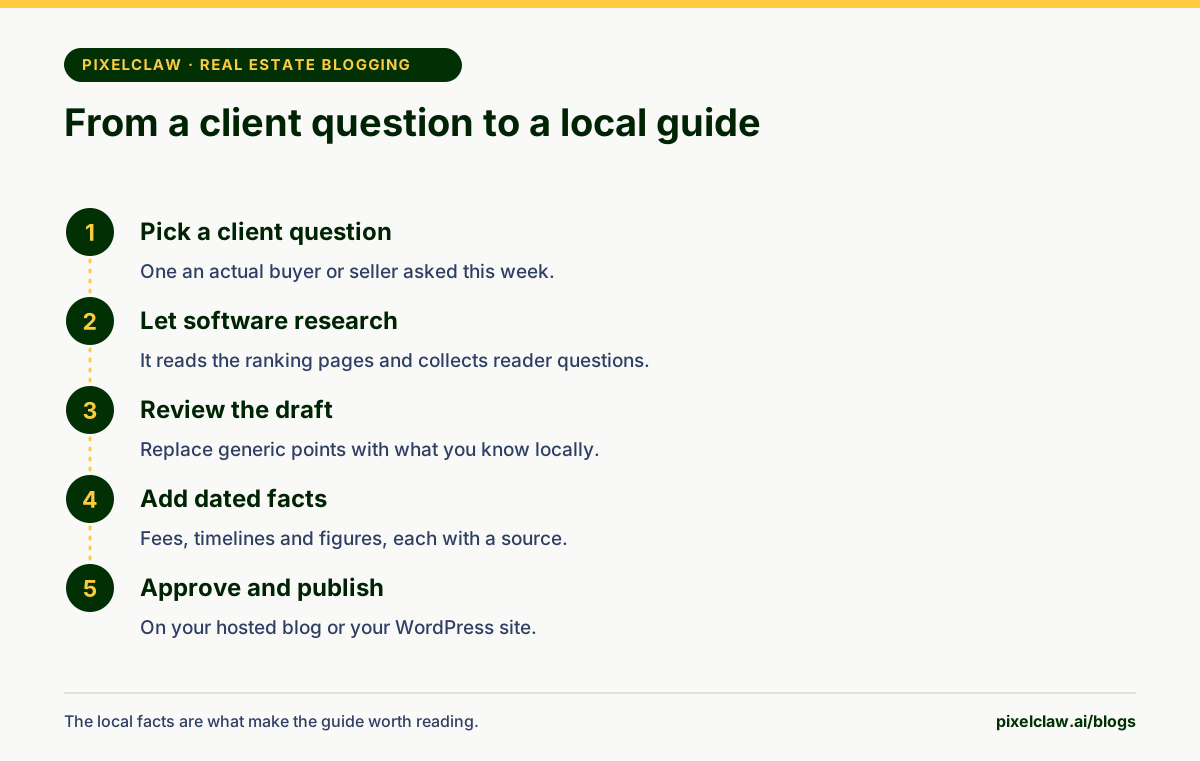
PixelClaw researches each topic by reading the pages that already rank and collecting the questions readers ask, then writes an outline and a draft. For an agent's blog that gives you the structure of a process guide or an area page, with common buyer and seller questions in place.
A business can add its website so PixelClaw builds a business profile the owner approves, which suits a brokerage. You can guide one post at a time in the writing studio, where the outline can be edited before the draft is written. That is where you add the local facts. Or you put topics in a queue and let Autopilot work through them at your plan's pace, which suits process explainers that do not hold figures.
Every draft is scored out of 100 from 21 checks in five areas: SEO carries 30% of the score, AEO 20%, AIO 15%, GEO 15% and SXO 20%. Most failing checks come with a one-click fix. A draft under 60 is held back. Finished posts wait for your approval by default, and with automatic publishing switched on a post must score 77 or more to go live on schedule.
Posts are published on a blog PixelClaw hosts for you, with sitemap.xml, robots.txt, llms.txt and structured data for articles and FAQs set up from the first day, or on an existing WordPress site through the PixelClaw plugin. Starter and higher plans can connect a custom domain, which lets the blog sit on your own address, and translate a post into eleven languages. On plans that include Competitor Spy, it shows topics competing sites cover that yours does not. PixelClaw makes a hero picture for each post it drafts.
How to choose real estate blogging software
Five questions help an agent pick a tool they can trust with their name.
- Does it invent local facts? Be wary of any tool that writes market figures without a source you can check.
- Does it research reader questions? Process and area questions are where agents get found.
- Do you approve every post? A wrong fee or a wrong area should never go live unseen.
- Does it hold weak drafts back? A score with a publish bar keeps thin pages off your site.
- Can you connect your own domain and site? Your blog should build your name.
Start a real estate blog this week
Write down the five questions clients asked you this month. Pick the one that comes up most often. That is your first post.
Create the blog, add your website so PixelClaw can build a business profile for you to approve, and add the question as a topic. Let it research and draft, then add the local steps, the dated figures with sources and one photo of your own. Read it for fair housing wording, fix the failing checks, approve the post and publish.
One guide a week builds a library in a year. Our guides to autoblogging and to whether blogging is still worth it cover pace and results, and business blogging software covers the wider case for a service business.
- Home buyers and sellers search for local process and area questions, and a page that answers one first brings an agent into the conversation early.
- Agents' blogs stall because client work comes first and each local guide needs checked facts.
- Software can research, outline, draft and publish, but it does not know your market or your listings.
- Market figures, listings and prices must come from the agent, carry a date and name a source.
- Do not predict prices, and keep every page consistent with fair housing rules.
Frequently Asked Questions
Should a real estate agent have a blog?+
A blog lets an agent answer the questions buyers and sellers ask before they pick someone to call. Articles on local areas and processes keep being found after a listing has sold. It works best when the agent writes about places and steps they know well.
Can AI write real estate blog posts?+
It can draft guides to a process, such as how closing works, and the structure of a neighbourhood page. It does not know your market, your listings or today's prices. Add those yourself, check each fact and have the draft reflect your local knowledge.
What should an agent write about?+
Write about the questions clients ask you: what a process involves, what a neighbourhood is like, what to prepare before a viewing and what costs to expect. Each one makes a page that can be found by someone in your area. A weekly question from a real client is a good source.
Can my real estate blog predict home prices?+
It should not. Nobody can reliably forecast a local market, and a confident prediction can mislead readers. Report what has happened, with a dated source, and describe what you see in your own deals without promising what comes next.
Do fair housing rules apply to my blog?+
Be careful. The Fair Housing Act prohibits housing discrimination based on race, color, national origin, religion, sex, familial status and disability. Describe homes and areas by facts, such as distance to a school or a transit stop, and avoid wording that steers readers toward or away from groups of people. If unsure, ask your broker or counsel.
Sources
- Blogging Statistics 2026: What 1,042 Content Marketers Told Us About What Works — Orbit Media Studios (The average post takes 3 hours 20 minutes to write and runs 1,312 words.)
- Creating helpful, reliable, people-first content — Google Search Central (Asks who created the content, how, and why, and stresses first-hand experience.)
- Google Search's guidance about AI-generated content — Google Search Central Blog (Automation is fine when it serves people. Using it mainly to manipulate rankings is spam.)
- AI features and your website — Google Search Central (Pages shown in Google's AI features must be indexed and eligible to appear in Search.)
- Fair Housing Act Overview — U.S. Department of Housing and Urban Development (The Act prohibits housing discrimination based on race, color, national origin, religion, sex, familial status and disability.)
Built & scored using PixelClaw.ai
More from this blog
Continue exploring autoblogging architecture, AI blog writing, and SEO / AEO / GEO playbooks.

Business Blogging Software: How a Blog Brings Customers to Your Business
What business blogging software does, why articles bring in customers who are already searching, and how it works for a local firm, a store, a SaaS company, an agency or a practice.
PixelClaw Editorial Team
Product and search team

Autoblogging in 2026: How to Run a Blog That Publishes Itself and Still Ranks
What autoblogging looks like when it works: a topic queue, research before writing, a score that holds weak drafts back, and editorial review before a draft reaches readers.
PixelClaw Editorial Team
Product and search team

AI Blogging Without the Slop: A Working Process for Posts People Trust
Where AI earns its place in a blog, where a person still has to step in, and a five-step process that turns AI drafts into posts worth putting your name on.
PixelClaw Editorial Team
Product and search team