Personal finance blogging
Niche guidePersonal Finance Blogging Software: Publish Money Guides With Dates and Sources
What personal finance blogging software can research and draft, why it is not financial advice, and how to keep rates, rules and affiliate links honest.

On this page▸
Personal finance blogging software researches the money questions readers ask, writes an outline and a draft, scores it and publishes it on your blog. It saves research and writing time. It is not financial advice, rates and rules change, so every post needs dates and sources, and affiliate relationships must be disclosed.
What is personal finance blogging software?
Personal finance blogging software handles the research, drafting and publishing for a blog about money. It collects the questions readers ask, writes an outline and a draft, scores it and publishes it on your blog after you approve it.
It is not a financial adviser, and its drafts are not financial advice. It reads pages that already rank, so it can explain how an emergency fund works. It cannot know today's savings rate or a reader's situation.
That fits a person who writes about their own journey with debt or budgeting, a financial coach who wants readers to find their explainers and a small firm that wants clear public guides, provided a qualified person reviews what is published.
What do money readers search for and ask AI assistants?
Money searches come from a decision. A reader is about to open an account, pay off a loan or file a return and wants a plain answer. AI assistants get the same questions, and they tend to quote a page that answers first, names its source and shows its date.
These are question types a finance blog can own. The last column is what the writer has to check.
| What the reader asks | What the post needs | What the writer checks |
|---|---|---|
| How big should my emergency fund be? | A rule of thumb and the reasoning | That it is labelled general information |
| Should I pay off debt or save first? | A way to compare, not a verdict | That no reader is told what to do |
| How does a credit score work? | A plain explainer | The official source for how it is calculated |
| What is the difference between a Roth and a traditional account? | A comparison table | Current limits and rules, dated |
| How do I build a budget on an irregular income? | A step-by-step method | Your own experience, honestly told |
| How do I start investing with a small amount? | A beginner explainer | A note that it is not advice, and a source |
| What should I know before taking an auto loan? | A checklist of terms | Rates, dated, from a named source |
| Which savings account is best right now? | A dated comparison | Disclosure of any commission |
Why most personal finance blogs stall
Orbit Media's 2026 survey of 1,042 content marketers puts the average post at 3 hours and 20 minutes to write. A money post adds fact checking, and rates and limits change, so the work does not end at publishing.
A finance blogger who has written thirty posts has thirty pages that can go out of date. Each time a rule changes, some of them become wrong. Many writers stop rather than keep up.
Software helps with the first draft and with structure. Maintenance stays with you, which is why a good finance workflow dates every figure and keeps a list of what to recheck.
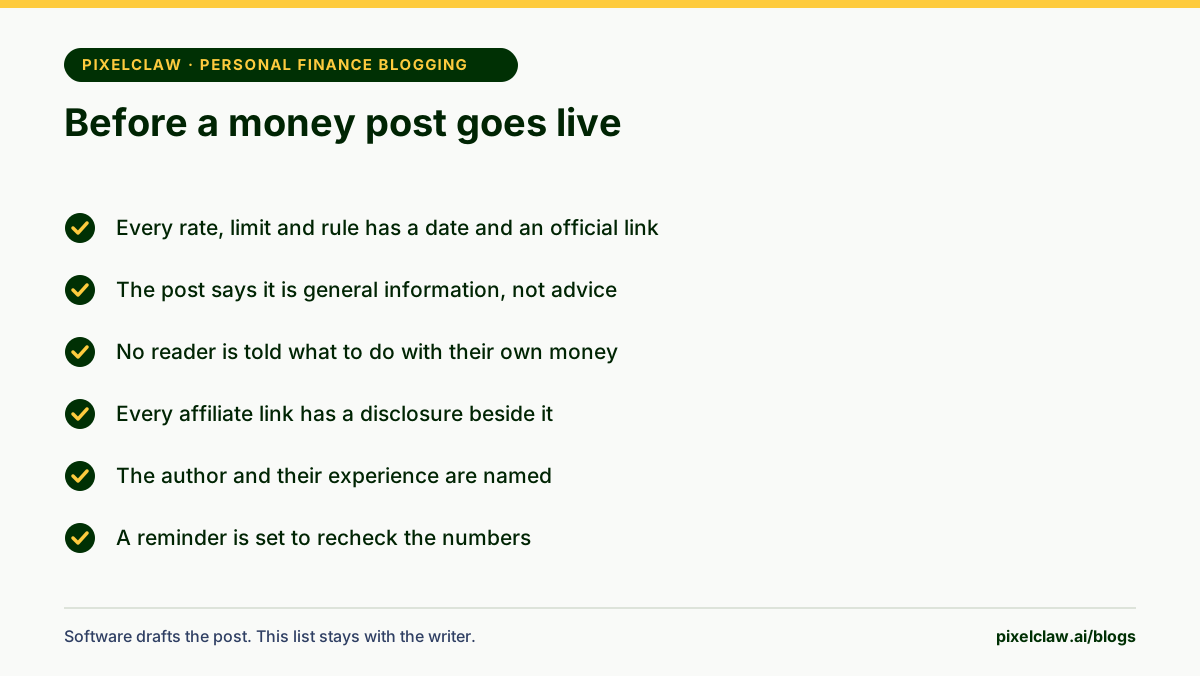
What only the writer can supply, and why it is not advice
The first limit is advice. A draft is general information. It does not know a reader's income, debts or goals, and it cannot be responsible for what someone does with it. Say on the page that the post is not financial advice, and do not tell readers what to buy.
The second is current facts. Rates, limits, deadlines and rules change. A draft can quote last year's number with confidence. Check each figure against the official source and write the date you checked. The Consumer Financial Protection Bureau publishes guides and answers on credit cards, mortgages, debt and more that are a good place to verify and link.
The third is your own story. A reader trusts the person who paid off the loan more than a page with the right steps. Google's guidance on helpful, people-first content asks about first-hand experience and expertise, and money is a subject where it counts.
The fourth is professional review where it is needed. Tax, retirement and investment content should be read by someone qualified in that area.
What makes a money post trusted by readers, Google and AI answers
Answer first, then qualify. If the post is about how big an emergency fund should be, give the common rule of thumb in the first paragraph and say who it does not suit.
Date everything and link everything. Put the date you checked beside each rate. Link the official page. Name the author and say what they know about the subject. Say what you earn from the page.
Disclosure is part of trust. The FTC's endorsement guidance says affiliate content needs a clear disclosure placed close to the recommendation. Put it next to each link in plain words, and do not rely on a footer.
PixelClaw sets up structured data for articles and FAQs from the first day, so the author and dates on the page are readable by search engines. Make sure they are true, and update the post when the numbers change.
How PixelClaw fits a personal finance blog
PixelClaw researches each topic by reading the pages that already rank and collecting the questions readers ask, then writes an outline and a draft. For a finance blog that gives you the structure of an explainer or a comparison, with the common questions in place.
You can guide one post at a time in the writing studio, where the outline can be edited before the draft is written. That is where you replace any number you cannot source and add your own story. Or you put topics in a queue and let Autopilot work through them at your plan's pace, which suits concept explainers that contain no rates. Keep approval on for posts with figures.
Every draft is scored out of 100 from 21 checks in five areas: SEO carries 30% of the score, AEO 20%, AIO 15%, GEO 15% and SXO 20%. Most failing checks come with a one-click fix. A draft under 60 is held back. Finished posts wait for your approval by default, and with automatic publishing switched on a post must score 77 or more to go live on schedule. The score judges how a post is built, not whether a figure is right.
Posts are published on a blog PixelClaw hosts for you, with sitemap.xml, robots.txt, llms.txt and structured data for articles and FAQs set up from the first day, or on an existing WordPress site through the PixelClaw plugin. Starter and higher plans can connect a custom domain and translate a post into eleven languages. PixelClaw makes a hero picture for each post it drafts. A personal blog can skip business details at setup, and a firm can add its website so PixelClaw builds a business profile the owner approves.
How to choose personal finance blogging software
Five questions help a finance blogger pick a tool that will not cause trouble.
- Does it claim to give financial advice? Avoid any tool that does.
- Does it research and let you check where facts came from? Every number needs a source.
- Do you approve every post? A wrong rate should never go live unseen.
- Does it hold weak drafts back? A score with a publish bar keeps thin posts off the site.
- Can you edit the outline before the draft? Your disclosures and caveats belong in the structure.
Start a personal finance blog this week
Choose one reader and one problem. Paying off student loans, budgeting as a freelancer or saving for a first home are all enough. Write down the five questions this reader asks, in their words.
Create the blog and add the first question as a topic. Let it research and draft, then replace every number with one you have checked, add the date and the official link, add your own experience and write the general-information note. Add a disclosure beside each affiliate link, fix the failing checks, approve the post and publish.
One post a week is a good pace, with a recheck day each month. Our guides to autoblogging and to whether blogging is still worth it cover pace and results, and business blogging software is the page for a firm that blogs for clients.
- Money readers search for specific decisions such as paying off debt, opening an account or understanding a term, and a post that answers one first gets the visit.
- Finance blogs stall because every figure needs checking and goes stale, so each post is maintenance as well as writing.
- Software can research, outline, draft and publish, but it is not financial advice and does not replace a qualified professional.
- Rates, limits and rules change, so each post needs the date checked and a link to the official source.
- Disclose affiliate relationships next to the link, and say that a post is general information.
Frequently Asked Questions
Can AI write a personal finance blog?+
It can draft explainers and background. It is not a financial adviser, and its numbers may be out of date or wrong. Check every rate, limit and rule against an official source, add your own experience and say plainly that the post is general information.
Is a personal finance blog financial advice?+
A blog about money is general information, not advice tailored to a reader. Say so on the page, and avoid telling readers what to buy or do with their own money. If you are licensed to give advice, follow the rules of your regulator.
How do I start a personal finance blog?+
Choose a clear reader and a topic you know, such as paying off student loans or budgeting on an irregular income. List the questions they ask and write from your own experience with sources for the facts. Create the blog and publish a first post with a date and a note that it is general information.
How do I keep rates and rules current in my posts?+
Write the date you checked beside every rate or limit and link the official page. Keep a list of posts that quote numbers and revisit them when rules change. Update the post, change the modified date and say what changed.
Do I need to disclose affiliate links for credit cards and accounts?+
Yes. The FTC says affiliate content needs a clear disclosure close to the recommendation, for example "I earn a commission if you apply through this link". Say it each time, near the link, and do not rank products by commission without telling readers.
Sources
- Blogging Statistics 2026: What 1,042 Content Marketers Told Us About What Works — Orbit Media Studios (The average post takes 3 hours 20 minutes to write and runs 1,312 words.)
- Creating helpful, reliable, people-first content — Google Search Central (Asks who created the content, how, and why, and stresses first-hand experience and expertise.)
- Google Search's guidance about AI-generated content — Google Search Central Blog (Automation is fine when it serves people. Using it mainly to manipulate rankings is spam.)
- Consumer resources — Consumer Financial Protection Bureau (Offers guides on buying a house, filing taxes, auto loans, college and retirement, and answers on credit cards, mortgages and debt.)
- The FTC's Endorsement Guides: What People Are Asking — U.S. Federal Trade Commission (Affiliate-link content needs a clear disclosure placed close to the recommendation.)
Built & scored using PixelClaw.ai
More from this blog
Continue exploring autoblogging architecture, AI blog writing, and SEO / AEO / GEO playbooks.

Business Blogging Software: How a Blog Brings Customers to Your Business
What business blogging software does, why articles bring in customers who are already searching, and how it works for a local firm, a store, a SaaS company, an agency or a practice.
PixelClaw Editorial Team
Product and search team

Autoblogging in 2026: How to Run a Blog That Publishes Itself and Still Ranks
What autoblogging looks like when it works: a topic queue, research before writing, a score that holds weak drafts back, and editorial review before a draft reaches readers.
PixelClaw Editorial Team
Product and search team

AI Blogging Without the Slop: A Working Process for Posts People Trust
Where AI earns its place in a blog, where a person still has to step in, and a five-step process that turns AI drafts into posts worth putting your name on.
PixelClaw Editorial Team
Product and search team