News blogging
Niche guideNews Blogging Software: Explainers and Local Guides, Not Breaking News
What news blogging software can draft, why it is not a breaking-news tool, and how an independent publisher keeps accuracy, attribution and corrections in human hands.

On this page▸
News blogging software researches the questions readers have about a story or a place, writes an outline and a draft, scores it and publishes it on your blog. It suits explainers, background and local guides. It is not a breaking-news tool, and accuracy, attribution and corrections remain the publisher's job.
What is news blogging software?
News blogging software handles the research, the first draft and the publishing for a news or local-information blog. It finds the questions readers have, reads the pages that already cover them, writes an outline and a draft and publishes on your site after you approve it.
It is not a newsroom. It does not call sources, attend meetings or confirm that an event happened. Its research reads pages that already rank, so it can only start after someone has reported the story.
That fits a clear kind of publisher. A local site that wants guides to how its town works, an industry newsletter that needs background pages and an independent writer who wants an archive that keeps being found are all examples. It does not fit a site whose product is being first.
What do readers search for and ask AI assistants about the news?
Most news searches arrive after the headline. People want to know what happened in plain words, what it means for them and what comes next. They also search for the fixed facts of local life, such as who to call, how a process works and when a deadline falls.
These are question types a news blog can answer well. The last column is the work only the publisher can do.
| What the reader asks | Page type | What the publisher must do |
|---|---|---|
| What does the new parking rule change? | Explainer | Read the actual notice and quote it |
| How do I appeal my property tax bill? | Local guide | Confirm the deadline with the office |
| Why did the school board vote that way? | Background | Cite the minutes and name who said what |
| Who is running for mayor? | Guide | Verify each candidate's own statements |
| What happened with the bridge closure? | Timeline | Date every entry and link the source |
| What does this court ruling mean for renters? | Explainer | Have a qualified person review the claims |
| When is the next road work scheduled? | Service page | Check the schedule and update the date |
| Is this viral claim true? | Fact check | Do the checking yourself and show it |
Why most news blogs stall
Orbit Media's 2026 survey of 1,042 content marketers puts the average post at 3 hours and 20 minutes to write. A news piece also needs reporting and checking, which a general post does not.
A small publisher has few people and one clock. Every new story pushes the older pages aside, so there is no time to write the explainer that would keep bringing readers in. The site becomes a run of one-day posts with nothing underneath.
That is the gap software can fill. Background pages and local guides do not race the clock, and a draft of one can wait in a queue until someone has time to check it.
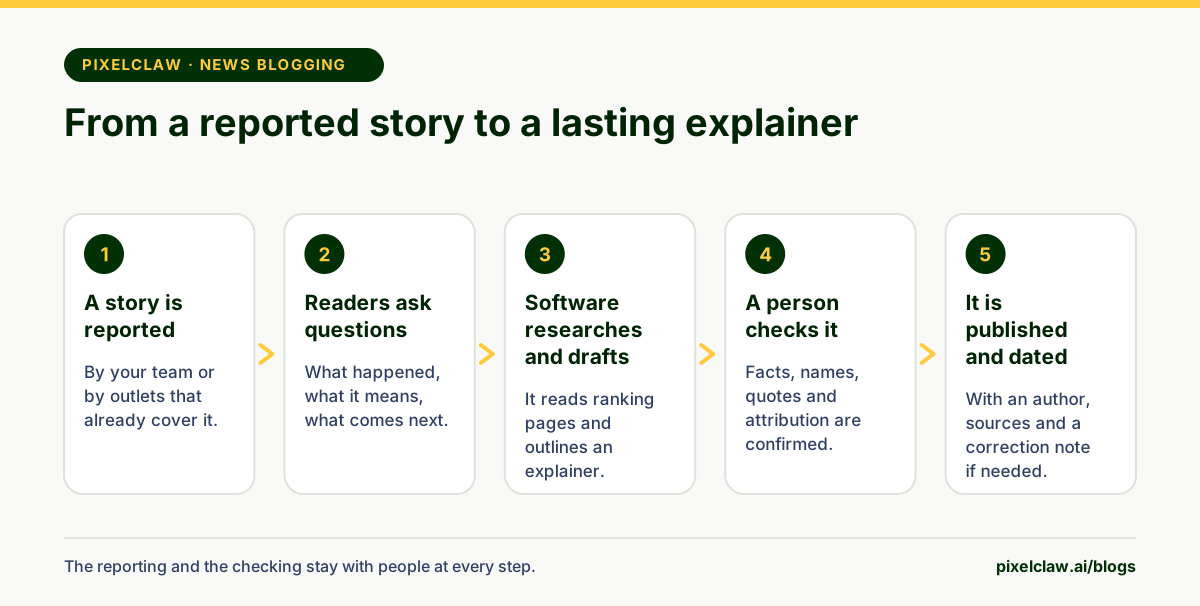
What only the publisher can supply
Accuracy comes first. A draft can state a claim that is out of date, wrong or taken from a weak source. Every fact needs to be checked against the document, the agency or the person it came from before it goes live.
Attribution is next. When a page says who said it, it must be true and it must be linked. Software can suggest where a claim might come from. It cannot confirm that a named person said it.
Corrections complete the set. A news site earns trust by owning its errors in public. Fix the mistake, say what changed and date the note. That decision belongs to an editor.
Finally, original reporting. The call to the council, the photo from the scene and the document you obtained are the reasons a reader chooses you over a summary. Google's guidance on helpful, people-first content asks who wrote a page and how. A named reporter with first-hand knowledge answers both.
What makes a news page trusted by readers, Google and AI answers
Start with what happened and why it matters in the first paragraph. Then give the context in plain order, with each claim tied to a named source and a link.
Show the dates. Google's article structured data lists the author, the date published and the date modified. PixelClaw sets up structured data for articles from the first day, so what you must do is keep those dates true, and mark a correction as a correction.
Name the author and say what they did, such as read the ordinance, attended the meeting or spoke to the office. Avoid volume for its own sake. Google's spam policies treat many pages made mainly to manipulate rankings as spam, and a flood of thin rewrites of other people's reporting is exactly that.
How PixelClaw fits a news blog
PixelClaw researches each topic by reading the pages that already rank and collecting the questions readers ask, then writes an outline and a draft. For a news blog that means the explainer, the background page or the local guide starts with the common questions already collected.
You can guide one post at a time in the writing studio, where the outline can be edited before the draft is written. That is where an editor adds the reporting and removes anything unverified. Or you put topics in a queue and let Autopilot work through them at your plan's pace, so the evergreen pages build up between stories.
Every draft is scored out of 100 from 21 checks in five areas: SEO carries 30% of the score, AEO 20%, AIO 15%, GEO 15% and SXO 20%. Most failing checks come with a one-click fix. A draft under 60 is held back. Finished posts wait for your approval by default, and with automatic publishing switched on a post must score 77 or more to go live on schedule. For news, keep the approval step on.
Posts are published on a blog PixelClaw hosts for you, with sitemap.xml, robots.txt, llms.txt and structured data for articles and FAQs set up from the first day, or on an existing WordPress site through the PixelClaw plugin. Starter and higher plans can connect a custom domain and translate a post into eleven languages, which helps a local site with readers in more than one language. PixelClaw makes a hero picture for each post it drafts.
How to choose news blogging software
Judge a tool by what it admits it cannot do. Five questions help.
- Does it say what it is not? A tool that implies it breaks news is overselling.
- Does it research before it writes? Drafts built from the pages that rank are easier to check than drafts from memory.
- Can an editor approve every post? Nothing should publish without a person reading it.
- Does it hold weak drafts back? A score with a publish bar keeps a thin page off the site.
- Does it set up dates, authors and sources on the page? Readers and search engines both look for them.
Start a news blog this week
Choose a beat that is small enough to know. A town, a school district, an industry or a single issue works. Write down eight questions that people on that beat ask again and again.
Create the blog, add the first question as a topic and let it research and draft. Read the draft against its sources, fix or delete anything you cannot confirm, add what you learned by phone or in person and sign it. Fix the failing checks, approve the post and publish.
Keep a short list of facts you have verified and where each came from. When a reader writes in with a correction, the list shows you what to check first. It also makes the next explainer on the same beat quicker to write, because the confirmed facts are already in one place, and it gives a second editor something to check against.
Publish one explainer a week alongside your reporting. Our guides to autoblogging and to whether blogging is still worth it cover pace and results, and business blogging software covers a publication run as a business.
- Readers search for the background behind a story, what it means for them and how a local process works, and those pages stay useful after the news moves on.
- News blogs stall because reporting, checking and writing all land on the same few people.
- Software can research pages that already rank, outline and draft explainers, but it does not report a new event.
- Accuracy, attribution and corrections are the publisher's job and cannot be handed to software.
- A trusted news page shows its author, its sources and its dates, and says when it has been corrected.
Frequently Asked Questions
Can AI write news articles?+
It can draft background pieces and explainers from sources that already exist. It cannot interview anyone or confirm a new event. Anything you publish as news needs reporting, checking and a named person who stands behind it.
Is news blogging software a breaking-news tool?+
No. PixelClaw's research reads pages that already rank, so it works after a story has been covered. Use it for explainers, background, what-it-means-for-you pieces and local guides, and report breaking events yourself.
What can a small news blog write about?+
Answer the questions people in your area or field keep asking. How a council process works, what a new rule changes, who is responsible for a service or what to do after an announcement all bring steady readers. These pages keep being found when the day's story is gone.
How should a news blog handle corrections?+
Fix the error, say what changed and date the correction on the page. Do not quietly edit a published claim. Google's article structured data includes a modified date, so an honest update can also be shown to search engines.
How do I attribute sources in an explainer?+
Name the source in the sentence and link to it, for example the agency, the document or the person quoted. Do not copy another outlet's wording. If you rely on a report, say which one and when it was published.
Sources
- Blogging Statistics 2026: What 1,042 Content Marketers Told Us About What Works — Orbit Media Studios (The average post takes 3 hours 20 minutes to write and runs 1,312 words.)
- Creating helpful, reliable, people-first content — Google Search Central (Asks who created the content, how, and why, and stresses first-hand experience.)
- Google Search's guidance about AI-generated content — Google Search Central Blog (Automation is fine when it serves people. Using it mainly to manipulate rankings is spam.)
- Article structured data — Google Search Central (Describes the author, datePublished and dateModified properties for articles.)
- Spam policies for Google web search — Google Search Central (Lists scaled content abuse, meaning many pages made mainly to manipulate rankings, as spam.)
Built & scored using PixelClaw.ai
More from this blog
Continue exploring autoblogging architecture, AI blog writing, and SEO / AEO / GEO playbooks.

Business Blogging Software: How a Blog Brings Customers to Your Business
What business blogging software does, why articles bring in customers who are already searching, and how it works for a local firm, a store, a SaaS company, an agency or a practice.
PixelClaw Editorial Team
Product and search team

Autoblogging in 2026: How to Run a Blog That Publishes Itself and Still Ranks
What autoblogging looks like when it works: a topic queue, research before writing, a score that holds weak drafts back, and editorial review before a draft reaches readers.
PixelClaw Editorial Team
Product and search team
AI Blogging Without the Slop: A Working Process for Posts People Trust
Where AI earns its place in a blog, where a person still has to step in, and a five-step process that turns AI drafts into posts worth putting your name on.
PixelClaw Editorial Team
Product and search team