AI Overviews
AI search guideHow to Rank in Google's AI Overviews: What Google Says and What to Change
Google has published what it takes to appear as a supporting link in AI Overviews and AI Mode. Here is that guidance in plain words, the myths to drop and the edits worth making.
On this page▸
To rank in AI Overviews, a page must first be indexed by Google and eligible to show a snippet. Google says no special markup is needed. Beyond that, answer the question plainly near the top, cover the related questions Google fans out to, keep facts in text, and support them with sources.
What it means to rank in AI Overviews
An AI Overview is the AI-written summary Google shows above the ordinary results for some searches, with a small set of links to the pages it drew on. AI Mode is the conversational version, where a person can keep asking follow-up questions. Google documents both in one place, under the name AI features.
Ranking is a loose word for it. There is no numbered position inside an Overview. A page is either shown as a supporting link or it is not, and the set changes from search to search. When people ask how to rank in AI Overviews, what they want is to be one of those links. That is the goal this guide uses.
The only requirements Google lists
Google's documentation, AI features and your website, is short on this point. To be eligible to appear as a supporting link, a page must be indexed and eligible to be shown in Google Search with a snippet. It says there are no additional technical requirements.
The same page says you do not need to create new machine-readable files, AI text files or special markup to appear in these features. That rules out a good share of what is sold as AI Overview optimization.
It also tells you what quietly excludes a page. A noindex tag removes it. So do the preview controls, nosnippet and max-snippet, if they are set so tightly that Google has nothing to show. Sites sometimes carry those settings from an old template without knowing. Check the page source of your most important posts for a robots meta tag before doing anything else.
Query fan-out: why pages appear for searches they do not rank for
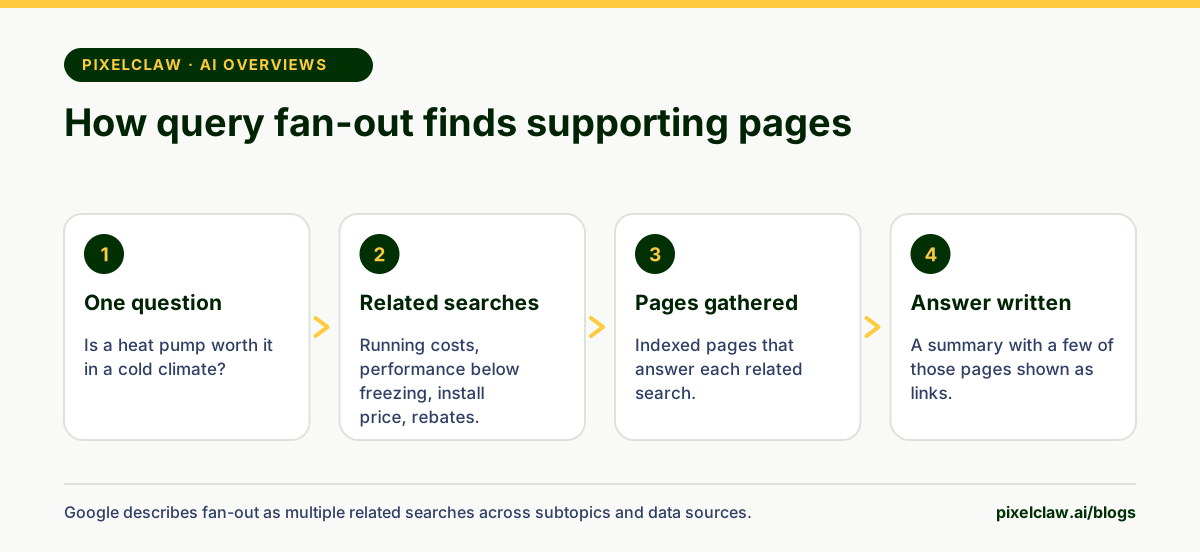
Google describes a technique it calls query fan-out. For one question, it issues multiple related searches across subtopics and data sources, then develops a response from the results.
Take "is a heat pump worth it in a cold climate". Google may also search for running costs, how well heat pumps work below freezing, installation prices and available rebates. A page that answers one of those well can be pulled in as a supporting link, even though it ranks nowhere for the original wording.
That changes what a good post looks like. A page that answers its main question and then the four or five questions a reader asks next has several ways in. A page built around one phrase has one. It also raises the value of related posts that link to each other, since each can be the answer to a different branch.
What Google's guidance tells you to do
The documentation lists best practices, and Google says they are the same ones that apply to Search generally. In plain words:
- Allow crawling, in robots.txt and in any CDN or hosting layer in front of the site.
- Make content easy to find through internal links.
- Give visitors a good page experience.
- Keep important content in text, not locked inside images or scripts.
- Support the text with good images and video where they help.
- Make structured data match what is visible on the page.
- Keep Merchant Center and Business Profile details current, if you sell products or serve a local area.
The edits that are worth making
Past eligibility, the work is ordinary good writing, pointed at the way a summary gets assembled.
Open with the answer. A summary is built from passages, and a passage that answers the question in two or three sentences is easy to use. Aim for 40 to 60 words before your first heading, with the subject named.
Write headings as the related questions. If fan-out is going to ask about running costs, a section headed "What does a heat pump cost to run in winter?" is a clean match.
Be specific and say where facts come from. A summary has to be defensible, so numbers with sources are easier to use than general statements. Give the date when a figure is time-sensitive.
Use lists and tables for steps and comparisons. Keep the page current, and show the date it was last updated.
Pew Research Center's study of real browsing adds one more hint. The sources cited most often in the AI summaries it recorded were Wikipedia, YouTube and Reddit. Summaries draw heavily on reference pages, video and discussion. If your subject is being discussed on Reddit or explained on YouTube, being a useful part of that helps in a way your own blog cannot.
Five myths worth dropping
Most of the bad advice on this subject contradicts something Google has written down.
| The claim | What the documentation says |
|---|---|
| You need special schema to get in | No special structured data is required |
| An llms.txt file gets you included | No AI text file or new machine-readable file is needed |
| Blocking Google-Extended takes you out | Google-Extended is for Gemini and does not affect Search |
| You can opt out of Overviews only | The controls are nosnippet, data-nosnippet, max-snippet and noindex |
| AI Overview traffic has its own report | It is counted inside the Web search type in Search Console |
The trade-off nobody likes
Appearing in an Overview is not the same as getting the visit. Pew Research Center tracked 900 US adults in March 2025. On visits where a results page had an AI summary, people clicked a traditional result 8% of the time, against 15% when there was no summary. They clicked a link inside the summary on 1% of visits.
So think about what each page is for. A post whose job is to make your name known, such as an explanation of a term or an answer to a common question, loses little by being summarised and gains a mention. A page that only pays if someone arrives, such as a pricing page or a booking page, should not depend on question-style searches for its traffic at all.
You cannot switch Overviews off for your site without also giving up ordinary snippets. What you can do is make sure that when a summary is shown, the passage it uses is yours and it names you.
How to see whether it is working
Search Console folds AI features into the Web search type, so there is no AI Overview report to open. Two habits fill the gap. Pick the ten searches that matter most, look at them in a private window each month, and note whether an Overview appears and whether you are in it. And watch for posts whose impressions climb while clicks stay level, which often means the post is being shown in a summary.
PixelClaw is our product, and it works on the page side of this. Every post is scored on the opening answer, FAQ, sources and structure described above, and a blog it hosts keeps its sitemap, structured data and crawler settings in order. To test a page you already have, the free AEO and GEO checker reports on the same points. For the trust signals AI systems lean on, read AIO blogs; for ChatGPT in particular, the ChatGPT SEO guide.
- Google lists two requirements for AI Overviews and AI Mode: the page is indexed, and it is eligible to show a snippet.
- There is no special schema, markup or AI text file that gets a page in.
- Query fan-out means Google runs several related searches, so pages can be picked for sub-questions nobody typed.
- Blocking Google-Extended does not remove you from AI Overviews; snippet controls do, and they affect ordinary results too.
- Clicks fall when a summary appears, so decide which pages you want cited and which need the click.
Frequently Asked Questions
Can I opt out of AI Overviews?+
Not on their own. Google says the controls are the ordinary preview ones: nosnippet, data-nosnippet, max-snippet and noindex. They limit what is shown from your page across Search, which includes the ordinary snippet under your result. There is no switch that removes a page from AI Overviews and leaves everything else alone.
Does ranking first guarantee a place in the AI Overview?+
No. Google's fan-out technique runs multiple related searches across subtopics and builds the answer from what they return. The supporting links can come from pages that rank for those related searches, so the first ordinary result is often there but not always.
Do AI Overviews need structured data?+
Google says there is no special structured data to add for its AI features. Its general advice still applies: if you use structured data, make sure it matches the text a visitor can see. Markup that claims things the page does not show works against you.
How do I track clicks from AI Overviews?+
You cannot isolate them. Google counts appearances in AI features inside Search Console's Performance report under the Web search type, mixed with ordinary results. Watch for pages whose impressions rise while clicks stay flat, and check your key searches by hand each month.
Is AI Mode optimized differently from AI Overviews?+
Google documents them together and lists the same requirements and best practices for both. AI Mode is a longer, conversational experience, and Google describes query fan-out for it as well, so thorough coverage of a topic's sub-questions matters at least as much there.
Sources
- AI features and your website — Google Search Central
- Google users are less likely to click on links when an AI summary appears in the results — Pew Research Center (Published July 22, 2025, from the browsing of 900 US adults in March 2025.)
- Google's common crawlers, including Google-Extended — Google Search Central
- Robots meta tag, data-nosnippet and X-Robots-Tag specifications — Google Search Central
Built & scored using PixelClaw.ai
More from this blog
Continue exploring autoblogging architecture, AI blog writing, and SEO / AEO / GEO playbooks.

AIO Blogs: Writing Posts That AI Systems Trust, Attribute and Recommend
AI optimization for bloggers: the authorship, sourcing and accuracy signals that decide whether Google's AI Overviews and chat assistants use your post or someone else's.
PixelClaw Editorial Team
Product and search team
AIO for Startups: What AI Optimization Means and How a New Brand Earns a Place in AI Overviews
AI systems summarize the sources they trust. Here is what AIO means, why it matters to startups, founders, bloggers and copywriters, and the trust signals a brand-new company can show from its first post.
PixelClaw Editorial Team
Product and search team

ChatGPT SEO: How to Get Your Pages Cited by ChatGPT Search
Six steps, in order, from letting OpenAI's search crawler in to checking whether your page is the one ChatGPT links, with what OpenAI itself has documented.
PixelClaw Editorial Team
Product and search team