Food blogging
Niche guideFood Blogging Software: Write Up Your Recipes Without Losing Your Weekends
What food blogging software can draft around a recipe you have cooked and tested, and what stays in your kitchen: the testing, the photos and the taste.
On this page▸
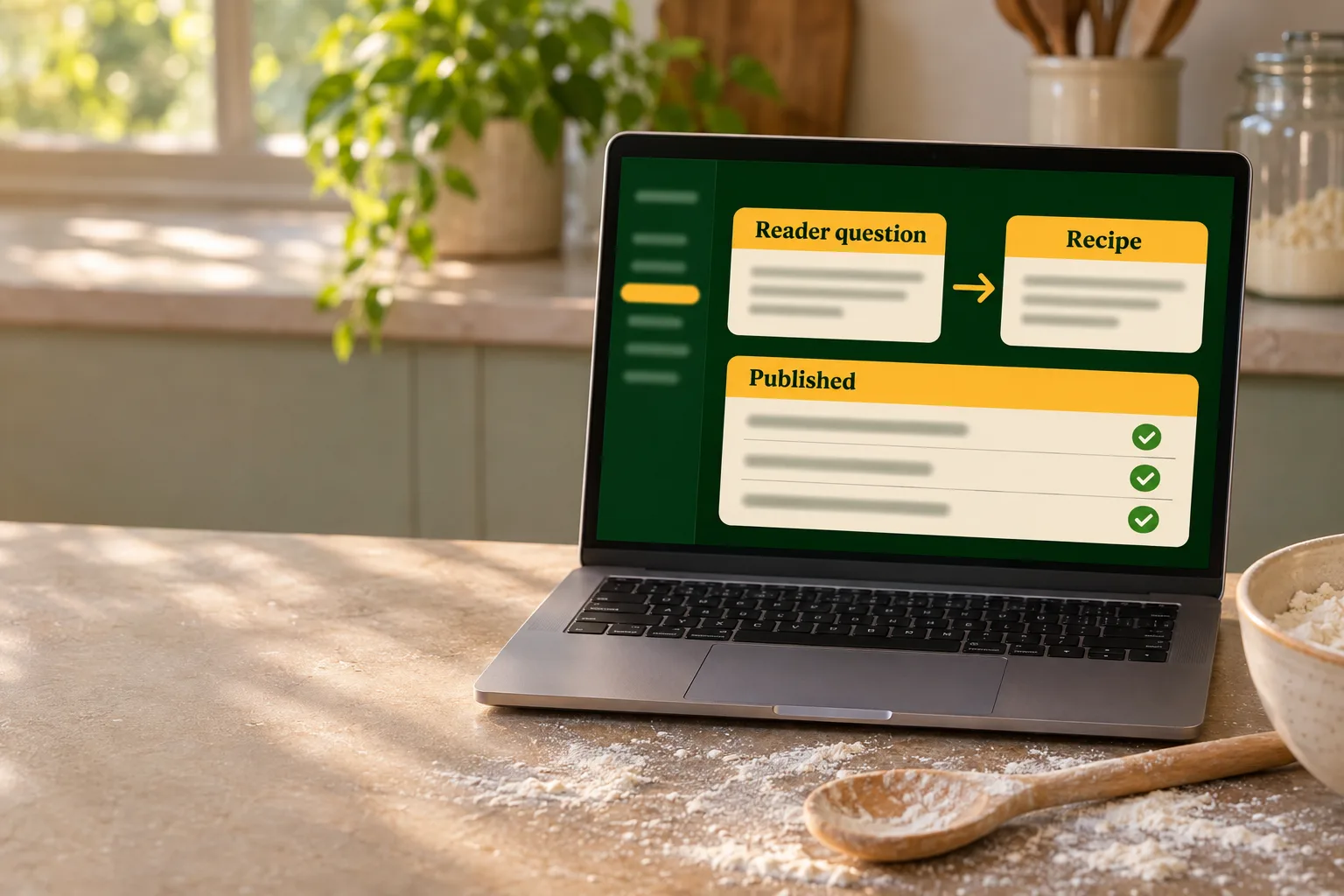
Food blogging software researches the questions cooks ask about a dish, then drafts the introduction, the method write-up, the tips and the questions around a recipe you have already cooked and tested. It scores the draft and publishes it on your blog. The recipe, the testing, the photos and the taste remain yours.
What is food blogging software?
Food blogging software takes over the writing and publishing work around a recipe. You supply the recipe and the photos. It researches the questions readers ask about the dish, drafts the introduction and the method write-up, adds tips and answers and publishes the post to your blog after you approve it.
It does not develop recipes. Nobody should publish a recipe that has not been cooked, and software cannot cook. Treat it as an assistant for the words, not for the food.
That fits the cook who has plenty of tested recipes and no time to write them up, and the new blogger who finds the blank page harder than the stove.
What do home cooks search for and ask AI assistants?
A recipe search is often a problem search. People ask why the cake sank, how long leftovers keep and what to use instead of buttermilk. AI assistants get the same questions, and they tend to quote the page that answers the question in its first lines.
These are question types a food blog can own, with the part only the cook can supply.
| What the reader asks | What the post needs | What the cook adds |
|---|---|---|
| Why did my sourdough not rise? | A short answer, then a troubleshooting list | The loaf you baked and what changed it |
| What can I use instead of eggs in brownies? | A list of swaps and what each does | Which swap you tested and how it turned out |
| How long does cooked rice keep in the fridge? | A direct answer with the storage steps | A cited food safety source and its date |
| Can I make this ahead for a party? | A make-ahead timeline | What you actually did the day before |
| How do I scale this recipe for twelve? | Guidance on what does not scale | The batch you cooked at that size |
| What is a good weeknight dinner under thirty minutes? | A short list with links | Recipes you have made and timed |
| Is this recipe good for beginners? | A plain skill check | Where first-timers tend to slip |
| Which pan should I use? | A comparison of the options | The pan you use and why |
Why most food blogs stall
Orbit Media's 2026 survey of 1,042 content marketers puts the average post at 3 hours and 20 minutes to write. A recipe post starts earlier. There is the shopping, the cooking, the photos and then the writing.
The writing is where most posts die. The dish is made and photographed, and the introduction, the method and the tips wait on a to-do list. Weeks later the photos are still on the phone.
That writing is the part software can start for you. It does not need your kitchen, only your recipe and notes.
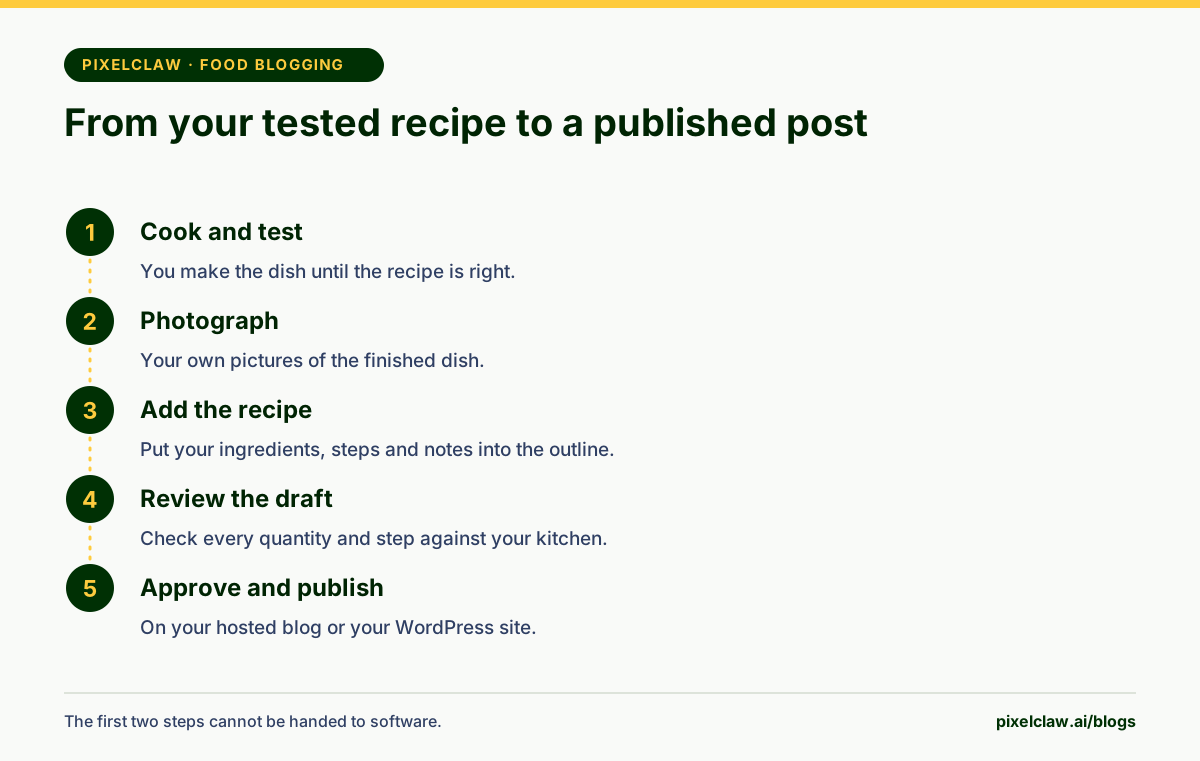
What only the cook can supply
The recipe itself is yours. Every quantity, temperature and time must come from a dish you have made, and a draft can get any of them wrong. Read each line against your own notes before the post goes live.
The photos are yours too. A reader can tell a picture of the dish you made from a picture of a dish somebody made. Your own photo is the strongest sign that the recipe works.
Taste and judgement are the third part. Whether the sauce needs more acid, which brand worked, what you would change next time. That is what readers come for, and no software can offer it.
Last, safety. Storage times and cooking temperatures should come from an official food safety source that you link and date. If you are unsure, leave the claim out.
What makes a recipe post trusted by readers, Google and AI answers
Answer first. If the post is about why a loaf sank, say the likely cause in the opening lines, then show the fix. A reader who gets that stays, and an assistant can quote it.
Then show that you did it. Mention the date you tested it, the pan, the oven and what went wrong the first time. Google's guidance on helpful, people-first content asks about first-hand experience, and a cook's own notes are exactly that.
Keep the page easy to read. Put the questions readers ask in an FAQ, and keep the method in clear numbered steps. Google says pages shown in its AI features must be indexed and eligible to appear in Search, so the basics of a crawlable page matter more than any trick.
Disclose any money. If you link to a pan or a mixer and earn a commission, the FTC's guidance says to put a clear disclosure close to the link.
How PixelClaw fits a food blog
PixelClaw researches each topic by reading the pages that already rank and collecting the questions readers ask, then writes an outline and a draft. For a food blog you add the recipe you tested to the outline, as short notes for each section, and the draft is built around them with the reader questions in place. A long recipe goes into the draft itself, in the editor.
You can guide one post at a time in the writing studio, where the outline can be edited before the draft is written. That is where you add your notes on what went wrong and what you would change. Or you put topics in a queue and let Autopilot work through them at your plan's pace. Autopilot suits the question posts, such as storage and swaps, more than a recipe that needs your input.
Every draft is scored out of 100 from 21 checks in five areas: SEO carries 30% of the score, AEO 20%, AIO 15%, GEO 15% and SXO 20%. Most failing checks come with a one-click fix. A draft under 60 is held back. Finished posts wait for your approval by default, and with automatic publishing switched on a post must score 77 or more to go live on schedule.
Posts are published on a blog PixelClaw hosts for you, with sitemap.xml, robots.txt, llms.txt and structured data for articles and FAQs set up from the first day, or on an existing WordPress site through the PixelClaw plugin. Starter and higher plans can connect a custom domain and translate a post into eleven languages. PixelClaw makes a hero picture for each post it drafts, but your own photo of the dish should lead. A personal blog can skip business details at setup.
How to choose food blogging software
A food blog needs a tool that respects the recipe. Five questions help.
- Does it claim to invent recipes? Be wary. A tested recipe cannot come from a tool that has never cooked.
- Does it draft around a recipe you supply? That is the safe way to use software in a kitchen blog.
- Does it research reader questions? Troubleshooting and swap questions are where food blogs find readers.
- Do you approve every post? Each quantity and step needs your eyes before it goes live.
- Does it hold weak drafts back? A score with a publish bar keeps a thin post off the site.
Start a food blog this week
Pick a focus you can keep cooking for a year. Dinners for two, bread, dairy-free baking or one national cuisine are all enough. Choose one recipe you have already made several times.
Photograph it, write your notes in plain words and list the questions friends asked when they ate it. Create the blog, add the dish as a topic, put your recipe notes and the questions into the outline and let PixelClaw write the draft. Read the draft with your notes open, correct every quantity and step, add one thing that went wrong and what you did about it, and publish.
Keep a notebook of what went wrong in each test. The failed batch, the sauce that split and the loaf that sank are the details readers value most, and they make the introduction of each post honest. Paste the notes into the topic so the draft starts from them, and cut any generic line that your notes already answer better.
One post a week is a good pace. Our guides to autoblogging and to whether blogging is still worth it cover pace and results, and business blogging software is the page for a food business such as a bakery or a meal-prep service.
- Cooks search for the problem behind the recipe, such as why a dough did not rise or what to swap for an egg, and a post that answers it first gets read.
- Food blogs stall because every post needs cooking, shooting, writing and formatting on top of the recipe itself.
- Software can draft the introduction, the method write-up, the tips and the questions around a recipe you supply.
- Recipes must be cooked and tested by the blogger, and the photos and the taste cannot come from software.
- Disclose affiliate links for equipment and ingredients next to the link, in plain words.
Frequently Asked Questions
Can AI write recipes for my food blog?+
It should not. A recipe has to be cooked and tested, and software has never tasted anything. Add your tested ingredients and steps to the outline as short notes, and PixelClaw drafts the introduction, the method write-up and the questions around them. You check each quantity and step against your own kitchen.
What is the best software for a food blog?+
Look for software that researches reader questions, drafts around a recipe you supply and lets you review before publishing. Check that it does not claim to invent or verify recipes. Try it on one dish you already make well.
How do I start a food blog?+
Choose a focus, such as weeknight dinners, gluten-free baking or one regional cuisine. Cook and photograph one recipe you trust, then write down the questions friends asked about it. Create the blog and publish that first post. A clear focus helps readers know why to come back.
Do I need to disclose affiliate links for kitchen equipment?+
Yes. The FTC says affiliate content needs a clear disclosure placed close to the recommendation, in wording like "I earn a commission from purchases made through this link". A label such as "affiliate link" on its own is not enough.
Does PixelClaw add nutrition information or recipe markup?+
No. PixelClaw does not calculate nutrition and does not add recipe markup to a post. It sets up article and FAQ structured data. If a reader needs nutrition facts, add them from a source you trust and say where they came from.
Sources
- Blogging Statistics 2026: What 1,042 Content Marketers Told Us About What Works — Orbit Media Studios (The average post takes 3 hours 20 minutes to write and runs 1,312 words.)
- Creating helpful, reliable, people-first content — Google Search Central (Asks who created the content, how, and why, and stresses first-hand experience.)
- Google Search's guidance about AI-generated content — Google Search Central Blog (Automation is fine when it serves people. Using it mainly to manipulate rankings is spam.)
- AI features and your website — Google Search Central (Pages shown in Google's AI features must be indexed and eligible to appear in Search.)
- The FTC's Endorsement Guides: What People Are Asking — U.S. Federal Trade Commission (Affiliate-link content needs a clear disclosure placed close to the recommendation.)
Built & scored using PixelClaw.ai
More from this blog
Continue exploring autoblogging architecture, AI blog writing, and SEO / AEO / GEO playbooks.

Business Blogging Software: How a Blog Brings Customers to Your Business
What business blogging software does, why articles bring in customers who are already searching, and how it works for a local firm, a store, a SaaS company, an agency or a practice.
PixelClaw Editorial Team
Product and search team

Autoblogging in 2026: How to Run a Blog That Publishes Itself and Still Ranks
What autoblogging looks like when it works: a topic queue, research before writing, a score that holds weak drafts back, and editorial review before a draft reaches readers.
PixelClaw Editorial Team
Product and search team
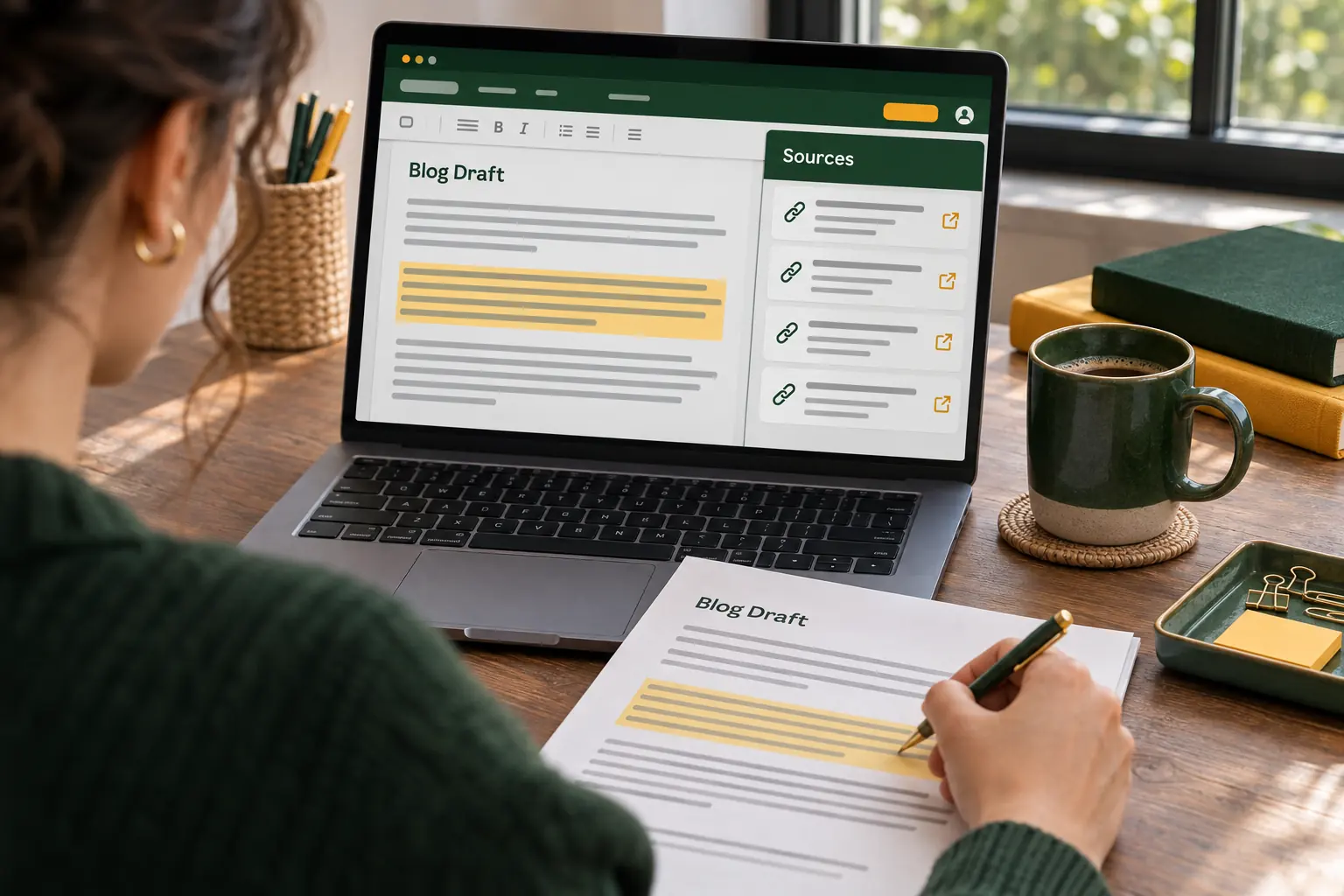
AI Blogging Without the Slop: A Working Process for Posts People Trust
Where AI earns its place in a blog, where a person still has to step in, and a five-step process that turns AI drafts into posts worth putting your name on.
PixelClaw Editorial Team
Product and search team