Fashion blogging
Niche guideFashion Blogging Software: Spend Your Time on Style, Not on Formatting
What fashion blogging software can research and draft, what stays with the stylist, and how to write trend and outfit posts that readers trust and disclose affiliate links properly.
On this page▸
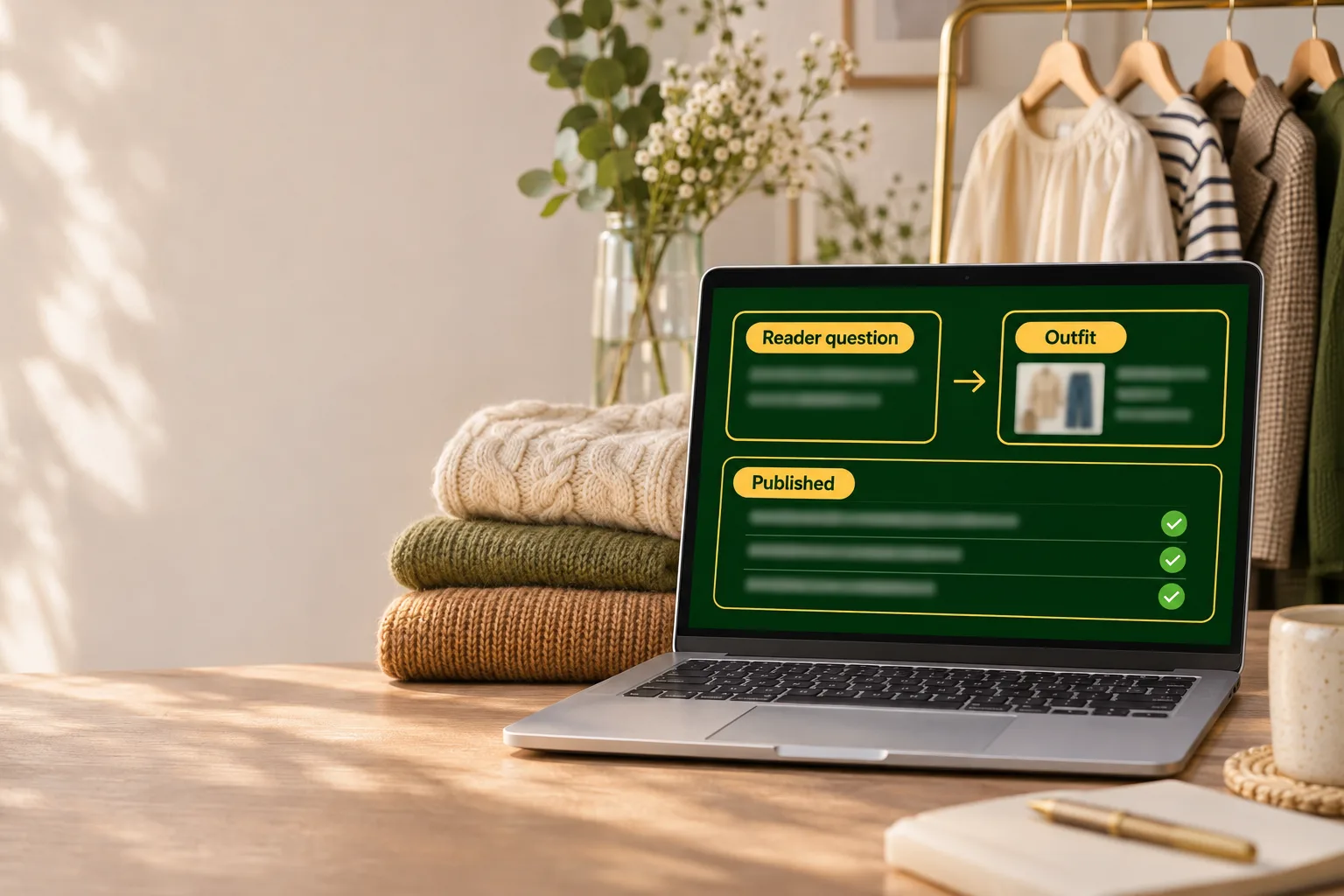
Fashion blogging software researches the questions readers ask about style, fit and trends, writes an outline and a draft, scores it and publishes it on your blog. It saves the writing and formatting time. The outfits, photos and opinions are yours, trend claims need dates, and affiliate links need a clear disclosure.
What is fashion blogging software?
Fashion blogging software handles the writing and publishing work around a style post. It researches the questions readers ask, writes an outline and a draft, scores the result and publishes it on your blog after you approve it. You supply the outfits, the pictures and the point of view.
It does not choose what suits a person or tell you what is on trend this week from first-hand sight. It reads pages that already exist. Treat it as the assistant that writes up what you already know.
That suits a stylist with a full wardrobe and little time, a shop owner who wants to answer customers' questions in public and a new blogger who knows what they like and struggles to turn it into a post.
What do readers search for and ask AI assistants about fashion?
Fashion searches are practical. Readers want to know what to wear to an event, how a piece should fit and whether an item is worth the price. They ask AI assistants the same things in full sentences, and an assistant tends to quote the page that answers first.
These are question types a fashion blog can own. The last column is the part only the stylist can give.
| What the reader asks | What the post needs | What the stylist adds |
|---|---|---|
| What do I wear to a summer wedding? | A short answer, then outfit options | Your own outfits in photos |
| How should a blazer fit? | A checklist of fit points | Pictures of good and bad fit |
| What is a capsule wardrobe? | A definition and a starter list | The pieces you actually kept |
| Are linen trousers worth the price? | A fair comparison | How yours held up after a season |
| What colours suit warm skin tones? | A guide with reasons | Your own swatches or photos |
| How do I style white sneakers for work? | Outfit formulas | Pictures from your own week |
| Which fashion trends are coming back this autumn? | A dated summary with sources | Which ones you would actually wear |
| How do I tell if a thrifted coat is good quality? | A checklist | A find you bought and what you looked for |
Why most fashion blogs stall
Orbit Media's 2026 survey of 1,042 content marketers puts the average post at 3 hours and 20 minutes to write. A fashion post begins before that, with styling, a location and a photographer, even if the photographer is a timer.
The writing is the part that gets postponed. The pictures are edited, the links are collected and the text waits. Then the season changes and the outfit no longer fits the moment.
Writing is the work software can start. It does not need your wardrobe, only your notes. That leaves your time for the part that is hard to copy, which is the eye.
What only the stylist can supply
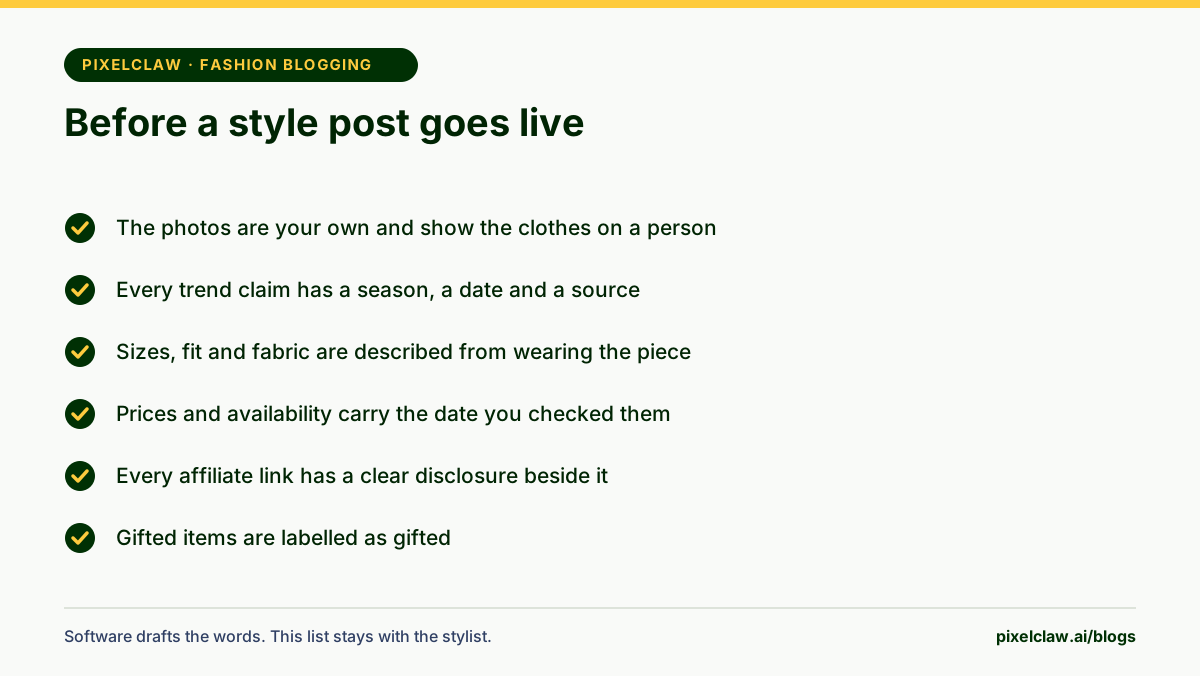
The outfits are yours. Software has never worn a jacket and cannot tell you the sleeves ride up. Fit, feel and how a fabric ages come from wearing the clothes.
The pictures are yours too. Readers trust a photo of the item on a real person more than a product shot from a shop. Google's advice on high quality reviews asks for your own visuals, measurements and reasons for calling something the best, and the same applies to style advice.
The point of view is the third part. Why you choose structured shoulders, why you avoid fast fashion or why you dress for a small budget. That voice is what readers follow.
Dates matter in fashion more than in most subjects. A statement such as "oversized tailoring is everywhere" is true for a season. Say which one and where you saw it.
What makes a fashion post trusted by readers, Google and AI answers
Answer in the first lines. If the post is about what to wear to a wedding, say the rule of thumb and the one thing to avoid before showing the options.
Show that you wore it. Describe the fit, name the size, say how tall you are and give the date. Name the author and link an author page. Google's guidance on helpful, people-first content asks who created the content and why, and a named stylist with photos answers both.
Be open about money. The FTC's guidance on endorsements says an affiliate-link post needs a clear and conspicuous disclosure near the recommendation. A label like "affiliate link" alone is not adequate, while a phrase such as "I earn a commission from purchases through this link" works. Do it every time, including on gifted items.
How PixelClaw fits a fashion blog
PixelClaw researches each topic by reading the pages that already rank and collecting the questions readers ask, then writes an outline and a draft. For a fashion blog you get the structure of a fit guide or an outfit post, with the common questions in place.
You can guide one post at a time in the writing studio, where the outline can be edited before the draft is written. That is where you add the pieces you wore and your own fit notes. Or you put topics in a queue and let Autopilot work through them at your plan's pace, which suits guides such as how to care for knitwear.
Every draft is scored out of 100 from 21 checks in five areas: SEO carries 30% of the score, AEO 20%, AIO 15%, GEO 15% and SXO 20%. Most failing checks come with a one-click fix. A draft under 60 is held back. Finished posts wait for your approval by default, and with automatic publishing switched on a post must score 77 or more to go live on schedule.
Posts are published on a blog PixelClaw hosts for you, with sitemap.xml, robots.txt, llms.txt and structured data for articles and FAQs set up from the first day, or on an existing WordPress site through the PixelClaw plugin. Starter and higher plans can connect a custom domain and translate a post into eleven languages. PixelClaw makes a hero picture for each post it drafts, but your own photographs should carry the outfit. A personal blog can skip business details at setup. A boutique can add its website so PixelClaw builds a business profile the owner approves.
How to choose fashion blogging software
Five questions separate a useful tool from one that fills a site with generic style advice.
- Does it research reader questions? Fit and styling questions are where fashion readers search.
- Can you edit the outline before the draft? Your point of view should come first.
- Do you approve every post? Trend claims and links need your eyes.
- Does it hold weak drafts back? A score with a publish bar keeps thin posts off the site.
- Does it leave pictures to you? Be wary of a tool that offers to invent outfits.
Start a fashion blog this week
Choose a viewpoint that is narrow enough to be yours. A body type, a budget, a climate, a workplace or a secondhand focus all work. Choose one outfit you wear often and photograph it in daylight.
Write your notes on fit and feel, then list five questions people ask when they see it. Create the blog, add the first question as a topic and let it research and draft. Open the draft, add your pictures and your fit notes, date any trend claim, add a disclosure beside each link and publish.
Keep a simple log of what you wear and how each piece holds up. After a season you will have real answers to questions such as whether the coat pilled or the trousers kept their shape. Those notes turn a generic styling post into one only you could write, and they give readers a reason to trust your next recommendation.
One post a week is enough to start. Our guides to autoblogging and to whether blogging is still worth it cover pace and results, and business blogging software covers the case where the fashion blog also sells something.
- Readers search for how to wear something, what suits their shape and budget, and which pieces last, and a post that answers one question first gets the visit.
- Fashion blogs stall because each post needs styling, photography, writing and link work around the outfit.
- Software can take the research, the outline, the draft and the publishing, but not the clothes or the eye behind them.
- Trend claims need dates and sources, and the stylist's own pictures are what readers trust most.
- Affiliate links need a clear disclosure next to the link, in plain words.
Frequently Asked Questions
Can AI write fashion blog posts?+
It can draft the structure and the background, such as how to style a trench coat or what a capsule wardrobe is. It has never worn the clothes and cannot see the outfit. Add your pictures, your fit notes and your opinion so the post reads like a person with taste wrote it.
What is the best software for a fashion blog?+
Choose software that researches reader questions, lets you edit the outline and draft, and holds weak drafts back before publishing. It should leave the styling and the photographs to you. Try it on one outfit post you would write anyway.
How do I start a fashion blog?+
Pick a point of view, such as workwear for petite women, thrifted menswear or sustainable basics. Photograph one outfit you wear often and list the questions people ask about it. Create the blog and publish that post first. A specific viewpoint gets you read faster than fashion in general.
How should I disclose affiliate links in a style post?+
Put a clear disclosure close to the link in plain words, such as "I earn a commission if you buy through this link". The FTC says a bare "affiliate link" label is not adequate. Free products and brand gifts need the same kind of disclosure.
How do I write about trends without getting them wrong?+
Date every trend claim and name the source, such as a runway season or a retailer report. A trend that was current last spring may be stale now. Update the post when the picture changes and note the update on the page.
Sources
- Blogging Statistics 2026: What 1,042 Content Marketers Told Us About What Works — Orbit Media Studios (The average post takes 3 hours 20 minutes to write and runs 1,312 words.)
- Creating helpful, reliable, people-first content — Google Search Central (Asks who created the content, how, and why, and stresses first-hand experience.)
- Google Search's guidance about AI-generated content — Google Search Central Blog (Automation is fine when it serves people. Using it mainly to manipulate rankings is spam.)
- The FTC's Endorsement Guides: What People Are Asking — U.S. Federal Trade Commission (Affiliate-link content needs a clear disclosure close to the recommendation. A bare "affiliate link" label is not enough.)
- Write high quality product reviews — Google Search Central (Recommends first-hand evidence, your own visuals and measurements, and justifying a pick as the best.)
Built & scored using PixelClaw.ai
More from this blog
Continue exploring autoblogging architecture, AI blog writing, and SEO / AEO / GEO playbooks.

Business Blogging Software: How a Blog Brings Customers to Your Business
What business blogging software does, why articles bring in customers who are already searching, and how it works for a local firm, a store, a SaaS company, an agency or a practice.
PixelClaw Editorial Team
Product and search team

Autoblogging in 2026: How to Run a Blog That Publishes Itself and Still Ranks
What autoblogging looks like when it works: a topic queue, research before writing, a score that holds weak drafts back, and editorial review before a draft reaches readers.
PixelClaw Editorial Team
Product and search team
AI Blogging Without the Slop: A Working Process for Posts People Trust
Where AI earns its place in a blog, where a person still has to step in, and a five-step process that turns AI drafts into posts worth putting your name on.
PixelClaw Editorial Team
Product and search team